
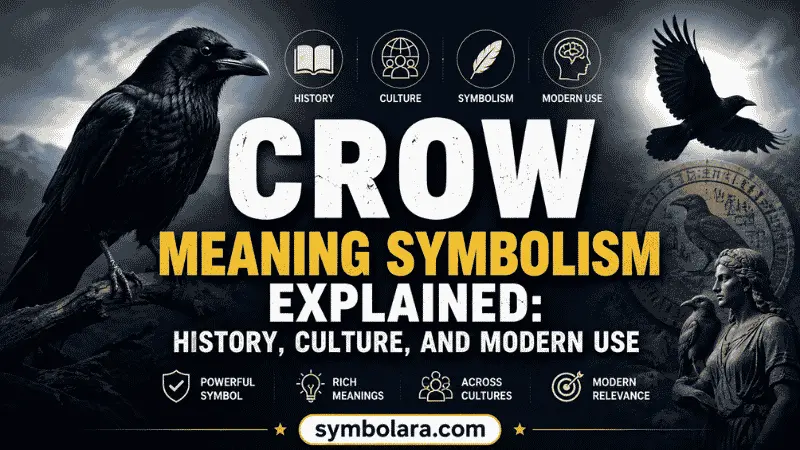
Crow Meaning Symbolism often centers on intelligence, adaptability, watchfulness, death, and change. In the United States, the crow occupies an unusual cultural position: it can look ominous in a Halloween scene yet admirable when its memory, problem-solving ability, or strong family bonds become the focus.
That contrast is one reason the bird works so well as a symbol. Crows are familiar enough to appear in suburban yards, city parks, farmland, cemeteries, and roadsides, but their glossy black feathers, loud calls, and observant behavior make them visually distinct. American Crows also thrive alongside people and use an unusually broad range of habitats.
The result is not one fixed meaning. A crow on a tattoo may represent survival or intelligence, while the same bird in a Gothic illustration may suggest death, unease, or the unknown. History, culture, and context determine which interpretation fits.
Quick Answer
Crow Meaning Symbolism most commonly represents intelligence, adaptability, awareness, and transformation in modern American culture, although crows can also suggest death, warning, or grief in darker settings. Historically, different traditions have connected crow-like birds with divine messages, ancestors, tricksters, memory, guidance, and the boundary between life and death.
TL;DR
- Crows commonly symbolize intelligence, adaptability, awareness, and survival.
- Black plumage helped create their association with death and mystery.
- Real crow behavior strengthens meanings involving memory and community.
- Ancient traditions gave crows both honorable and troubling roles.
- Native traditions vary and should never be treated as one belief system.
- Modern tattoos often emphasize resilience, independence, or personal change.
What a Crow Looks Like and Why Its Appearance Matters
Crows belong to the corvid family, which also includes ravens, jays, and magpies. The American Crow is a large, all-black bird with a stout bill, dark eyes, strong legs, and the familiar caw call. Its feathers can show bluish, purple, or greenish highlights in strong light rather than appearing flat black.
That appearance has shaped centuries of interpretation. Black is frequently used in American visual culture for mourning, night, seriousness, secrecy, and the unknown. When a black bird is shown against a bare tree, cemetery, stormy sky, or autumn landscape, those associations become even stronger.
Yet appearance explains only part of the crow’s symbolism. The bird’s behavior—watching people, gathering in groups, remembering danger, exploiting new food sources, and adapting to cities—also contributes to its modern reputation.
What Crows Commonly Symbolize in the United States
Modern American interpretations usually fall into several overlapping categories. Some come from observable behavior; others come from literature, seasonal imagery, folklore, or older cultural traditions.
| Context | Common U.S. Meaning | Why the Association Fits |
| Everyday nature | Intelligence and awareness | Crows appear observant and solve practical problems |
| Personal symbolism | Adaptability and resilience | They thrive in changing human environments |
| Gothic imagery | Death and foreboding | Black feathers and carrion associations create a darker mood |
| Group imagery | Community and protection | Crows cooperate, communicate, and maintain family groups |
| Spiritual interpretation | Change or a message | People often treat unusual encounters as personally meaningful |
| Tattoos and fashion | Independence and transformation | Dark crow imagery can signal survival, identity, or reinvention |
No entry in the table is a universal definition. A crow does not automatically symbolize death because it is black, and a crow tattoo does not automatically mean transformation. The surrounding image and the owner’s intention matter more than a symbolic dictionary.
Intelligence, Memory, and Strategic Thinking
Intelligence is one of the strongest positive meanings attached to crows today.
American Crows can cooperate, recognize unusual food opportunities, mob predators, and adjust readily to human environments. Long-running research has also demonstrated their ability to associate particular human faces with danger and retain that information for years.
That makes the crow a natural emblem for someone who values observation over brute force. In a tattoo, logo, story, or personal emblem, it can suggest thinking before acting, remembering past experience, detecting danger, or learning how a difficult system works.
This meaning differs from the older stereotype of the crow as merely sly or deceptive. Modern knowledge of corvid cognition has made cleverness easier to interpret as competence rather than dishonesty.
Adaptability, Survival, and Resourcefulness
Few qualities fit the modern American crow as neatly as adaptability.
American Crows occupy farmland, towns, cemeteries, parks, shorelines, vacant lots, yards, and other human-altered environments. Their diet is equally flexible, ranging from seeds and fruit to insects, small animals, carrion, and discarded food.
Symbolically, that flexibility becomes resourcefulness: use what is available, read the environment, and change tactics when circumstances change.
This is why crow imagery can appeal to people who have rebuilt their lives after setbacks. The bird does not symbolize effortless success. It more often suggests surviving by paying attention, adjusting quickly, and making intelligent use of imperfect conditions.
Family, Community, and Collective Protection
The solitary black crow silhouetted on a branch is visually memorable, but real American Crows are highly social.
Family groups can include a breeding pair and offspring from previous years, and family members may cooperate in raising younger birds. Crows also forage and roost together, while large winter gatherings can contain enormous numbers of birds.
These behaviors give crow symbolism a communal side that Gothic art often overlooks. A group of crows can represent family loyalty, shared knowledge, collective defense, or strength through cooperation.
Their mobbing behavior is especially relevant. When a predator appears, multiple crows may gather and loudly harass it. In symbolic art, therefore, several crows can plausibly communicate solidarity or vigilance rather than danger.
Why Crows Became Symbols of Death and Omen
The connection between crows and death is old, but it does not mean crows predict that someone will die.
Part of the association comes from ecology. Crows are omnivores and will eat carrion when it is available. Their dark plumage and harsh calls also fit the visual language that European and American artists developed around night, graveyards, battle, decay, and mourning. Even scientific and museum discussions of crows note how strongly fear and ominous folklore have shaped human reactions to them.
A crow in horror imagery therefore works as atmosphere. It can tell the viewer that something is wrong, hidden, dead, or approaching.
The mistake comes when metaphor becomes prediction. A crow landing near a house is normal wildlife behavior, not evidence of an impending death.
Are Crow “Funerals” Really Mourning?
One of the most interesting modern additions to crow symbolism comes from their response to dead members of their species.
Groups of crows sometimes gather around a dead crow, producing behavior that people readily describe as a funeral. Research on wild American Crows, however, indicates that these gatherings can serve an important practical function: the birds learn about places, animals, or people associated with danger.
That distinction matters. Calling the behavior human-style mourning goes beyond what the evidence establishes.
Symbolically, though, the behavior still supports themes of memory, mortality, vigilance, and learning from loss. The meaning becomes more interesting when it is grounded in what crows actually do rather than romanticized as a supernatural ritual.
Transformation and Crossing Into a New Phase
Crow symbolism frequently appears during stories about change because the bird combines several qualities that fit transition: intelligence, darkness, survival, and movement between wild and human spaces.
In contemporary tattoos and personal artwork, transformation does not have to mean a mystical rebirth. It may refer to leaving a difficult relationship, recovering after failure, changing identity, beginning a new career, or accepting a painful experience without allowing it to define the future.
Death imagery can also work metaphorically in this context. Something old ends so something different can begin.
For that reason, a crow flying away from bare branches can read very differently from a crow sitting beside a skull. The first may emphasize release and movement; the second may emphasize mortality or remembrance.
Ancient Greek Crow Symbolism and the Constellation Corvus
Crow imagery appears in classical Mediterranean tradition, although there was never one universal Greek or Roman crow meaning.
The constellation Corvus, whose Latin name means crow or raven, became associated with Apollo. In one classical story connected with Corvus, Apollo sends a crow to collect water. The bird delays its task, then attempts to excuse its failure with a false story involving a water snake. The crow, cup, and snake become associated with the neighboring constellations Corvus, Crater, and Hydra.
Within that particular tale, the crow represents distraction, failed responsibility, and attempted deception.
This is a useful reminder that ancient symbolism was often narrative rather than dictionary-like. The bird meant what its role in a specific story required. It could be clever in one tale and unreliable in another.
Crows, Ravens, and Religious Symbolism
Crow and raven symbolism are often blended online, but the birds should not automatically be treated as interchangeable.
Both belong to the genus Corvus, yet the common names refer to different species, and Americans can usually distinguish the familiar American Crow from the larger Common Raven by size, proportions, calls, and flight characteristics.
This distinction matters especially in biblical discussions. Famous biblical episodes involving black corvids generally refer to ravens, including the bird Noah releases after the flood. Therefore, claims that every biblical raven passage gives the same symbolic meaning to crows should be treated cautiously.
Christian scripture also does not establish a universal rule that seeing a crow predicts death, punishment, or demonic activity. Those ideas come more from later folklore and symbolic interpretation than from a straightforward biblical teaching.
Difference Between Crow Symbolism and Raven Symbolism
Crow and raven symbolism often overlap because both birds belong to the corvid family and share similar dark coloring. However, they do not always carry the same cultural meaning.
Crows are often connected with adaptability, intelligence, community, and everyday observation because they live closely alongside humans in many environments. Ravens are more frequently associated with mythology, prophecy, mystery, and powerful storytelling traditions.
The difference becomes especially important when discussing historical or religious examples. Some famous traditions specifically involve ravens rather than crows, so replacing one bird with the other can change the original meaning.
In modern art and personal symbolism, people sometimes choose crows and ravens based on appearance rather than strict cultural differences. The surrounding imagery and personal intention usually determine the final interpretation.
Indigenous North American Meanings Require Cultural Precision
Statements such as “the crow means X to Native Americans” are too broad to be reliable. Indigenous nations have distinct languages, stories, ceremonial practices, artistic systems, and relationships with animals.
Pacific Northwest traditions are a good example of why precision matters. Raven has major social, artistic, and narrative importance in several Northwest Coast cultures. Among the Tlingit, for example, Raven is part of a specific moiety and clan system; in some northeastern Tlingit communities, the corresponding moiety terminology uses Crow and Wolf. These identities are part of living cultural structures, not generic animal-spirit definitions.
The Apsáalooke people, commonly called the Crow Nation in English, should not be reduced to bird symbolism either. The name Apsáalooke has been explained as referring to “children of the large-beaked bird,” which Europeans later interpreted as “crow.”
When discussing Indigenous crow imagery, the safest and most respectful approach is to identify the specific nation and tradition instead of assigning one supposed “Native American meaning.”
Crow Symbolism in Hindu and Japanese Traditions
Outside the United States, crows can carry meanings very different from the Western Gothic image.
In several Hindu ancestral observances, feeding crows has a place within practices honoring the dead. During Pitru Paksha traditions, food may be offered to crows alongside offerings or meals associated with ancestors, religious specialists, cows, and people in need. This connects the bird with remembrance and the relationship between living families and deceased relatives.
Japanese tradition offers another contrast. Yatagarasu, the mythological crow associated with guidance, appears in stories connected with the legendary Emperor Jimmu. Historical Japanese objects have also carried imagery identified as the mythological Yatagarasu.
These traditions show why “crow equals death” is far too narrow. Depending on cultural setting, the same family of birds can be associated with ancestors, guidance, divine purpose, intelligence, or warning.
Crow Symbolism in Modern American Culture
American crow imagery mixes natural history with Gothic aesthetics.
During fall and Halloween, black crows appear on porch decorations, wreaths, signs, artificial branches, cemetery scenes, and horror-themed displays. The bird works visually because its silhouette remains recognizable even in a simple black shape.
Gothic fashion and dark illustration use crows for similar reasons. A crow can suggest melancholy without showing explicit grief, danger without showing a monster, or death without showing a body.
Contemporary nature enthusiasts often read the bird differently. For them, crow imagery may celebrate intelligence, urban wildlife, curiosity, and the remarkable ability of nonhuman animals to recognize and respond to individual people. As Americans have learned more about corvid behavior, admiration has increasingly existed alongside older fear-based folklore.
Crow Symbolism in Literature and Popular Culture
Crows have become powerful symbols in literature, films, and storytelling because they can represent both wisdom and darkness. Writers often use the bird to create atmosphere, suggest mystery, or highlight themes of change and survival.
In many stories, a crow appears as a watcher or messenger. Its ability to observe from above makes it a natural symbol for knowledge, secrets, and hidden information. In darker genres, crows often appear near scenes involving loss, danger, or the unknown because audiences already recognize their connection with Gothic imagery.
The meaning changes depending on the story. A crow may represent intelligence and independence in one work, while another may use the same bird to represent grief, isolation, or uncertainty.
Modern entertainment continues to use crow imagery because the bird carries multiple meanings at once. It can feel mysterious without being purely negative, which makes it useful for exploring complex human experiences.
Crow Tattoos, Jewelry, Fashion, and Decor
A crow tattoo usually works best when interpreted from the entire design rather than the bird alone.
A single flying crow may suggest independence, escape, or movement into a new stage. A crow with a skull places greater emphasis on mortality, remembrance, or Gothic identity. A crow with flowers can contrast life and death, while a crow with a moon often creates a nocturnal, intuitive, or mysterious atmosphere.
Several crows together may emphasize community, family, or collective strength. An alert crow perched above a landscape can communicate watchfulness.
Jewelry and fashion use the same visual vocabulary in a subtler form. Crow pendants, rings, embroidered jackets, and graphic prints often appeal to people drawn to alternative aesthetics, nature, intelligence, or darker forms of self-expression.
Decor changes the meaning again. A realistic crow sculpture in a garden can simply celebrate wildlife; a black artificial crow on a gravestone decoration clearly belongs to the language of Halloween and horror.
Does the Number of Crows Change the Meaning?
Lists claiming that one crow means bad luck, two mean good luck, three predict a particular event, and so on should be treated as folklore rather than a universal symbolic system.
Humans naturally search for patterns when several conspicuous birds appear together. Crows, however, are social animals, so seeing multiple birds often has an ordinary biological explanation involving food, family activity, predator defense, or communal roosting.
If someone personally associates three crows with family or seven crows with a meaningful memory, that interpretation can still matter to them. It simply should not be presented as an objective code that all cultures recognize.
Emotional and Psychological Meaning
Crow imagery often appeals to people who identify with being observant, misunderstood, independent, resilient, or difficult to intimidate.
The bird can also externalize emotions that are hard to represent directly. Grief may be shown through a quiet crow on a bare branch. Anxiety may appear as a circling flock. Confidence may appear as a single bird staring directly at the viewer.
These are artistic interpretations, not psychological diagnoses.
A crow encountered during a difficult period may also become personally meaningful because the person already associates it with memory, survival, or change. That experience can be emotionally significant without requiring the bird to have delivered a supernatural message.
Crow Symbolism in Dreams: Meaning and Common Interpretations
A crow appearing in a dream can have many interpretations depending on the dream’s setting, emotions, and personal experiences. There is no single universal meaning, but many people connect crow dreams with awareness, change, memory, or situations that require attention.
A peaceful crow in a dream may represent observation, intelligence, or the need to notice something important. A flying crow can suggest movement, transition, freedom, or leaving behind an old stage of life. A group of crows may reflect ideas about community, relationships, or information coming from different sources.
Dark or unsettling crow dreams are often connected with fear, uncertainty, or hidden concerns. However, the bird itself does not mean something negative will happen. Dream symbolism usually reflects the dreamer’s emotions and personal associations rather than predicting future events.
For some people, a crow dream may represent resilience because crows survive in changing environments and adapt quickly. The meaning depends on the dream details, including the crow’s behavior, the location, and the feelings experienced during the dream.
Common Misunderstandings and Cultural Misuse
The first major misunderstanding is that crows are inherently evil. They are animals responding to food, predators, social relationships, and changing environments. Their reputation for darkness comes largely from human interpretation.
The second is that crow and raven traditions can always be combined. They overlap visually and biologically, but specific myths, religious passages, and cultural traditions may concern one rather than the other.
A third issue is particularly important in the United States: Jim Crow. The phrase developed from a racist blackface minstrel character popularized in the nineteenth century and later became the name commonly applied to systems of racial segregation and discrimination. That history belongs to American racism and minstrelsy; it should not be presented as evidence of an ancient symbolic meaning inherent in the bird itself.
Finally, Indigenous traditions should not be turned into generic claims such as “crows are Native spirit guides.” Meanings belong to particular communities, stories, languages, and ceremonial contexts.
How Crow Symbolism Has Changed Over Time
The crow’s darker associations have never disappeared, but the balance has changed.
Older European-derived imagery often emphasized blackness, carrion, ominous calls, cunning, and death. Modern Americans still recognize that visual language immediately, particularly in horror and Halloween settings.
At the same time, scientific understanding has made different traits more visible. Cooperative families, problem solving, memory, predator awareness, and adaptation to cities provide concrete reasons to admire the bird.
As a result, a modern crow can stand for something more complex than an omen. It may represent a person who notices what others miss, remembers hard lessons, protects their community, and survives by adapting.
FAQs
It is neither inherently good nor bad. Symbolically, someone might interpret the encounter as a reminder to stay alert or adapt, but biologically it is simply a common bird going about its normal activities.
Its black appearance often contributes to meanings involving mystery, mourning, night, seriousness, and the unknown. Modern interpretations also emphasize intelligence, resilience, observation, and independence.
Common meanings include intelligence, survival, personal transformation, remembrance, independence, and Gothic identity. Other objects in the tattoo—such as skulls, flowers, moons, clocks, or additional crows—usually narrow the intended meaning.
It can symbolize death in Western art, horror, and mourning imagery, but it does not predict literal death. The association comes partly from dark visual traditions and the crow’s willingness to eat carrion.
There is no universal spiritual interpretation. Some people use the encounter as a personal reminder of awareness, change, memory, or adaptability, while others simply appreciate it as wildlife behavior.
Not always. Their meanings overlap because both are black corvids, but individual myths and religious traditions may specifically involve ravens or specifically involve crows, so the original cultural context matters.
A crow does not universally represent bad luck. Some folklore connects crows with warnings or death, while modern interpretations often focus on intelligence, survival, and adaptation.
Conclusion
Crow Meaning Symbolism is best understood as a combination of intelligence, adaptability, vigilance, social connection, mortality, and change rather than a single fixed message. Modern American culture keeps the older image of the ominous black bird, especially in Gothic and Halloween settings, while also increasingly recognizing the crow as a remarkably capable and socially complex animal.
Its history adds further layers: classical stories could portray the crow as clever or unreliable, Hindu traditions can connect crows with ancestral remembrance, Japanese mythology can associate a crow with guidance, and Indigenous North American traditions require nation-specific interpretation rather than broad generalizations.
What the crow means in any particular image ultimately depends on context. A cemetery crow, a family of crows defending one another, and a crow tattoo created after a major life change may use the same bird, but they are telling three very different stories.


[…] traditional interpretations from scientific facts. A Blood Moon is an astronomical event, while symbolic meanings come from human culture and […]
[…] modern American culture, the sand dollar most often symbolizes peace, luck, simplicity, and the emotional pull of the […]
[…] That distinction keeps personal spirituality separate from documented cultural history. […]
[…] European culture gave the rose meanings that went beyond erotic or romantic love. Medieval and Renaissance imagery frequently associated […]