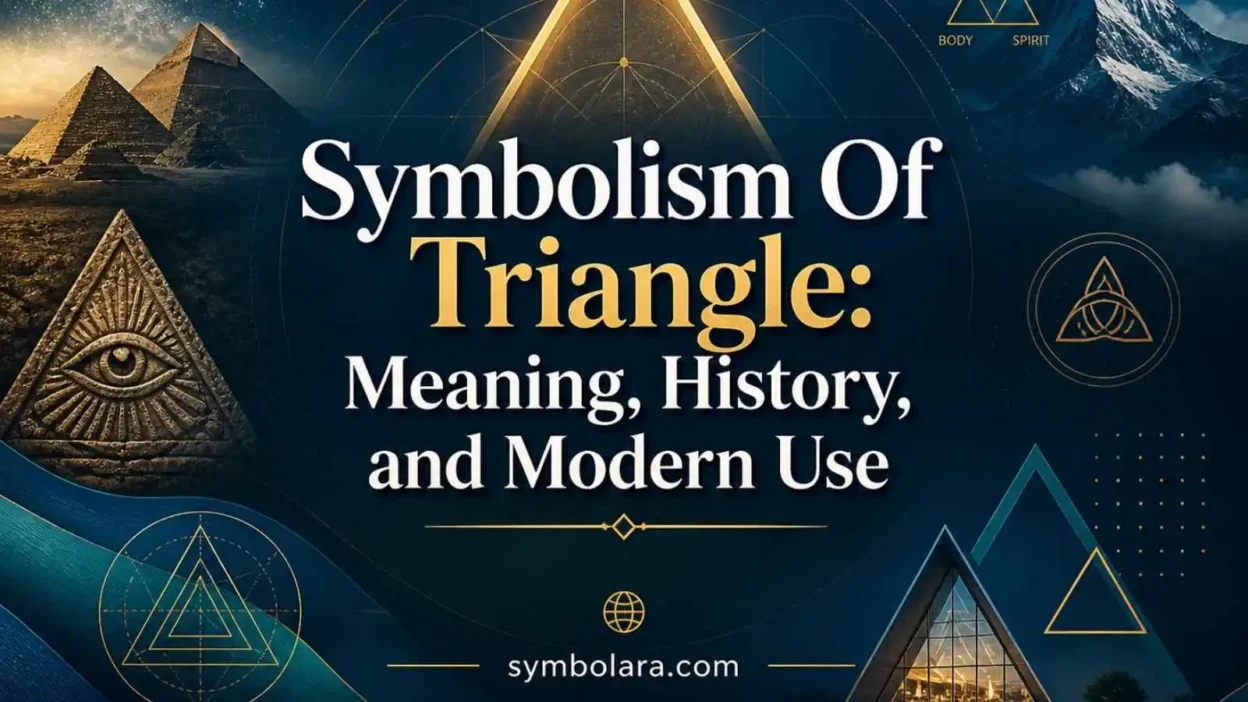
People search for the Symbolism Of Triangle because the shape seems simple, but its meanings change sharply depending on context. A triangle on a church window does not say the same thing as a triangle on a road sign, a tattoo, a Pride symbol, or a minimalist necklace.
That is part of what makes the triangle so enduring in American culture. It is one of the easiest shapes to recognize, but it rarely feels neutral. Its three points can imply stability, hierarchy, motion, warning, spiritual order, or the idea that separate parts belong together.
In the United States today, people most often read triangles through design, religion, traffic symbols, tattoos, wellness language, and identity-based symbolism. Older meanings still matter, but modern Americans usually interpret the triangle by asking two basic questions first: which way is it pointing, and where is it being used?
Quick Answer
Symbolism Of Triangle most commonly represents balance, strength, and three-part unity in modern American culture, especially in design, tattoos, and spiritual or self-development language. Historically, it has also symbolized the Christian Trinity, elemental systems such as fire and water, and other traditions built around the symbolic power of the number three.
TL;DR
- In the U.S., triangles often signal unity, direction, or warning.
- The number three drives most triangle meanings.
- Christianity strongly shaped Western triangle symbolism.
- Orientation changes meaning: upward and downward are not identical.
- Modern tattoos use triangles for identity, growth, and simplicity.
- Some triangle symbols carry painful historical baggage.
What A Triangle Looks Like and Why People Notice It
A triangle is a closed shape with three sides and three points, but people do not respond to it as just a piece of geometry. It has sharp direction, visible tension, and a built-in sense of relation among three parts. Unlike a circle, which feels continuous, or a square, which feels settled, a triangle often feels active. Your eye follows it toward a point.
That is one reason it appears so often in visual culture. People see triangles in road signs, church art, logos, mountain imagery, award icons, warning labels, jewelry, and social media graphics. Even when viewers do not consciously name the symbolism, they often feel its effects.
The Core Meaning: Three Parts Held Together
The most common symbolic logic of the triangle comes from the number three. A line can connect two things, but a triangle creates a system. That makes it useful for expressing ideas such as mind, body, and spirit; past, present, and future; birth, life, and death; or beginning, middle, and end.
In modern American usage, that often gets simplified into words like balance, wholeness, alignment, or connection. People use the triangle when they want to suggest that life works best when several important parts support each other rather than compete. That reading is common in tattoo culture, coaching language, wellness branding, and minimalist art.
Why The Triangle Also Suggests Strength and Stability
Not all triangle symbolism comes from abstract ideas. Some of it comes from how the shape behaves visually and structurally. A triangle distributes force in a way that makes it useful in engineering and architecture, so people commonly associate it with support and strength.
In everyday American interpretation, an upright triangle often feels grounded because it has a base and a clear top point. That can make it read as confidence, order, focus, or upward drive. This is why triangles show up so often in logos, athletic branding, outdoor gear, and “performance” design language.
Ancient Roots and Early Philosophical Meaning
Western symbolic readings of the triangle were shaped in part by ancient Greek thought. In Plato’s Timaeus, the physical world is described through elemental structures built from triangles, linking geometry to cosmology and the order of nature. That does not mean ordinary ancient people all “used the triangle” in one single symbolic way, but it does show how early philosophy connected triangular form with the structure of reality.
That classical habit of linking shape, proportion, and meaning stayed influential for centuries. In later Western thought, geometry was not just mathematics. It could also suggest harmony, reason, and the intelligible order behind visible things.
The Triangle In Christianity
In Christian visual culture, the triangle became a familiar symbol of the Trinity: Father, Son, and Holy Spirit. This symbolism became especially recognizable in Western art and church design, where an equilateral triangle could stand for unity among three persons sharing one divine nature.
Many Americans still know this meaning even if they are not especially religious. A triangle enclosing an eye, for example, is often read as a Christian or Providence-related image because of long-standing Western iconography. In churches, stained glass, altar decoration, and older devotional art, triangle imagery can still signal divine order, sacred completeness, and doctrinal clarity.
Alchemy, Elements, and Direction
The triangle also took on distinct meanings in alchemy and related symbolic systems. An upright triangle represented fire, while an inverted triangle represented water. When a horizontal line was added, the symbols could indicate air or earth.
Those meanings still shape modern interpretations, especially online and in tattoo culture. People may choose an upward triangle to suggest heat, ambition, ascent, or masculine-coded energy, while a downward triangle can suggest water, receptivity, intuition, or feminine-coded symbolism. These readings are modern blends of older esoteric systems and newer self-expression culture, so they should be treated as interpretive rather than universal.
What It Commonly Means In The United States
In the United States, triangle symbolism is usually less about formal doctrine and more about recognizable public meanings. The inverted triangle on a yield sign tells drivers to slow down and give way. That makes one of the country’s most familiar triangle meanings practical: caution paired with judgment.
Outside traffic signage, Americans often read triangles as modern, clean, intelligent, and slightly intense. In branding, they can imply movement, innovation, edge, or goal-directed energy. In home decor and fashion, they often suggest geometric simplicity with just enough symbolic weight to feel intentional.
Triangle Symbolism in Logos and Branding
Triangles appear frequently in American branding because they communicate movement, confidence, and structure with very few visual elements. Companies often use triangles when they want their identity to feel modern, energetic, or forward-looking.
An upward-pointing triangle can suggest progress, achievement, and reaching a higher goal. This makes it common in industries connected to technology, sports, education, and innovation.
A triangle can also create a feeling of stability. Since the shape has three connected sides, designers often use it to represent reliability, teamwork, and strong foundations.
The direction of the triangle changes the message. Sharp angles may create a bold or competitive feeling, while softer geometric designs may appear more balanced and approachable.
In modern American design, triangle logos are rarely chosen only because of ancient symbolism. Most brands use them because the shape naturally attracts attention and communicates ideas like growth, precision, and confidence.
A Quick Comparison of Common Meanings
| Context | Meaning in the USA | Common Associations | Notes |
| Church art | Divine unity | Trinity, sacred order | Usually Christian in meaning |
| Traffic signs | Yield or caution | Attention, right-of-way | Common public-life meaning |
| Tattoos | Personal balance or growth | Mind-body-spirit, change | Often individualized |
| Branding | Motion or strength | Innovation, focus, edge | Depends on orientation |
| Pride history | Memory and resistance | Pink triangle, reclamation | Carries serious historical weight |
Emotional and Psychological Meaning
Emotionally, triangles can feel more charged than softer shapes. Their angles create tension, and their point directs attention. That makes them useful when someone wants to communicate determination, pressure, movement, ambition, or a need for order.
Psychologically, the triangle often appeals to people who want a symbol that feels disciplined rather than sentimental. A heart broadcasts emotion immediately. A triangle feels more coded. It can suggest that a person values structure, self-control, layered meaning, or the idea that identity is built from connected parts.
Triangle Symbolism in Dreams: Common Interpretations
Dreams often use simple shapes to represent ideas, emotions, or situations that feel important to the dreamer. A triangle appearing in a dream may represent balance, change, direction, or a relationship between three connected elements.
An upright triangle in a dream may suggest confidence, progress, ambition, or the desire to move toward a goal. Because the shape points upward, many people associate it with growth and forward movement.
An upside-down triangle may represent reflection, emotional awareness, or a need to look inward. Some people connect it with water symbolism because of older elemental traditions, although dream meanings are always personal rather than universal.
The surrounding details matter most. A triangle drawn on paper, a triangle appearing in nature, or a triangle inside a building may each suggest different ideas. The dreamer’s emotions during the dream often provide the strongest clue.
Rather than having one fixed meaning, triangle dreams are usually interpreted as symbols of connection, choices, personal growth, or the need to bring different parts of life into balance.
Why It Appears In Tattoos and Personal Style
Triangle tattoos remain popular because they are simple to draw, easy to scale, and open to personal interpretation. Some people use them for a three-part value system, such as family, faith, and purpose. Others use them for change, resilience, or elemental symbolism. Overlapping triangles can imply relationship, duality, or the joining of opposites.
In jewelry and fashion, triangles often function the same way minimalist lettering does: they look modern while quietly carrying meaning. A plain metal triangle pendant can read as stylish even to someone who knows nothing about symbolism, while still feeling personal to the wearer. That flexibility helps explain why the shape stays popular in American self-expression.
The Meaning of Double Triangles and Interlocking Triangles
Two triangles combined together often create a stronger symbolic message than a single triangle. Interlocking triangles are commonly associated with connection, balance, and the relationship between opposing forces.
A common example is the six-pointed star formed by overlapping upward and downward triangles. Across different traditions, this design has carried meanings connected to unity, harmony, and the meeting of different energies.
In tattoo culture and modern design, double triangles may represent relationships, personal transformation, or the balance between different parts of life. Some people choose them to symbolize family connections, emotional balance, or personal growth.
However, the meaning depends heavily on cultural background and personal intention. There is no single universal definition for every double-triangle symbol.
Cross-Cultural Meanings Beyond The United States
Outside the United States, triangle symbolism also appears in religious, philosophical, and artistic traditions, though meanings vary widely. In some South Asian contexts, upward and downward triangles can symbolize male and female principles or cosmic union when interlocked. In Western esoteric traditions, overlapping triangles have likewise represented the union of opposites.
What matters most is not to flatten these traditions into one generic “spiritual” reading. The triangle is not a universal code with one agreed meaning across all cultures. It is a reusable form that different traditions have loaded with different ideas, often because the number three and directional geometry are so symbolically useful.
Triangle Symbolism in Nature and Everyday Life
Triangles appear throughout nature and daily life, which helps explain why humans naturally attach meaning to the shape. Mountains often create triangular forms, and many cultures connect mountain peaks with strength, achievement, and reaching toward something higher.
Animals, plants, and natural patterns can also create triangular shapes. These forms often feel balanced because they combine stability at the base with movement toward a point.
In everyday American life, triangles appear in architecture, road signs, tools, art, and technology. Some examples are purely practical, while others gain symbolic meaning because people connect shapes with ideas and emotions.
The triangle remains powerful because it exists between stability and movement. It can feel grounded while also pointing toward change, making it one of the most adaptable shapes in human design.
The Pink Triangle and Why Context Matters
One of the most important cautions in triangle symbolism involves the pink triangle. In Nazi Germany, pink triangles were used in concentration camps to mark men persecuted under anti-homosexual policies. Later, activists reclaimed the symbol as a sign of protest, memory, and resistance, especially during the AIDS crisis and in LGBTQ activism.
Because of that history, a triangle is not always neutral. Color, orientation, and setting matter. A pink triangle used in queer activism can carry remembrance and defiance, while someone else may see it first through Holocaust history. In American culture, this is a strong example of how symbols can be transformed without losing the gravity of their earlier use.
Common Misunderstandings About Triangle Symbolism
A frequent misunderstanding is the idea that every triangle is automatically “sacred” or “spiritual.” In reality, many triangles are simply functional, decorative, or compositional. A designer may choose one because it directs the eye, not because it encodes ancient wisdom.
Another mistake is assuming that one triangle meaning overrides all others. It does not. A triangle in a church, a tattoo studio, a highway system, and a Pride rally cannot be interpreted the same way. Symbolism depends on cultural setting, not just shape alone.
How The Meaning Has Changed Over Time
The triangle’s symbolic history is really a history of reuse. In classical thought, it could point to order and the structure of matter. In Christian art, it became a compact sign of divine three-in-one unity. In alchemy, it helped organize the elements. In modern America, it often communicates design intelligence, self-definition, caution, or social memory.
What changed was not the shape itself but the social need around it. Different eras have used the triangle to solve different symbolic problems: how to picture doctrine, how to signal right-of-way, how to build a logo, how to mark identity, or how to reclaim a history of persecution. That adaptability is the reason the shape keeps returning.
FAQs
What does a triangle usually symbolize?
In current American usage, a triangle usually symbolizes balance, unity, strength, or direction. The exact meaning changes with context, especially when religion, design, tattoos, or public signage are involved.
Is a triangle a positive or negative symbol?
It can be either. Many people use it positively for stability, growth, or three-part harmony, but triangles can also signal caution, danger, or painful historical memory depending on color, placement, and cultural use.
What does a triangle tattoo mean?
A triangle tattoo often represents a personal triad such as mind, body, and spirit or past, present, and future. It can also symbolize change, resilience, elemental identity, or a clean minimalist style rather than one fixed belief.
What does an upside-down triangle symbolize?
An upside-down triangle can symbolize water in alchemical traditions and may also suggest receptivity or inwardness in later spiritual interpretations. In everyday U.S. life, though, the most familiar inverted triangle is the yield sign, so many Americans first read it as caution or giving way.
Why is the triangle linked to Christianity?
The link comes mainly from the doctrine of the Trinity: Father, Son, and Holy Spirit. Because the triangle can show three distinct points forming one whole, it became a useful visual shorthand in Western Christian art and teaching.
Does triangle symbolism mean the same thing in every culture?
No. Different traditions use the triangle for different reasons, even when they all draw on the number three or on directional geometry. That is why responsible interpretation always starts with context instead of assuming a universal meaning.
What does a triangle necklace symbolize?
A triangle necklace may symbolize balance, strength, personal growth, or a connection between three important values. Many people choose triangle jewelry because it combines simple design with personal meaning.
What does three triangles symbolize?
Three triangles may symbolize layered ideas such as connection, growth, cycles, or three important parts working together. The exact meaning depends on the design, culture, and personal interpretation.
Conclusion
The central idea behind Symbolism Of Triangle is not one single message but a pattern: three parts, one form, and a shape that feels purposeful rather than accidental. In modern American life, that usually translates into balance, focus, strength, direction, or carefully chosen identity.
Its older meanings still matter. Christianity gave it one of its most durable Western readings, alchemical systems tied it to elemental oppositions, and modern activism showed that triangle symbolism can also carry memory, warning, and reclamation.
That is why the triangle keeps showing up across so many parts of public and private life: it is simple enough to recognize instantly, but flexible enough to keep saying something new.

[…] history still affects modern perception in the United States. Even people with little knowledge of formal tea traditions often […]