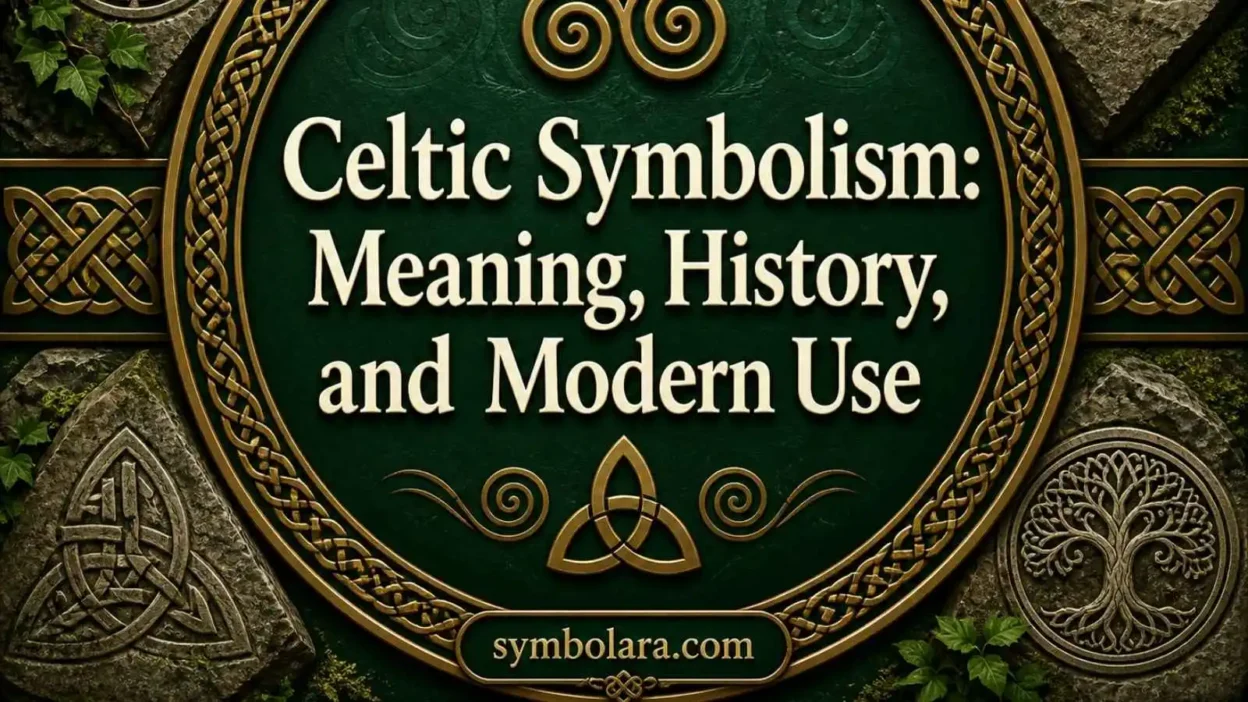
Celtic symbolism usually refers to a group of visual motifs linked to the ancient Celtic world and to later Irish, Scottish, Welsh, and Insular Christian art. In modern American culture, people often think first of knots, crosses, spirals, and other designs that suggest ancestry, continuity, faith, and connection to Irish identity.
People care about these symbols because they show up in everyday life, not just in museums or history books. Americans see them in tattoos, jewelry, St. Patrick’s Day decor, church art, family crests, and social media aesthetics.
What makes the topic tricky is that “Celtic symbolism” is not one fixed ancient code with one official meaning for each design. Some motifs are genuinely old, some were shaped by early medieval Christianity, and some meanings people repeat today are modern interpretations layered onto older art.
Quick Answer
Celtic symbolism commonly represents eternity, interconnectedness, heritage, faith, and the cycles of life in modern American culture, especially through knotwork, the Celtic cross, and triple-spiral designs. Historically, those meanings grew from a mix of ancient European and Celtic traditions, early medieval Irish and British Christian art, and later Irish cultural identity.
TL;DR
- Celtic symbols often suggest continuity and connection.
- Not every “Celtic” meaning is ancient.
- Knotwork largely flourished in early medieval art.
- In the U.S., Irish heritage shapes many interpretations.
- Spiral imagery can be older than the Celts.
- Context matters, especially with cross-like symbols.
What Celtic symbolism looks like
Most people in the United States use the phrase “Celtic symbolism” to describe a recognizable visual family: endless knot patterns, ringed crosses, spirals, triquetra-like forms, stylized animals, and manuscript ornament. Those designs are strongly associated with Ireland and the broader Celtic world, even though they come from different time periods and artistic traditions.
That is why the term can feel broader than a single symbol. It includes prehistoric spiral carving, Iron Age Celtic culture, early Christian manuscript art, and later heritage design all under one umbrella.
Celtic Symbols and Their Individual Meanings
Celtic symbolism includes many individual designs, and each symbol carries different associations depending on its history and modern use. While some meanings come from historical traditions, others developed through later cultural interpretation.
Celtic Knot Meaning
Celtic knots are among the most recognizable Celtic designs. Their endless patterns often represent connection, continuity, loyalty, and lasting relationships. Today, people commonly choose Celtic knots for wedding rings, tattoos, and family-themed artwork because the design appears to have no clear beginning or ending.
Triquetra Meaning
The triquetra, also called the Trinity Knot, is a three-pointed design often associated with Irish Christian art. Many people connect it with the Holy Trinity, while others interpret it as representing balance, unity, and the three stages of life. The exact meaning depends on the historical or personal context where it appears.
Triskele Meaning
The triskele or triple spiral is a three-part spiral design found in ancient Irish art. Modern interpretations often connect it with movement, growth, progress, and cycles. Because the symbol appears in prehistoric contexts, its original meaning remains uncertain.
Celtic Tree of Life Meaning
The Celtic Tree of Life is a popular modern symbol connected with growth, family roots, balance, and the relationship between people and nature. Many contemporary interpretations focus on strength, ancestry, and the idea that life remains connected through generations.
Celtic Animals and Nature Symbols
Animals such as wolves, stags, horses, and birds appear in Celtic-inspired artwork. Their meanings vary, but modern interpretations often associate them with strength, freedom, protection, wisdom, and connection to the natural world.
What it commonly means in the United States
In modern U.S. culture, Celtic symbolism most often signals heritage, especially Irish ancestry, followed by ideas like family continuity, loyalty, spiritual grounding, and the idea that life is made of connected parts rather than isolated pieces. That American reading makes sense in a country where the Census Bureau reported 30.5 million residents claiming Irish ancestry in 2023 and where St. Patrick’s Day functions as a broad celebration of Irish identity.
Americans also tend to read Celtic designs emotionally rather than academically. A knot may be chosen for a wedding band because it looks unbroken. A cross may be worn to express both Christian faith and Irish background. A spiral may be used in tattoo culture to suggest growth, motion, or life stages. Those meanings are modern, but they fit the visual character of the designs.
Ancient roots and early Celtic worlds
Historically, the Celts were not just one nation but a wide group of Indo-European peoples spread across large parts of Europe. Britannica places their archaeological roots in the Iron Age and notes their range from the British Isles and northern Spain to Anatolia. That matters because “Celtic” never referred to one neat, unified symbolic system.
So when modern readers ask what Celtic symbolism “really” means, the careful answer is that meanings depended on place, period, and later interpretation. Some forms tied to Celtic identity today are far older than the historical Celts, while others emerged much later in Christian Ireland and Britain.
Why spirals matter so much
Spirals are among the oldest motifs now folded into Celtic symbolism. Newgrange in Ireland, a Neolithic monument built around 3200 BCE, is famous for carved spiral designs whose original meaning is still unknown. That uncertainty is important: modern people often attach meanings like rebirth or life cycles to spiral forms, but scholars cannot fully verify what prehistoric makers intended.
Even so, spiral imagery keeps attracting modern interpretation because it visually suggests movement, return, and expansion. In American use, spiral-based Celtic designs are often read as symbols of change, resilience, seasonal rhythm, or the repeated turns of family history. That reading is modern rather than provable ancient doctrine, but it is easy to understand from the form itself.
How knotwork became central to Celtic identity
When many Americans picture Celtic art, they picture knotwork first. Yet the best-known interlaced patterns belong especially to the early medieval Insular world of Ireland and Britain, not to the earliest Celtic past. Britannica describes the Book of Kells as a masterpiece of the Hiberno-Saxon style and notes the dense interlace of works such as the Book of Kells and related manuscript traditions.
That helps explain the most common modern meaning of Celtic knots: endless connection. Because the lines seem to continue without obvious beginning or end, Americans often read them as symbols of eternity, family bonds, enduring love, or spiritual continuity. The design itself encourages that interpretation, even when a precise ancient explanation is unavailable.
The Celtic cross and its layered meaning
The Celtic cross stands at the intersection of Christian belief and Irish visual identity. In its traditional form, it is usually a cross with an elongated vertical line and a ring around the arms. In American life, it often symbolizes faith, heritage, memory, and connection to Ireland all at once.
Its meaning also grew over time. Early Christian communities in the British Isles created a strong visual culture in which crosses, manuscript ornament, and carved stone all worked together. That is why the Celtic cross feels historical to many people today: it carries both religious meaning and the prestige of old stone monuments and medieval art.
Why shamrocks and triplicity shape modern interpretations
Not every symbol now called Celtic is knotwork or a cross. American ideas about Celtic symbolism are also shaped by the shamrock and by broader three-part imagery. History.com notes that the shamrock was sacred in ancient Ireland as a sign of spring and by the 1600s had become a symbol of Irish pride and emerging nationalism. The same article also repeats the famous tradition that St. Patrick used the shamrock to explain the Christian Trinity.
That helps explain why so many Americans interpret triquetra-style or triple-form Celtic designs as standing for unity in threes: mind, body, spirit; past, present, future; or the Christian Trinity. Some of those readings are devotional, some are spiritual, and some are simply personal. What matters is that the visual appeal of triplicity meets a long Irish and Christian habit of reading meaning into groups of three.
What Celtic symbolism communicates emotionally
Emotionally, Celtic symbolism often signals steadiness more than drama. Endless lines suggest lasting attachment. Spirals suggest motion without chaos. Stone crosses suggest durability, mourning, and devotion. Because of that, people in the United States often choose Celtic designs at moments involving identity, grief, marriage, baptism, or remembrance.
The symbolism also appeals to people who want something meaningful without being loud. A Celtic ring or tattoo can communicate ancestry, spiritual seriousness, loyalty to family, or a sense of rootedness, while still feeling artistic rather than purely verbal.
Celtic Symbolism Meaning in Dreams and Spiritual Interpretations
Many people explore Celtic symbolism through a spiritual or personal lens, especially when they encounter these designs in dreams, meditation, or personal reflection. These interpretations usually come from modern spiritual beliefs rather than confirmed ancient Celtic teachings.
A Celtic knot appearing in a dream may be interpreted as a reminder of relationships, connection, or life patterns. A spiral may represent personal growth, change, or a journey through different stages of life. A Celtic cross may be connected with faith, protection, remembrance, or spiritual reflection.
These meanings are personal interpretations rather than universal rules. The same symbol can represent different ideas depending on someone’s background, beliefs, and experiences.
The lasting appeal of Celtic symbols comes from their ability to encourage reflection. Their repeating patterns, balanced shapes, and connection to history allow people to attach personal meaning while still appreciating their cultural roots.
Where Americans see it today
Celtic symbolism has a strong public life in the United States because Irish identity has a long, visible place in American culture. St. Patrick’s Day celebrations, parades, merchandise, church events, and Irish-themed design all keep these motifs familiar. The Census Bureau notes that the first St. Patrick’s Day parade took place in New York City on March 17, 1762, and the holiday has since evolved into a celebration of Irish culture more broadly.
Today, people encounter Celtic motifs on gravestones, wedding jewelry, pub logos, sports branding, holiday merchandise, decorative home goods, genealogy pages, and tattoo flash sheets. In those settings, the designs often work less as strict historical statements and more as shorthand for ancestry, continuity, devotion, or Irish-coded style.
Celtic Symbolism in Irish Culture and Heritage
Celtic symbolism plays an important role in Irish cultural identity, although modern meanings developed through many historical layers. These symbols connect people with Ireland’s artistic traditions, religious history, family stories, and national heritage.
For many Irish Americans, Celtic designs represent a connection to ancestors and family origins. A Celtic cross necklace, knot tattoo, or traditional-inspired artwork may serve as a reminder of heritage rather than a strict historical statement.
Ireland’s medieval manuscripts, carved stone crosses, and decorative arts helped preserve many designs now recognized around the world. Works such as illuminated manuscripts and stone monuments continue to influence how people understand Celtic visual culture today.
However, Celtic identity has never depended on one symbol alone. Different regions, time periods, and communities used different artistic styles. Modern Celtic symbolism is best understood as a continuing tradition shaped by history, culture, religion, and personal meaning.
Celtic symbolism in tattoos, jewelry, and personal style
Tattoos and jewelry are two of the most common modern homes for Celtic symbolism. Knots are popular for wedding bands because they visually read as unbroken. Crosses are chosen for memorial tattoos and religious jewelry because they can express both belief and family background. Spirals and triskele-inspired designs are often chosen by people who want a symbol of motion, transition, or layered identity.
This personal use also explains why meanings vary so much. A person may wear a Celtic design for Irish ancestry, while another chooses the same form for Christian faith, and another simply likes the design’s sense of continuity. Modern symbolism is often personal first and historical second.
Celtic Symbolism in Modern Art, Fashion, and Design
Celtic symbolism continues to influence modern creative fields, including fashion, graphic design, architecture, and decorative art. Designers often use Celtic-inspired patterns because they combine historical depth with visually balanced forms.
Interlaced knots, spirals, and geometric patterns appear in jewelry collections, clothing designs, logos, home decorations, and digital artwork. Their popularity comes from both appearance and symbolism.
In modern design, Celtic-inspired imagery often communicates ideas such as tradition, craftsmanship, heritage, and connection. A person may choose these designs because they appreciate Irish history, enjoy the artistic style, or want a symbol with personal meaning.
Today, Celtic symbolism exists between history and creativity. It continues to evolve while keeping recognizable connections to older artistic traditions.
Cross-cultural meaning beyond the United States
Outside the U.S. lens, Celtic symbolism sits at the meeting point of several traditions: prehistoric monument culture, Iron Age Celtic identity, medieval Christian manuscript art, and regional cultures in Ireland, Scotland, Wales, the Isle of Man, and Brittany. That is why the same design can carry religious, ethnic, artistic, and even political meanings depending on where it appears.
In practice, this means readers should be careful with blanket claims. A spiral in a prehistoric Irish monument, a cross in an early medieval monastic context, and knotwork on a modern American necklace are connected, but they are not identical in meaning.
How meanings changed over time
The story of Celtic symbolism is really a story of reuse. Some motifs began before the historical Celts. Some became prominent in early Christian art. Later, Irish nationalism, tourism, jewelry design, and diaspora culture pushed them into modern global circulation. By the time they reached contemporary American life, many had gathered additional meanings tied to heritage, sentiment, and visual style.
That is why a modern explanation of Celtic symbolism has to leave room for both history and reinterpretation. People are not wrong to find present-day meaning in these designs, but those present-day meanings are often layered onto forms whose original contexts were narrower, different, or partly lost.
Common misunderstandings about Celtic symbolism
A common misunderstanding is that every Celtic symbol has one official ancient translation. In reality, many popular explanations are modern simplifications. The visual forms are old and important, but scholars cannot confirm a neat one-to-one definition for every knot or spiral repeated online today.
Another misunderstanding is that all ringed crosses called “Celtic crosses” mean the same thing in every setting. Context matters. The traditional Christian Irish form is widely used in ordinary religious and heritage settings, while a stripped-down short cross within a circle can be used in extremist imagery and should be judged by surrounding context.
Controversies and misuse
Most uses of Celtic symbolism are ordinary and non-extremist. ADL specifically notes that the traditional Celtic cross is a common Christian and Irish-pride symbol, and that most uses are not racist.
At the same time, ADL also warns that a white supremacist version of the “Celtic Cross,” usually a short square cross interlocked with a circle, has been widely used by neo-Nazis and other extremist groups. That does not erase the symbol’s legitimate religious and cultural history, but it does mean viewers should pay attention to style, setting, and accompanying imagery before assuming meaning.
Celtic symbolism at a glance
| Context | Meaning in the USA | Common Associations | Notes |
| Celtic knotwork | Continuity, family, eternal connection | Wedding bands, tattoos, jewelry | Modern emotional meaning is stronger than any fixed ancient definition. |
| Celtic cross | Faith, remembrance, Irish heritage | Churches, gravestones, necklaces | Traditional elongated form is usually non-extremist. |
| Triple spiral or triskele-style design | Growth, cycles, movement | Tattoos, spiritual art, heritage design | Spiral symbolism is older than the historical Celts. |
| Shamrock-related symbolism | Irish pride, spring, St. Patrick’s Day | Holiday decor, parades, apparel | Strongly shaped by U.S. holiday culture. |
| Manuscript-style ornament | Learning, sacred art, heritage prestige | Book design, logos, decorative art | Often tied to the visual legacy of the Book of Kells. |
How to Choose a Celtic Symbol for Personal Meaning
Choosing a Celtic symbol usually depends on the personal message someone wants to express. Because many designs have layered histories, people should consider both the traditional background and their own interpretation.
Someone looking for a symbol of connection may choose a Celtic knot because of its endless pattern. A person focused on faith may prefer a Celtic cross. Those interested in change or personal growth may connect with spiral-based designs.
Before choosing a Celtic symbol, it is useful to understand its cultural background and avoid assuming that every online explanation represents ancient tradition. Learning the history behind a design can create a deeper appreciation for its meaning.
The strongest symbolic choices often combine respect for history with personal significance.
FAQs
What does Celtic symbolism usually represent?
In the United States, Celtic symbolism usually represents heritage, continuity, faith, and connectedness. The exact meaning depends on the symbol, but knotwork, crosses, and spirals are often read as signs of lasting bonds and rooted identity.
Does every Celtic symbol have an exact ancient meaning?
No. Some symbols have well-documented historical contexts, but many popular modern explanations go beyond what historians can prove. That is especially true for knot patterns and prehistoric spirals whose original meanings are partly unknown.
What does a Celtic knot mean in a tattoo?
Most people use it to suggest an unbroken bond, eternal love, family connection, or spiritual continuity. That is mainly a modern symbolic reading based on the knot’s endless visual form.
Is the Celtic cross a religious symbol or a cultural one?
It is both. In ordinary use, it can express Christian faith and Irish heritage at the same time, which is one reason it remains so popular in American jewelry, memorial art, and personal devotion.
Why do Americans connect Celtic symbols with St. Patrick’s Day?
Because Irish identity is highly visible in American public culture, and St. Patrick’s Day became a broad celebration of Irish heritage in the United States. Shamrocks and other Irish-coded motifs helped pull wider Celtic imagery into holiday and heritage design.
Are Celtic symbols always positive?
Usually, but not automatically. Most uses are harmless and meaningful, yet a few simplified cross forms have been adopted by extremists, so visual context matters before interpreting what someone intends.
Can anyone use Celtic symbols?
Yes, people around the world use Celtic-inspired designs in art, jewelry, tattoos, and personal expression. Understanding the historical background helps people use these symbols respectfully and accurately.
Conclusion
Celtic symbolism endures because it gives people a visual way to express continuity, ancestry, faith, and identity without needing many words. Its appeal comes partly from beauty, but also from the way different eras left their mark on the same visual language: prehistoric carving, Celtic tradition, Christian art, Irish heritage, and modern self-expression.
For American readers, Celtic Symbolism usually means more than archaeology alone. It lives in holidays, family memory, church life, tattoos, jewelry, and design, which is why it still feels current even when its roots are very old.
[…] the United States, butterfly symbolism has also taken on social meanings beyond private growth. Smithsonian reporting on monarch imagery in Latinx immigrant activism […]
[…] ColorFamily Symbolism Meaning […]
[…] People often search for meaning when a crow repeatedly visits their home, taps against glass, or appears during an emotional moment. While science explains this behavior through reflections, territory, or curiosity, cultural symbolism gives the encounter additional personal meaning. […]