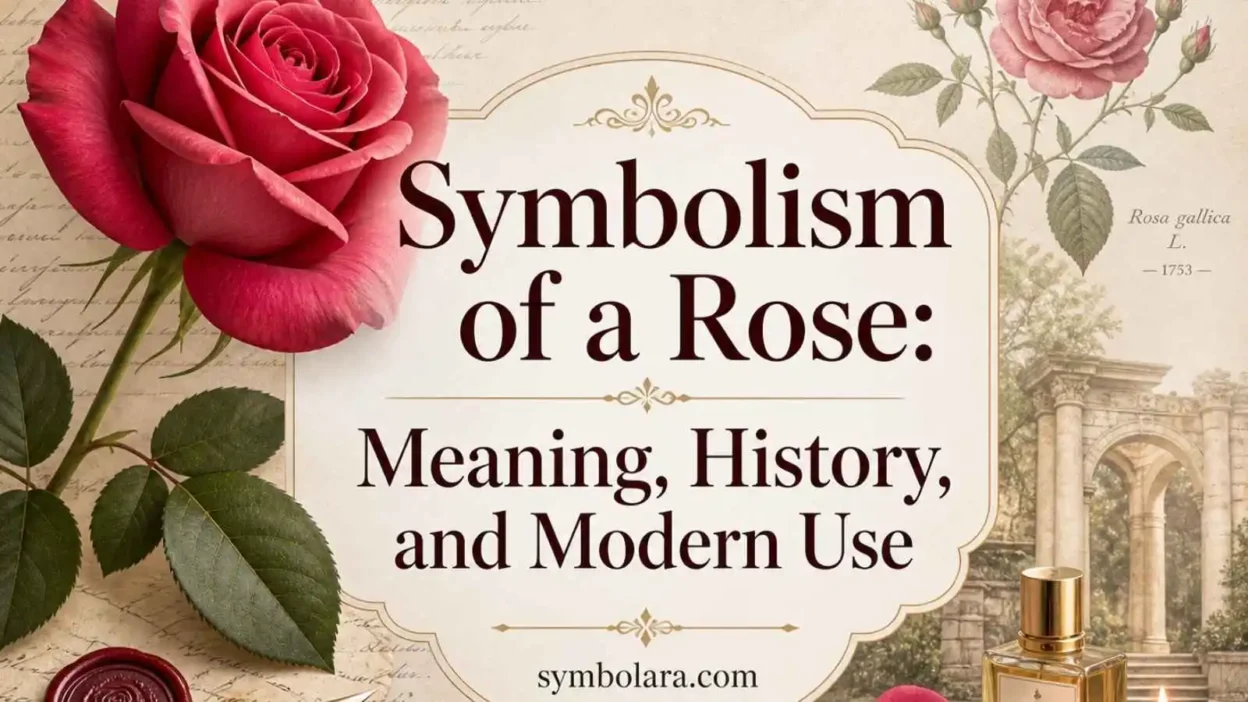
Rose symbolism matters because Americans do not use the flower in only one way. A rose can mean romance on Valentine’s Day, sympathy at a funeral, gratitude on Mother’s Day, or personal strength in a tattoo. The Symbolism Of A Rose comes from a long mix of classical myth, Christian imagery, courtship customs, politics, and modern consumer culture.
People often think the rose simply means love, but that is only the starting point. Its soft petals and sharp thorns make it especially useful as a symbol because it can express beauty and pain at the same time. That combination helps explain why roses appear in weddings, memorials, religious art, fashion, emojis, and personal style across the United States.
Quick Answer
Symbolism Of A Rose most commonly represents romantic love in modern American culture, especially in dating, Valentine’s Day gifts, and expressions of affection. Historically, though, the rose has also symbolized beauty, devotion, purity, honor, grief, secrecy, and the tension between pleasure and pain.
TL;DR
• In the U.S., roses most often mean love and affection.
• Color changes the message people read.
• Ancient myth tied roses to love and beauty.
• Christianity linked roses with Mary and devotion.
• Americans also use roses in grief, tattoos, and holidays.
• The flower can signal both beauty and hurt.
What a Rose Looks Like and Why That Matters Symbolically
A rose is easy to recognize: layered petals, a strong scent, and a stem usually guarded by thorns. Those physical traits help create its symbolic range. The bloom suggests beauty, tenderness, and attraction, while the thorns introduce caution, sacrifice, or emotional risk.
That physical contrast is one reason the rose has lasted as a symbol when many other flowers did not. A rose can say, “I love you,” but it can also suggest that love is not simple. In American culture, that tension shows up everywhere from breakup songs to tattoo art, where a rose may stand for devotion, heartbreak, survival, or a mix of all three.
What It Most Commonly Means in the United States
In the United States today, the rose most often stands for romantic love. Red roses are especially tied to dating, anniversaries, proposals, and Valentine’s Day. That meaning is so common that many Americans do not need any explanation when they receive a red rose.
But American usage is broader than romance. Roses also mark appreciation, remembrance, apology, celebration, and sympathy. A bouquet can function almost like social shorthand: it communicates care in a way that feels formal enough for ceremonies but personal enough for intimate relationships. That flexibility helps explain why roses remain central in gift culture even when flower trends change.
Why Rose Color Changes the Meaning
Color is one of the biggest reasons rose symbolism feels specific rather than generic. Americans usually read red roses as passion or romantic love, white roses as purity or remembrance, pink roses as admiration or gratitude, and yellow roses as friendship or cheerful affection. These meanings are not fixed laws, but they are widely recognized enough to shape how bouquets are bought and interpreted.
That color system matters because roses often appear in moments where people want to communicate without many words. A single red rose sends one message. A white arrangement at a memorial sends another. Yellow roses can feel warm and friendly rather than romantic, which is why they are common in congratulations, recovery, or platonic gifts.
Ancient Roots in Love, Beauty, and Desire
Some of the rose’s oldest symbolic associations in the Western tradition come through Aphrodite, the Greek goddess of love and beauty, and Venus, her Roman counterpart. In classical tradition, the rose became connected with desire, physical beauty, fertility, and attraction. That ancient link still shapes modern meanings, even for people who do not know the mythology directly.
This matters because modern symbolism is rarely invented from scratch. When Americans use roses to represent love, they are drawing on older ideas that were carried forward through literature, art, gardens, and popular custom. Over time, the rose stopped belonging only to myth and became a broader sign of human attachment.
How Christianity Changed Rose Symbolism
Christian tradition gave the rose meanings beyond romance. In Catholic symbolism especially, the rose became associated with the Virgin Mary, beauty joined with purity, and devotion joined with suffering. Even the word rosary comes from the idea of a garland of roses, showing how strongly the flower entered Christian imagination.
This religious layer changed the emotional range of the flower. A rose could now suggest prayer, grace, sacred love, or joy rather than only earthly attraction. That is one reason the rose still works in American settings that are solemn or spiritual, including church decor, memorials, and faith-based art.
Spiritual Meaning of a Rose
The spiritual meaning of a rose goes beyond romance and beauty. Across many traditions, roses represent qualities that people connect with the inner self, including devotion, transformation, compassion, and emotional growth.
In many Christian traditions, the rose represents divine love, purity, and spiritual devotion. The flower’s beauty can symbolize the beauty of faith, while its thorns can represent sacrifice, suffering, and the challenges that come with spiritual growth.
Some people also view the rose as a symbol of personal transformation. A rose begins as a small bud before opening into a complete flower, which can represent growth, maturity, and becoming a stronger version of oneself.
In modern spiritual discussions, roses are often connected with the heart because they represent emotions, relationships, and compassion. A rose may remind people to balance openness with protection, much like the flower’s delicate petals and sharp thorns exist together.
Although spiritual interpretations vary between individuals and cultures, the rose continues to represent the connection between beauty, love, struggle, and personal meaning.
How Courtship and the Language of Flowers Expanded Its Meaning
The rose gained new social power in the nineteenth century through the “language of flowers,” often called floriography. During that period, especially from the 1820s to the 1880s, people in Britain and America used flowers as coded messages in courtship. Roses fit perfectly into that system because color, freshness, and arrangement could all suggest different feelings.
That period helped turn the rose into a modern communication tool. It was no longer just a mythic or sacred flower. It became part of everyday social life, where bouquets could express attraction, refusal, loyalty, jealousy, or admiration. Many color meanings Americans still recognize today were shaped by that era.
Why the Rose Also Symbolizes Pain, Risk, and Loss
The rose is not only a cheerful symbol. Its thorns make it one of the clearest natural symbols for the idea that beauty can come with danger or cost. In literature, tattoos, and everyday speech, roses often stand for love that wounds, beauty that fades, or desire that carries consequences.
This darker side is part of why the flower remains believable. Symbols survive when they can hold contradiction. A rose can express infatuation, but it can also mark grief, regret, or emotional endurance. In American tattoo culture, for example, rose designs often carry meanings like resilience, memory, and surviving heartbreak rather than simple romance.
Meaning of a Black Rose Symbolism
Black rose symbolism often represents mystery, change, endings, and emotional depth. Unlike traditional red or white roses, black roses usually carry darker meanings connected with transformation rather than simple romance.
In modern American culture, a black rose can symbolize the end of a chapter, personal change, independence, or overcoming difficult experiences. Many people choose black rose tattoos because the image can represent survival, strength, and the ability to grow after hardship.
Black roses also appear in gothic fashion, art, and alternative styles because their dark appearance creates associations with mystery, individuality, and rebellion. However, the meaning depends heavily on context. For one person, a black rose may represent loss or grief. For another, it may represent confidence and personal transformation.
The black rose shows how symbolism changes over time. A flower traditionally connected with beauty can also become a symbol of endings, renewal, and emotional strength.
Rose Symbolism in American Holidays and Public Life
The rose has a strong public life in the United States. It is the national flower, and it also appears in one of the country’s best-known annual spectacles, the Rose Parade in Pasadena, where floral display, civic pride, and celebration merge into a distinctly American ritual. That public presence helps keep the rose visible even outside personal relationships.
American holiday culture also reinforces rose symbolism. Roses show up heavily around Valentine’s Day, Mother’s Day, anniversaries, and memorial observances. In practice, this means the flower has become a shared cultural language: one bloom can signal romance, a bouquet can signal gratitude, and an arrangement can express sympathy without needing a long explanation.
Where Americans Use Roses Today
Modern Americans encounter rose symbolism in more places than greeting cards and florists. Roses appear in tattoos, perfumes, wedding florals, home decor, jewelry, social posts, album art, and emojis. The rose emoji, for example, is commonly used for romance, Valentine’s Day, and affectionate messages, but it can also carry broader meanings depending on context.
This broad use matters because symbols change when they move across media. In a tattoo, a rose may signal devotion, remembrance, or a hard-earned sense of self. In jewelry, it may suggest elegance or sentimental attachment. Online, it can be sincere, flirtatious, ironic, or political depending on who is using it and why.
Rose Symbolism in Tattoos and Body Art
Rose tattoos are among the most recognizable forms of flower symbolism because they allow people to express personal stories through a familiar image. While many people associate rose tattoos with love and romance, the meaning often goes much deeper.
A rose tattoo may represent devotion to a person, a memory of someone important, personal growth, or survival after difficult experiences. The combination of soft petals and sharp thorns makes the rose especially powerful for people who want an image that represents both beauty and struggle.
The design choices also influence the meaning. A single rose may suggest simplicity or focused emotion, while a rose combined with a skull, clock, name, or other symbols may communicate ideas about mortality, time, loyalty, or remembrance.
In modern American tattoo culture, the rose remains popular because it can represent many different experiences while still maintaining a timeless appearance.
Emotional and Psychological Meaning
Psychologically, the rose often communicates feelings people want to express carefully rather than bluntly. It can soften a message. Giving a rose may make affection feel graceful instead of awkward, or make sympathy feel respectful instead of intrusive. That emotional usefulness is part of its cultural staying power.
The flower also signals identity. Someone who chooses rose imagery may be drawn to ideals like beauty, devotion, longing, elegance, romance, or emotional complexity. Because the rose is both beautiful and guarded, it can also suggest a personality that is warm but not unprotected.
Rose Symbolism in Dreams: Common Interpretations
Dream interpretations involving roses often connect the flower with emotions, relationships, and personal experiences. Because roses have strong associations with love and beauty, seeing a rose in a dream may reflect feelings connected to affection, connection, or emotional growth.
The details of the dream often influence the interpretation. A blooming rose may suggest happiness, new beginnings, or emotional fulfillment. A wilted rose may represent change, disappointment, or the end of an important period. A rose with thorns may symbolize a situation that includes both positive and difficult experiences.
The color of the rose can also affect personal interpretation. A red rose may connect with passion or strong emotions, while a white rose may suggest peace, remembrance, or innocence.
Dream symbolism is personal rather than universal. A rose in a dream may reflect memories, relationships, hopes, or feelings that are meaningful to the individual experiencing it.
Cross-Cultural and Religious Meanings Beyond the U.S.
Outside the American mainstream, rose symbolism expands further. In Christian traditions, it can carry Marian meaning and devotional significance. In classical Western mythology, it connects to Aphrodite and Venus. In European history, it also took on political meaning through the red and white roses associated with the houses of Lancaster and York.
These meanings do not cancel one another out. They stack. That is why a rose can feel romantic in one setting, sacred in another, and historical in a third. Symbols last when they can move across cultures and still remain recognizable. The rose is one of the clearest examples of that.
Rose Symbolism in Literature and Art
Writers and artists have used roses for centuries because the flower can communicate complex emotions quickly. In literature, a rose often represents love, beauty, desire, memory, or something valuable that requires protection.
The famous phrase “a rose by any other name” from Shakespeare’s Romeo and Juliet helped strengthen the idea that a rose represents essential beauty beyond its physical appearance. The flower became a way for writers to explore identity, attraction, and the meaning people attach to things.
Artists also use roses to create contrast. A bright rose may represent hope or affection, while a damaged or fading rose may suggest loss, time, or change. Because the flower combines elegance and vulnerability, it continues to appear in paintings, poetry, photography, and modern visual design.
A Quick Comparison of Common Meanings
| Context | Meaning in the USA | Common Associations | Notes |
| Red rose | Romantic love | Passion, dating, Valentine’s Day | The most widely recognized meaning |
| White rose | Purity or remembrance | Weddings, funerals, faith, innocence | Can feel joyful or solemn |
| Pink rose | Admiration and gratitude | Mother’s Day, thanks, affection | Often gentler than red |
| Yellow rose | Friendship and warmth | Cheer, recovery, congratulations | Usually non-romantic |
| Rose tattoo | Love, memory, resilience | Beauty, pain, devotion, loss | Meaning depends on style and pairing |
| Rose emoji | Affection or romance | Flirting, celebration, aesthetics | Can also be ironic or political online |
Common Misunderstandings About Rose Symbolism
One common mistake is assuming every rose means romance. In reality, color, occasion, and setting matter. White roses at a memorial do not communicate the same thing as red roses on Valentine’s Day, and yellow roses usually read as friendship rather than passion.
Another misunderstanding is treating rose symbolism as fixed and universal. It is not. Some meanings are widely shared, but others depend on religion, region, family tradition, or personal experience. A person may choose a rose tattoo for grief, not love, or use the rose emoji playfully rather than seriously.
How the Meaning of the Rose Changed Over Time
The rose began in Western symbolism with strong ties to love, beauty, and desire. Christian traditions then added purity, sacred devotion, and joy. Later, floriography turned the rose into a social code for personal communication, and modern mass culture turned it into a gift, a design motif, and a digital shorthand.
What changed most is not the core idea but the range. The rose still points to human feeling, but now it can cover romance, mourning, style, faith, memory, politics, and online expression. In that sense, the rose did not lose its meaning over time. It accumulated meanings.
FAQs
What does a rose usually symbolize?
In the United States, a rose most commonly symbolizes love and affection, especially romantic love. Its exact meaning changes with color and context, so it can also represent remembrance, purity, gratitude, or friendship.
What does a rose tattoo mean?
A rose tattoo often represents love, devotion, beauty, or emotional endurance. Because the flower includes both petals and thorns, many people also use it to symbolize pain, survival, or the idea that something beautiful can come with struggle.
Do roses have religious meaning?
Yes. In Christian tradition, especially Catholic symbolism, the rose has long been linked with the Virgin Mary, prayer, purity, and joy. That religious meaning is separate from modern dating culture, though both uses still exist side by side.
Why are roses associated with Valentine’s Day?
Roses became strongly tied to courtship through older love traditions and the nineteenth-century language of flowers. In modern America, that association is reinforced every year through Valentine’s Day gifting, where flowers remain one of the most popular categories.
Do different rose colors mean different things?
Usually, yes. Red commonly signals romance, white suggests purity or remembrance, pink signals appreciation, and yellow suggests friendship. These meanings are widely recognized, though personal and cultural interpretations can still vary.
Can a rose symbolize something negative?
It can. The thorns make the rose a natural symbol for pain, danger, or emotional risk. In some settings, a wilted or dark rose may suggest heartbreak, loss, or the end of something once cherished.
What does a red rose symbolize besides love?
Although red roses are strongly associated with romantic love, they can also represent respect, courage, deep admiration, and strong emotional connections.
What does a pink rose symbolize?
A pink rose commonly symbolizes admiration, gratitude, kindness, and appreciation. In American culture, pink roses are often used for friendships, thank-you gifts, and gentle expressions of affection.
Conclusion
The rose remains one of the most flexible symbols in American life because it can say more than one thing at once. It can express love, longing, gratitude, reverence, grief, beauty, memory, and even caution. Very few symbols move as easily between weddings, funerals, tattoos, churches, parades, and text messages.
That is the lasting strength of the Symbolism Of A Rose. It does not survive because it is vague. It survives because people still find it specific, readable, and emotionally useful in real life.