
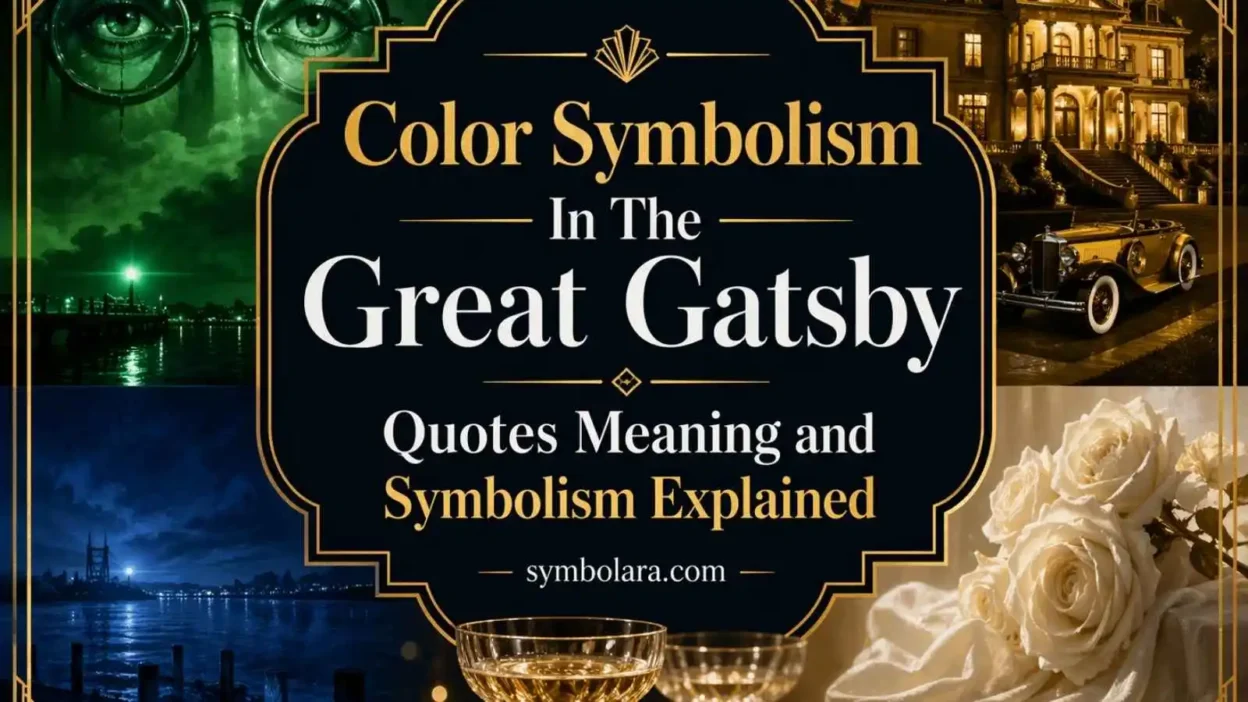
F. Scott Fitzgerald’s novel is one of the few American classics where color feels almost as important as plot. That is why readers still search for Color Symbolism In The Great Gatsby Quotes: the novel keeps tying emotion, status, and illusion to repeated shades that seem simple at first and revealing on a second look.
In everyday reading, people remember the green light. But Fitzgerald’s color system is wider than that. White, yellow, gold, blue, gray, silver, and even blackened or faded tones help shape how readers understand Daisy, Gatsby, wealth, romance, and the rot underneath the Jazz Age surface.
That matters in the United States because The Great Gatsby is not just a school text. It is part of the American language of ambition. People reference it when talking about old money style, luxury culture, doomed romance, fake glamour, and the American Dream gone sideways. Its colors are one reason those ideas still feel vivid.
Quick Answer
In modern American reading, Color Symbolism In The Great Gatsby Quotes most commonly symbolizes desire, wealth, illusion, and the gap between appearance and reality. Historically within the novel, Fitzgerald uses colors like green, white, yellow, blue, and gray to show how beauty, money, class, and hope can look attractive from a distance but turn unstable or corrupt up close.
TL;DR
- Green points to desire and an unreachable future.
- White suggests elegance, not pure innocence.
- Yellow and gold split glamour from moral decay.
- Blue often signals dreaminess, distance, and artifice.
- Gray exposes social waste beneath luxury.
- Americans read the colors as American Dream symbols.
Why Color Matters So Much in the Novel
Some novels use color for atmosphere. Fitzgerald uses it to organize meaning. Colors appear around people, rooms, clothing, cars, lights, weather, and landscape so often that they begin to function like a second layer of narration.
This is especially important because Nick Carraway tells the story in retrospect. He does not give readers a neutral camera view. He filters what he sees through mood, memory, attraction, irritation, and moral judgment. Color becomes part of that filter. A white dress is never just a white dress. A yellow car is not just a car. A green light is not just a light.
That is why readers and teachers often talk about color symbolism through quotes. Fitzgerald’s exact wording matters. He places color right beside emotionally loaded scenes, which makes the colors feel like evidence.
The Main Symbolic Pattern: Beauty on the Surface, Damage Underneath
If one idea ties the whole color system together, it is this: the novel keeps showing surfaces that charm people before exposing the cost beneath them.
That pattern fits the book’s larger argument about American ambition in the 1920s. Gatsby creates an image of success bright enough to attract crowds, Daisy, and even Nick’s fascination. Yet the more dazzling the image becomes, the more obvious its instability looks. Fitzgerald does not present corruption as ugly from the start. He presents it as appealing, stylish, and socially admired.
That is why the color scheme feels so effective. The colors are often beautiful first and troubling second. Readers are meant to experience the seduction before they fully see the damage.
Green: Hope, Desire, Money, and the Future That Keeps Moving
Green is the novel’s best-known color because of the light at the end of Daisy’s dock. In American culture today, many readers treat that green light as shorthand for longing itself: wanting a life, a person, or a version of success that always seems close but never quite becomes real.
Inside the novel, green carries several ideas at once. It suggests hope because Gatsby reaches toward it as if the future can still be claimed. It also suggests money, which matters in a book obsessed with class mobility and display. And because the light shines across water, green becomes a color of distance. It is visible, specific, and still unreachable.
What makes green so memorable is that it changes meaning without disappearing. At first it stands for Gatsby’s dream of Daisy. Later, once Daisy is physically near, the light loses some of its magic. That shift matters. Fitzgerald is showing that desire often depends on distance. Once the dream becomes ordinary life, its symbolic glow weakens.
For modern U.S. readers, this is why the green light often stands for the American Dream itself: always promising movement, always sliding further ahead.
White: Purity, Performance, and the Look of Innocence
Many first-time readers assume white means innocence in a straightforward way. Fitzgerald makes that interpretation tempting on purpose. Daisy and Jordan are introduced in white dresses in a bright, airy room, and Daisy’s earlier life is also linked to white clothing and a white car. The image is graceful, expensive, and carefully staged.
But white in The Great Gatsby is not moral purity. It is the appearance of purity. That distinction is one of the novel’s sharpest moves. Daisy looks delicate, floating, almost bridal. Yet her choices are often evasive, self-protective, and destructive. White helps build her social aura: untouched, refined, desirable, above the mess.
In American culture, white often carries associations with weddings, cleanliness, prestige, and innocence. Fitzgerald uses those familiar meanings, then complicates them. Daisy is not false because she wears white; she is false because white helps shield her from consequence.
That is why white remains one of the novel’s most effective colors. It shows how class privilege can make harmful people look harmless.
Yellow and Gold: Wealth, Display, and Moral Tarnish
Readers often group yellow and gold together, but the novel gets more interesting when they are separated.
Gold usually points to genuine luxury, old wealth, or high-value polish. It has an aristocratic feel. Yellow, by contrast, often feels louder, cheaper, or more exposed. It can still look glamorous, but it carries a slight sourness. In American terms, gold suggests prestige; yellow often suggests flashy display.
This distinction helps explain Gatsby’s world. He wants the glow of high status, but much of what surrounds him feels overdone rather than secure. His famous yellow car is impressive, but it also becomes tied to violence and death. The yellow party atmosphere is attractive, yet unstable. The shade does not simply mean “money.” It points to money that performs itself.
That makes yellow one of the novel’s most modern colors. Americans still recognize the difference between quiet wealth and conspicuous wealth. Fitzgerald understood that long before “old money aesthetic” became a social media phrase.
Blue: Dreaminess, Distance, and Emotional Unreality
Blue is easier to miss because it does not announce itself like the green light. But it appears in key places: Gatsby’s “blue gardens,” twilight scenes, blue lawns, blue smoke, and those moments when glamour becomes cool, remote, or slightly unreal.
In American color psychology, blue often suggests calm, sadness, distance, and sophistication. Fitzgerald uses all of those. Blue softens the world into atmosphere. It turns parties into a kind of dream theater. It gives Gatsby’s surroundings beauty, but also removes them from ordinary human warmth.
This is one reason Gatsby feels both magnetic and lonely. Blue lets his world shimmer without becoming solid. It is beautiful and detached at the same time.
Blue also helps balance the novel’s brighter colors. Green reaches forward. Yellow flashes outward. White floats. Gray sinks. Blue hovers. It is the color of suspended feeling, when life looks cinematic but not fully lived.
Gray: Waste, Exhaustion, and the Price of Other People’s Splendor
Gray belongs most clearly to the valley of ashes, the industrial wasteland between glittering wealth and Manhattan movement. Here Fitzgerald drops the brightness and gives readers a landscape of dust, ash, and spiritual fatigue.
If green is aspiration, gray is aftermath.
The valley matters because it shows what the glamorous world depends on but does not want to see. In modern American reading, the gray wasteland often symbolizes the people and places left behind by wealth culture: labor, environmental damage, social neglect, and emotional depletion. Fitzgerald’s vision is not abstract. Gray is physical. It gets on bodies, buildings, roads, and air.
Gray also exposes the moral imbalance of the novel. The rich move through bright spaces; the vulnerable live amid residue. That contrast is one reason the book still feels current. Americans still recognize systems where luxury is visible and the cost is pushed out of sight.
Silver and Metallic Tones: Cool Glamour Without Warmth
Silver appears less often in casual summaries, but it matters. When Fitzgerald describes silver surfaces, silver voices, or silver-like elegance, the effect is rarely cozy. Silver is polished, elite, and slightly cold.
Daisy often lives in this emotional temperature. She gleams. She is exquisite. But she is not dependable. Silver helps express a beauty that reflects light rather than generating warmth. That is a useful distinction in a novel where people confuse radiance with character.
In modern U.S. culture, silver can still suggest upscale style, luxury minimalism, and refined detachment. Fitzgerald’s use feels surprisingly contemporary for that reason. The metallic sheen is appealing, but human closeness does not necessarily come with it.
Color and Character: Who Carries Which Meanings?
The novel’s colors are not random decorations. They cluster around certain people and expose what those people represent.
| Character or Context | Meaning in the USA | Common Associations | Notes |
| Gatsby and the green light | Longing and ambition | Future, desire, money, dream-chasing | Hope mixed with illusion |
| Daisy in white and silver | Beauty with moral evasiveness | Innocence, class, charm, emotional distance | Surface purity, not ethical purity |
| Gatsby’s yellow car | Flashy wealth and danger | Status display, spectacle, recklessness | Luxury becomes fatal |
| Blue gardens and twilight scenes | Romantic unreality | Mood, distance, atmosphere, sadness | Dreamlike rather than stable |
| Valley of ashes in gray | Social and moral decay | Waste, exhaustion, forgotten people | Counterpoint to luxury |
This pattern is one reason color symbolism is so teachable. Readers can track the shades and see how Fitzgerald turns image into judgment.
The Great Gatsby Color Symbolism Chart: Meaning of Each Color
| Color | Symbolic Meaning | Major Connection in the Novel |
|---|---|---|
| Green | Hope, ambition, desire, future dreams | Gatsby’s green light and his dream of Daisy |
| White | Beauty, elegance, social status, false innocence | Daisy’s appearance and wealthy lifestyle |
| Yellow | Display, wealth, excitement, danger | Gatsby’s yellow car and flashy image |
| Gold | Luxury, prestige, high social value | Wealth and upper-class appearances |
| Blue | Distance, fantasy, emotional unreality | Gatsby’s parties and dreamlike world |
| Gray | Waste, emptiness, social inequality | Valley of ashes and forgotten lives |
| Silver | Cold elegance and polished appearance | Wealth, beauty, and emotional distance |
| Black | Mystery, darkness, loss, and moral uncertainty | The darker side of ambition and consequence |
This chart shows that Fitzgerald rarely uses colors in a simple way. Each shade develops a larger idea about identity, wealth, relationships, and the American Dream.
Why Quotes Matter More Than Summary
A lot of modern discussion reduces Gatsby’s colors to one-word definitions: green equals hope, white equals innocence, yellow equals corruption. That shorthand is useful for study guides, but it can flatten the novel.
The actual quotes are more slippery. Fitzgerald often puts beauty and discomfort in the same sentence. A room can glow and feel false. A dress can look angelic while the person wearing it avoids responsibility. A car can shine and kill. That tension is the point.
So when people search for quotes about color symbolism, they are usually looking for more than literary proof. They are trying to understand how Fitzgerald makes an image carry two truths at once. That is one reason the book still holds up for general readers, not just students.
Famous Color Symbolism Quotes From The Great Gatsby Explained
Readers often search for color symbolism quotes from The Great Gatsby because Fitzgerald’s descriptions reveal meaning through small visual details. The colors become powerful because they appear during important emotional moments instead of existing as simple decoration.
One of the most famous examples is the green light at the end of Daisy’s dock. Gatsby’s repeated focus on the light transforms a small object into a symbol of hope, desire, and an imagined future. The distance between Gatsby and the light reflects the distance between his dream and reality.
White imagery connected to Daisy also carries important meaning. Fitzgerald uses descriptions of white clothing and bright settings to create an atmosphere of elegance and refinement. However, these images also suggest how appearances can hide complicated truths.
The yellow imagery surrounding Gatsby’s car and wealth creates another important contrast. The color suggests attention, luxury, and social display, but it also becomes connected with danger and destruction. Fitzgerald shows that impressive appearances can carry hidden consequences.
The gray imagery of the valley of ashes works differently. Instead of attraction, gray creates feelings of emptiness and neglect. It represents the forgotten spaces and people existing beneath the surface of wealth and celebration.
These examples show why Fitzgerald’s color symbolism remains memorable. The colors do not simply represent one idea. They change as characters reveal their choices, failures, and desires.
What These Colors Say About Class in America
One of the most American things about the novel is how closely color is tied to class performance. The characters are not simply rich or poor. They are legible through style. Fitzgerald notices fabrics, cars, lawns, lights, shirts, jewelry, and interiors because class in this world is visual before it is moral.
White and silver help old-money spaces appear effortless. Yellow and overbright display often cling to aspiration. Gray marks the people excluded from both glamour and safety. Green hangs between desire and capital.
Modern Americans still read these signals instinctively. Quiet luxury, flashy luxury, inherited wealth, performative wealth, curated innocence, and class-coded taste all remain familiar categories. The novel’s colors still make sense because the culture still sorts people through image.
How Color Symbolism Connects to The American Dream in The Great Gatsby
Color symbolism in The Great Gatsby is closely connected to Fitzgerald’s criticism of the American Dream. The novel does not suggest that ambition itself is wrong. Instead, it questions what happens when success becomes focused only on money, appearance, and social approval.
Green represents the desire to reach a better future. Gatsby believes that wealth and determination can help him recreate the past and finally achieve the life he wants. However, the green light also shows the danger of chasing an ideal that may never exist.
White represents the image of success many people admire. Daisy’s world appears beautiful, controlled, and perfect from the outside. Yet Fitzgerald reveals that this polished surface protects selfish choices and avoids responsibility.
The contrast between bright colors and gray spaces also reflects economic inequality. While wealthy characters enjoy luxury, the valley of ashes shows the people and places ignored by that prosperity.
For modern American readers, these symbols still feel relevant because society continues to debate wealth, status, opportunity, and the meaning of success. Fitzgerald’s colors remind readers that a successful appearance does not always represent a successful life.
Emotional Meaning: Why Readers Feel the Colors
The color symbolism works because it is emotional before it is interpretive.
Green feels restless. White feels airy and deceptive. Yellow feels overstimulated. Blue feels lonely. Gray feels deadened. Gold feels prestigious. Silver feels cool.
Readers do not need a teacher to feel those effects. Fitzgerald builds a sensory world where color helps regulate mood. That is why the novel stays with people even when they forget details of the plot. They remember the feeling of reaching across dark water toward a green point. They remember bright rooms and drifting curtains. They remember the ash-gray stretch between privilege and ruin.
This emotional precision is part of what makes the symbolism feel human instead of mechanical.
How Americans Commonly Interpret These Symbols Today
In the United States, The Great Gatsby is widely read through the lens of the American Dream. That lens shapes how people interpret the colors even outside the classroom.
Green is usually read as aspiration and unattainable desire. White is read more skeptically now than it once was, especially by readers alert to the performance of femininity and class. Yellow often gets linked to excess and danger. Gray is commonly understood as the social underside of economic fantasy.
Modern audiences also bring in newer concerns. Readers may connect the valley of ashes to environmental damage, or Daisy’s whiteness to social protection through status, beauty, and wealth. These are modern emphases, but they fit the novel rather than distorting it.
In other words, the colors endure because they are flexible without being empty.
Cross-Cultural Reading: What Changes Outside the U.S.
Outside the United States, some color associations shift. White, for example, does not always mean purity in every culture; in some traditions it is tied to mourning. Green may suggest growth, nature, or sacred associations more strongly than money. Gold can signal holiness or state power as much as wealth.
Still, the American setting of The Great Gatsby keeps the U.S. meaning central. This is a novel about money culture, image management, and social aspiration in a distinctly American frame. Cross-cultural readings can add nuance, but they do not replace the book’s own national context.
That said, international readers often respond to the same basic tension: glamorous surfaces hiding emotional emptiness. That part travels well.
Modern Use in Pop Culture, Fashion, and Digital Life
The novel’s color symbolism shows up constantly in modern American life, even when people have not read the book recently.
Green lights are used in essays, speeches, and posts about impossible goals. White-and-gold Gatsby-inspired fashion evokes old-money fantasy, Jazz Age glamour, and curated elegance. Yellow vintage cars or champagne-heavy visuals can signal excess that is almost cartoonish. Blue nighttime party imagery often borrows the book’s atmosphere of beauty tinged with sadness.
On social media, Gatsby references often get simplified into aesthetics: linen, pearls, champagne towers, lawn parties, art deco fonts. But the strongest modern uses preserve the original irony. They show luxury while hinting that luxury is unstable, performative, or emotionally empty.
That combination is exactly why the novel remains culturally alive.
Why The Great Gatsby Color Symbolism Still Matters Today
The color symbolism of The Great Gatsby remains powerful because modern culture still values appearance, status, and personal image. The same ideas Fitzgerald explored in the 1920s appear today in fashion, social media, advertising, and lifestyle trends.
The green light continues to represent goals people chase but cannot fully reach. Many Americans connect it with career ambition, personal dreams, and the constant search for something better.
White and gold Gatsby-inspired designs often appear in weddings, luxury branding, and fashion because they communicate elegance and sophistication. However, the novel encourages people to look beyond appearances and question what those images hide.
The contrast between glamour and emptiness also feels familiar in the digital age. Social media often presents carefully designed versions of success, similar to Gatsby’s carefully created public identity.
This lasting connection explains why The Great Gatsby remains more than a historical novel. Its colors continue to represent modern struggles with identity, ambition, wealth, and the difference between image and reality.
Common Misreadings and Overstatements
The biggest mistake is treating each color as if it has one fixed meaning. Fitzgerald is more subtle than that. Green is not only hope. White is not only innocence. Yellow is not only wealth. Context changes everything.
Another common mistake is turning the symbolism into something mystical. The colors are not secret codes dropped into the novel for puzzle-solving. They are part of how Fitzgerald writes social perception. He wants readers to notice how Americans attach moral value to style, color, polish, and display.
A third mistake is assuming Gatsby himself is the pure dreamer while everyone else is merely corrupt. The color system does not let him off the hook. His world is beautiful, but it is also staged, excessive, and implicated in harm. Fitzgerald admires Gatsby’s intensity more than he admires the Buchanans, but admiration is not innocence.
How the Meanings Change by the End
By the close of the novel, the colors do not disappear, but their balance shifts. The book moves away from party brightness toward autumn, fading light, and a harsher understanding of what has happened.
Green remains, but now it belongs less to Gatsby alone and more to the general human habit of reaching toward a receding future. Gray remains as social truth. White loses whatever innocence it seemed to promise. Yellow is stained by death. Blue becomes more elegiac than glamorous.
That evolution is what gives the symbolism staying power. Fitzgerald does not hand readers a static chart. He lets color meanings ripen, collapse, and darken as the dream fails.
Frequently Asked Questions
What does the green light symbolize in The Great Gatsby?
It usually symbolizes Gatsby’s longing for Daisy and the future he imagines with her. In a broader American reading, it also stands for the dream of success that feels visible and attainable but keeps slipping away.
Does white really mean innocence in the novel?
Not in a simple way. White helps create the look of innocence, elegance, and refinement, especially around Daisy, but Fitzgerald uses that look to question whether beauty and moral goodness actually belong together.
Why is the yellow car so important?
The yellow car represents spectacle, status, and the danger built into Gatsby’s version of wealth. It starts as a glamorous object and ends up tied to carelessness, violence, and fatal consequences.
What does the valley of ashes symbolize?
It symbolizes the human and material waste hidden behind bright prosperity. For many American readers, it is the novel’s clearest picture of what economic glamour leaves behind.
Is blue a major color symbol in The Great Gatsby?
Yes, even though it gets less attention than green or white. Blue often marks Gatsby’s world as dreamy, distant, beautiful, and emotionally unreal rather than grounded and secure.
Are the color meanings fixed, or do they change?
They change with context and with the novel’s movement. Fitzgerald often starts with a familiar association, like white for innocence or green for hope, then complicates it through character behavior and narrative outcome.
What does gold symbolize in The Great Gatsby?
Gold symbolizes luxury, prestige, and social value. However, Fitzgerald also uses gold imagery to question whether wealth and beauty truly represent happiness or moral success.
Conclusion
The genius of Fitzgerald’s color writing is that it feels intuitive before it becomes analytical. Readers sense that the colors matter because each one carries emotion, class meaning, and moral pressure at the same time. What looks bright is often unstable. What looks pure is often protected. What looks hopeful is often just out of reach.
That is why Color Symbolism In The Great Gatsby Quotes still matters for American readers today. The colors do more than decorate the novel’s world; they explain how desire, status, illusion, and damage operate inside it. Fitzgerald understood that people often chase what glows, trust what looks refined, and notice the cost too late.

[…] while others fear them because certain species can be dangerous. This emotional contrast explains why snakes became symbols of both positive and negative […]
[…] matters because color symbolism usually starts with repeated experience. Indigo is not just a color name on a chart. It is a shade […]
[…] mix of comfort and uncertainty explains the symbol’s staying power. A forest is visually simple to recognize, but emotionally it is never flat. It […]
[…] Its yellow color drives much of its symbolism. […]