
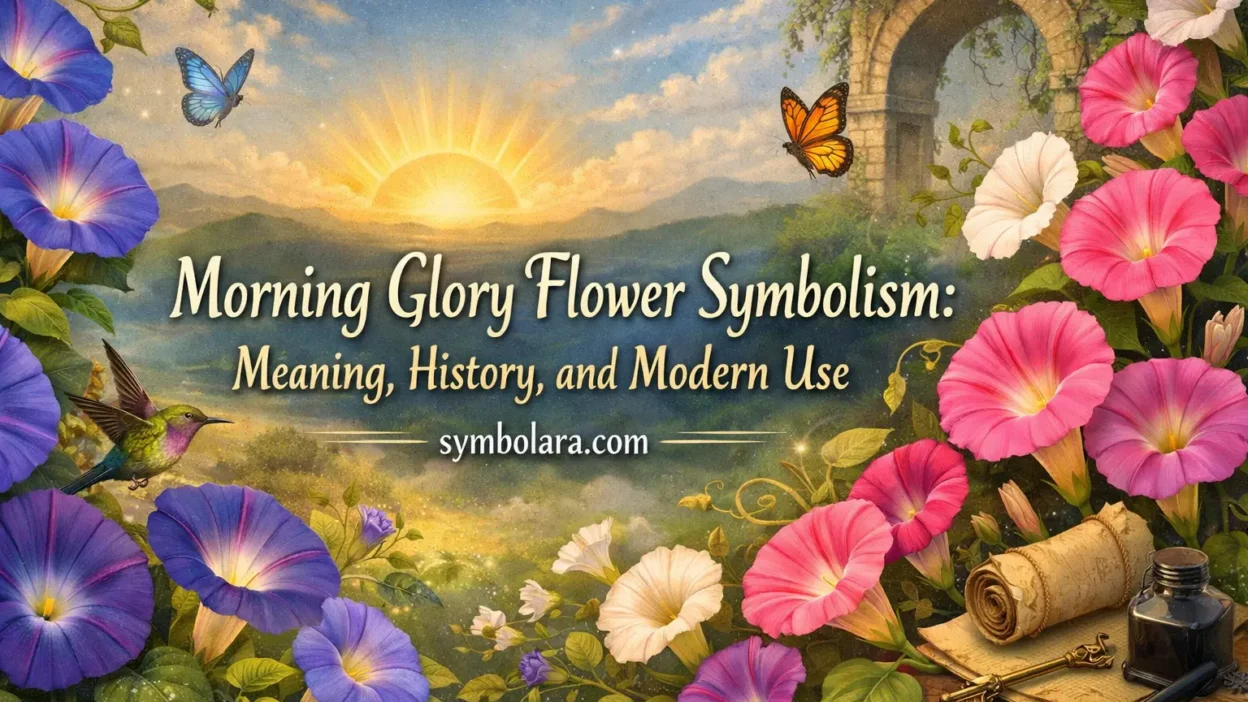
Morning glory flower symbolism usually centers on affection, renewal, fleeting beauty, and the quiet truth that something meaningful can be brief without being unimportant. In modern American culture, the flower often suggests summer mornings, tenderness, nostalgia, and the passing nature of time. That meaning comes largely from the plant’s visible behavior: many morning glories open early, fade quickly, and make impermanence feel easy to see.
That is why the flower feels different from a rose or sunflower. A rose often signals enduring romance or passion. A sunflower usually feels bright, confident, and outward-facing. Morning glory is softer and more reflective. It tends to symbolize beauty that arrives vividly, then slips away.
Quick Answer
Morning glories most often symbolize affection, renewal, fleeting beauty, and the passing of time. In the United States, they are commonly understood as flowers of summer memory, quiet love, soft nostalgia, and meaningful impermanence. Their symbolism comes from both their climbing habit and their short-lived blooms, which open in the morning and often fade by midday or night depending on the species and conditions.
Why The Morning Glory Became Symbolic
Morning glory symbolism begins with what the flower actually does. Common garden morning glories are twining vines with heart-shaped leaves and trumpet-shaped flowers, often in blue, purple, pink, or white. Many open early in the day, and some blossoms fade by noon in warm sun. That daily cycle is the heart of the symbol. It ties the flower to dawn, freshness, and the brief life of beautiful things.
Its growth habit matters too. Morning glory climbs quickly, wraps around supports, and reaches upward toward light. Because of that, the plant can symbolize attachment, persistence, and forward motion as much as delicacy. The flower looks fragile, but the vine is vigorous. That contrast helps explain why people often read it as both gentle and determined.
What Morning Glories Symbolize Most Commonly Today
In current U.S. usage, morning glories usually carry four main meanings: affection, renewal, fleeting beauty, and time passing.
Affection comes from older flower-language traditions and from the flower’s inviting, soft appearance. Renewal comes from the way a fresh bloom opens with morning light. Fleeting beauty comes from how visibly short-lived the flower can be. The sense of time passing comes almost automatically, because the bloom seems to mark the day itself.
These meanings make morning glory especially useful for personal symbolism. It suits moments, memories, and feelings that matter deeply but are not permanent. It can stand for a summer that cannot be repeated, a relationship remembered with tenderness, or a stage of life that felt brief and luminous.
Morning Glory Symbolism Compared With Other Popular Flowers
Morning glory has a unique place among popular symbolic flowers because its meaning focuses less on permanence and more on the experience of the moment.
| Flower | Common Symbolic Meaning | Main Difference From Morning Glory |
|---|---|---|
| Rose | Love, passion, devotion | Often represents lasting romance and commitment |
| Sunflower | Happiness, confidence, positivity | Feels brighter and more outward-focused |
| Lily | Purity, renewal, remembrance | Often carries stronger spiritual associations |
| Cherry Blossom | Beauty, change, impermanence | Shares the theme of fleeting beauty |
| Morning Glory | Affection, renewal, brief beauty, time | Emphasizes daily cycles and meaningful moments |
This comparison shows why morning glory remains distinctive. While many flowers symbolize beauty, morning glory specifically highlights the relationship between beauty and time. It encourages appreciation of experiences as they happen rather than focusing only on what lasts forever.
Morning Glory Symbolism in Love and Relationships
In relationships, morning glory symbolism often represents gentle affection, emotional connection, and appreciation for meaningful moments. Unlike symbols that focus only on permanent commitment, the flower carries a softer message: love can be valuable even when life changes.
The flower’s short blooming period gives it a unique romantic meaning. It suggests that relationships do not need to remain unchanged to be important. A brief connection, a special memory, or a season of happiness can still leave a lasting emotional impact.
For some people, morning glory represents a love that grows naturally over time. The climbing vine reflects attachment and connection because it reaches outward while staying connected to its roots. This makes the flower a fitting symbol for relationships built on care, support, and shared growth.
In modern American culture, morning glory may appear in romantic artwork, wedding-inspired designs, anniversary gifts, and personal tattoos. Its message is usually not dramatic passion but quiet appreciation, tenderness, and the beauty of shared experiences.
Why Impermanence Is Central To Its Meaning
Impermanence is not just one interpretation of morning glory. It is the reason most of the flower’s symbolic meanings exist at all. Many flowers do not last long, but morning glory makes that shortness unusually visible. You can watch it open, brighten, and fade within a narrow span of time. The symbol does not need much explanation because the plant performs it in real life.
That is why morning glory often carries both sweetness and wistfulness. It is rarely a harsh symbol. Instead, it suggests that beauty can be brief and still be fully real. In American emotional language, that makes it a strong flower for nostalgia, memory, youth, seasonal change, and relationships that mattered even if they did not last.
Early Botanical Roots And Broader History
Morning glory is not a single plant but a large group within the morning glory family, Convolvulaceae. The genus Ipomoea includes many familiar species. Britannica notes that common morning glory (Ipomoea purpurea) is an annual vine with heart-shaped leaves and purple, pink, or white flowers, while other well-known morning glories such as heavenly blue forms are native to tropical America.
That matters because modern U.S. garden symbolism did not appear out of nowhere. Morning glories became part of American visual and emotional culture through horticulture, ornamental planting, and the movement of species from tropical America into broader garden use. Their symbolic meanings grew out of their actual form, bloom behavior, and everyday familiarity.
The plant family also has a deeper ethnobotanical history. Britannica notes that some morning glory species have been associated with ceremonial use among Zapotec peoples, and Poison Control warns that seeds of certain morning glories contain chemicals similar to LSD and can be poisonous if eaten in sufficient quantity. That history is real, but it is separate from the ordinary symbolic meaning of the flower in modern American gardens, art, and personal imagery.
How Victorian Flower Language Shaped Its Meaning
A great deal of modern American flower symbolism still passes indirectly through Victorian floriography. Nineteenth-century flower dictionaries were not perfectly consistent, but they often attached emotional or moral ideas to specific blooms. In one Victorian reference, Convolvulus is linked with meanings such as “night,” while other entries across the same tradition show how floral meaning was assigned through visual behavior, poetic association, and sentiment rather than strict botany.
That helps explain why morning glory in later Anglo-American culture often came to feel romantic, delicate, and slightly wistful. Even when modern readers do not know the old flower books, they often inherit the same emotional pattern: the flower suggests tenderness touched by instability, beauty touched by brevity, and affection touched by distance or passing time.
What Morning Glory Means In The United States
In the United States, morning glory usually feels informal, domestic, and seasonal rather than grand or ceremonial. It belongs to porch trellises, fences, mailboxes, cottage gardens, and late-summer yards. University of Missouri horticulture guidance describes morning glory as a fast-growing vine with large heart-shaped leaves that can cover a trellis in about six weeks and bloom through summer, which helps explain why many Americans associate it with everyday beauty rather than elite floral symbolism.
That everyday quality changes the meaning. In American culture, morning glory often symbolizes the kinds of beauty people remember from ordinary life: a grandmother’s garden, warm weather, a porch at sunrise, or a bloom noticed on a morning walk. It feels personal rather than official. It suggests sincerity rather than display.
Because of that, morning glory often fits themes such as slow living, summer nostalgia, youthful emotion, memory, and appreciation for simple things that do not last forever.
Japanese Asagao And The Meaning Of Summer
One of the richest cultural histories around morning glory comes from Japan, where asagao became a major artistic and seasonal motif. The Metropolitan Museum of Art describes a Hiroshige print in which the evanescence of morning glory blossoms, “which open in the morning and wither by night,” is emphasized in the accompanying poem. British Museum collection records also show morning glory as a recurring Edo-period artistic subject.
This matters because it confirms that the flower’s association with ephemerality is not just a modern internet slogan or a Western invention. Across cultures, people repeatedly noticed the same thing: morning glory is beautiful, fresh, and visibly short-lived. For American readers, the Japanese history deepens the flower’s meaning by showing how strongly it has long been connected to summer, passing time, and reflective beauty.
Emotional And Psychological Associations
Emotionally, morning glory often communicates gentleness with an undertone of sadness. It can symbolize hope because each bloom opens with a new day. It can symbolize vulnerability because the beauty is so obviously temporary. And it can symbolize acceptance, because the flower does not fight the fact that it will fade.
Psychologically, that gives it a particular appeal. Morning glory suits people who want a symbol that is positive but not naive. It works well for themes such as healing, memory, emotional growth, change, and appreciation. It often says, “This mattered,” rather than, “This will last forever.”
That is one reason the flower feels at home in journals, tattoos, sentimental gifts, botanical prints, and garden-centered decor. It is emotional without being overly dramatic.
Morning Glory Symbolism in Dreams and Personal Reflection
Dreams about morning glory flowers are often interpreted through the same themes that define the flower in everyday symbolism: renewal, emotional growth, beauty, and temporary experiences. Because the flower opens with the morning light, many people connect it with fresh starts, new awareness, and moving into a different stage of life.
A blooming morning glory in a dream may represent optimism, a new opportunity, or a feeling that something positive is beginning. A fading flower may reflect acceptance of change, memories from the past, or the understanding that some experiences are meaningful even when they do not continue forever.
The climbing vine also adds another layer of symbolism. Since morning glory grows upward and reaches toward sunlight, it can represent personal development, ambition, emotional connection, or the desire to move forward. In personal reflection, the flower often reminds people to notice small moments of beauty instead of waiting for perfect or permanent circumstances.
However, dream symbolism is personal rather than universal. The meaning depends on the dreamer’s emotions, memories, and life situation. Someone who remembers morning glories from childhood may connect the flower with family, home, and nostalgia, while another person may see it as a symbol of healing and personal renewal.
How Color Changes The Meaning
Color shifts the tone of morning glory symbolism even when the core message stays the same.
Blue morning glories often feel calm, sincere, reflective, and summery. Purple ones tend to feel more romantic, introspective, or emotionally rich. White forms can suggest simplicity, freshness, tenderness, or remembrance. These are cultural readings rather than fixed botanical laws, but they help explain why the flower works so well in personal symbolism and design.
The Missouri horticulture guide’s emphasis on sky-blue and clear white hues helps reinforce why many Americans read morning glory as fresh, airy, and morning-centered rather than heavy or formal.
Where The Symbol Appears Today
Today, morning glory symbolism appears most often in home gardens, botanical art, vintage-style prints, fabric patterns, tattoos, greeting cards, and social media imagery built around sunrise, summer, or nostalgia. It is much more likely to appear in personal or decorative settings than in official civic symbolism.
That modern usage makes sense. Morning glory is visually attractive, emotionally legible, and easy to connect with ordinary life. Its vine form also gives it a natural design advantage. In tattoos and illustrations, it can wrap around a wrist, ankle, shoulder, or larger floral composition in a way that many single-stem flowers cannot.
Because of that, a morning glory tattoo may suggest a brief but meaningful relationship, a love of mornings, a memory of a home garden, or a personal reminder to appreciate temporary things.
Morning Glory Symbolism in Tattoos and Body Art
Morning glory tattoos have become popular because the flower combines visual elegance with layered symbolism. The twisting vine allows artists to create flowing designs that naturally follow the shape of the body, making it a common choice for wrists, arms, shoulders, ankles, and floral compositions.
A morning glory tattoo may represent personal growth, emotional healing, memories, or the acceptance of change. Many people choose this flower because it reflects an important life chapter rather than a single fixed idea.
The flower’s connection with mornings also gives it a hopeful quality. It can symbolize beginning again after a difficult period, appreciating a new phase of life, or carrying a meaningful memory forward.
Because morning glory has both delicate flowers and a strong climbing vine, the tattoo often balances two ideas: vulnerability and resilience. It shows that something can appear gentle while still having the strength to continue growing.
Common Morning Glory Meanings By Context
| Context | Common Meaning In The U.S. | Typical Associations | Notes |
| Home gardens | Summer beauty, nostalgia | Porches, trellises, fences | Feels informal, domestic, and personal |
| Floral art | Fleeting beauty | Dawn, memory, softness | Works especially well in vintage or botanical styles |
| Tattoos | Meaningful impermanence | Growth, affection, remembrance | Vine form suits wraparound designs |
| Japanese-inspired imagery | Summer and ephemerality | Asagao, poetry, seasonal awareness | Often reflective rather than purely romantic |
| Sentimental or memorial use | Brief life, lasting memory | Tenderness, loss, affection | Usually gentle rather than dramatic |
Misunderstandings, Negative Associations, And Misuse
Morning glory is not always read sentimentally. Some gardeners associate the name with bindweed and other difficult vines. The University of Missouri notes that morning glory is often viewed negatively because it shares a common name with hard-to-control weedy relatives, even though ornamental morning glories are different plants.
That gives the flower a second symbolic life in some contexts. Instead of tenderness or beauty, it may suggest unruliness, overgrowth, or something that spreads too quickly.
There is also the issue of seeds. Poison Control states that morning glory flowers themselves are not dangerous to eat in the ordinary sense, but the seeds can be poisonous in large quantities and may cause symptoms ranging from diarrhea to hallucinations. That has led some people to reduce the flower to drug lore, which is misleading. The flower’s ordinary symbolic meaning in American culture is still centered on gardens, transience, affection, and summer memory, not intoxication.
How The Meaning Has Changed Over Time
Morning glory symbolism has widened over time. Older interpretations often leaned harder into mortality, brevity, and unstable love because the bloom’s short life made those meanings obvious. Modern American use is usually softer. The flower still represents impermanence, but the tone is less tragic and more appreciative.
That shift reflects a broader cultural change. Contemporary symbolism often favors emotional nuance over rigid allegory. So instead of one fixed meaning, morning glory now works as a flexible sign of affection, early light, seasonal beauty, memory, and the acceptance that not everything valuable is permanent.
Morning Glory as a Symbol of New Beginnings and Hope
Morning glory is strongly connected with new beginnings because its daily cycle starts with the arrival of morning light. Each opening bloom creates a visual reminder that every day offers another opportunity for growth, change, and renewal.
This meaning has made morning glory appealing in personal gardens, artwork, and symbolic gifts. People often associate the flower with moving forward after change, starting a new chapter, or welcoming a fresh perspective.
The symbol is especially meaningful because it does not ignore difficulty. Morning glory does not represent endless perfection; instead, it reflects the idea that new beginnings can exist alongside uncertainty. The flower opens fully even though it will eventually fade, showing that temporary moments can still hold value.
For many modern readers, this makes morning glory a realistic symbol of hope. It represents progress, awareness, and the choice to appreciate each stage of life as it arrives.
Frequently Asked Questions
What does the morning glory flower symbolize most often?
Most often, it symbolizes affection, renewal, fleeting beauty, and the passing of time. In American culture, it usually carries a soft, reflective feeling rather than a highly formal or doctrinal one.
Is morning glory symbolism positive or negative?
Usually it is positive, but it has a wistful edge. The flower often celebrates beauty, tenderness, and new beginnings while also reminding people that some lovely things are brief.
What does a morning glory tattoo usually mean?
A morning glory tattoo often suggests meaningful impermanence, affection, memory, personal growth, or movement toward light. Its vine form also makes it a natural symbol of attachment and persistence.
Does morning glory have a religious meaning?
It can appear in spiritual or reflective settings, but in the United States it is not one of the most fixed religious flower symbols. Its strongest meanings usually come from bloom behavior, garden culture, Japanese seasonal art, and older flower-language traditions.
Why is morning glory linked with impermanence?
Because the bloom opens early and fades quickly. That daily cycle makes passing time visible, which is why the flower so often symbolizes brief beauty, memory, and the temporary nature of meaningful moments.
Is morning glory only a symbol of unrequited love?
No. Older flower-language traditions sometimes pushed it in that direction, but modern American readers usually interpret it more broadly as tenderness, nostalgia, brief beauty, affection, or emotional transience rather than heartbreak alone.
Conclusion
Morning glory flower symbolism endures because the flower explains itself so clearly. It opens with the day, catches the eye, and fades fast enough to make time feel visible. From that simple pattern come its most lasting meanings: affection, renewal, fleeting beauty, and the reminder that something does not need to last forever to matter.
In the United States, morning glory is usually understood through gardens, summer memory, personal style, and sentimental art more than through strict religious doctrine. It belongs to porches, fences, sketchbooks, tattoos, and recollections of warm, bright mornings. That grounded familiarity is part of its power.


[…] and personal reflection. While dreams do not have scientifically proven universal meanings, flowers in dreams are commonly viewed as symbols connected to feelings, memories, and personal […]
[…] lotus flower is one of the strongest symbols of personal change. Because it grows from muddy water and produces a beautiful bloom, it is often […]
[…] use, gladiolus most often symbolizes strength, integrity, honor, remembrance, and admiration. These meanings appear in sympathy flowers, milestone bouquets, August birthday gifts, and arrangements meant to encourage someone through a […]