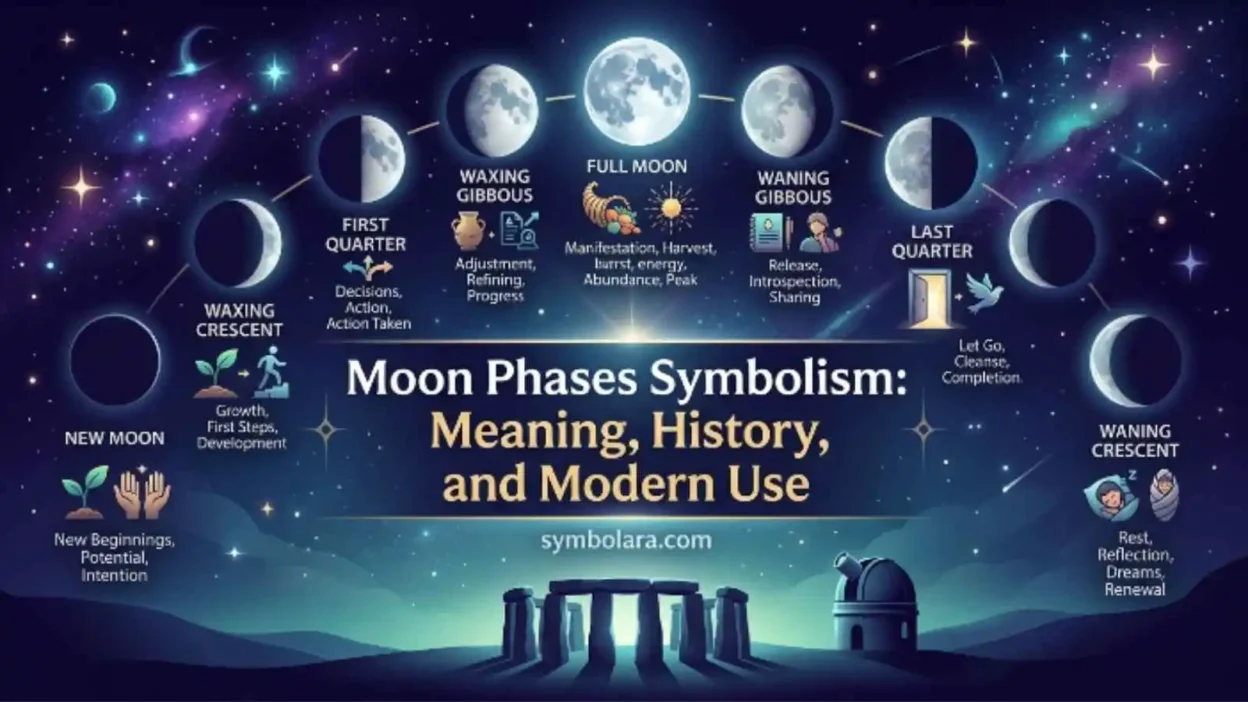
The moon has long been one of the most recognizable symbols in the night sky. Unlike many celestial objects, it visibly changes shape throughout the month, creating a natural cycle that people can observe without special tools. Because of these changing appearances, Moon Phases Symbolism has become closely connected with ideas about growth, transformation, endings, and new beginnings.
People encounter moon phase imagery everywhere today—from jewelry and tattoos to wellness products, home décor, social media graphics, and spiritual practices. While modern interpretations often focus on personal growth, the symbolism of the moon’s phases has roots that stretch back thousands of years.
Understanding what the moon phases symbolize requires looking at history, religion, folklore, psychology, and contemporary culture. The meaning has evolved over time, but the basic idea remains remarkably consistent: life moves in cycles, and change is a natural part of existence.
Quick Answer
Moon phases commonly symbolize life cycles, personal growth, change, and renewal in modern American culture. Historically, they were also associated with timekeeping, agricultural rhythms, feminine symbolism, spiritual beliefs, and the natural progression from beginnings to endings.
TL;DR
- Symbolize change, growth, and transformation.
- Reflect natural cycles and recurring patterns.
- Historically linked to farming and calendars.
- Often represent feminine energy and intuition.
- Popular in tattoos, jewelry, and décor.
- Modern meanings emphasize self-development.
What Are the Moon Phases?
Moon phases are the changing appearances of the moon as viewed from Earth during its approximately 29.5-day cycle.
The major phases include:
- New Moon
- Waxing Crescent
- First Quarter
- Waxing Gibbous
- Full Moon
- Waning Gibbous
- Last Quarter
- Waning Crescent
Because the moon appears to grow, reach fullness, and then diminish before beginning again, people have naturally connected these changes with human experiences. The moon became a visual reminder that nothing remains static forever.
This recurring cycle is the foundation of nearly all moon phase symbolism.
The Core Meaning of Moon Phases
Today, the most common symbolic meaning of moon phases is transformation through cycles.
Rather than representing a single emotion or idea, the moon’s phases symbolize a process:
- Beginnings
- Development
- Achievement
- Reflection
- Release
- Renewal
Many people view the lunar cycle as a metaphor for life itself. Projects begin, relationships evolve, careers change, and personal identities grow over time.
Unlike symbols that suggest permanence, moon phases remind people that change is expected and often necessary.
Ancient Roots and Early Symbolism
Long before modern calendars existed, communities watched the moon to measure time.
Ancient societies noticed predictable lunar patterns and used them to organize hunting, planting, religious ceremonies, and seasonal activities. Because the moon reliably returned to each phase, it became associated with order and predictability within a changing world.
Many early civilizations viewed the moon as a bridge between earthly life and the heavens. Its regular cycle suggested that nature followed rules and rhythms larger than any individual person.
This connection between the moon and cyclical time remains one of its strongest symbolic meanings today.
Moon Phase Symbolism in Different Cultures Around the World
Moon phase symbolism developed differently across cultures, but many societies connected the moon with time, nature, and human experiences.
In ancient Mesopotamia, lunar cycles helped people organize calendars and religious events. The moon’s predictable pattern made it a symbol of order and cosmic rhythm. In ancient Greece and Rome, lunar symbolism became connected with deities associated with the moon, nature, and fertility.
Many Indigenous cultures in North America also used lunar cycles to track seasons, hunting periods, and important community events. Different nations developed their own moon names and meanings based on local environments and traditions.
In parts of East Asia, the moon often became associated with harmony, reflection, family connections, and seasonal celebrations. The Mid-Autumn Festival, for example, highlights the moon as a symbol of reunion and togetherness.
Although interpretations differ, a common theme appears across many cultures: the moon represents recurring patterns, observation, and humanity’s connection with the natural world.
Why Cycles Matter in Moon Symbolism
The symbolic power of moon phases comes largely from repetition.
Most people experience recurring patterns in life:
- Childhood, adulthood, and aging
- Successes and setbacks
- Beginnings and endings
- Emotional highs and lows
- Seasonal changes
The moon offers a visible representation of these recurring experiences.
Unlike a straight-line journey, moon symbolism suggests that progress often happens in loops and stages. An ending may also be a beginning. A period of rest may be necessary before growth resumes.
This cyclical view is one reason moon phase imagery remains appealing across cultures and generations.
Symbolism of Each Major Moon Phase
Each phase has developed its own symbolic associations.
| Moon Phase | Common Symbolic Meaning | Common Associations | Notes |
| New Moon | Beginnings | Goals, fresh starts | Blank slate symbolism |
| Waxing Crescent | Hope | Planning, intention | Early growth |
| First Quarter | Action | Decisions, effort | Moving forward |
| Waxing Gibbous | Refinement | Preparation, focus | Near completion |
| Full Moon | Completion | Clarity, celebration | Peak achievement |
| Waning Gibbous | Gratitude | Reflection, sharing | Learning from experience |
| Last Quarter | Release | Letting go | Reassessment |
| Waning Crescent | Rest | Healing, renewal | Preparing for a new cycle |
These interpretations are especially popular in modern spiritual and self-development communities.
What Does a Crescent Moon Symbolize?
The crescent moon is one of the most recognizable lunar symbols and often represents growth, transition, and possibility.
A waxing crescent moon, which appears after the New Moon, is commonly associated with progress, hope, and new opportunities. Because the visible light increases each night, many people interpret it as a symbol of gradual development.
A waning crescent moon is often connected with rest, reflection, and completing a cycle before a new beginning.
Across history, the crescent moon has appeared in art, architecture, religious imagery, and national symbols. Its meaning varies depending on the culture and context, but it often reflects the idea of movement between different stages of life.
Moon Phases and Feminine Symbolism
Many traditions have connected the moon with femininity.
Part of this association comes from the rough similarity between the lunar cycle and the average menstrual cycle. Across various cultures, this connection led people to associate the moon with fertility, motherhood, nurturing, and creation.
Modern interpretations often expand this symbolism to include:
- Intuition
- Emotional awareness
- Creativity
- Adaptability
However, contemporary views increasingly recognize that moon symbolism can apply to anyone, regardless of gender. The moon’s cycles are now more commonly understood as representing universal human experiences.
Religious and Spiritual Interpretations
The moon has appeared in religious traditions around the world.
In some belief systems, lunar cycles help determine sacred dates and religious observances. In others, the moon symbolizes divine order, reflection, or spiritual illumination.
Modern spiritual communities often use moon phases as opportunities for:
- Setting intentions
- Reflection
- Meditation
- Personal evaluation
- Goal tracking
While these practices vary widely, they generally focus on aligning personal activities with the symbolism of each phase rather than claiming supernatural influence.
Moon Phases in American Culture
In the United States, moon phase symbolism has become increasingly visible during the twenty-first century.
Americans often encounter moon phase imagery in:
- Wellness brands
- Astrology content
- Fashion
- Social media
- Home decoration
- Personal journals
- Meditation practices
For many people, the moon represents mindfulness rather than religion. Tracking lunar phases can serve as a reminder to pause, evaluate goals, and recognize personal growth.
The symbolism is often less about predicting events and more about creating meaningful rituals around change and self-reflection.
Emotional and Psychological Meaning
Psychologically, moon phases symbolize acceptance of change.
Many people find comfort in the idea that difficult periods are temporary. Just as the moon does not remain dark forever, emotional challenges eventually shift.
The symbolism can communicate:
- Patience during uncertainty
- Hope during transitions
- Confidence in growth
- Acceptance of endings
- Trust in renewal
This emotional dimension explains why moon imagery often appears during major life transitions such as graduation, parenthood, career changes, or recovery from hardship.
Why Moon Phases Are Popular in Tattoos
Moon phase tattoos have become one of the most recognizable symbolic tattoo designs.
People choose them for several reasons:
- To represent personal transformation
- To honor life milestones
- To symbolize resilience
- To mark recovery or healing
- To celebrate personal growth
Unlike symbols tied to a specific event, moon phases can represent an ongoing journey. A tattoo showing the entire lunar cycle often communicates that life consists of many stages rather than a single destination.
The design is also visually appealing because it combines simplicity with layered meaning.
Moon Phases in Jewelry and Fashion
Moon phase jewelry is widely worn for both aesthetic and symbolic reasons.
Necklaces, bracelets, rings, and earrings featuring lunar imagery often symbolize:
- Personal evolution
- Independence
- Connection to nature
- Spiritual curiosity
- Individual identity
Fashion designers frequently use moon motifs because they are recognizable without being tied to a single belief system.
A person may wear moon phase jewelry simply because they appreciate its appearance, while another may view it as a meaningful reminder of life’s ongoing changes.
Home Décor and Interior Design Symbolism
Moon phase artwork has become a popular feature in American homes.
Decorative moon phase displays often communicate:
- Calmness
- Balance
- Natural rhythms
- Reflection
- Connection to the outdoors
Bedrooms, meditation spaces, and reading areas frequently incorporate lunar imagery because the moon is associated with quiet observation and nighttime contemplation.
The symbolism aligns well with contemporary design trends that emphasize wellness and intentional living.
What Do Moon Phase Symbols Mean in Art and Design?
Moon phase symbols have become popular visual elements in modern art and design because they communicate ideas without needing words.
Artists often use lunar cycles to represent:
- Personal transformation
- The passage of time
- Balance between light and darkness
- Emotional change
- Connection with nature
A complete moon phase design showing the moon moving from new to full and back again often represents a journey. It can suggest progress, reflection, and the understanding that every stage has value.
In graphic design, moon phases appear in posters, logos, book covers, and digital artwork because the symbol feels both ancient and modern. Its simple shapes make it recognizable while allowing different viewers to attach their own meaning.
For many Americans today, moon phase artwork is less about a specific belief system and more about expressing ideas of growth, balance, and natural cycles.
Moon Phases in Digital Culture and Social Media
Social media has expanded the visibility of moon symbolism.
Moon phase graphics appear in:
- Vision boards
- Wellness content
- Astrology communities
- Digital planners
- Motivational posts
Many creators use lunar imagery as a visual shorthand for growth, transformation, and self-improvement.
Even among people who do not follow astrology or spiritual practices, moon phase visuals often function as motivational symbols. They provide a recognizable way to discuss progress and personal development.
Common Misunderstandings About Moon Symbolism
One common misconception is that all moon symbolism originates from a single tradition.
In reality, meanings developed independently across many cultures over long periods. Different societies emphasized different aspects of the moon, including timekeeping, fertility, divinity, navigation, and seasonal change.
Another misunderstanding is that moon phase symbolism always involves supernatural beliefs. Many people appreciate lunar symbolism purely as a metaphor for life’s cycles without attaching religious or mystical significance.
The symbol’s flexibility helps explain its broad appeal.
How the Meaning Has Evolved Over Time
The symbolism of moon phases has changed significantly over the centuries.
In ancient societies, practical concerns often dominated. People relied on lunar cycles for agriculture, navigation, and calendars.
Later, religious and mythological interpretations became more prominent. The moon appeared in stories about gods, goddesses, creation, and cosmic order.
Today, many Americans interpret moon phases through a personal lens. Rather than focusing on farming or mythology, they use the symbol to think about growth, goals, healing, and self-awareness.
Although the context has changed, the central theme remains remarkably similar: life unfolds through recurring stages.
Positive and Negative Symbolic Interpretations
Moon phases are generally viewed positively, but interpretations can vary.
Positive meanings include:
- Renewal
- Growth
- Wisdom
- Adaptability
- Hope
- Resilience
More challenging interpretations can include:
- Uncertainty
- Emotional fluctuation
- Impermanence
- Letting go of the past
These less comfortable associations are not necessarily negative. Instead, they reflect the reality that change often involves both opportunity and loss.
The moon’s symbolism acknowledges both sides of transformation.
Moon Phase Symbolism in Astrology and Modern Spiritual Practices
Moon phases play an important role in modern astrology and spiritual communities, where people often connect each phase with different personal themes.
In astrology-based practices, the New Moon is commonly associated with setting intentions and beginning new projects. The Full Moon is often viewed as a time for reflection, completion, and evaluating progress.
Many people use moon phase calendars, journals, or personal rituals as tools for mindfulness. These practices are usually symbolic rather than scientific predictions. They provide a structured way for individuals to pause, think about goals, and reflect on changes in their lives.
The popularity of lunar practices in the United States shows how ancient symbols can take on new meanings. Today, moon phases often function as personal reminders to slow down, observe patterns, and create moments of self-reflection.
FAQs
What do moon phases symbolize spiritually?
Spiritually, moon phases often symbolize personal evolution, reflection, and alignment with natural cycles. Different traditions interpret them differently, but many use the lunar cycle as a framework for growth and self-examination.
What does a full moon symbolize?
A full moon commonly symbolizes completion, clarity, achievement, and heightened awareness. It is often viewed as the stage where efforts and intentions reach their most visible results.
Are moon phase tattoos considered spiritual?
They can be, but they do not have to be. Some people choose them for spiritual reasons, while others view them as symbols of resilience, life transitions, or personal growth.
Why are moon phases associated with femininity?
Historically, many cultures connected the lunar cycle with fertility and the menstrual cycle. Modern interpretations often broaden this symbolism to include intuition, creativity, and adaptability rather than limiting it to gender-specific meanings.
Do moon phases have different meanings in different cultures?
Yes. While many cultures associate the moon with cycles and change, specific meanings vary widely. Some traditions emphasize agriculture, others focus on religious observances, mythology, or concepts of balance and renewal.
What do moon phases symbolize in modern American culture?
In the United States, moon phases most commonly symbolize self-improvement, mindfulness, life transitions, and personal growth. They frequently appear in wellness, fashion, décor, and digital culture.
Is moon phase symbolism positive or negative?
It is generally positive, though it acknowledges challenges. The symbolism recognizes that growth often involves endings, uncertainty, and change before renewal can occur.
What does the moon cycle symbolize in literature?
In literature, the moon cycle often represents change, time passing, emotional shifts, and the repeating patterns of life. Writers use lunar imagery to show transformation and personal journeys.
Conclusion
The enduring appeal of moon phases comes from their ability to make abstract experiences visible. Everyone encounters beginnings, endings, growth, setbacks, and renewal, and the lunar cycle provides a familiar image for those experiences.
Over time, societies have connected the moon with calendars, agriculture, religion, mythology, femininity, and personal transformation. While specific interpretations differ, the central message remains consistent: change is natural, recurring, and often necessary.
Today, Moon Phases Symbolism continues to resonate because it reflects a reality people recognize in their own lives. The moon reminds us that every stage has its place, and that endings and beginnings are often part of the same cycle.