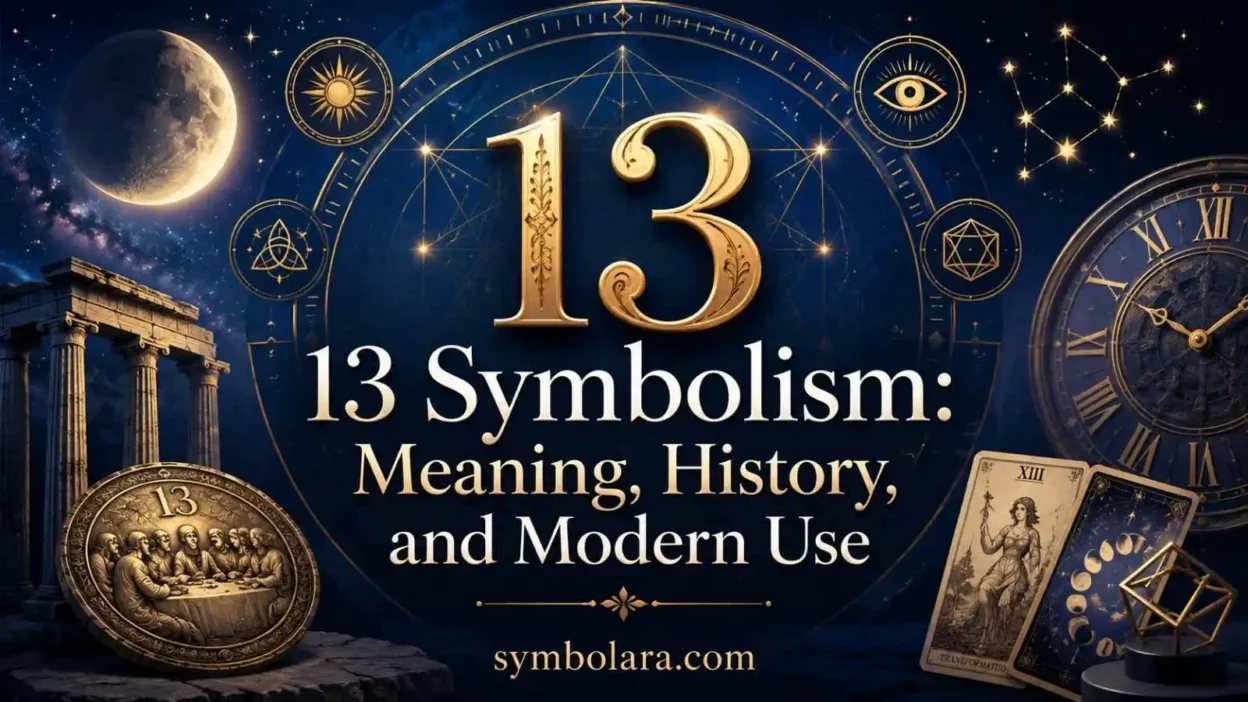
13 Symbolism is unusual because it carries two opposite meanings in American culture. For many people, the number immediately suggests bad luck, Friday the 13th, haunted imagery, skipped hotel floors, and the uneasy feeling that something is slightly out of order. For others, it represents American beginnings, rebellion against superstition, personal transformation, or even good luck.
That contrast is what makes the number worth understanding. It is not just an “unlucky number.” It is a symbol shaped by religion, folklore, architecture, pop culture, national history, and the way people turn old fears into personal meaning.
In the United States today, the number 13 appears in patriotic symbols, tattoos, horror movies, sports jerseys, brand imagery, social media captions, and everyday superstitions. Its meaning depends heavily on context.
Quick Answer
13 Symbolism commonly represents bad luck, disruption, and superstition in modern American culture, especially through Friday the 13th and the fear known as triskaidekaphobia. Historically, it has also been tied to the original 13 colonies, religious stories, folklore about disorder after completion, and modern ideas of transformation or defying fear.
TL;DR
- 13 often symbolizes bad luck in U.S. culture.
- It also represents America’s 13 original colonies.
- Friday the 13th made the fear more famous.
- Tattoos often use 13 as rebellion or survival.
- Some cultures treat 13 as lucky or sacred.
- Its modern meaning is becoming more flexible.
What the Number Looks Like and Where People Encounter It
As a symbol, 13 is visually simple: the digit 1 followed by the digit 3, or the Roman numeral XIII. That plain appearance is part of its effectiveness. It does not need a complicated image to carry meaning. A room number, floor label, calendar date, tattoo, jersey, or license plate can become symbolic simply because it contains 13.
Americans often encounter it in ordinary places: apartment buildings, hotel elevators, Friday the 13th jokes, horror films, sports uniforms, birth dates, school numbers, and online handles. The number can feel ominous in one setting and completely personal in another.
In design, XIII can look more formal or dramatic than “13,” which is why it appears in tattoos, logos, and gothic-inspired graphics. The Arabic numeral feels modern and direct; the Roman numeral feels older, ceremonial, or cinematic.
What It Commonly Means in the United States
In the United States, 13 most commonly symbolizes bad luck, but that is only the first layer. The number can also stand for independence, original American unity, risk, humor, transformation, and refusal to be controlled by superstition.
| Context | Meaning in the USA | Common Associations | Notes |
| Friday the 13th | Bad luck or eerie timing | Horror, jokes, caution | The best-known modern use |
| U.S. flag and founding symbols | Original colonies and unity | Independence, revolution | A positive national meaning |
| Tattoos | Rebellion, survival, luck reversal | Flash tattoos, personal milestones | Meaning depends on wearer |
| Buildings and hotels | Avoidance of superstition | Missing 13th floors, room numbers | Often practical, not mystical |
| Pop culture | Fear made entertaining | Horror films, memes, costumes | Usually playful or dramatic |
| Personal numerology | Change or transformation | Endings, renewal, reinvention | More common in spiritual circles |
This split meaning is why 13 feels more complicated than many other numbers. It can signal anxiety or confidence, depending on who uses it.
Why 13 Became Associated With Bad Luck
The unlucky reputation of 13 developed gradually in Western culture. One common explanation connects it to Christian tradition, especially the Last Supper, where Jesus dined with his twelve apostles before his arrest and crucifixion. Later superstition attached danger to having 13 people seated at a table, though the exact historical development is more complex than the simplified story many people repeat.
Another explanation is structural. In many traditions, 12 represents order: 12 months in a year, 12 zodiac signs, 12 hours on a clock face, 12 apostles, 12 tribes of Israel. Thirteen comes just after that neat sense of completion, so it can feel like an extra, unstable number that breaks the pattern.
This does not mean the number itself is unlucky. Symbols work because people assign meaning to them, repeat that meaning, and build habits around it. Over time, 13 became a cultural shorthand for something out of balance.
The Role of Friday the 13th
Friday the 13th is the strongest reason Americans connect 13 with bad luck today. The date combines two older anxieties: the suspicion around the number 13 and the separate idea that Friday could be unlucky in some Christian and European traditions. The phrase gained wider cultural force through literature, journalism, and later horror entertainment.
In everyday American life, Friday the 13th is usually more playful than frightening. People post jokes, horror fans rewatch scary movies, tattoo shops may run themed flash events, and brands sometimes use the date for spooky promotions.
Still, some people take it seriously. The fear of the number 13 is called triskaidekaphobia, while fear of Friday the 13th has been described with longer terms such as paraskevidekatriaphobia. For most Americans, though, the date works as a shared cultural mood: unlucky enough to joke about, familiar enough to market.
The Complete Number 12 and the Disruptive Number 13
One of the clearest ways to understand 13 is to compare it with 12. Twelve often suggests order, cycles, and completion. It fits naturally into calendars, clocks, dozens, religious systems, and traditional patterns of measurement.
Thirteen interrupts that tidy structure. It is one more than expected. That is why it can symbolize disorder, excess, or a step into unknown territory. The symbolism does not come from mathematics alone; it comes from the way cultures emotionally respond to patterns.
This is also why 13 can be positive. If 12 is the completed circle, 13 can be the first step beyond it. For some people, that means risk. For others, it means growth, rebellion, or a break from an old system.
The Patriotic Side: Thirteen Colonies and American Identity
In the United States, 13 has a major positive meaning because it represents the original 13 colonies. The American flag has 13 stripes to honor those colonies, while the 50 stars represent the current states. That makes 13 part of the country’s visual identity, especially in classrooms, civic ceremonies, Independence Day imagery, and historical education.
The Great Seal of the United States also uses the number 13 repeatedly, including in stripes, stars, arrows, and other symbolic groupings connected to the original states. In that setting, 13 does not mean bad luck at all. It means union, founding, and political independence.
This patriotic meaning matters because it shows how symbols change by context. The same number that feels unlucky in an elevator can feel honorable on a flag.
Why Does the Number 13 Appear on the Great Seal and $1 Bill?
The repeated number 13 on the Great Seal of the United States represents the states that formed the original American union. It has a historical and patriotic meaning rather than an unlucky one.
Several parts of the seal use groups of 13:
- 13 stars appear above the eagle.
- 13 stripes appear on the shield.
- 13 arrows sit in the eagle’s left talon.
- The reverse includes an unfinished pyramid with 13 levels.
Official U.S. sources explain that these groups refer to the original 13 states. The constellation of stars represents the new nation joining other sovereign nations, while the arrows and olive branch express the powers of war and peace.
The Great Seal was officially adopted by the Continental Congress on June 20, 1782. Its reverse later became familiar to millions of Americans because it appears on the back of the U.S. $1 bill.
This is one of the clearest examples of 13 carrying a strongly positive meaning in American symbolism.
Religion, Myth, and Folklore Connected to 13
Christian storytelling has had a strong influence on the Western fear of 13. The Last Supper association became one of the most repeated explanations for why 13 at a table was considered unlucky. Over time, the number became linked with betrayal, death, and the anxiety of being the “extra” person in a sacred or social group.
Norse mythology is also often mentioned in popular explanations. A common modern version says Loki arrived as an uninvited thirteenth guest at a divine feast, leading to the death of Balder. However, scholars and careful summaries often note that this exact “thirteenth guest” framing is not as firmly rooted in the earliest Norse sources as popular retellings suggest.
Folklore often works this way. A story may become symbolically influential even when its historical details are debated. What matters culturally is that people used these stories to explain why 13 felt disruptive.
What Does the Number 13 Mean in the Bible and Jewish Tradition?
The Bible does not give the number 13 one universal meaning such as evil, bad luck, or a curse. Some later interpretations connect it with rebellion because Genesis 14:4 says several kings served Chedorlaomer for 12 years and rebelled in the thirteenth year. However, the verse describes a historical event within the story; it does not state that every appearance of 13 symbolizes rebellion.
Christian associations between 13 and misfortune developed more strongly through later tradition, especially stories surrounding Jesus, the twelve apostles, and the Last Supper. Those cultural associations helped shape Western superstition but should not be treated as a direct biblical rule.
Jewish tradition provides a very different association. Traditionally, a Jewish boy becomes responsible for observing the commandments at age 13, the age connected with becoming bar mitzvah. Traditional practice usually places a girl’s religious majority at 12, although some Jewish communities observe age 13 for both.
This history shows why calling 13 a purely “biblical bad-luck number” oversimplifies its religious meaning.
Cross-Cultural Meanings Beyond American Superstition
The number 13 is not negative everywhere. In some cultural settings, it has been treated as lucky, sacred, or cosmologically important. Maya cosmology, for example, included 13 heavens arranged above the earth, giving the number a role in a structured view of the universe.
In some places, other numbers carry the fear that Americans often attach to 13. Italy has stronger unlucky associations with 17 in certain contexts, and some East Asian cultures treat 4 with caution because of sound associations with death. This reminds us that number symbolism is cultural, not universal.
For American readers, this is an important distinction. The number 13 may feel naturally unlucky because the association is so familiar, but that feeling was learned through stories, customs, media, and repeated social cues.
Emotional and Psychological Meaning
Emotionally, 13 often symbolizes uncertainty. It sits between order and change, which makes it useful for expressing anxiety, rebellion, or transition. A person may use 13 to suggest that they are not afraid of bad luck, or that they have survived difficult circumstances.
Psychologically, the number also shows how humans look for patterns. Once a culture labels something unlucky, people remember negative events connected to it and ignore all the ordinary moments when nothing happens. That pattern reinforces the superstition.
For people who embrace the number, 13 can feel empowering. Wearing it, tattooing it, or calling it lucky becomes a way of saying, “I decide what this means.”
Modern Use in Tattoos, Jewelry, and Personal Style
In tattoo culture, 13 often means more than bad luck. It can represent rebellion, risk, survival, transformation, or a personal milestone. Some people choose it because they were born on the 13th, overcame a difficult period, or want to turn a feared number into a protective mark.
Friday the 13th tattoo events have also made the number more playful. Many tattoo shops offer small flash designs on that date, turning superstition into a ritual of style and humor. Common designs include the number 13 with black cats, horseshoes, skulls, dice, daggers, moons, or old-school lettering.
Jewelry and fashion use the number in a similar way. A small XIII pendant or ring can suggest edge without being too literal. It can also function as a private symbol for someone who connects it to family, timing, identity, or resilience.
Design, Architecture, and Everyday Avoidance
One of the clearest signs of 13’s influence is the missing 13th floor. Many hotels, apartment towers, and office buildings skip from 12 to 14 on elevator panels, even though the physical floor still exists. This practice reflects customer expectations more than engineering logic.
The same avoidance appears in room numbers, event planning, airline seating patterns, and table arrangements. A hotel may avoid Room 13 not because management believes in the superstition, but because some guests might feel uncomfortable booking it.
This makes 13 a rare symbol that affects practical decisions. It shapes labels, floor plans, marketing choices, and the small design details people barely notice until they look closely.
Pop Culture, Sports, and Lucky Reversals
American pop culture has strengthened the eerie side of 13, especially through horror films and Halloween-adjacent imagery. The Friday the 13th franchise turned the date into a recognizable entertainment brand, making the number feel cinematic, suspenseful, and slightly campy.
Sports often reverse the meaning. Athletes who wear 13 can make it look confident rather than unlucky. Dan Marino, one of the most famous NFL quarterbacks to wear the number, helped show that 13 can be associated with skill and success rather than misfortune.
Taylor Swift is another modern example. She has long treated 13 as a personal lucky number, connecting it to her birthday and career milestones. For fans, that helped make the number feel less cursed and more like a signature of identity, timing, and belonging.
The Number 13 and Transformation
In spiritual and symbolic systems, 13 is often connected to endings and new beginnings. This meaning is especially visible in tarot, where the Death card is traditionally numbered XIII in many decks. In modern tarot interpretation, that card is commonly read as transformation, closure, release, and transition rather than literal death.
This association makes sense beyond tarot. Thirteen follows a completed cycle of 12, so it can symbolize the moment after an ending, when a new pattern has not fully formed yet. That can feel uncomfortable, but it can also feel freeing.
For this reason, people sometimes use 13 to mark recovery, reinvention, sobriety, grief, divorce, career change, or any life stage where one identity ends and another begins.
What Does the Number 13 Mean Spiritually and in Numerology?
Spiritually, the number 13 is often interpreted as a symbol of change, rebuilding, personal growth, and creating a stronger foundation. These meanings come mainly from modern numerology and spiritual traditions rather than from one universal religious teaching.
In numerology, 13 is commonly reduced to the number 4 because 1 + 3 = 4. Numerology traditions often associate 4 with stability, structure, discipline, and practical effort. Some interpretations also connect 1 with beginnings and independence and 3 with creativity and expression. Together, these ideas can make 13 a symbol of changing your life while building something more stable.
Some spiritual communities also call 13 an angel number. In that belief system, repeatedly seeing 13 may be viewed as a reminder to reconsider old habits, accept change, or work toward a stronger future. These interpretations are personal beliefs rather than predictions or proven supernatural messages.
For many people, that is part of 13’s appeal: a number once feared as unlucky becomes a symbol of taking control of change.
Common Misunderstandings and Misuse
The most common misunderstanding is that 13 has one fixed meaning. It does not. It can be unlucky, patriotic, lucky, rebellious, spiritual, humorous, or deeply personal depending on the setting.
Another mistake is treating all historical explanations as equally proven. Some stories about 13 are old; others are later interpretations that became popular because they were easy to repeat. The Knights Templar story, for example, is often linked to Friday the 13th in modern pop culture, but that connection became much more prominent in recent retellings than in medieval belief itself.
The number can also be misused when people exaggerate its meaning into fear-based claims. Symbolism is not evidence that a date, person, room, or event is doomed. At its best, the number helps people talk about fear, chance, change, and identity.
How the Meaning Is Changing Today
The modern meaning of 13 is becoming less fearful and more flexible. Many Americans still recognize the bad-luck association, but fewer treat it as a rule. The number now appears just as often in memes, tattoos, fan culture, personal branding, and playful horror aesthetics.
Younger audiences often use it ironically or intentionally. Choosing 13 can be a way to reject superstition, claim outsider identity, or turn an old warning sign into a style choice.
That evolution is typical of symbols. Meanings do not disappear all at once. They loosen, overlap, and get reused. Today, 13 can still make people pause, but it can also make them smile.
FAQs
What does the number 13 symbolize?
The number 13 most often symbolizes bad luck, disruption, or superstition in American culture. It can also represent transformation, rebellion, personal survival, or the original 13 colonies, depending on the context.
Is 13 always a bad luck number?
No. While 13 is widely associated with bad luck in the United States, it also has positive meanings. In American patriotic symbolism, it represents the 13 original colonies, and in personal use it may stand for luck, identity, or overcoming fear.
What does a 13 tattoo mean?
A 13 tattoo can mean rebellion, survival, transformation, or a personal connection to the number. Some people choose it to reverse bad luck, while others connect it to a birthday, milestone, Friday the 13th tattoo tradition, or a major life change.
Why do buildings skip the 13th floor?
Many buildings skip the 13th floor label because of superstition and customer comfort. The floor still physically exists, but it may be labeled 14, 12A, M, or something else to avoid negative reactions from tenants or guests.
What does 13 mean in American history?
In American history, 13 represents the original colonies that declared independence from Great Britain. That meaning appears in the 13 stripes of the U.S. flag and in repeated groupings on the Great Seal.
Why is Friday the 13th considered unlucky?
Friday the 13th combines the unlucky reputation of 13 with older negative associations around Friday in some Western traditions. Modern books, newspapers, movies, and jokes helped turn the date into one of America’s best-known superstitions.
Can 13 symbolize transformation?
Yes. Because 13 comes after 12, a number often associated with completion, it can symbolize the step beyond a finished cycle. In modern spiritual and tattoo meanings, it often points to change, endings, renewal, and personal reinvention.
Is 13 considered positive in Judaism?
Thirteen can have a positive coming-of-age association in Jewish tradition. A Jewish boy traditionally becomes responsible for observing the commandments at age 13, which is the age connected with becoming bar mitzvah.
Conclusion
The number 13 has lasted as a symbol because it holds tension. It can suggest fear, disorder, and bad luck, but it can also represent independence, courage, transformation, and national origin. Americans understand it through elevators and horror movies, but also through the flag, the Great Seal, tattoos, sports, and personal stories.
13 Symbolism is not about one fixed meaning. It is about how a simple number became a meeting point for superstition, history, humor, identity, and change.
That is why 13 still matters: it shows how people inherit meanings, question them, and sometimes turn them into something of their own.