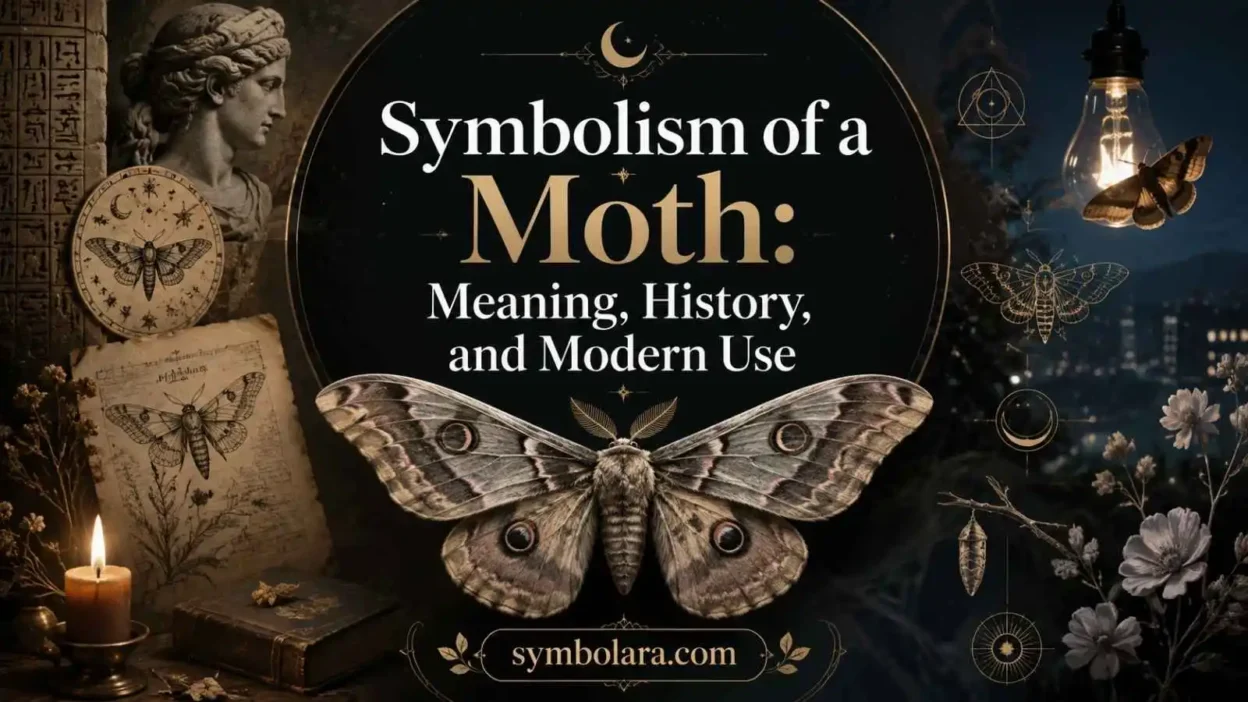
Moths often appear in quiet moments: near a porch light, against a window screen, inside an old closet, or in a tattoo filled with moons, flowers, and shadows. The symbolism of a moth centers on transformation, intuition, vulnerability, longing, and the strange pull of light in darkness.
Unlike butterflies, moths do not usually suggest bright, public renewal. They carry a more private mood. Their nighttime movement, fragile bodies, and attraction to lamps give them a meaning that feels emotional, reflective, and sometimes uneasy.
In modern American culture, people use moth imagery to express survival, grief, personal change, spiritual curiosity, and the desire to follow something bright even when it may come with risk. That layered meaning makes the moth one of the most expressive symbols in nature-inspired art and design.
Quick Answer
The symbolism of a moth commonly points to transformation, intuition, vulnerability, and attraction to light in modern American culture. Historically, people have also linked moths with souls, death omens, secrecy, longing, and the thin boundary between life and loss.
TL;DR
- Moths symbolize quiet transformation and inner change.
- Their pull toward light suggests longing and risk.
- Folklore links moths with souls and death.
- Americans use moths in tattoos, art, and decor.
- Moth meaning feels darker than butterfly symbolism.
- Context changes whether moths feel comforting or ominous.
What a Moth Represents at First Glance
A moth is a winged insect closely related to the butterfly, but culture gives it a different emotional tone. Many moths fly at night, rest with muted wings, and move toward light sources. Some look plain and dusty, while others show dramatic markings, soft colors, or eye-like patterns.
People encounter moths in familiar places. They gather around porch lights, flutter near lamps, appear in gardens, hide in closets, or rest on walls during warm evenings. These everyday encounters shape the way people read them as symbols.
Because moths belong so strongly to dusk and night, they suggest the hidden side of life. They bring to mind private thoughts, old memories, emotional sensitivity, and changes that happen quietly rather than in public view.
A butterfly often feels sunny and celebratory. A moth feels more introspective. It speaks to the part of human life that grows in darkness before anyone notices it.
What Moths Commonly Symbolize in the United States
In the United States today, moths most often symbolize transformation, attraction, intuition, and emotional vulnerability. These meanings appear in tattoos, jewelry, home decor, gothic art, personal essays, and social media imagery.
Transformation comes from the moth’s life cycle. Like butterflies, moths begin as caterpillars, enter a cocoon or pupal stage, and emerge with wings. This natural change gives the moth a clear connection to growth, transition, and personal reinvention.
Attraction comes from the moth’s movement toward light. Americans commonly use the phrase “like a moth to a flame” to describe a person drawn toward something irresistible but potentially harmful. That image can apply to love, ambition, addiction, curiosity, or dangerous desire.
Intuition comes from the moth’s nighttime world. Since it moves through dimness, people often see it as a symbol of inner guidance. The moth suggests that not every path appears clearly at first.
Vulnerability also shapes its meaning. A moth looks delicate, and even a light touch can damage its wings. That fragility makes it a fitting symbol for sensitivity, grief, tenderness, and emotional exposure.
Why Light Gives the Moth Its Strongest Meaning
The image of a moth circling a lamp or flying toward a flame carries one of the clearest symbolic messages. It shows attraction, longing, and risk in a single scene.
People often recognize themselves in that image. A person may chase a relationship, dream, habit, or goal that feels bright and necessary, even when it causes pain. The moth gives that experience a visual form.
The phrase “moth to a flame” usually includes a warning. It does not simply describe desire. It describes desire that can overwhelm judgment. In that sense, the moth represents the moment when instinct becomes stronger than caution.
Modern life gives this symbol even more relevance. Artificial light can confuse night-flying insects, pulling them away from natural movement. As a symbol, the moth can suggest how easily people lose direction when something artificial looks like guidance.
This meaning does not make the moth foolish. Instead, it makes the moth tragic, tender, and recognizable. It follows what looks like light, even when that light may not lead anywhere safe.
Transformation Without the Brightness of a Butterfly
Moths and butterflies both transform, but they do not carry the same emotional meaning. The butterfly usually suggests visible change, beauty, freedom, and renewal in daylight. The moth suggests change that happens privately, slowly, or after hardship.
This difference matters because not every transformation feels joyful. Some changes come through grief, loss, illness, burnout, heartbreak, or loneliness. A person may become stronger without feeling radiant.
The moth fits that kind of story. It represents growth that does not need applause. It can symbolize a person who has changed internally before the world sees any outward difference.
For many Americans, moth imagery feels more honest than butterfly imagery. A butterfly can seem too polished for certain experiences. A moth allows room for darkness, confusion, and survival.
That is why moth tattoos, drawings, and jewelry often appeal to people who want a symbol of resilience rather than simple beauty. The moth says transformation can happen in shadow.
Night, Secrecy, and the Hidden Self
Moths live in the imagination of night. Because many species fly after sunset, people connect them with secrecy, dreams, memory, and unseen emotional life.
Night does not always mean danger. It can also mean privacy, reflection, protection, and mystery. A moth moving through darkness can suggest the parts of the self that people do not show easily.
This makes the moth a strong symbol for introspection. It may point to feelings someone has ignored, truths they have avoided, or instincts they have not yet trusted. When a moth appears in art or dreams, many people read it as a sign to pay attention to what has been hidden.
American design trends often place moths beside moons, candles, mushrooms, skulls, pressed flowers, antique keys, or old books. These pairings strengthen the mood of memory, shadow, and private discovery.
The moth does not ask people to fear darkness. It suggests that darkness can hold information, beauty, and change.
Moth Dream Meaning and Common Dream Scenarios
Dreaming about a moth often symbolizes quiet change, persistent desire, or something pulling at your attention during an uncertain period. Dream meanings are personal rather than predictive, so the details of the dream matter more than any fixed “dictionary” meaning.
Common moth dream scenarios include:
- A moth circling a light: Attraction to a person, goal, habit, or idea that may deserve a closer look.
- A moth trapped at a window: Wanting change while feeling blocked by a boundary, fear, or old pattern.
- A moth resting on your hand or body: Vulnerability, trust, or a new part of yourself becoming easier to accept.
- Many moths at once: Several worries, memories, or unfinished emotions competing for attention.
- A dead moth: The end of a fixation, identity, or chapter that once had a strong emotional pull.
The emotional tone is important. A calm dream may point toward acceptance or curiosity, while a frightening dream may reflect anxiety about change, loss, or losing control. The moth works best as a prompt for reflection, not a prediction of what will happen next.
Folklore, Death, and the Soul
Many cultures have linked moths with death, souls, and omens. This connection grew from the moth’s nighttime habits, silent movement, and sudden appearances inside homes.
In parts of European folklore, people sometimes saw a moth entering the house as a sign from the dead or a warning of loss. Some households treated a pale moth as a soul visiting the living. Others viewed dark moths with fear because they arrived at night and seemed to belong to an unseen world.
American culture inherited some of these ideas through immigrant traditions, literature, ghost stories, and gothic art. Today, a person might notice a moth after a loved one dies and take comfort from it. Someone else might feel uneasy because moths remind them of old omens or horror imagery.
Death symbolism does not always point to literal death. Moths can represent endings, mourning, memory, and transition. They can also symbolize the fragile nature of life.
This layered meaning explains why the moth works so well in memorial tattoos and grief-related art. It can honor loss without using obvious mourning symbols.
Biblical Meaning of Moths
In the Bible, moth symbolism centers more on decay, human frailty, and the temporary nature of material wealth than on transformation. Biblical writers use moth damage as a clear image of how quickly valued possessions can lose their worth.
Matthew 6:19–20 warns against storing up treasures on earth, where moths and other forms of decay can destroy them. The larger lesson is about placing lasting value above possessions that can disappear. Isaiah 51:8 also uses moth-eaten clothing as an image of what passes away, while Job 13:28 compares human decline with a garment damaged by moths.
For Christian readers, the moth can therefore symbolize impermanence, humility, and the danger of putting too much trust in material security. That meaning differs from modern spiritual interpretations about intuition or personal transformation.
The Bible does not teach that a moth entering a house, landing on someone, or appearing at night automatically carries a divine message. Those encounter-based meanings come from later folklore, personal belief, and modern symbolism rather than a direct biblical teaching.
The Death’s-Head Hawkmoth and Dark Symbolism
The death’s-head hawkmoth has shaped the darker side of moth symbolism more than almost any other species. This large moth carries a skull-like marking on its back, which has made people associate it with mortality, fear, and the supernatural.
Its appearance gives it a dramatic visual identity. The skull marking, heavy body, and nocturnal behavior create an image that feels almost designed for gothic storytelling. Some species can also make a squeaking sound when disturbed, which adds to their eerie reputation.
Artists, filmmakers, tattoo designers, and horror fans often use the death’s-head hawkmoth to suggest danger, hidden identity, or the closeness of beauty and death. In American pop culture, this moth frequently appears in dark crime, thriller, and gothic imagery.
Still, this specific moth should not define every moth. A luna moth, clothes moth, or small brown porch moth carries a different emotional tone. Species, color, setting, and design all shape the meaning.
The death’s-head hawkmoth gives moth symbolism one of its most memorable dark images, but it does not tell the whole story.
Moths in American Homes and Gardens
Moth symbolism in the United States grows from everyday life as much as folklore. A moth at a porch light can feel like a summer evening. A moth in a closet can suggest hidden damage. A large moth on a screen door can feel rare and memorable.
Gardens give moths a more positive meaning. Many moths visit flowers at night and help pollinate plants. Because people often overlook this work, the moth can represent quiet usefulness and unseen contribution.
Homes give moths a more complicated meaning. Clothes moths can damage wool, silk, and stored fabrics. In that setting, they may symbolize neglect, decay, or the slow loss of things people meant to preserve.
Porch lights create the most familiar image. A moth circling a bulb can feel beautiful, sad, or absurd depending on the viewer. That simple scene explains why moth symbolism moves so easily between poetry, warning, humor, and memory.
| Context | Meaning in the USA | Common Associations | Notes |
| Porch light | Attraction and longing | Summer nights, instinct, risk | Often tied to “moth to flame” imagery |
| Tattoo | Private transformation | Survival, grief, intuition | Usually darker than butterfly symbolism |
| Garden | Hidden usefulness | Pollination, night ecology | Highlights work people rarely notice |
| Closet | Decay and neglect | Old fabric, memory, loss | Gives the moth a practical meaning |
| Gothic art | Mortality and mystery | Skulls, candles, moonlight | Often uses death’s-head moth imagery |
These everyday settings keep the symbol grounded. The moth does not only belong to myths or dreams. It also belongs to lamps, gardens, closets, and ordinary American homes.
Spiritual Meaning of a Moth
Many people give moths spiritual meaning, especially during grief, uncertainty, or major life changes. They may see a moth as a reminder to trust intuition, notice subtle signs, or follow a quieter kind of guidance.
A white moth often suggests peace, protection, or a gentle presence. Some people see it as comforting after a death. A black moth may suggest mystery, warning, grief, or the need to face something hidden. Brown and gray moths often suggest humility, ordinary life, and quiet endurance.
These meanings come from personal interpretation, color symbolism, folklore, and modern spiritual culture. They do not operate as fixed rules. A moth’s meaning can change depending on timing, setting, and the person who sees it.
The most grounded way to read spiritual moth symbolism treats it as reflective rather than predictive. A moth can help someone name a feeling or mark a transition without turning every appearance into a supernatural message.
In that sense, the moth works as a spiritual symbol because it encourages attention. It asks people to notice what draws them, what unsettles them, and what they may need to change.
What Does It Mean When a Moth Lands on You?
When a moth lands on you, people often read the moment as a more personal version of moth symbolism. It can represent change coming close to home, emotional sensitivity, or a need to notice what currently holds your attention.
The encounter does not have one fixed spiritual meaning. A moth may simply pause on a safe surface, and an ordinary biological event does not prove that a supernatural message has been sent. Symbolically, however, the closeness of the encounter can make themes such as intuition, vulnerability, and transformation feel more immediate.
Context changes the interpretation. If the moth lands on you during grief, you may connect it with memory or comfort. During a major decision, it may remind you to examine what is drawing you forward. If the experience feels unsettling, it can represent caution rather than guidance.
A useful interpretation asks two questions: What was I thinking about when it happened, and did the encounter feel calming, urgent, or uncomfortable? Those details often reveal more than the moth alone.
Why Moth Tattoos Appeal to So Many People
Moth tattoos have become popular because they combine beauty with emotional complexity. A moth can look delicate, eerie, symmetrical, natural, and personal all at once.
Many people choose a moth tattoo to represent survival after a dark season. It may mark grief, recovery, self-discovery, or a life change that happened quietly. Compared with a butterfly tattoo, a moth often feels more private and less polished.
Design choices add meaning. A moth with a moon can suggest intuition or feminine energy. A moth with flowers can point toward renewal. A moth with a skull can honor mortality. A moth with a flame can show desire, danger, or obsession.
Tattoo style also changes the message. Fine-line moths feel delicate and personal. Blackwork moths feel bold and gothic. Traditional designs can give the moth a more symbolic, emblem-like quality.
For many people, the moth tattoo says, “I changed in the dark and kept going.” That message gives the image lasting emotional appeal.
Color and Species Meanings
Color strongly affects how people interpret moth symbolism. A white moth feels very different from a black moth, and a luna moth carries a different mood than a small brown moth near a closet.
White moths often suggest peace, purity, spirits, gentleness, or memory. Their pale color can feel ghostlike, which makes them meaningful in mourning traditions and personal spiritual experiences.
Black moths usually suggest mystery, warning, grief, protection, or hidden knowledge. They do not always mean something negative. In modern symbolism, a black moth can represent the courage to face difficult emotions.
Brown and gray moths suggest humility, camouflage, survival, and ordinary life. They may not look dramatic, but they can symbolize endurance and quiet persistence.
The luna moth holds a special place in American nature symbolism. Its pale green wings, long tails, and short adult life make it a symbol of renewal, rarity, beauty, and brief moments that matter. People often read its appearance as memorable because it feels uncommon and visually striking.
Species matters because moths do not all create the same feeling. A household moth, a luna moth, and a death’s-head hawkmoth each bring a different symbolic mood.
Moths in Literature, Film, and Pop Culture
Writers and artists use moths because they can carry several meanings at once. A moth near a window can suggest longing. A moth near a flame can suggest danger. A moth with skull-like markings can suggest death, secrecy, or hidden identity.
Literature often uses moths to show fragile life. Their delicate bodies make them useful images for mortality, desire, and vulnerability. A moth that keeps returning to light can mirror a character who cannot resist a person, dream, or destructive pattern.
Film and television often lean into the darker side of moth imagery. Gothic stories, thrillers, and horror visuals use moths to create unease. The death’s-head hawkmoth, in particular, has become a recognizable image in suspense and crime-related aesthetics.
Online culture adds a lighter layer. Memes about moths loving lamps turn the insect into a funny symbol of irresistible attraction. This humor works because people already understand the basic image.
Pop culture has not replaced older moth meanings. Instead, it has expanded them. Today, the moth can feel spooky, tender, funny, stylish, mournful, or deeply personal.
Cross-Cultural Meanings and Respectful Interpretation
Moth symbolism changes across cultures, religions, and regions. Some traditions connect moths with souls, ancestors, dreams, or messages from the dead. Others focus on the moth’s attraction to flame as a symbol of desire, illusion, surrender, or destruction.
In some poetic traditions, the moth and flame image expresses overwhelming longing. The moth loses itself in the light, which can represent love, devotion, or self-destruction depending on context.
European folk beliefs often gave moths a more ominous meaning, especially when they appeared inside the home. Pale or dark moths could suggest spirits, warnings, or death-related signs.
American culture draws from many of these traditions but also reshapes them through tattoo culture, gothic design, personal spirituality, and environmental awareness.
Care matters here. It would be inaccurate to claim that all cultures read moths the same way. It would also be careless to assign one single meaning to broad categories like “Native American symbolism” or “Asian symbolism.” Specific communities hold specific traditions, and moth meanings vary widely.
A respectful reading keeps the symbol flexible rather than forcing it into one universal message.
Emotional and Psychological Meaning
Psychologically, the moth often represents the tension between desire and self-protection. It moves toward light, even when that light may confuse or harm it. People use that image to describe obsession, hope, curiosity, longing, or emotional risk.
The moth also represents sensitivity. Its fragile wings and soft body make it a natural image for people who feel easily affected by the world around them. Someone may identify with a moth because it feels delicate but persistent.
Another psychological meaning comes from navigation. Moths move through darkness by instinct. As a symbol, that behavior can suggest trust in intuition when logic does not provide a clear answer.
For people working through grief or personal change, the moth can also represent survival. It does not need bright daylight to keep moving. That makes it a meaningful image for anyone who has had to change quietly, heal privately, or find direction during an uncertain season.
The moth’s emotional meaning rarely feels simple. It lives somewhere between longing, caution, tenderness, and endurance.
Common Misunderstandings About Moth Symbolism
One common misunderstanding treats moths as purely negative symbols. Folklore does link moths with death and warning, but modern meanings also include transformation, intuition, resilience, and hidden beauty.
Another misunderstanding treats moths as darker versions of butterflies. While both insects transform, their symbolism differs. Butterflies usually suggest visible renewal, while moths suggest private change and movement through uncertainty.
People also misunderstand the “moth to flame” image. The moth does not represent stupidity. It represents instinct, attraction, confusion, and the danger of mistaking one kind of light for another.
Online symbolism guides sometimes create another problem by presenting cultural meanings too broadly. Moth folklore varies by place, religion, family, and historical period. A careful interpretation avoids claiming one fixed meaning for everyone.
These misunderstandings matter because moth symbolism works best when people allow it to stay complex. The moth can warn, comfort, unsettle, and inspire at the same time.
How Moth Meaning Has Changed Over Time
Older moth meanings leaned heavily toward omens, spirits, death, and the uncanny. Before electric lighting, people lived closer to seasonal darkness and candlelight. A moth entering the home at night could feel more startling and meaningful than it might today.
Later, gothic literature and visual art strengthened the connection between moths, mortality, and hidden desire. The death’s-head hawkmoth gave artists a striking image for fear and death.
In modern American culture, the moth has taken on more personal meanings. People now use it to represent trauma recovery, shadow work, quiet strength, spiritual curiosity, and alternative beauty. Tattoos and social media have helped expand the symbol beyond old superstition.
Environmental awareness also changes the way people see moths. Many now recognize moths as pollinators and important parts of nighttime ecosystems. This gives the moth a meaning tied to overlooked labor and ecological balance.
The symbol has not lost its darker meanings. Instead, it has gained more layers. Today, a moth can represent death, healing, humor, desire, nature, memory, or identity depending on context.
FAQ
What does a moth symbolize spiritually?
A moth spiritually symbolizes intuition, transformation, and guidance during uncertain times. Some people also view moths as signs of a loved one’s presence after death, especially when one appears during grief.
Is a moth a good or bad symbol?
A moth can carry either positive or negative meaning. It may represent healing, survival, and inner change, or it may warn against obsession, illusion, and dangerous attraction.
What does a moth tattoo mean?
A moth tattoo often means private transformation, resilience, grief, intuition, or attraction to light. The design details matter because moons, skulls, flowers, and flames each add a different emotional message.
Why do people connect moths with death?
People connect moths with death because moths fly at night, move silently, and appear suddenly in homes. Folklore also links them with souls, omens, and visits from the dead.
What does a white moth mean?
A white moth often suggests peace, gentleness, spiritual presence, or memory. During mourning, some people read a white moth as a comforting sign rather than a warning.
What does a black moth symbolize?
A black moth commonly symbolizes mystery, grief, warning, shadow, or hidden knowledge. In modern interpretations, it can also represent facing fear and moving through emotional darkness.
How does moth symbolism differ from butterfly symbolism?
Butterflies usually represent visible renewal, beauty, and freedom. Moths represent quieter transformation, intuition, vulnerability, and the complicated pull toward light.
What does a moth at a window symbolize?
A moth at a window can symbolize longing, searching, or feeling close to something that remains out of reach. The window creates a boundary between the moth and the light, making the image useful for expressing blocked goals, emotional distance, or the search for a clearer direction.
Conclusion
Moths carry a quieter and more complicated meaning than many familiar nature symbols. They speak to transformation, but not always the bright kind. Their symbolism includes longing, instinct, grief, vulnerability, hidden beauty, and the search for direction in darkness.
The symbolism of a moth matters in modern American culture because it fits experiences that people often struggle to express plainly. A moth can warn against false light, honor a private loss, mark personal survival, or remind someone to trust a subtle inner pull.
That is why the moth remains such a meaningful symbol. It shows that change does not need daylight to begin.