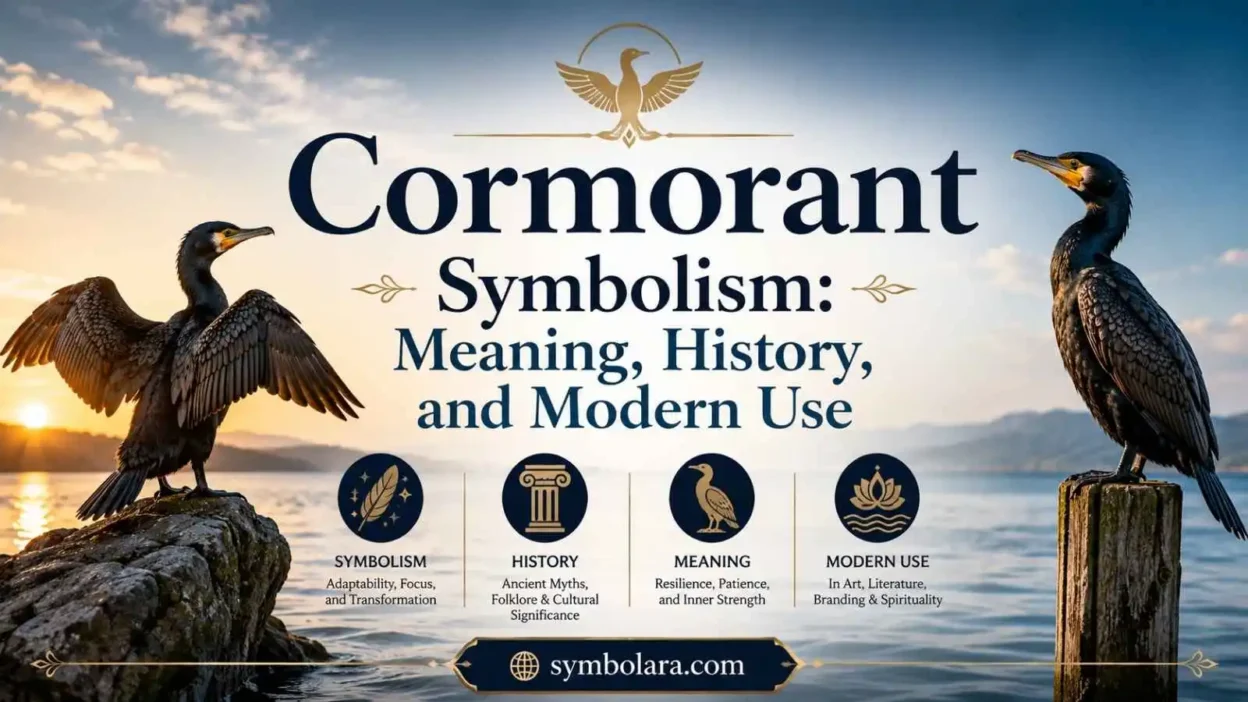
Cormorant Symbolism centers on resourcefulness, patience, survival, and the ability to move between emotional depth and everyday life. This dark waterbird looks practical rather than decorative, with a hooked bill, long neck, low swimming posture, and a striking habit of spreading its wings after a dive.
Across the United States, people see cormorants near oceans, bays, rivers, reservoirs, marshes, and the Great Lakes. They do not carry the gentle familiarity of doves or cardinals, and they do not project the national grandeur of eagles. Their appeal comes from something quieter: endurance, focus, and the skill to survive in demanding places.
The bird matters symbolically because it lives at several crossroads. It belongs to wildlife observation, coastal identity, fishing history, folklore, ecological debate, and personal meaning. For many modern Americans, the cormorant speaks to resilience without sentimentality.
Quick Answer
Cormorant Symbolism commonly represents resourcefulness, patience, adaptability, and emotional self-reliance in modern American culture. Historically, cormorants have also suggested appetite, sea lore, skilled fishing, endurance, and the uneasy line between survival and excess.
TL;DR
- Cormorants symbolize patience, survival, and adaptability.
- Their diving suggests emotional depth.
- Their open wings evoke recovery.
- Older literature linked them with greed.
- Americans connect them with water and resilience.
- Tattoos often use them for personal transformation.
What a Cormorant Looks Like
A cormorant has a dark body, a slim hooked bill, a long neck, and webbed feet built for swimming. In the United States, many people know the double-crested cormorant, especially around lakes, rivers, harbors, and shorelines.
The bird often floats low in the water. From a distance, only its head and neck may show above the surface. That posture gives it a watchful, secretive look, as though it knows more about the water than the viewer can see.
Its most memorable pose comes after diving. The bird stands upright on a rock, dock, piling, or branch and spreads its wings wide. People often remember that silhouette because it looks dramatic and almost ceremonial, even though the bird simply needs to dry and reset before hunting again.
What Cormorants Commonly Mean in the United States
In modern American culture, the cormorant most often suggests endurance through difficulty. It does not look soft, ornamental, or eager to please. Its meaning comes from action: diving, searching, resurfacing, resting, and returning to the water.
Many people interpret the bird as a symbol of adaptability. Cormorants can live around saltwater or freshwater, move through air and water, and find food in environments that demand skill. This makes them natural symbols for people who adjust to changing circumstances without losing their focus.
The bird can also represent solitude without isolation. A single cormorant standing with open wings has a strong individual presence, even though cormorants may gather in colonies. That image appeals to people who value independence, emotional discipline, and quiet persistence.
Why Diving Shapes the Bird’s Meaning
The cormorant’s deepest symbolism comes from its diving behavior. It does not wait on the surface or skim casually for food. It enters the water, disappears from sight, and hunts below.
That movement gives the bird a clear emotional meaning. It can represent the willingness to go beneath appearances, face what others avoid, and search in difficult places for what life requires.
This meaning does not need mystical exaggeration. The bird earns the symbolism through its real behavior. It succeeds because it can enter a challenging environment, remain focused, and return with what it needs. For people, that becomes a useful image for grief work, therapy, creative concentration, problem-solving, or any season that requires serious inner effort.
The Wing-Drying Pose and Recovery
The cormorant’s open-winged stance carries one of its clearest modern meanings. After a dive, the bird pauses in the open air with wings extended.
That image suggests recovery after effort. The bird has gone underwater, hunted, worked, and resurfaced. Before it dives again, it must expose itself to sun and wind.
For many Americans, this pose can symbolize rest without shame. The cormorant does not pause because it has failed. It pauses because recovery belongs to survival. That makes the bird a fitting emblem for burnout recovery, emotional reset, healing after hardship, or learning when to stop before continuing.
Ancient Roots of the “Sea Raven”
The word “cormorant” connects to the older idea of a “sea raven.” That association helps explain why European imagination often gave the bird darker meanings.
Like ravens and crows, cormorants have dark plumage, sharp profiles, and an intelligent-looking presence. They also live around coastlines, storms, fish, boats, and uncertain water. Older communities often read those traits as serious, strange, or even ominous.
This does not mean everyone viewed cormorants negatively. Their appearance simply made them easier to connect with hunger, secrecy, and watchfulness than with joy or gentleness. The “sea raven” identity helped the bird gain symbolic complexity, especially in cultures that already treated dark birds as signs of intelligence, danger, or spiritual warning.
Greed, Hunger, and an Older Reputation
Cormorants have sometimes symbolized greed and overconsumption. This meaning came partly from their visible skill as fish hunters. To people who depended on fish for food or income, a bird that swallowed fish whole could look like a competitor.
Writers in English literature sometimes used the cormorant as a metaphor for gluttony or predatory desire. They turned the bird’s natural appetite into a moral image for human excess. In those works, the cormorant did not represent wildlife as much as uncontrolled hunger.
That older reputation still shapes some modern attitudes. Anglers, fishery managers, and shoreline communities have sometimes blamed cormorants for reduced fish numbers or ecological imbalance. Yet that reaction often reveals more about human conflict with wildlife than about the bird itself.
Symbolically, the cormorant raises a difficult question: when does survival begin to look like greed to someone else?
Christian-Influenced Art and Literature
The cormorant does not hold the same central place in Christian symbolism as the dove, lamb, fish, or eagle. Still, Christian-influenced art and literature sometimes used the bird because its appearance invited moral interpretation.
Some medieval and heraldic images showed the cormorant with outspread wings. That pose could suggest endurance, sacrifice, or a stern kind of dignity, especially when artists treated the bird as an emblem rather than a natural subject.
Literary uses often leaned darker. Writers connected the bird with temptation, hunger, corruption, or predatory desire. These meanings belong more to poetry and moral imagination than to formal religious teaching.
Modern readers should keep that distinction clear. Older Christian-influenced writing sometimes treated the cormorant as a warning symbol, but the bird can also suggest discipline, exposure, survival, and return after descent.
Asian Traditions and Fishing Skill
In China and Japan, cormorants have strong ties to traditional fishing. Skilled handlers trained the birds to catch fish, especially in river settings. In Japan, ceremonial cormorant fishing often brings together boats, firelight, practiced movement, and close coordination between human and bird.
This tradition gives the cormorant a different symbolic tone. Instead of greed, the bird suggests training, patience, partnership, and technique. The relationship between handler and bird highlights discipline and cooperation with the natural world.
Modern viewers may also notice ethical questions about using animals for work or display. That tension matters. The tradition carries beauty, history, and skill, but people should not flatten it into a simple decorative image.
For American symbolism, this context adds meanings of mastery and controlled instinct. It also reminds readers to treat cultural references with care rather than borrowing them casually.
Maritime Folklore and Coastal Memory
Cormorants naturally entered maritime folklore because they live where people fish, sail, watch weather, and face the dangers of water. Coastal communities often read birds as signs of changing conditions, nearby fish, storms, or the mood of the sea.
Some northern European traditions viewed cormorants with more sympathy than English moral literature did. In those settings, people sometimes connected the bird with sailors, sea spirits, or memories of those lost on the water.
American coastal regions can give the bird a similar emotional role. In Maine, Alaska, the Pacific Northwest, the Gulf Coast, and the Great Lakes, a cormorant on a piling or breakwater can feel like part of local memory. It may suggest home, weather, work, fishing culture, or the patience required to live near water.
Cormorant Symbolism in Native American and Indigenous Contexts
Cormorant symbolism in Indigenous contexts requires careful attention because Native American cultures are not a single tradition. Different nations have their own relationships with animals, landscapes, and stories, and a broad “Native American meaning” cannot accurately describe all communities.
In coastal and river regions, waterbirds often hold importance because they are connected with fishing, seasonal changes, survival, and relationships with the natural world. Where cormorants appear in local traditions, their meaning depends on the specific community and its stories.
A respectful modern interpretation focuses on the bird’s real qualities: skill in water, patience during hunting, and adaptation to changing environments. These traits can overlap with values found in many Indigenous teachings about observing nature and learning from animals.
When discussing cormorant symbolism, it is better to identify a specific cultural source rather than assign one universal Indigenous meaning to the bird.
How Americans Read the Symbol Today
Most Americans do not inherit one fixed meaning for the cormorant. They build meaning from observation, place, and personal experience.
| Context | Meaning in the USA | Common Associations | Notes |
| Coastal sightings | Adaptability and survival | Fishing, weather, patience | Common near shorelines and lakes |
| Tattoos | Resilience and independence | Diving, recovery, solitude | Often chosen for transformation |
| Wildlife debates | Misunderstood nature | Fishery conflict, conservation | Reflects human-wildlife tension |
| Art and decor | Stark coastal beauty | Silhouettes, open wings | Fits nautical and minimalist styles |
| Personal reflection | Emotional depth | Introspection, endurance | Linked to diving and resurfacing |
The cormorant does not function as a national emblem, but it can serve as a personal or regional one. Its meaning grows strongest in places where water shapes daily life.
Emotional and Psychological Meaning
Psychologically, the cormorant represents someone who has learned to endure uncertainty. The bird moves between visible and hidden worlds: air and water, surface and depth, group and solitude.
That pattern makes it a strong symbol for emotionally observant people who do not always express everything outwardly. The bird does not announce itself with bright color or song. It communicates through posture, patience, and action.
It can also suggest self-possession. A cormorant dives when necessary, rests when necessary, and does not seem concerned with looking graceful. In human terms, that can point to maturity, practical confidence, and the ability to recover without needing approval.
For someone moving through grief, reinvention, or a difficult transition, the cormorant may feel more honest than a traditionally cheerful symbol. It does not promise ease. It shows return.
Cormorant Symbolism in Dreams: Common Interpretations
A cormorant appearing in a dream is often interpreted as a symbol of exploration, patience, and emotional awareness. Because the bird moves between air and water, many people connect it with the relationship between outward actions and hidden feelings.
Dreaming of a diving cormorant may represent a need to look deeper into a situation rather than accepting what appears on the surface. It can reflect personal growth, self-discovery, or the search for answers during a difficult period.
A cormorant with open wings may carry a different meaning. Some people interpret this image as a sign of recovery, freedom, or preparing for a new stage after a challenging experience.
The meaning depends heavily on the dreamer’s emotions and life circumstances. A calm cormorant near water may feel peaceful, while a threatening or dark scene may reflect uncertainty, fear, or unresolved concerns. Dream symbolism is personal, so the bird’s meaning comes from the connection the dreamer creates with the image.
Cormorants in Tattoos and Personal Style
People often choose cormorant tattoos because the bird feels serious, coastal, and less common than an eagle, owl, swallow, or raven. Its shape works well as a black silhouette, a diving figure, or a wing-spread design.
A cormorant tattoo may represent resilience after hardship. A diving bird can suggest inner work, while a wing-spread bird can suggest healing after struggle. A perched cormorant may point to patience, watchfulness, or independence.
The bird can also matter to people connected with fishing, sailing, marine biology, conservation, or shoreline communities. In that case, the meaning includes place as well as personality.
Some people choose the cormorant because it carries a more complicated symbolic history. It can acknowledge hunger, shadow, survival, and moral ambiguity without turning those themes into decoration.
Jewelry, Decor, and Coastal Design
In jewelry and decor, the cormorant usually appears in simple, graphic forms. Its long neck, dark body, and open-winged posture make it easy to recognize in silhouette.
Inside a home, cormorant imagery suggests coastal restraint rather than bright beach-themed decoration. It pairs well with driftwood, stone, linen, dark metal, weathered wood, and muted nautical colors.
As jewelry, the bird can communicate independence, connection to water, or a private story of endurance. A small cormorant pendant or ring feels understated because not everyone will identify the bird immediately.
That subtlety adds to its appeal. The symbol does not demand attention. It rewards people who recognize it.
Cormorant Symbolism in Art and Photography
Artists and photographers often use cormorants because the bird has a strong visual identity. Its dark silhouette, long neck, and open-wing posture create images that feel dramatic without needing bright colors or exaggerated details.
In photography, a cormorant can represent patience and observation. Wildlife photographers often capture the bird while diving, resting, or standing with wings spread, showing different stages of effort and recovery.
In paintings and coastal artwork, the cormorant may symbolize the connection between people and water. It often appears alongside oceans, boats, rocks, and shorelines because the bird naturally belongs to those environments.
Modern artists may also choose the cormorant because it feels less common than popular symbols like eagles or butterflies. Its unusual appearance allows creators to express themes of independence, resilience, solitude, and quiet strength.
Digital Culture and Modern Use
Cormorants appear less often in digital culture than ravens, owls, eagles, or swans. That rarity can make them attractive to people who prefer overlooked animals and coastal imagery.
The bird fits themes of ecological awareness, emotional depth, solitude, and resilience. It appears in wildlife photography, local nature pages, conservation posts, coastal art, and personal reflections about water.
Social media especially favors the wing-spread pose. Even viewers who do not know the species can understand the image: a dark bird pausing after immersion, open to light and air before moving again.
In modern digital use, the cormorant rarely functions as a lucky charm or formal spiritual sign. More often, it acts as an aesthetic and emotional marker: observant, patient, self-contained, and connected to water.
Common Misunderstandings
The biggest misunderstanding treats cormorants only as symbols of greed or destruction. That idea comes from older literature and modern conflicts over fish. It does not tell the full story.
Cormorants eat fish because they are fish-eating birds. Their behavior carries no moral intention. When people call them greedy or malicious, they often project economic frustration onto wildlife.
Another mistake gives the cormorant one universal spiritual meaning. No single meaning covers Japanese fishing traditions, European literary metaphors, American tattoos, coastal folklore, and ecological debates.
A stronger interpretation keeps these contexts separate. The bird can represent survival in one setting, appetite in another, trained skill in another, and mourning or memory somewhere else.
What Does a Cormorant Crossing Your Path Mean?
Seeing a cormorant in everyday life does not have one fixed meaning or guaranteed message. For many people, however, an unexpected encounter with this bird becomes a moment of personal reflection.
A cormorant crossing your path may remind you to stay adaptable, observe carefully, and approach challenges with patience. Its ability to move between water and land makes it a natural symbol of flexibility and balance.
Some people connect the sighting with emotional growth because the bird dives below the surface before returning to the open air. This can represent looking inward, facing difficult experiences, and coming back stronger.
A more practical interpretation is also valuable: seeing a cormorant may simply reflect the beauty and complexity of wildlife. Personal meaning often develops from the moment, location, and emotions connected with the encounter.
Controversies and Misuse
Modern controversy around cormorants usually involves ecology and economics. In parts of North America, people debate the bird’s effect on fish populations, aquaculture, sport fishing, and wildlife management.
Some people see cormorants as competitors. Conservation-minded observers often view them as native birds that humans unfairly blame for larger environmental problems. These debates influence symbolism because they shape whether people see the bird as a villain, survivor, or misunderstood species.
The bird also appears in vague “spirit animal” content that makes broad claims about Indigenous meaning without naming a specific nation, story, or cultural context. That approach disrespects the diversity of Indigenous traditions.
A careful modern reading avoids sweeping claims. People can find personal meaning in the cormorant, but cultural interpretations need specificity and respect.
How the Meaning Has Changed Over Time
The cormorant’s meaning has shifted across history. Coastal communities first knew it as a practical bird: a fisher, a weather companion, and a dark presence near working water.
European literature later emphasized hunger, appetite, and moral danger. Asian fishing traditions developed meanings of discipline, partnership, and trained skill. Maritime folklore added memory, loss, and the emotional life of the sea.
Today, especially in the United States, people increasingly read the cormorant through ecology and personal resilience. Birders, photographers, artists, tattoo collectors, and coastal residents often see more than an old symbol of greed.
They see a bird that survives by entering difficult depths, returning to the surface, and standing openly until it can move again.
Is the Cormorant Positive or Negative?
The cormorant can carry both positive and negative meanings. Positive interpretations include adaptability, patience, recovery, fishing skill, emotional depth, and self-reliance.
Negative readings focus on appetite, greed, secrecy, and conflict. Those meanings come mostly from older writing and human frustration over shared resources.
For modern personal use, positive meanings tend to dominate. People who choose cormorant imagery usually connect with resilience, not gluttony. Still, the older negative side gives the bird complexity and prevents the symbol from feeling too simple.
FAQs
What does a cormorant symbolize?
A cormorant usually symbolizes resourcefulness, patience, adaptability, and survival. Because it dives below the surface, it can also suggest emotional depth, introspection, and the ability to return after difficult experiences.
Is a cormorant a good or bad omen?
A cormorant does not carry one universal omen meaning. Some traditions connect it with warning or appetite, while others associate it with skill, endurance, and the sea. Modern American interpretation usually leans toward resilience rather than misfortune.
What does a cormorant tattoo mean?
A cormorant tattoo often represents independence, recovery, emotional strength, or connection to water. A diving design may point to inner work, while a wing-spread design can suggest healing after struggle.
What does the cormorant mean spiritually?
Spiritually, the cormorant can represent movement between surface life and inner depth. Many people read it as a reminder to face hidden feelings, recover after effort, and trust practical instincts.
Why do people associate cormorants with greed?
People associate cormorants with greed because the birds hunt fish skillfully and swallow their catch whole. Older writers turned that natural feeding behavior into a metaphor for human appetite and excess.
Do cormorants have Native American symbolism?
No single Native American meaning applies to the cormorant. Indigenous cultures have distinct stories, places, and traditions, so any claim needs a specific cultural source rather than a broad label.
What does seeing a cormorant mean?
Seeing a cormorant can remind someone to stay patient, observant, and willing to look beneath the surface. When the bird spreads its wings, the moment may also suggest rest, recovery, and preparation.
Why are cormorants associated with water symbolism?
Cormorants are connected with water because they are expert divers and depend on rivers, lakes, and oceans for survival. Their relationship with water creates meanings related to depth, adaptation, and exploration.
Conclusion
The cormorant carries meaning because of what it does. It dives, searches, resurfaces, and rests in the open air, creating a natural symbol of adaptability, emotional endurance, and recovery after effort.
Cormorant Symbolism also includes older tensions: hunger, greed, sea lore, fishing skill, and human conflict with wildlife. Those meanings belong to the bird’s history, but they do not define the whole animal.
In modern American culture, the cormorant works best as a symbol of resilient self-reliance. It does not rely on brightness or charm. It earns attention by surviving the water and returning to the light.