
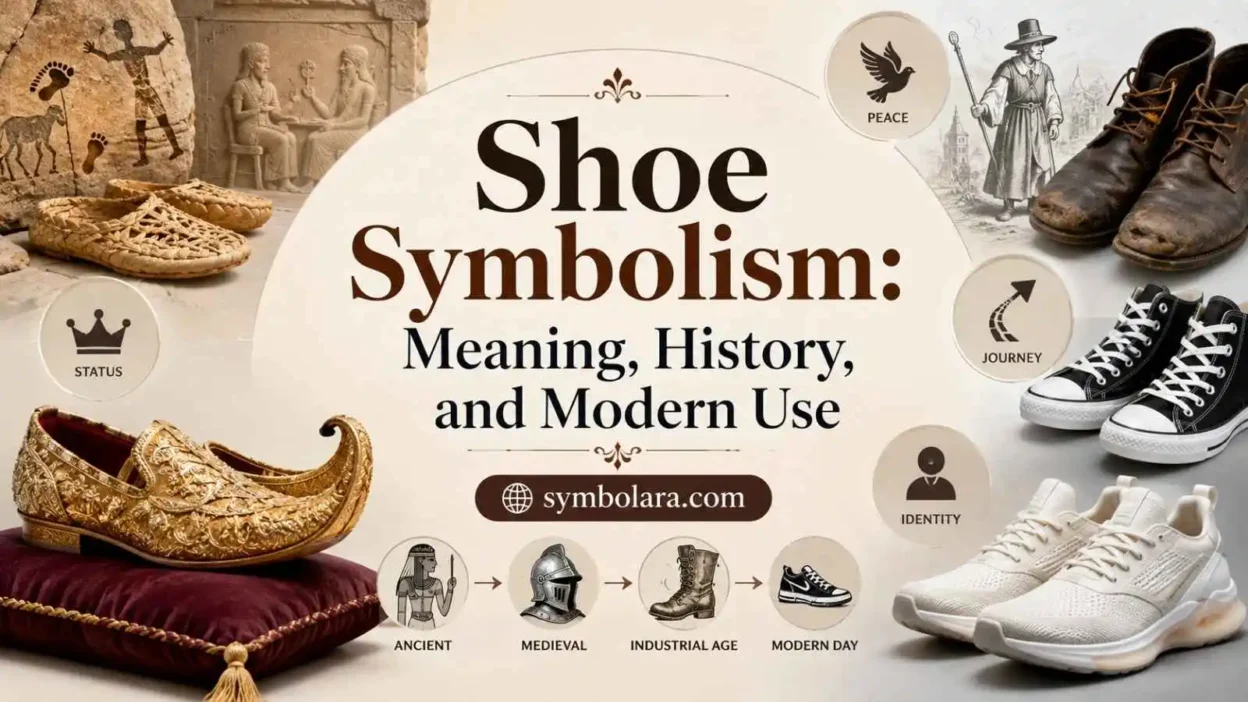
Shoes are ordinary objects, but they carry unusual symbolic weight. In daily life they protect the body, shape how a person moves, and quietly tell others something about taste, class, work, culture, and identity. That is why Shoe Symbolism appears in stories, religious customs, fashion, weddings, memorials, protest, and American pop culture.
People notice shoes because they sit at the meeting point between the body and the world. They touch the ground, collect dust, cross thresholds, and mark the practical reality of movement. A worn pair of boots suggests labor or endurance. White sneakers may suggest ease, youth, or street style. Ruby slippers can mean longing for home.
In the United States, shoes are especially symbolic because they move across many parts of life: sports, celebrity culture, weddings, school rituals, memorials, work uniforms, and personal style. A shoe can be practical, fashionable, sacred, rebellious, sentimental, or political depending on where it appears and who is wearing it.
Quick Answer
Shoe Symbolism commonly represents life’s journey, personal identity, social status, and the direction a person is taking in modern American culture. Historically, shoes have also symbolized protection, sacred boundaries, authority, humility, marriage, protest, and remembrance.
TL;DR
- Shoes often symbolize movement, identity, and life direction.
- Footwear has long marked class, labor, gender, and status.
- Removing shoes can signal respect, humility, or sacred space.
- In America, sneakers strongly symbolize youth, style, and culture.
- Shoes can represent memory, grief, protest, or absence.
- Wedding shoes often suggest luck, transition, and new beginnings.
What Shoes Usually Symbolize Today
In modern American culture, shoes most often symbolize where someone is going and who they are becoming. This meaning comes naturally from their purpose. Shoes carry people from one place to another, so they easily become symbols of movement, progress, independence, ambition, and transition.
A new pair of shoes can feel like a fresh start. Parents buy children new school shoes before the academic year. Adults buy work shoes for a new job. Runners choose shoes before training for a race. Brides select wedding shoes for the walk down the aisle. In each case, the shoe is not just an accessory; it marks a step into a new role.
Shoes also symbolize identity because they are one of the most personal visible items people wear. Unlike a coat or hat, shoes reveal how a person expects to move through the world. Work boots, heels, loafers, cowboy boots, ballet flats, high-tops, and running shoes all create different impressions before a person says a word.
This is why shoes can feel intimate. They shape posture, comfort, speed, and confidence. A person may remember the shoes they wore at graduation, on a first date, during military service, or while working a difficult job. Footwear becomes a record of where the body has been.
Why Shoes Are Such Strong Symbols
Shoes matter symbolically because they are practical, visible, and close to the ground. They belong to the body, but they also touch the outside world. That gives them a built-in double meaning: they protect the person while also showing evidence of contact with streets, soil, workplaces, public spaces, and travel.
A clean pair of dress shoes may suggest control, preparation, or formality. Muddy boots may suggest work, hardship, rural life, or survival. Bare feet may suggest vulnerability, poverty, holiness, relaxation, childhood, or freedom depending on the context.
Shoes also carry traces of the individual. They stretch, crease, scuff, and wear according to the owner’s habits. That physical imprint makes old shoes emotionally charged. A coat may hang in a closet, but worn shoes often seem to hold the shape of a person’s daily life.
This is why shoes appear so often in museums, memorials, and family keepsakes. They are small enough to be ordinary, but personal enough to stand in for a whole life. A child’s shoe, a soldier’s boot, or a dancer’s worn slipper can communicate presence and absence at the same time.
Ancient Roots of Shoe Meaning
The oldest surviving footwear shows that shoes began as protection before they became fashion. Archaeologists have identified Fort Rock-style sandals from the northern Great Basin, especially Oregon, as among the oldest directly dated footwear in the world, with examples dating roughly 10,500 to 9,200 years before present.
That early history matters because the first symbolic layer of shoes is survival. Before shoes communicated style or status, they protected feet from heat, cold, stones, insects, and rough terrain. In that sense, shoes symbolize human adaptation: the ability to move farther, carry more, and live in difficult environments.
The 5,500-year-old Areni-1 leather shoe from Armenia shows another step in footwear history. It was made from a single piece of leather and preserved unusually well, demonstrating that ancient shoes could already be shaped, tied, and fitted to the body.
As societies became more stratified, footwear began to mark rank, gender, wealth, occupation, and access. Shoes were no longer only about walking. They became part of social language. Materials, height, color, decoration, and impracticality could all announce that a person did not need to perform rough labor.
Shoes as Symbols of Status and Class
Shoes have long been used to signal class. Expensive materials, delicate fabrics, polished leather, embroidery, high platforms, and impractical shapes often suggested that the wearer had money, servants, leisure, or social importance. The more difficult a shoe was to walk or work in, the more strongly it could imply privilege.
The Venetian chopine is a clear historical example. These high platform shoes, popular among some women in sixteenth-century Venice, helped keep feet above wet or dirty streets, but they also elevated the wearer’s body and displayed status. The Metropolitan Museum of Art notes both their practical function and their role in signaling social elevation.
In modern America, class symbolism still appears in footwear, though the codes have changed. Designer heels, limited-edition sneakers, handmade boots, luxury loafers, and pristine white shoes can all signal access to money or taste. At the same time, some Americans deliberately choose worn, practical, or understated shoes to reject flashy status displays.
The meaning is never fixed. A work boot may suggest blue-collar labor in one setting, rugged fashion in another, and expensive heritage branding in another. A sneaker may be affordable gym wear, a collector’s object, or a cultural statement. Shoes are status symbols precisely because they can move between usefulness and display.
Shoes, Work, and Everyday American Identity
In the United States, shoes often symbolize work because many jobs are visually tied to specific footwear. Steel-toe boots suggest construction, factories, warehouses, and trades. Nurse clogs and supportive sneakers suggest healthcare labor. Polished dress shoes suggest offices, courtrooms, finance, sales, or formal service roles.
These associations are not only about appearance. They reflect the physical demands of work. A person who stands all day, walks hospital floors, climbs ladders, farms land, serves tables, or works in public safety chooses shoes for endurance. Footwear becomes a sign of how labor shapes the body.
American culture also uses shoes to divide public and private life. Work shoes may be removed at the door. Dress shoes may be saved for church, weddings, funerals, interviews, or court appearances. Sneakers may signal off-duty comfort. Slippers suggest home, rest, and privacy.
This everyday symbolism is one reason shoes appear so often in stories about ambition. “Filling someone’s shoes” means taking on a role or responsibility. “Walking in someone else’s shoes” means trying to understand another person’s experience. These phrases work because footwear is already linked to identity, duty, and lived perspective.
Sneakers and Modern American Culture
No type of footwear carries more modern American symbolism than sneakers. Sneakers began as athletic shoes, but they now represent sports, music, youth culture, streetwear, celebrity, nostalgia, race, class, and self-expression. Smithsonian catalog records and cultural collections treat sneakers not just as shoes, but as objects connected to American life, sports, entertainment, and identity.
Basketball shoes are especially symbolic. They connect individual performance with aspiration. A child wearing the shoes of a famous athlete is not only wearing a product; they are borrowing an image of skill, confidence, and possibility. This is why sneakers can become emotionally important far beyond their practical use.
Sneaker culture also reveals how Americans turn ordinary objects into collectibles. Limited releases, collaborations, resale markets, and vintage models create a language of taste and belonging. A pair of sneakers can signal neighborhood ties, music preferences, sports loyalty, nostalgia for the 1990s, or membership in a style community.
At the same time, sneakers can expose inequality. The same shoe may be seen as fashion on one person and judged as suspicious or inappropriate on another. This double standard shows that footwear symbolism is shaped not only by the object, but by race, class, gender, place, and social expectations.
Shoes in Fairy Tales, Film, and Pop Culture
Shoes are central to many well-known stories because they can transform identity. In “Cinderella,” the slipper identifies the hidden bride and lifts her from neglect into recognition. In “The Red Shoes,” dancing shoes become a symbol of compulsion, art, vanity, and punishment. In many folktales, shoes mark movement between ordinary life and enchanted possibility.
For American audiences, Dorothy’s ruby slippers from The Wizard of Oz are probably the most famous symbolic shoes. They represent home, protection, longing, and the discovery that the power to return was with Dorothy all along. The Smithsonian’s National Museum of American History preserves one of the film’s pairs, underscoring their place in American movie memory.
The ruby slippers also show how film can change symbolism. In L. Frank Baum’s original book, Dorothy’s shoes were silver; the 1939 film made them ruby to take advantage of color cinema. Their meaning now depends heavily on the visual memory of red sequins, yellow brick, and the phrase “there’s no place like home.”
Pop culture often uses shoes this way. A character’s footwear can quickly tell viewers whether they are rebellious, wealthy, innocent, dangerous, practical, glamorous, or out of place. Shoes become shorthand for personality because audiences already know how to read them.
Shoe Symbolism in Literature and Common Expressions
Shoes appear in literature and everyday language because they naturally represent human experience. Walking, standing, and moving are powerful images for personal growth, responsibility, and perspective.
Common expressions show how deeply shoes are connected with identity:
- “Walk in someone else’s shoes” means trying to understand another person’s experiences and feelings.
- “Fill someone’s shoes” means taking over a role or responsibility after someone leaves.
- “Get back on your feet” means recovering after hardship or difficulty.
- “Put yourself in their shoes” means imagining another person’s situation.
Writers use shoes because they are both personal and universal. Everyone has a relationship with footwear, which makes shoes effective symbols for journeys, challenges, and transformation.
From fairy tales to modern novels, shoes often mark moments when characters change. They may leave home, discover identity, gain power, or return with new understanding. The symbolism works because shoes connect physical movement with emotional progress.
Religious and Sacred Meanings of Shoes
In religious settings, shoes often symbolize the boundary between ordinary space and sacred space. Removing shoes can express humility, respect, purity, or awareness that a place should not be entered casually.
In biblical tradition, Moses is told to remove his sandals before the burning bush because the ground is holy. That act has often been interpreted as a gesture of reverence: the ordinary dust of travel is set aside before an encounter with the divine. In the Book of Ruth, removing a sandal also appears in connection with legal transfer and public confirmation, showing that footwear could symbolize authority, obligation, and agreement.
In Islamic practice, shoes are commonly removed before entering mosques to preserve cleanliness in prayer areas and show respect for sacred space. In many Asian households and temples, removing shoes separates the outside world from the clean interior. Japanese homes, for example, traditionally use the entryway as a threshold where outdoor shoes are left behind before stepping into the living space.
Across these traditions, the meaning is not that shoes are bad. Rather, shoes carry the outside world. Removing them marks a change in behavior: from public movement to reverence, hospitality, prayer, or domestic calm.
Wedding Shoes and New Beginnings
Wedding shoes symbolize transition. They are worn for the walk into marriage, so they naturally suggest hope, commitment, beauty, and the movement from one life stage to another. In American weddings, the meaning is usually personal rather than superstitious. Brides, grooms, and wedding parties choose shoes for style, comfort, tradition, photographs, dancing, and self-expression.
Older wedding customs gave shoes more explicit symbolic meaning. In parts of European tradition, old shoes were thrown after newlyweds as a wish for luck, fertility, or transfer into married life. Victorian-era customs also helped spread the rhyme that includes “a sixpence in your shoe,” linking footwear to prosperity and good fortune.
Today, American couples often personalize this symbolism. A bride might wear blue shoes for the “something blue” tradition. A groom might wear sneakers that reference a favorite team. Some couples write messages on the soles of wedding shoes or choose footwear that honors a family member.
Wedding shoes also reveal a practical truth: symbolism must still walk. Beautiful shoes that hurt can become a memorable part of the day for the wrong reason. That tension between appearance and comfort is part of why wedding footwear feels so meaningful. It carries both the dream and the body.
Shoes as Symbols of Travel, Freedom, and Escape
Because shoes make movement possible, they often symbolize freedom. A good pair of shoes allows a person to leave, explore, work, run, dance, migrate, or begin again. This symbolism appears in American road stories, hiking culture, running communities, military life, and coming-of-age narratives.
Boots can symbolize readiness for difficult ground. Running shoes can symbolize discipline or recovery. Hiking shoes can suggest self-reliance and closeness to nature. Worn-out sneakers can suggest a long personal journey, whether literal or emotional.
Shoes can also symbolize escape. In stories about poverty, war, domestic control, or social restriction, the ability to put on shoes and leave may represent autonomy. Conversely, the absence of shoes can imply helplessness, exposure, captivity, or forced displacement.
This meaning is especially clear in phrases like “get back on your feet.” Although the phrase does not mention shoes directly, it belongs to the same symbolic field. Feet, shoes, and walking all connect to agency: the ability to stand, choose, and move forward.
Emotional and Psychological Meaning
Shoes are psychologically expressive because they reveal choices about comfort, attention, identity, and risk. A person may wear shoes to blend in, stand out, feel taller, feel protected, look professional, appear relaxed, or signal belonging to a subculture.
Research on first impressions has found that people make judgments from shoes and that some footwear cues can correlate with perceived traits such as status, age, or personality. These judgments are not always fair or accurate, but they show how strongly people read shoes as social information.
Emotionally, shoes can hold memory. Parents keep baby shoes. Runners save the shoes from a first marathon. Families may preserve a loved one’s boots, slippers, or dress shoes after death. These objects become meaningful because they show scale, habit, and presence.
Shoes can also affect how a person feels in the moment. High heels may create a sense of formality or height but can also cause discomfort. Sneakers may create ease and mobility. Boots may create a sense of toughness or readiness. The symbolism works both outwardly and inwardly: shoes communicate to others, but they also change how the wearer inhabits the body.
What Does Losing a Shoe Symbolize?
Losing a shoe is commonly interpreted as a symbol of uncertainty, transition, or feeling unprepared. Because shoes help people move forward, a missing shoe can represent difficulty finding direction or confidence.
In dreams and storytelling, a lost shoe may suggest a change in identity, a disrupted journey, or a situation where someone feels exposed. The meaning is not universal, but the connection comes from the practical role of shoes: without them, movement becomes harder.
A lost shoe can also represent change. Leaving behind an old pair may suggest moving away from a previous stage of life. In some stories, losing footwear creates a turning point that leads to growth or transformation.
For modern American readers, the meaning depends on personal experience. Someone who loses a favorite pair may feel frustration, while someone replacing old shoes may see the loss as a chance for a fresh beginning.
Color and Style Symbolism
Shoe color often changes meaning. Black shoes usually suggest formality, professionalism, mourning, or restraint. White shoes can suggest cleanliness, youth, summer, minimalism, or bridal style. Red shoes suggest visibility, confidence, passion, theatricality, or danger depending on the context.
Style matters just as much as color. Heels can symbolize glamour, femininity, performance, social pressure, or authority. Boots can suggest labor, protection, rebellion, military discipline, Western identity, or fashion toughness. Sandals can suggest ease, travel, informality, ancient tradition, or warm weather. Slippers suggest domestic comfort and privacy.
| Context | Meaning in the USA | Common Associations | Notes |
| Sneakers | Youth, style, movement | Sports, streetwear, music | Often tied to identity and status |
| Work boots | Labor and endurance | Trades, farms, construction | Can also signal rugged fashion |
| Wedding shoes | Transition and hope | Marriage, luck, beauty | Often personalized by couples |
| Dress shoes | Formality and respect | Work, church, ceremonies | Polishing suggests preparation |
| Bare feet or no shoes | Vulnerability or freedom | Childhood, poverty, relaxation | Meaning depends heavily on setting |
| Shoes in memorials | Absence and remembrance | Loss, grief, human presence | Often used to make tragedy tangible |
Shoe symbolism is strongest when color, condition, and context work together. Red heels at a party, muddy boots after a storm, white sneakers at graduation, and empty shoes at a memorial do not say the same thing. The shoe must be read in its setting.
Different Types of Shoes and Their Symbolic Meanings
Different types of shoes carry different symbolic meanings because each style connects with a specific lifestyle, activity, or social role. A shoe’s purpose often shapes the message people attach to it.
Common footwear meanings include:
- Boots: Boots often symbolize strength, protection, endurance, and readiness. Work boots can represent dedication and labor, while fashion boots may suggest confidence or independence.
- High heels: High heels are often linked with elegance, confidence, beauty, performance, and formal identity. They can also represent expectations placed on appearance and presentation.
- Sneakers: Sneakers commonly symbolize youth, movement, athletic ability, creativity, and personal style. In American culture, they are strongly connected with sports, music, and street fashion.
- Sandals: Sandals often represent comfort, travel, simplicity, and connection with warm climates. They may also carry historical and religious associations because of their ancient use.
- Loafers and dress shoes: These styles usually represent professionalism, responsibility, tradition, and social formality.
The meaning of footwear depends on more than the shoe itself. The person wearing it, the situation, and the cultural setting all influence the symbolism. A pair of boots may represent hard work in one context and fashion confidence in another.
Shoes in Tattoos, Jewelry, Decor, and Social Media
Shoe imagery appears in tattoos when people want to symbolize a journey, a child, a sport, a career, or a loved one. Baby shoe tattoos often honor children or parenthood. Ballet shoes may symbolize discipline and art. Running shoes can mark recovery, endurance, or a major race. Combat boots may honor military service or resilience.
In jewelry, tiny shoe charms can symbolize travel, fashion, motherhood, or a personal milestone. A high heel charm may suggest glamour or confidence. A sneaker charm may suggest youth or sport. A boot charm may suggest country identity, toughness, or work.
In home decor, shoes often appear near thresholds. Entryway shoe racks, porch boots, and carefully arranged sneakers communicate household habits. In some American homes, a no-shoes policy has become more common because of cleanliness, comfort, cultural influence, or concern about tracking dirt indoors.
On social media, shoes are visual shorthand. A “shoe selfie” can show a destination, outfit, lifestyle, or mood without showing the face. New sneakers, wedding heels, muddy hiking boots, or tiny baby shoes each tell a quick story. Digital culture has made shoes even more symbolic because they photograph well and communicate identity instantly.
Protest, Insult, and Public Misuse
Shoes can also symbolize disrespect. In some cultures, showing the sole of a shoe or throwing a shoe at someone is insulting because the sole touches the ground and is associated with dirt. One widely known modern example occurred in 2008, when an Iraqi journalist threw shoes toward U.S. President George W. Bush during a Baghdad press event as an act of protest.
This does not mean shoes always carry insult in those cultures, nor does it mean Americans should flatten the meaning into a stereotype. The symbolism depends on gesture, setting, and intention. A shoe worn normally is not the same as a shoe thrown in anger.
In the United States, shoes tied over power lines are another often-misread symbol. Popular explanations connect them to gangs, drugs, memorials, pranks, bullying, rites of passage, or neighborhood marking, but there is no single universal meaning. Some cases may be memorials or local customs; others may be simple imitation or vandalism. Reader’s Digest summarizes the issue well: many theories exist, but the meaning is often uncertain.
The main caution is simple: shoes can be symbolic without having one secret meaning. Context matters more than rumor.
Shoes, Memory, and Mourning
Shoes can become especially moving symbols in memorials because they suggest the people who once wore them. Empty shoes imply absence. They show that someone had a body, a route, a daily life, and a place in the world.
Holocaust memorials and museum exhibits often use shoes in this way. At Auschwitz and in other contexts of remembrance, preserved shoes help visitors grasp the human scale of mass murder without reducing victims to numbers. PBS has described shoes and similar personal objects as creating a spiritual link with those who were killed.
The Shoes on the Danube Bank memorial in Budapest uses sculpted shoes to remember Jews murdered along the river during World War II. The footwear represents people forced to remove their shoes before being shot, turning ordinary objects into a public act of mourning and historical witness.
In everyday American grief, shoes can carry a quieter version of this meaning. A pair left by the door after someone dies may be too painful to move. A child’s outgrown shoes may be kept long after they are useful. Footwear remains because it feels close to the person’s movement through life.
What Do Old or Worn-Out Shoes Symbolize?
Old shoes often symbolize experience, memory, endurance, and the passage of time. Unlike new shoes, worn footwear carries visible evidence of movement, struggle, and daily life.
A scratched boot may represent years of hard work. A faded sneaker may remind someone of childhood, sports, travel, or important personal moments. Because shoes physically touch the ground, wear marks can feel like a record of where a person has been.
In American culture, old shoes are often connected with emotional attachment. People may keep a loved one’s shoes after death, save a pair from a major achievement, or preserve childhood shoes as family memories.
Worn shoes can also symbolize resilience. They show that a person has continued moving despite difficulty. However, they can have different meanings depending on context. For some, old shoes represent comfort and history; for others, they may represent hardship, poverty, or a need for change.
The strongest interpretation comes from the story behind the shoes, not only their appearance.
Cross-Cultural Meanings Worth Knowing
Different cultures read shoes in different ways. In many American settings, shoes indoors are normal, although more households now ask guests to remove them. In Japanese-influenced etiquette, removing shoes at the entryway marks respect for the home and separates outdoor dirt from indoor living. In many mosques, shoe removal protects the cleanliness of prayer spaces.
In some Middle Eastern and South Asian contexts, the sole of the shoe can be insulting when deliberately displayed or used in a gesture. In Western fashion history, elevated or ornate shoes often suggested rank or wealth. In Chinese history, tiny embroidered lotus shoes are associated with foot-binding, a practice now widely understood as a painful sign of gender restriction and status rather than beauty alone.
These differences matter because a symbol can be respectful in one context and offensive in another. A shoe on a shelf, a shoe at a doorway, a shoe thrown in protest, and a shoe removed before prayer are all different signs.
For American readers, the best approach is to avoid assuming one universal meaning. Shoes are global objects, but their symbolism is local, historical, and situational.
How the Meaning of Shoes Has Changed
The symbolism of shoes has changed from survival to identity. Early footwear protected the body from terrain. Later, shoes marked occupation, wealth, religious boundaries, gender expectations, and social rank. In the modern United States, shoes still carry those meanings, but they also function as personal branding.
Mass production made shoes more accessible, while advertising made them more expressive. Athletic shoes became lifestyle objects. Work boots became fashion items. High heels moved between glamour, workplace expectation, feminist critique, and personal choice. Sneakers moved from gyms and courts into offices, runways, Congress, and luxury auctions.
This evolution shows why shoes remain symbolically flexible. They are never just one thing. They are tools, memories, status markers, cultural signs, and emotional objects.
The most important change is that modern Americans increasingly use shoes to choose an identity rather than simply inherit one. A person may wear cowboy boots in Brooklyn, designer sneakers in a boardroom, or combat boots with a dress. Footwear now helps people combine influences, signal taste, and negotiate who they want to be.
Common Misunderstandings About Shoe Symbolism
One common misunderstanding is that every shoe symbol has a hidden spiritual meaning. Often, the meaning is practical before it is symbolic. Shoes symbolize journeys because they are used for walking. They symbolize class because they cost money and show wear. They symbolize sacred boundaries because they carry dirt from outside.
Another misunderstanding is that shoes always reveal personality accurately. They can give clues, but they can also mislead. A person may wear cheap shoes because they are practical, expensive shoes because they were a gift, or formal shoes because a job requires them. Social judgment based on footwear can easily become unfair.
A third misunderstanding is that old customs should be read through modern values without context. Wedding shoe customs, sacred shoe removal, and protest gestures all come from specific social worlds. Their meanings should be explained carefully rather than treated as universal signs.
The strongest reading of any shoe symbol asks three questions: Who is wearing or displaying the shoe? Where is it placed? What action is connected to it?
FAQs
What do shoes symbolize spiritually?
Spiritually, shoes often symbolize the boundary between ordinary life and sacred space. Removing shoes can express humility, respect, purity, or readiness to enter a place with greater awareness.
What does a shoe tattoo mean?
A shoe tattoo usually symbolizes a journey, personal identity, movement, endurance, or a major life stage. The exact meaning depends on the type of shoe, such as baby shoes for parenthood, running shoes for perseverance, or boots for strength and work.
Are shoes a positive or negative symbol?
Shoes can be positive or negative depending on context. They may symbolize protection, progress, and self-expression, but they can also represent insult, social pressure, poverty, grief, or absence.
What do shoes symbolize in American culture?
In American culture, shoes often symbolize identity, status, work, sport, fashion, and personal freedom. Sneakers are especially important because they connect athletics, music, youth culture, celebrity, and street style.
What does it mean when shoes appear in dreams?
In common dream interpretation, shoes often relate to direction, confidence, preparation, or how someone is moving through life. A lost shoe may suggest uncertainty, while new shoes may suggest change or a fresh role.
Why are empty shoes used in memorials?
Empty shoes are used in memorials because they represent the people who once wore them. They make absence visible and help viewers connect emotionally with individual lives rather than abstract numbers.
Why do some cultures remove shoes indoors?
Many cultures remove shoes indoors to protect cleanliness and mark a boundary between the outside world and private or sacred space. The practice can express respect for a home, a host, a temple, or a prayer area.
Why are shoes important symbols in stories?
Shoes are powerful story symbols because they represent movement, identity, and transformation. Characters often change when they receive, lose, or choose a special pair of shoes.
Conclusion
Shoes symbolize movement, identity, protection, status, memory, and the places people are trying to reach. Their meaning comes from their closeness to the body and their contact with the world: they carry dust, effort, direction, and personal history.
In modern American life, Shoe Symbolism appears in sneakers, wedding traditions, work boots, film props, tattoos, memorials, and everyday style. A pair of shoes can suggest ambition, grief, belonging, rebellion, comfort, or transformation depending on its context.
That is why footwear remains such a readable symbol. Shoes may be ordinary, but they show how people move through public life, private memory, and the long road between who they were and who they are becoming.



[…] and religious traditions, wedding rings may be worn on the right hand, which shows that the symbolism of rings is meaningful but not […]