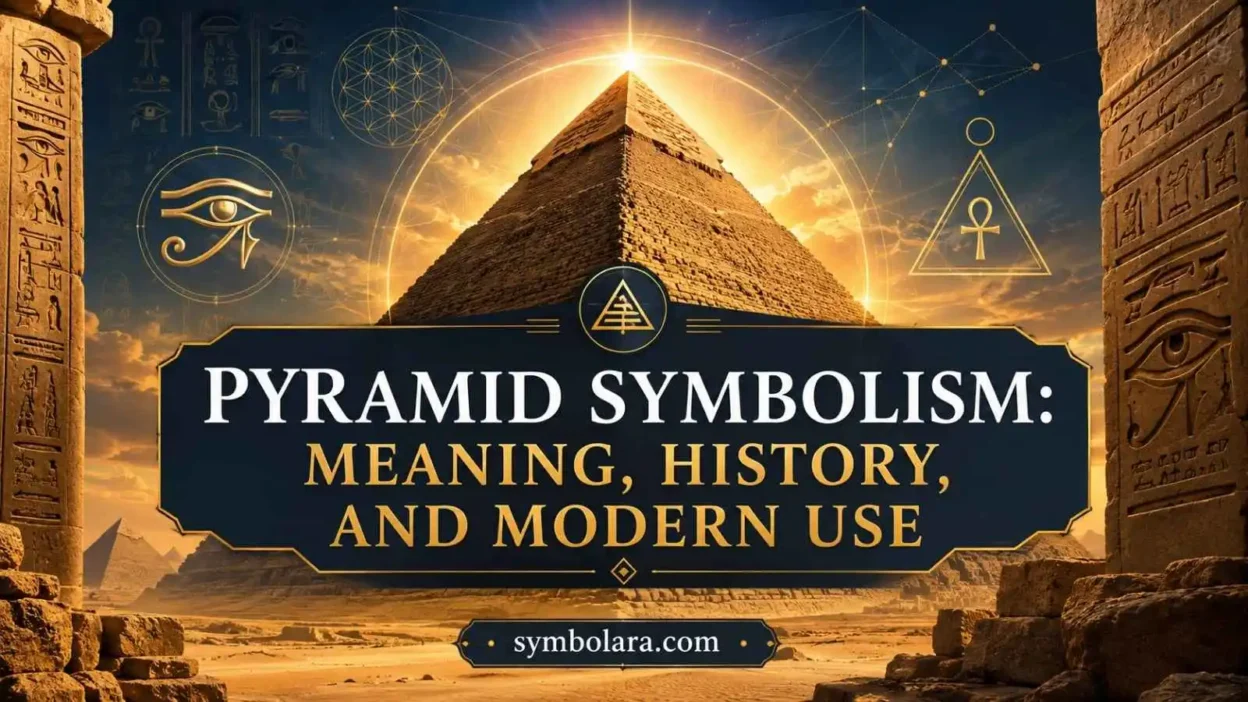
Pyramid Symbolism begins with a shape almost everyone recognizes: a broad base rising toward a single point. At first glance, the form looks simple, but it can suggest stability, ambition, sacred order, ancient power, mystery, hierarchy, or personal growth.
Across the United States, people see pyramids on the one-dollar bill, in tattoos, jewelry, logos, classroom diagrams, home decor, museum exhibits, and online culture. Because the symbol appears in so many places, its meaning changes depending on the setting.
A pyramid is not one fixed message. Instead, it is a visual form that has gathered meaning from ancient tombs, temple platforms, national symbols, spiritual art, psychology charts, luxury branding, and pop culture.
Quick Answer
Pyramid Symbolism commonly represents stability, ambition, order, and the climb from a strong foundation toward a higher goal in modern American culture. Historically, pyramids have also been associated with sacred architecture, royal authority, the afterlife, solar power, and the connection between earth and sky.
TL;DR
- Broad bases suggest strength, stability, and endurance.
- Pointed tops suggest ambition, focus, and ascent.
- Ancient pyramids linked rulers, death, gods, and heaven.
- Americans often connect pyramids with money and mystery.
- Tattoos use pyramids for growth, discipline, or transformation.
- Conspiracy meanings are modern distortions, not the whole story.
What a Pyramid Symbol Looks Like
A pyramid is a three-dimensional form with a wide base and sloping sides that meet at a point. In art and symbolism, it may appear as a triangle, a stepped monument, a smooth-sided structure, or a layered diagram.
Most Americans picture the Egyptian-style pyramid first: smooth sides, sharp apex, desert setting, and monumental scale. Another familiar version is the stepped pyramid, built from stacked platforms that rise in visible tiers.
People encounter pyramid imagery in many ordinary places. Dollar bills, tattoo flash sheets, museum displays, jewelry charms, spiritual artwork, company logos, album covers, and classroom charts all use the form in different ways.
This flexibility gives the pyramid unusual symbolic range. Depending on context, it can feel architectural, mathematical, ancient, national, mystical, or corporate.
What Pyramids Commonly Mean in the United States
In modern American culture, the pyramid most often symbolizes structure, achievement, endurance, and rising toward a goal. Its wide base suggests that anything lasting needs support, while its pointed top suggests focus, success, or completion.
That meaning explains why pyramids appear so often in diagrams about education, business, health, psychology, and personal development. A pyramid chart turns abstract progress into something visible: basic needs below, advanced goals above; broad responsibilities at the bottom, rare achievements at the top.
National symbolism also shapes the American reading of the pyramid. The unfinished pyramid on the Great Seal, shown on the back of the one-dollar bill, connects the form with durability, nation-building, and the idea of a project still being completed.
At the same time, pop culture has attached pyramids to secrecy and hidden power, especially when an eye appears above the structure. Online discussions often amplify that meaning, even though it is only one modern layer of interpretation.
The Core Meanings Behind the Shape
Much of the pyramid’s meaning comes from its physical structure. A heavy base rising into a narrow point naturally suggests order, hierarchy, direction, and intention.
The base represents support. It can stand for family, tradition, discipline, knowledge, community, practical work, or the early stages of growth. Without a base, nothing above it can hold.
Sloping sides create a sense of movement. They lead the eye upward, suggesting progress, effort, refinement, and the narrowing of attention as a goal becomes more defined.
At the top, the peak represents completion or focus. Depending on the setting, it may point to wisdom, authority, spiritual awareness, leadership, personal mastery, or the highest level of achievement.
Because of this structure, the pyramid can feel inspiring and severe at the same time. It can encourage growth, but it can also suggest exclusivity because only a small point sits above the rest.
Why Are Pyramids Considered Powerful Symbols?
Pyramids are considered powerful symbols because their design combines simplicity with strong visual meaning. A wide base, rising sides, and pointed peak create an image that people immediately connect with structure and direction.
The shape also represents human effort. Building upward from a foundation reflects ideas such as patience, discipline, learning, and long-term achievement. These themes appear in personal development, architecture, education, and leadership.
Their historical importance adds to their symbolic power. Ancient pyramids required advanced planning, engineering, labor, and cultural organization. Because they survived for thousands of years, they became symbols of endurance and human ambition.
Modern interpretations continue to evolve, but the basic message remains consistent: a strong foundation supports lasting growth.
Ancient Egyptian Roots and the Afterlife
Ancient Egypt gives modern Americans the most familiar historical image of the pyramid. These monuments were not only large buildings; they were connected to royal burial, sacred order, kingship, and beliefs about life after death.
Egyptian pyramids stood within larger funerary complexes that could include temples, causeways, chapels, walls, and smaller surrounding structures. Their meaning came from this full sacred landscape, not from the pyramid shape alone.
For the Egyptians, royal death was tied to divine continuity. The pyramid helped express the pharaoh’s status and the belief that the ruler’s existence continued beyond ordinary human life.
Solar imagery also shaped Egyptian pyramid symbolism. Sloping sides have often been interpreted in relation to rays of sunlight, and Egyptian religion connected kingship with the sun, renewal, and cosmic order.
For modern readers, this does not mean every pyramid symbol is “about death.” Rather, one of the shape’s most influential meanings comes from a culture where death, royal power, and sacred renewal were closely linked.
The Pyramid as a Symbol of Stability and Endurance
A pyramid looks stable because its weight moves downward and outward. Unlike a narrow tower, the shape appears rooted, balanced, and difficult to overturn.
This visual stability makes the pyramid a natural symbol of endurance. It suggests something carefully built, something that resists collapse, and something meant to last beyond one moment or generation.
American design often uses this meaning in institutions, educational models, memorial language, and leadership graphics. A company may use a pyramid to suggest reliability, while a teacher may use one to show how simple concepts support advanced learning.
The message is easy to understand: lasting success rests on a foundation. When the base is strong, the structure can rise higher.
The Pyramid as a Symbol of Ambition and Ascent
While the base suggests stability, the upward point suggests ambition. A pyramid does not spread endlessly outward; it rises toward a focused peak.
That upward motion gives the symbol a strong connection to personal growth. Many people read the pyramid as a sign of discipline, long-term effort, and the climb from basic beginnings toward a meaningful goal.
In tattoos, motivational art, fitness culture, and business imagery, the shape often represents step-by-step progress. Someone might choose a pyramid as a reminder to build patiently rather than chase fast results.
Ambition is not the only message, though. The narrowing shape can also suggest that higher goals require trade-offs, sharper focus, and fewer distractions.
The Unfinished Pyramid in American Symbolism
One of the most important American pyramid images appears on the reverse side of the Great Seal and on the back of the one-dollar bill. This design shows an unfinished pyramid with thirteen levels and the Eye of Providence above it.
The unfinished pyramid is generally understood as a symbol of strength, endurance, and continuing growth. Its thirteen levels refer to the original states, while the incomplete top suggests that the American project was still being built.
For many Americans, the image feels memorable because it combines architecture, Latin mottos, an eye, and national identity. That unusual combination has made the dollar-bill pyramid one of the most recognized symbolic images in everyday American life.
Its strangeness has also invited speculation. Some people read the image through conspiracy theories, but that modern habit should not replace the broader historical meaning of the design.
Pyramid Meanings in Different Contexts
| Context | Meaning in the USA | Common Associations | Notes |
|---|---|---|---|
| Dollar bill | National endurance and unfinished growth | Strength, history, providence | Often misread through conspiracy theories |
| Tattoos | Personal growth or mystery | Discipline, ascent, ancient wisdom | Meaning depends heavily on added imagery |
| Jewelry | Focus, balance, protection, style | Minimalism, spirituality, geometry | Often used as a subtle personal symbol |
| Decor | Order, calm, ancient atmosphere | Geometry, desert imagery, modern design | Can feel spiritual or architectural |
| Diagrams | Hierarchy and progression | Learning, needs, business, goals | The base-to-peak structure explains levels |
| Pop culture | Secrecy, power, hidden systems | Money, elites, “all-seeing eye” imagery | Often detached from historical meaning |
Cross-Cultural Meanings of Pyramids
Pyramids are not limited to Egypt. Different societies built pyramid-like structures for different purposes, and those differences matter.
In ancient Mesopotamia, ziggurats were stepped temple towers connected to city religion. Although they shared a rising form with Egyptian pyramids, their function was different. These structures were more closely tied to sacred elevation and temple life than to royal tombs.
Mesoamerican stepped pyramids often supported temples and ceremonial spaces. Their platforms, stairways, and alignments connected them to ritual life, political authority, astronomy, and sacred geography.
Because of these differences, it is inaccurate to say that pyramids mean one thing everywhere. Across cultures, the form often suggests height, sacred order, and human effort, but the exact meaning depends on the society that built and used it.
Emotional and Psychological Meaning
Psychologically, the pyramid is a symbol of order. It takes messy ideas such as growth, status, need, power, or knowledge and arranges them into visible levels.
That structure can feel reassuring. A pyramid makes progress look understandable: start at the base, move through the levels, and aim toward a clear point.
Emotionally, the shape often carries a mix of awe and distance. It feels impressive, but not intimate. The mood is closer to discipline, patience, and permanence than comfort or softness.
For people drawn to personal symbolism, a pyramid can say, “I am building something,” “I am becoming stronger,” or “I am focused on a higher goal.” Those meanings make the form especially appealing in tattoos, jewelry, and motivational art.
Pyramid Tattoos and Personal Style
A pyramid tattoo can represent growth, strength, ambition, mystery, or a connection to ancient history. The design details usually decide which meaning comes forward.
A simple outline pyramid often suggests balance, clarity, and focus. Adding stairs can emphasize progress, life stages, or the difficulty of moving upward. Including the sun may point toward renewal, energy, or ancient Egyptian influence.
When an eye appears with the pyramid, the meaning shifts toward awareness, watchfulness, spiritual perception, or secrecy. Desert scenery, stars, moons, snakes, or geometric lines can add still more layers.
Not every pyramid tattoo has a historical or spiritual message. Some people choose the shape because they like clean geometric art, while others use it as a private reminder of endurance and self-discipline.
Pyramids in Jewelry, Decor, and Fashion
In jewelry and fashion, pyramids often work as sharp geometric symbols. Their clean lines feel modern, while their ancient associations add a sense of age and meaning.
Pyramid pendants, rings, earrings, and charms may suggest focus, balance, protection, or personal strength. Sometimes the appeal is symbolic; in other cases, the shape is chosen mainly for style.
Home decor uses pyramid forms in a different way. Small sculptures, crystal pyramids, prints, and architectural objects can create a sense of order, calm, or desert-inspired atmosphere.
Fashion often gives the pyramid a bolder tone. Studs, patterns, album visuals, and luxury branding may use pyramid shapes to suggest edge, status, control, or mystery.
Pyramids in Pop Culture and Digital Culture
Modern pop culture frequently uses pyramids to suggest hidden power. Music videos, movie posters, album covers, and internet memes often pair pyramids with eyes, money, glowing light, or secret-society imagery.
Sometimes this use is serious, but often it is playful or dramatic. Creators borrow the pyramid because audiences immediately recognize the mood it creates: ancient, coded, powerful, and slightly suspicious.
Digital culture has made that meaning even stronger. A pyramid with an eye can quickly become shorthand for surveillance, elite control, or a hidden system behind public life.
Still, pop culture symbolism should not erase older meanings. Long before modern conspiracy imagery, pyramids were sacred structures, royal monuments, temple platforms, geometric forms, and national symbols.
Religious and Spiritual Interpretations
The pyramid is not a central symbol in most mainstream American religious practice, but it does appear in spiritual, esoteric, and philosophical settings.
Some modern spiritual interpretations treat the pyramid as a symbol of ascent from physical life toward higher awareness. The base can represent material existence, while the peak suggests insight, unity, or spiritual clarity.
In Christian-influenced symbolism, the Eye of Providence above a pyramid has sometimes been understood as divine oversight. Broader spiritual communities may connect pyramids with sacred geometry, meditation, energy, or ancient wisdom.
These interpretations need careful handling. Many modern spiritual meanings are recent reinterpretations, not direct continuations of ancient Egyptian or Mesoamerican belief.
What Does a Pyramid Symbolize in Dreams?
A pyramid appearing in a dream is often interpreted as a symbol of personal growth, stability, ambition, or a search for deeper understanding. The meaning depends on the dream’s setting, emotions, and the dreamer’s personal experiences.
Seeing a pyramid from a distance may represent a long-term goal or something the dreamer wants to achieve. Climbing a pyramid can suggest progress, overcoming challenges, or moving toward a higher level of awareness. Standing inside one may relate to reflection, protection, history, or discovering hidden parts of oneself.
A damaged or falling pyramid can carry a different meaning. Some people interpret it as a sign of unstable foundations, changing beliefs, or concerns about success and security.
Dream symbolism is personal rather than universal. A pyramid in one person’s dream may represent achievement, while another person may connect it with history, spirituality, travel, or curiosity about ancient cultures.
Pyramid Symbolism in Sacred Geometry and Modern Spiritual Design
In modern spiritual and artistic communities, pyramids are sometimes connected with sacred geometry because of their balanced proportions, symmetry, and relationship between a broad foundation and a focused point.
Many people interpret the pyramid shape as a symbol of alignment between different levels of existence. The base may represent physical life, while the upward point may represent awareness, purpose, or spiritual development.
Pyramid-shaped objects, artwork, and meditation designs are sometimes used as visual reminders of balance, intention, and personal focus. These interpretations belong mainly to modern spiritual practices rather than documented beliefs from ancient pyramid builders.
The connection between pyramids and sacred geometry shows how symbols can gain new meanings over time. A structure originally created for specific cultural purposes can later become a broader symbol of harmony, transformation, and personal reflection.
The Pyramid as a Symbol of Hierarchy
One of the most common modern uses of the pyramid is hierarchy. A pyramid chart shows levels of need, importance, authority, achievement, or control.
Visually, the structure makes hierarchy easy to understand. The largest or most basic layer sits at the bottom, while smaller, more advanced, or more powerful levels appear above it.
This can be useful in education, business, and psychology, but the same structure can also invite criticism. A pyramid may suggest inequality, gatekeeping, or a system where many people support a small group at the top.
Context determines the meaning. In one setting, the pyramid represents progress; in another, it represents power concentrated above everyone else.
Pyramid Symbolism in Business, Branding, and Leadership
Businesses often use pyramid imagery because the shape communicates ideas that are easy to recognize: strength, organization, progress, and achievement.
A pyramid logo may suggest that a company has a strong foundation, clear goals, or a structured approach. The upward movement toward the peak can represent growth, innovation, or reaching a higher standard.
Leadership models also use pyramid structures to show relationships between different levels of responsibility. For example, a business pyramid may place customers, employees, managers, or executives at different levels depending on the purpose of the model.
However, pyramid imagery can create different impressions. Some viewers associate the shape with teamwork and progress, while others connect it with strict hierarchy or unequal power. The surrounding design and message determine how people understand the symbol.
Controversies and Misuse
The pyramid is often misunderstood because of its connection to the Eye of Providence, secret-society rumors, and internet conspiracy theories. The dollar-bill image especially attracts speculation because it looks unusual and highly symbolic.
A common mistake is assuming every pyramid, triangle, or eye-in-triangle design refers to the same hidden meaning. Triangles, pyramids, eyes, and rays of light have appeared in many artistic, religious, political, and decorative contexts.
Another misuse involves reducing ancient pyramids to alien theories or pseudo-history. Such claims ignore the labor, knowledge, engineering, religious life, and cultural achievements of the people who built them.
A respectful interpretation separates evidence-based history from modern fantasy. Pyramids can feel mysterious because they are ancient, monumental, and difficult to imagine fully, but they do not need false stories to be meaningful.
How Pyramid Meaning Has Changed Over Time
The pyramid’s meaning has shifted as it moved from ancient architecture into modern visual culture. Its earliest meanings were tied to specific societies and their religious, political, and ceremonial needs.
In Egypt, pyramids were linked to royal burial, divine order, and the afterlife. Mesopotamian ziggurats emphasized sacred elevation and temple life, while Mesoamerican stepped pyramids often supported ritual activity and public ceremony.
American symbolism added another layer when the unfinished pyramid became part of the Great Seal. From there, the image entered everyday life through the one-dollar bill.
Today, the pyramid appears in diagrams, corporate design, tattoos, spiritual art, fashion, social media, and entertainment. The shape has become less tied to one civilization and more connected to broad ideas of structure, ascent, power, mystery, and hierarchy.
Positive and Negative Meanings
The pyramid has both positive and negative meanings. Its message depends on how it is used and what appears around it.
Positive meanings include stability, discipline, wisdom, endurance, protection, and long-term vision. These meanings usually appear when the pyramid represents personal growth, strong foundations, sacred architecture, or lasting achievement.
Negative meanings include elitism, secrecy, control, inequality, and exclusion. Those meanings appear when the shape represents rigid hierarchy, hidden power, or a system where many people support a few at the top.
Neither side cancels the other. The pyramid works as a symbol because it can inspire someone to build upward while also reminding others to question who controls the peak.
Common Misunderstandings About Pyramids
One misunderstanding is that pyramids only symbolize ancient Egypt. Egyptian pyramids are the most famous in the United States, but pyramid-like structures appear in several ancient cultures.
Another misconception is that pyramid symbols are always occult or conspiratorial. Some modern designs deliberately use that mood, yet the shape itself can be mathematical, architectural, national, spiritual, decorative, or educational.
A third mistake is reading every pyramid as a sign of power over others. In many personal uses, the shape points instead to inner development, patience, memory, or the connection between earth and sky.
A stronger interpretation always looks at the full design. Smooth sides, steps, eyes, suns, doorways, tombs, temples, charts, and surrounding colors can all change the meaning.
FAQs
Spiritually, a pyramid often symbolizes ascent, focus, and the movement from earthly life toward higher awareness. In modern spiritual settings, the base may represent physical existence while the peak suggests insight or unity.
A pyramid tattoo can mean personal growth, strength, discipline, mystery, or connection to ancient history. Added symbols such as suns, eyes, stairs, stars, or desert imagery make the meaning more specific.
It can be positive or negative depending on context. Positive meanings include stability, ambition, and wisdom, while negative meanings can include elitism, secrecy, or rigid hierarchy.
The unfinished pyramid on the dollar bill is generally understood as a symbol of national strength, endurance, and continuing growth. Its incomplete top suggests that the American project was still in progress.
No. Egyptian pyramids are the best known in American culture, but pyramid-like structures also appear in Mesopotamian and Mesoamerican traditions. Their meanings differ by culture, function, and religious setting.
Pyramids feel mysterious because they are ancient, monumental, and often connected to religion, death, astronomy, or hidden interiors. Modern pop culture has intensified that feeling by linking pyramid imagery with secret societies and conspiracy themes.
An upside-down pyramid often suggests instability, reversal, challenge, or a system turned upside down. In modern design, it can also represent disruption, questioning authority, or rejecting traditional hierarchy.
Pyramid symbols can have religious or spiritual meanings in some contexts, especially because ancient pyramids were connected with sacred practices. However, pyramids are also used in architecture, design, education, business, and popular culture without a religious meaning.
Conclusion
The pyramid is one of the clearest visual symbols of building upward from a foundation. Its base suggests stability; its rising sides suggest effort; its peak suggests completion, ambition, or higher vision.
Pyramid Symbolism has roots in ancient tombs, temples, sacred architecture, national identity, and modern visual culture. In the United States, it is especially shaped by the dollar bill, hierarchy charts, tattoos, spiritual design, and pop culture’s interest in hidden power.
A pyramid can mean endurance, growth, wisdom, mystery, or control. The strongest interpretation depends on context, but the central idea remains grounded: what rises high must be built on something strong.