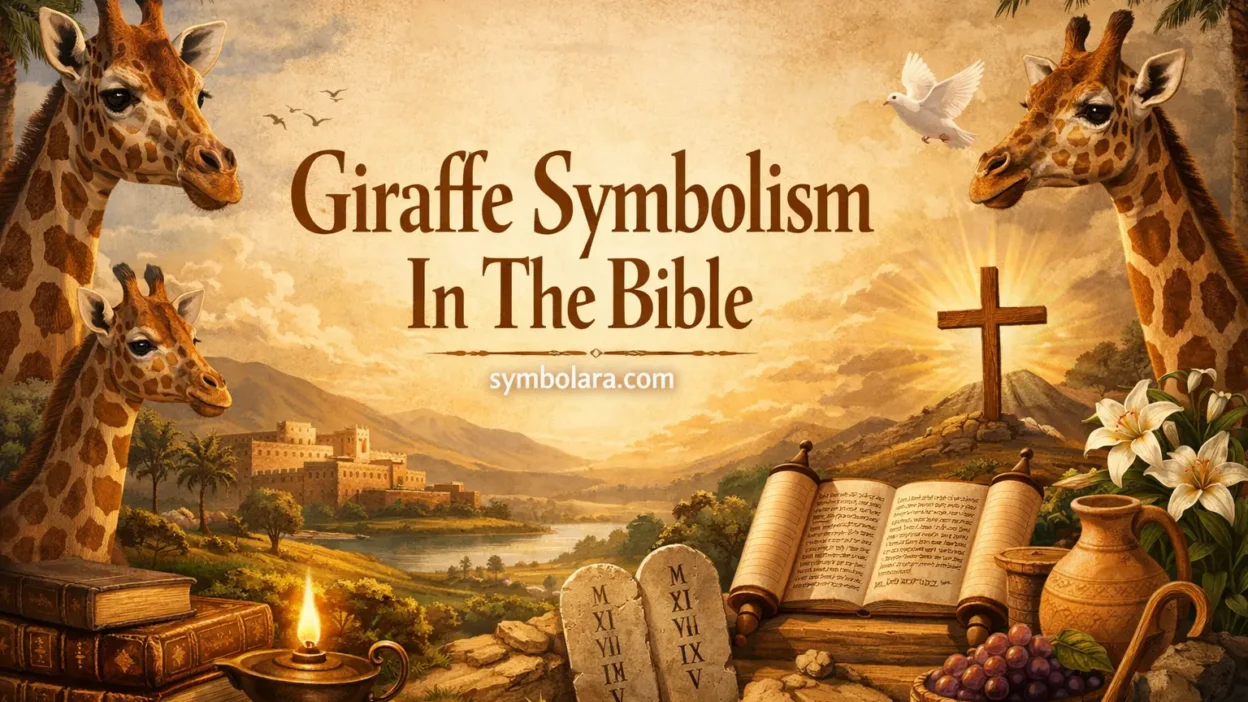
Giraffe symbolism in the Bible attracts readers because it sits in a careful middle ground between Scripture, later Christian reflection, and modern animal symbolism. Many people want to know whether the giraffe has a direct biblical message or whether its meaning comes mostly from devotional interpretation built around the animal’s appearance and character.
That distinction matters. In most modern English Bibles, the giraffe does not appear as a clear, major biblical symbol in the way the lamb, lion, dove, or serpent does. Deuteronomy 14:5 includes a debated animal name, and some older translation traditions render it as “camelopard” or connect it to the giraffe, while many modern translations use other animals instead and note that some identifications in the list are uncertain.
In the United States, that has led to a very specific kind of meaning. Bible-centered readers often treat the giraffe less as a fixed scriptural emblem and more as a devotional symbol of perspective, gentleness, watchfulness, calm strength, and seeing beyond the immediate moment. That reading is interpretive rather than doctrinal, but it still resonates strongly.
Quick Answer
In American Christian reading, giraffe symbolism in the Bible usually points to spiritual perspective, gentle strength, watchfulness, and rising above fear. But the Bible does not assign the giraffe a clear, widely agreed symbolic role, so most of these meanings come from later reflection rather than direct biblical teaching.
What The Giraffe Looks Like And Why That Matters
A giraffe is the tallest living land animal, with a long neck, long legs, a spotted coat, and a calm but highly alert bearing. Britannica notes that giraffes were known in the ancient world and even appear in early Egyptian tomb paintings, which helps explain why they could be noticed and remembered symbolically even if they never became a central biblical image.
Those visible features naturally invite symbolic reading. Height suggests broader vision. A long neck suggests reaching upward or seeing farther. Spots suggest distinct identity. A calm stance suggests peaceful strength rather than aggression.
For American readers, the giraffe also feels approachable. It is powerful, but it is not usually read as predatory or violent. Because of that, it tends to gather uplifting meanings more easily than animals associated with threat or domination.
Is The Giraffe Actually In The Bible?
This is the key question, and it needs a careful answer.
In most familiar modern English translations, readers will not find “giraffe” plainly listed as a standard biblical animal. Deuteronomy 14:5 names several clean animals, but modern versions usually render the final disputed term as something like antelope, mountain sheep, ibex, or similar animals. Bible Gateway’s NIV note explicitly says that the precise identification of some of the animals in the chapter is uncertain.
At the same time, some older or alternative traditions do connect the verse to the giraffe. Bible Hub’s parallel display shows older renderings such as “camelopardalus,” while Biblical Archaeology Review notes a possible reference to the giraffe in Deuteronomy 14:5 and describes giraffes as unusual animals that could have reached the biblical world through trade or gift exchange.
That means the strongest accurate conclusion is this: the giraffe has a possible biblical link, but not a fixed, universally accepted one. Any symbolic meaning built from that link should be presented modestly.
Curious how other birds are interpreted in Scripture? Explore the deeper spiritual meaning behind flamingos in this guide on Flamingo Symbolism in the Bible.
Giraffe Symbolism In The Bible Compared With Other Biblical Animals
While the giraffe has a debated connection to biblical animal lists, other creatures in Scripture have much stronger and clearer symbolic roles. Understanding this difference helps readers place giraffe symbolism in the right context.
Animals such as the lamb, dove, lion, serpent, eagle, and sheep appear repeatedly throughout the Bible and are connected with specific themes. The lamb often represents sacrifice and innocence, the dove is associated with peace and the Holy Spirit, the lion can represent power and kingship, and the eagle is often connected with renewal and strength.
The giraffe stands apart because its symbolism comes mostly from reflection on its physical characteristics rather than repeated biblical stories or teachings. Its long neck, height, and calm behavior inspire ideas of vision, patience, and awareness, but these meanings developed through interpretation rather than direct scriptural statements.
This comparison does not make giraffe symbolism less meaningful. Instead, it shows that symbols can exist on different levels. Some are directly established in religious texts, while others become meaningful through cultural understanding, personal reflection, and devotional use.
Why The Uncertainty Matters
Because the textual connection is debated, giraffe symbolism in Christian writing is mostly devotional rather than doctrinal. Readers may still draw lessons from the animal, but those lessons should not be presented as settled biblical teaching.
That honesty actually improves the symbolism. It lets the giraffe work as a meditation symbol without forcing it into a scriptural role the text itself does not clearly assign.
Does The Bible Teach A Spiritual Meaning For The Giraffe?
The Bible does not provide a specific teaching that assigns the giraffe a spiritual meaning. Unlike animals such as the serpent, dove, or lamb, the giraffe does not appear as a recurring biblical symbol with a clearly defined message.
However, many Christians use animals as reminders of spiritual principles by reflecting on their characteristics. In this way, the giraffe can represent ideas that connect with biblical themes, such as wisdom, patience, humility, and looking beyond immediate circumstances.
The important distinction is between biblical teaching and personal reflection. A reader may find encouragement in the giraffe’s symbolism, but that interpretation should be understood as a meaningful meditation rather than a direct command or doctrine from Scripture.
This balanced approach allows the giraffe to remain a valuable spiritual symbol while respecting the historical and textual limits of the Bible.
The Core Meaning At A Glance
When Americans look for biblical giraffe meaning, a few themes appear again and again.
The first is perspective. The giraffe sees farther than others, so it becomes a symbol of stepping back, praying, and seeing life from a higher angle. The second is gentle strength. The animal is large and capable, yet it does not usually symbolize cruelty or domination. The third is uniqueness. No other land animal looks quite like it, so it often stands for being set apart without shame.
These meanings are not handed down by one defining Bible verse. They come from the animal’s form, the debated biblical connection, and the way devotional readers apply visible traits to spiritual life.
Giraffe Symbolism In Christian Interpretation
Seeing Farther Spiritually
In Christian reflection, the giraffe often stands for lifted vision. Because it rises above the ground and sees across distance, it becomes a picture of prayerful perspective. The symbolic lesson is not that believers literally become removed from life, but that they are invited to see beyond panic, beyond the present crisis, and beyond what is immediately in front of them.
That fits well with familiar Christian devotional language about trusting God’s larger view, even if the giraffe itself is not assigned that role directly in Scripture.
Strength Without Harshness
Another common reading is gentle strength. The giraffe is tall and powerful, yet it does not usually evoke brutality. That makes it appealing in Christian encouragement writing, especially for readers who value humility, peace, and steadiness more than forceful self-assertion.
Being Set Apart
Its unusual shape also supports a moral lesson about distinctness. In church culture, that can easily become a message about being set apart, not needing to copy the crowd, and trusting that difference does not cancel dignity or purpose.
Historical Background Before Christianity
Long before modern devotional writing, giraffes already had a visible place in African and Egyptian visual history. Britannica states that giraffes appear in early Egyptian tomb paintings, and the Met’s collection includes works from the Tomb of Rekhmire depicting Nubians with a giraffe and a monkey, showing that the animal was known and represented in the ancient world.
That said, the giraffe was not central to the everyday symbolic world of ancient Israel in the way sheep, goats, doves, lions, or serpents were. Biblical Archaeology Review notes only a possible reference in Deuteronomy 14:5 and explains that the giraffe would have been unusual in the biblical region apart from exceptional trade or diplomatic exchange.
This helps explain why giraffe symbolism feels more modern and interpretive than classical and fixed. The animal was known broadly in the ancient world, but it was not one of Scripture’s major recurring symbolic creatures.
What Giraffe Symbolism Means In The USA
In the United States, giraffe symbolism often bridges faith and encouragement. A Christian reader may see prayerful perspective in the giraffe. A nonreligious reader may simply see calm wisdom, uniqueness, and emotional balance. The symbol moves easily between devotional journals, nursery art, motivational posts, and personal reflection because it feels peaceful, memorable, and visually elevated.
American culture also tends to favor symbols that feel personal and uplifting. The giraffe fits that pattern well. It looks distinctive without looking menacing, so it naturally becomes a symbol of hope, grace, perspective, and staying above daily chaos.
Spiritual And Cross-Cultural Meanings
Outside strict Bible interpretation, giraffes are often linked with intuition, wider awareness, and the ability to connect what is near with what is far away. Those meanings come naturally from the animal’s shape and posture.
Its African cultural presence also deserves respect. The giraffe has appeared in art and visual culture across Africa for thousands of years, but those meanings are not identical from one people or place to another. The safest and most respectful claim is not that Africa has one giraffe meaning, but that the animal has long carried symbolic and visual importance in multiple African settings.
For American readers, that is a useful reminder: symbolism should be handled with appreciation and restraint, not flattened into one slogan.
Like ravens in the Bible, giraffe symbolism also reveals deeper spiritual lessons and biblical meaning through animals.
Emotional And Psychological Meaning
Psychologically, the giraffe often suggests emotional distance in the best sense of the phrase. Not coldness, but breathing room. It symbolizes stepping back from immediate drama, noticing patterns, and responding with calm instead of panic.
People also tend to read the giraffe as a balance between thought and feeling. Its height suggests mental or spiritual perspective, while its grounded body and slow movement keep it from feeling detached or severe. That combination helps explain why the giraffe often feels wise, gentle, centered, and quietly strong.
Modern Uses In Everyday Life
Today, giraffes show up in tattoos, decor, children’s spaces, greeting products, and social media. A giraffe tattoo may suggest uniqueness, grace, calm strength, or a commitment to seeing life from a higher angle. In decor, the giraffe often adds warmth, wonder, softness, and a peaceful safari feel. In faith-oriented settings, it can function as a reminder to pause, pray, and widen one’s view.
That everyday flexibility matters because it shows how symbols travel in American culture. A giraffe can appear in a devotional notebook one day and in playful home decor the next without losing its core associations with calm, perspective, and charm.
Misunderstandings And Overstatements
The biggest mistake is saying that the Bible clearly teaches a fixed symbolic meaning for giraffes. It does not. At most, there is a debated textual link in Deuteronomy 14:5, supported by some older translation traditions and treated cautiously by modern translators and scholars.
Another mistake is treating every animal encounter as a coded biblical message. Personal reflection can be meaningful, but it should not be confused with biblical scholarship. A responsible article leaves room for wonder while staying honest about the limits of the text.
Negative Or More Tense Meanings
The giraffe is usually read positively, but not always. Because it stands high above others, it can sometimes symbolize pride, emotional distance, or feeling out of place. A long neck may also be read as overreaching or watching from too far above ordinary life.
Still, in American use, those darker readings are secondary. Most readers do not see the giraffe as arrogant. They see it as unusual, calm, graceful, and gifted with perspective.
How The Meaning Has Shifted Over Time
In the ancient world, the giraffe was known and depicted, but it was not a major biblical religious symbol. Later translation traditions gave it a possible foothold in Bible-related discussion through the debated wording of Deuteronomy 14:5. In modern America, however, the giraffe has become far more of an inspirational and devotional symbol than a textual one.
That shift reflects a broader modern habit. Many readers now approach animals through psychology, personality, encouragement, and personal growth as much as through formal theology. The giraffe has therefore moved from being a possible biblical animal to being a symbol of elevated vision, uniqueness, and quiet grace.
When Giraffe Symbolism Feels Most Meaningful
The giraffe often feels especially resonant during seasons of stress, transition, healing, or self-discovery. Someone facing uncertainty may be drawn to its “see farther” symbolism. Someone who feels different may connect with its uniqueness. For Christians, it often works best as a meditation symbol rather than a doctrinal one: a reminder to lift the eyes, slow down, and trust that perspective matters.
FAQs
Is the giraffe directly mentioned in the Bible?
Not in a clear, widely agreed way in most modern translations. The connection usually comes from older translation traditions around Deuteronomy 14:5, where the animal identification is debated.
What does a giraffe symbolize for Christians?
For many Christians, it symbolizes perspective, gentle strength, calm awareness, and spiritual vision. Those meanings come mostly from devotional interpretation rather than from a fixed biblical teaching.
Why do people connect giraffes with spiritual vision?
Because the giraffe’s height naturally suggests seeing farther and rising above confusion. That physical trait easily becomes a metaphor for discernment, prayer, and the bigger picture.
Is giraffe symbolism positive or negative?
In the United States, it is mostly positive. Some readers can see hints of pride or distance in the animal’s height, but the stronger modern reading is grace, steadiness, uniqueness, and perspective.
What does a giraffe tattoo usually mean?
It often suggests grace, calm strength, individuality, or a wider view of life. In a faith setting, it may also hint at spiritual perspective and trust.
Does giraffe symbolism belong only to Christianity?
No. Giraffes also carry symbolic value in broader African visual history, general spirituality, psychology, and modern lifestyle symbolism. Christian meaning is only one layer of the larger story.
Conclusion
Giraffe symbolism in the Bible is best understood with both honesty and imagination. The giraffe does not stand among Scripture’s most established symbolic animals, and its direct biblical footing is limited and debated. But that does not make the symbol empty. It simply means readers should treat it as devotional reflection rather than fixed doctrine.
That is also why the giraffe continues to resonate. For many American readers, it has become a meaningful symbol of perspective, grace, gentle strength, and being set apart without fear. It invites a simple but powerful lesson: lift your eyes, widen your view, and move through life with quiet steadiness.