
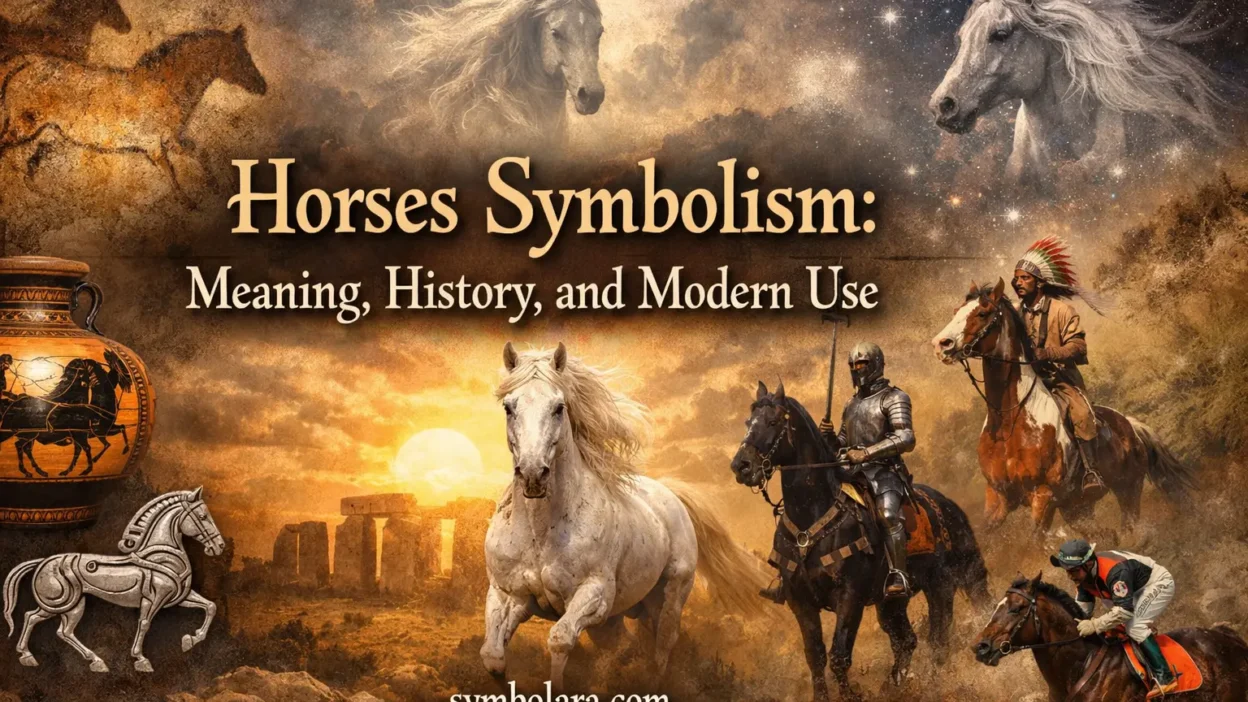
Horses have carried people into war, across open country, through farm work, sporting events, ceremonies, and stories. That long partnership helps explain why horses symbolism can communicate so many ideas at once. A running horse may suggest freedom, while a saddled working horse can represent discipline, service, or partnership.
For Americans, horse imagery is especially connected with the West. Mustangs, ranch horses, rodeo scenes, cavalry images, and mounted riders have helped make the animal an emblem of independence and wide-open space. The association is so firmly established that federal law describes wild free-roaming horses and burros as symbols of the historic pioneer character of the West.
Still, there is no single universal horse meaning. Ancient societies used horses as signs of rank and military ability, some religious traditions connected them with divine figures or supernatural travel, and particular Native nations developed their own cultural and ceremonial relationships with horses.
Quick Answer
Horses symbolism most commonly represents freedom, strength, independence, movement, endurance, and personal drive in modern American culture. Historically, horses have also symbolized prestige, warfare, spiritual relationships, travel, authority, and prosperity in different cultures.
TL;DR
- Horses commonly symbolize freedom, strength, endurance, and forward movement.
- Mustangs strongly represent independence and the American West.
- Native horse meanings vary among individual nations and traditions.
- Ancient horses could signify wealth, warfare, status, and sacred relationships.
- Color, posture, and context can completely change a horse image.
- Modern horse imagery appears widely in tattoos, fashion, art, and decor.
What Horse Imagery Looks Like and Where It Appears
A horse symbol can be realistic or highly stylized. Familiar forms include a horse running with its mane flying, a rearing stallion, a mare beside a foal, a lone mustang, a mounted rider, a horse head, a horseshoe, or an entire herd.
The pose matters because horses communicate differently depending on how they are shown. A galloping horse emphasizes speed and release. A rearing horse appears forceful and defiant. A calm horse beside a person can suggest trust, cooperation, or companionship.
Americans encounter these images almost everywhere: ranch and Western decor, sports logos, state and local imagery, jewelry, tattoos, clothing, movie posters, children’s books, paintings, social media graphics, rodeo advertising, and equestrian organizations.
Historically, horses have appeared in an unusually broad range of American settings, including open ranges, farms, cities, military life, sports, and recreation. That range helps explain why horse symbolism feels equally at home in rugged Western imagery and more refined equestrian design.
What Horses Commonly Symbolize in the United States
Modern American interpretations usually begin with freedom and strength, but the exact meaning depends on context.
| Context | Common U.S. Meaning | Typical Association |
| Wild horse or mustang | Freedom, independence | Open land, untamed life |
| Galloping horse | Momentum, ambition | Progress, speed, determination |
| Work or ranch horse | Endurance, reliability | Labor, discipline, partnership |
| Horse and rider | Trust, skill, control | Cooperation, leadership |
| Mare and foal | Care, family bonds | Protection, tenderness |
| Herd of horses | Community, belonging | Cooperation, shared movement |
One reason the animal carries so many positive meanings is that strength and sensitivity coexist in the same creature. Horses are physically imposing, yet successful interaction with them depends heavily on training, communication, awareness, and trust.
That combination makes the horse especially useful as a symbol for strength that does not have to mean aggression.
Why Freedom Became the Horse’s Dominant Modern Meaning
Few images communicate motion as instantly as a horse running across open ground.
Unlike a stationary lion or eagle, a running horse visually occupies space. Its legs stretch forward, its mane and tail move with the wind, and the landscape appears to open around it. Artists and advertisers can therefore suggest escape, possibility, speed, or independence without adding explanatory text.
The American mustang strengthens that connection. Wild horses living on Western public lands became culturally associated with landscapes that Americans already imagined as vast and unconstrained. Congress reinforced this national symbolism when the Wild Free-Roaming Horses and Burros Act of 1971 formally connected wild horses with the historic and pioneer character of the West.
For personal symbolism, freedom does not always mean rejecting society. A horse tattoo or painting may instead represent leaving an unhealthy situation, becoming financially independent, choosing one’s own path, or regaining control after a restrictive period.
Horses and the Symbolic American West
The horse cannot be separated from the visual language of the American West.
Cowboys, ranchers, cavalry troops, Native riders, stage travel, cattle work, rodeos, and frontier stories all contributed to the animal’s place in the national imagination. The cowboy himself became a major popular symbol of the nineteenth-century West, later romanticized through entertainment and visual culture.
As a result, Western horse imagery often communicates self-reliance, toughness, practical skill, endurance, and life close to the land.
Yet that imagery is partly cultural mythology. The historical West included ranch labor, Native displacement, military campaigns, migration, Black cowboys, Mexican and Spanish equestrian traditions, women riders, immigrant communities, and commercial expansion. A lone cowboy riding toward the horizon tells only one part of that story.
Modern Western symbolism is therefore best understood as a blend of real equestrian history and later romantic storytelling.
Native American Horse Meanings Require Cultural Context
There is no single “Native American horse meaning.” Indigenous nations have distinct histories, religions, artistic traditions, languages, and relationships with animals.
As horses spread through the Plains during the colonial era, many communities incorporated them into transportation, hunting, trade, warfare, wealth, social life, and ceremony. Horses transformed mobility for numerous Plains peoples and became important enough to appear in songs, stories, artworks, clothing, equipment, and ceremonial objects.
In some Plains traditions, horses also developed explicitly spiritual relationships with people. Historical objects and traditions document associations with beauty, healing, supernatural power, and ceremonial life.
Those meanings should not be collapsed into claims such as “the horse is the Native American symbol of freedom.” That phrase replaces many living cultures with one modern stereotype.
A more respectful interpretation identifies the particular nation, historical period, artwork, story, or ceremony whenever possible.
Ancient Horses Could Represent Wealth, Rank, and Military Power
Before horses became romantic symbols of personal freedom, they often signaled something more concrete: resources and power.
Keeping horses required land, food, equipment, and skilled handlers. In societies where horses were essential to transportation or warfare, owning them could distinguish elites from people with fewer resources.
Ancient Greek horse imagery provides a clear example. Horse ownership carried aristocratic status, while riding and chariot competition displayed wealth and prestige. Bronze horse figures were also dedicated at religious sanctuaries as offerings.
Across the Eurasian steppe, mobile horse-centered societies used riding for migration, pastoral life, trade, and warfare. The horse consequently became inseparable from mobility and military effectiveness in many regions.
This history explains why horse imagery can symbolize not only freedom but also authority, social standing, conquest, speed, and command.
Horses in Mythology Connect Earthly Speed With Supernatural Travel
Mythology frequently enlarges the horse’s natural abilities.
Greek tradition gives the most recognizable American example: Pegasus, the winged horse. Adding wings transforms ordinary speed into supernatural movement, which is why Pegasus imagery now easily suggests imagination, elevation, inspiration, and extraordinary achievement.
Celtic and Gallo-Roman traditions offer a different connection through Epona, a goddess closely associated with horses. Archaeological and written evidence shows that her worship spread across a wide area of the Roman world, including among military communities.
Norse mythology includes Sleipnir, Odin’s extraordinary eight-legged horse, whose ability to carry the god across mythic realms makes him associated with exceptional travel and passage between worlds.
The common thread is movement. Because real horses could carry humans farther and faster than walking, mythology could extend that ability into journeys that ordinary people could never make.
Horse Symbolism in Art and Literature
Horses have played a major role in art and literature because they combine physical beauty with powerful human ideas. Artists often use horses to represent movement, ambition, courage, and the relationship between humans and nature.
In paintings, a horse may communicate more than the animal itself. A rider on horseback can symbolize leadership, exploration, or control, while a lone horse may suggest independence and personal strength. Throughout history, artists have used horses to show rulers, warriors, heroes, and everyday people connected with travel and transformation.
Literature also uses horses as meaningful characters rather than simple animals. Stories often present horses as loyal companions, symbols of adventure, or partners during difficult journeys. Their ability to carry characters across great distances makes them natural symbols of change, discovery, and personal growth.
In American literature and popular culture, horses frequently appear alongside themes of the frontier, identity, survival, and freedom. Western novels and films especially use horses to represent independence and the challenges of life beyond settled communities.
However, horse symbolism in art and writing depends on the story’s context. A heroic war horse, a peaceful farm horse, and a mythical flying horse may all represent completely different ideas.
Horse Symbolism in Chinese Culture
Chinese horse imagery traditionally carries many favorable associations.
Horses were historically linked with military strength, communication, travel, prestige, and imperial authority. They also occupy a place in the Chinese zodiac, where the horse is associated with qualities such as vigor and strength.
Museum interpretations of Chinese horse imagery identify positive associations including power, strength, vitality, prosperity, and success.
Those associations help explain why Chinese-inspired horse art may communicate advancement or achievement rather than the American idea of an untamed wilderness.
Context remains important. A Chinese zodiac horse, a Tang dynasty ceramic horse, and an American mustang painting may depict the same animal while carrying very different cultural messages.
Horses in Biblical and Christian Symbolism
Biblical horse imagery is more complicated than the modern freedom symbol.
Horses frequently appear in settings connected with armies, rulers, chariots, judgment, and conflict. The best-known examples for many Americans are the Four Horsemen of Revelation, whose horses accompany catastrophic figures associated with conquest, warfare, famine, and death.
That imagery gave the horse a lasting connection with apocalypse and overwhelming forces beyond ordinary human control.
Christian symbolism is not entirely negative, however. Revelation also uses a white horse in an image of divine victory, so a white horse in Christian artwork can carry associations with triumph, righteousness, or heavenly authority.
This is a good example of why color alone cannot determine meaning. A white horse in a wedding illustration, a Western photograph, and an apocalyptic painting may symbolize completely different things.
Emotional and Psychological Meaning
Horse imagery often appeals to people who want to express both autonomy and emotional connection.
A lone horse can represent independence, solitude, or refusing to follow a crowd. A horse and rider may emphasize trust, self-control, and cooperation. A herd shifts the message toward belonging, protection, and social connection.
The animal can also represent perseverance. Horses are culturally associated with sustained movement, physical effort, training, and demanding journeys, so they work naturally as symbols of continuing through difficulty.
Some people interpret horses as signs of instinct or emotional sensitivity because riding and handling them require attention to behavior and responsiveness. In personal artwork, that can become a metaphor for balancing instinct with discipline.
These are psychological interpretations rather than fixed scientific meanings. What a horse represents emotionally depends largely on the person’s experiences and the way the animal is depicted.
How Color, Pose, and Setting Change the Meaning
A horse rarely communicates meaning through species alone. Visual details do much of the work.
A white horse commonly suggests purity, heroism, victory, or an idealized spiritual presence in modern Western imagery. Religious or funerary contexts can change that reading.
A black horse often looks dramatic and may suggest strength, independence, elegance, danger, grief, or the unknown. These meanings come largely from broader Western color associations rather than an ancient universal rule about black horses.
A brown or chestnut horse usually produces a more naturalistic impression. In ranch, farm, and countryside imagery, it can emphasize reliability, work, warmth, and connection with the land.
Pose matters just as much. A rearing stallion appears defiant; a galloping herd feels energetic and free; a grazing horse suggests calm; a mare protecting a foal shifts attention toward care.
Even fences matter. A horse behind a fence can symbolize safety and home in one image but limitation or confinement in another.
Horse Symbolism in Different Horse Breeds
Different horse breeds can create different symbolic impressions because people associate them with specific histories, environments, and uses.
Mustangs often represent freedom, resilience, and independence because of their connection with the American West and open landscapes. Their survival in challenging environments strengthens their image as symbols of endurance.
Arabian horses are commonly associated with elegance, heritage, intelligence, and refinement because of their long historical connection with Middle Eastern cultures and selective breeding traditions.
Thoroughbred horses often symbolize speed, competition, achievement, and ambition because of their connection with racing and athletic performance.
Draft horses, such as Clydesdales and other working breeds, frequently represent strength, reliability, patience, and service because of their historic role in agriculture and heavy labor.
However, breed symbolism is not universal. A horse’s meaning depends on the viewer’s personal experiences, cultural background, and the context where the image appears.
Horse Tattoos, Jewelry, Decor, and Modern Style
Modern horse imagery is highly personal.
In tattoos, galloping horses are popular choices for themes of freedom, recovery, determination, and starting over. A rearing horse can emphasize courage or refusal to submit, while a realistic portrait may simply memorialize a beloved horse.
Horse jewelry often works differently. Small horse-head pendants, horseshoes, equestrian bracelets, and riding motifs may express a connection to riding culture rather than abstract symbolism. Someone who grew up around horses may wear the image as a family or lifestyle marker.
Home decor frequently divides into two styles. Western designs use horses with desert landscapes, barns, ranch equipment, leather, or rustic materials. More formal equestrian decor emphasizes saddles, bridles, racing, jumping, and traditional riding culture.
Digital culture keeps adapting the same imagery. Running horses appear in motivational graphics because movement visually supports phrases about progress, ambition, independence, and refusing to remain stuck.
Horse Symbolism in Modern Branding and Logos
Companies and organizations often use horse imagery because the animal communicates qualities that many brands want to represent.
A horse logo may suggest speed, reliability, elegance, performance, or tradition. Racing organizations often use horses to highlight competition and athletic ability, while Western brands may use horses to communicate authenticity, independence, and connection with outdoor life.
Luxury brands sometimes use equestrian imagery because horses have historical associations with prestige, craftsmanship, and refined lifestyles. Sports and automotive brands may also use horse symbols to create a sense of power, energy, and performance.
The meaning of a horse logo depends on the brand’s purpose and audience. A symbol that represents luxury in one setting may represent adventure or freedom in another.
This flexibility is one reason horses remain popular visual symbols in modern design.
Horse Symbolism in Dreams: Common Interpretations
Horse dreams are often interpreted through themes connected with movement, emotions, and personal goals. Because horses are strongly associated with travel and energy, many people view them as symbols of progress, independence, or a desire for change.
A running horse in a dream may reflect motivation, freedom, or the feeling of moving toward a goal. A calm horse may represent balance, trust, or emotional stability. Meanwhile, a frightened or trapped horse could symbolize feelings of restriction, pressure, or a situation where personal freedom feels limited.
The details of the dream usually matter more than the animal alone. The horse’s color, behavior, environment, and the dreamer’s emotions can influence the interpretation.
For example, a person riding a horse may associate the image with confidence, direction, or taking control of a situation. Seeing a herd of horses may connect with relationships, community, or shared goals.
Dream symbolism is personal rather than scientifically fixed. A horse dream may reflect individual experiences, memories, cultural influences, or emotions rather than a universal message that applies to everyone.
How Horse Meanings Have Changed and Where Interpretations Go Wrong
The symbolism of horses has shifted because people’s relationships with horses have changed.
For much of human history, horses were practical assets. They moved people and goods, influenced warfare, supported agriculture, carried messages, displayed wealth, and expanded the distance a person could travel.
Industrial transportation reduced many of those everyday roles. In the United States, horses became increasingly associated with recreation, ranch heritage, competition, conservation, nostalgia, and personal identity. The practical transportation animal could now be imagined more easily as an emblem of freedom.
That romantic image can create misunderstandings.
One is the tendency to describe any horse design as a Native “spirit animal” symbol. Indigenous cultural institutions specifically warn against treating diverse Native animal traditions as interchangeable or copying sacred and community-specific imagery without context.
Another is assuming that the wild mustang represents uncomplicated wilderness. Wild horses are legally protected and culturally celebrated, but their management also involves real questions about herd populations, rangeland conditions, animal welfare, and competing uses of public land.
Recognizing those complications does not weaken the symbol. It simply separates romantic imagery from history and living cultural realities.
Horse and Horseshoe Symbolism: Understanding the Difference
Horse symbolism and horseshoe symbolism are closely connected, but they do not represent exactly the same ideas.
The horse itself usually represents movement, freedom, strength, endurance, partnership, and personal power. Its meaning often comes from the animal’s behavior, history, and relationship with humans.
The horseshoe, however, developed a separate symbolic identity. In many Western traditions, horseshoes became associated with protection and good fortune because they were placed on horses’ hooves and were believed to guard against harm.
The difference becomes important when interpreting artwork or decorations. A running horse image may focus on independence and progress, while a horseshoe hanging above a doorway may suggest luck, safety, or protection.
Both symbols come from the long human relationship with horses, but each carries its own cultural history and meaning.
FAQs
A horse can represent movement, strength, freedom, transition, or a relationship between ordinary life and the sacred, depending on the tradition. There is no universal spiritual meaning, so claims about a single “horse spiritual meaning” should be treated cautiously.
Horse tattoos commonly express independence, freedom, endurance, courage, or forward movement. A portrait tattoo may have a more personal meaning, such as honoring a particular animal, family tradition, or equestrian lifestyle.
In American culture, a wild horse most strongly symbolizes freedom, independence, and life beyond human control. The mustang is especially connected with the Western landscape and the cultural memory of the frontier.
They can be, but the idea is more commonly attached to the horseshoe than to every horse image. In other traditions, including Chinese cultural symbolism, horse imagery can carry favorable associations with success, vitality, and prosperity.
A white horse can represent purity, victory, heroism, spiritual authority, or an idealized form of freedom in Western imagery. Biblical context can give it additional associations with divine triumph or apocalyptic imagery.
Meanings differ by nation and historical setting. Among several Plains peoples, horses became important to travel, hunting, warfare, wealth, art, ceremony, and spiritual relationships, but those traditions should not be reduced to one universal Native meaning.
A herd usually shifts the emphasis from individual freedom toward community, cooperation, belonging, and collective movement. If the herd is shown running freely, the image can combine those ideas with energy and independence.
Conclusion
The horse carries such varied meanings because people have experienced it in so many roles: working partner, military asset, status marker, ceremonial presence, sporting companion, mythological creature, and image of the open landscape.
In the United States, horses symbolism most often centers on freedom, strength, endurance, independence, and forward movement, particularly when the animal is shown running or living wild. At the same time, Western history, Native traditions, ancient religion, mythology, and modern personal use add meanings that cannot be reduced to one formula.
The most accurate interpretation comes from looking at the whole image the horse’s pose, color, setting, cultural tradition, and the reason someone chose to use it.
[…] is this: the giraffe has a possible biblical link, but not a fixed, universally accepted one. Any symbolic meaning built from that link should be presented […]
[…] out that flowers, animals, garments, gestures, and objects in older paintings were often chosen for symbolic meaning as much as visual beauty. A flower might suggest purity, mortality, sorrow, or resurrection […]
[…] Hawk DreamPossible Symbolic Meaning […]