
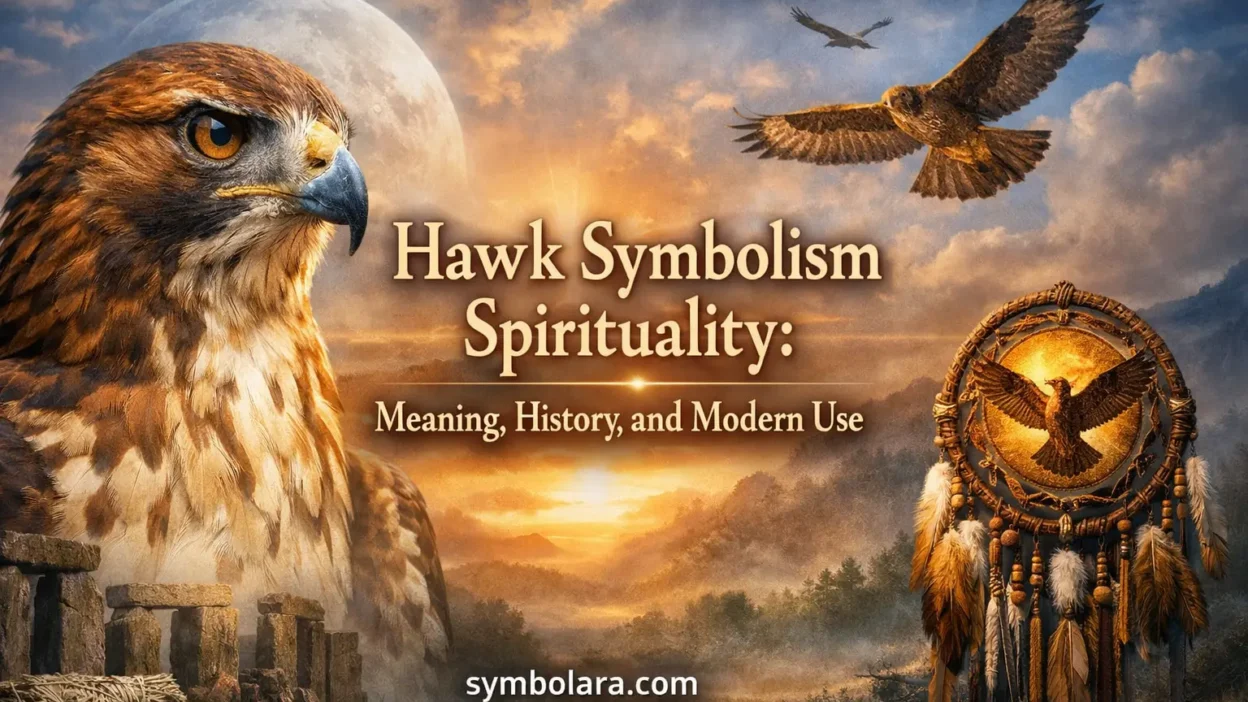
People usually search for Hawk Symbolism Spirituality because the bird feels unusually noticeable. A hawk crosses the road, circles overhead, lands on a pole outside the house, or appears again and again during a stressful stretch of life. Even people who are not especially religious often pause when it happens.
That reaction makes sense in the United States, where hawks are both familiar and dramatic. Red-tailed Hawks are among the most common hawks in North America, and many Americans know the silhouette without knowing the species name: broad wings, steady circles, a fixed stare, and the sense that the bird sees more than we do from the ground.
What gives the hawk symbolic force is not just appearance. It is behavior. Hawks hunt by watching carefully, traveling light, and acting at the right moment. That is why modern spiritual language around hawks usually points to awareness, clarity, timing, and a wider point of view rather than to vague ideas about “energy.”
Quick Answer
Hawk Symbolism Spirituality commonly symbolizes alertness, perspective, discernment, and timely action in modern American culture, especially when people read a hawk sighting as a reminder to pay attention and see the bigger picture. Historically, hawks and hawk-like birds have also been linked to sky power, rulership, protection, hunting skill, and sacred vision in traditions ranging from ancient Egypt to many Indigenous cultures, though those meanings are not all identical.
TL;DR
- In the U.S., hawks often mean focus and perspective.
- Their symbolism comes from visible hunting behavior.
- Ancient cultures tied hawk-like birds to sky authority.
- American meaning is more personal than ceremonial.
- Not all Indigenous hawk meanings are interchangeable.
- Modern use appears in tattoos, decor, and self-identity.
What A Hawk Is and Why People Notice It
A hawk is a daytime bird of prey, built for hunting with strong talons, a hooked beak, and soaring flight. In daily American life, hawks often appear alone on fence posts, utility poles, bare branches, or high in the sky riding warm air. That combination of height, patience, and sudden motion is a big reason the bird feels symbolic in the first place.
Unlike smaller birds that blend into background noise, a hawk tends to interrupt a scene. It creates a pause. You look up. That pause is part of its modern spiritual meaning. The hawk becomes a sign of attention because it forces attention.
What It Commonly Means in the United States
In contemporary U.S. culture, the hawk most often symbolizes four things: vigilance, clarity, independence, and decisive action.
Vigilance comes from the bird’s visible watchfulness. A perched hawk appears to scan everything below it. Clarity comes from its reputation for distance vision and from the way it circles high above a landscape. Independence grows from the fact that many birds of prey are commonly seen alone. Decisive action follows because the hawk does not drift forever; it watches, chooses, and moves. These are the traits most Americans are drawing on when they describe a hawk as a “sign.”
That is why the bird shows up in motivational language, personal reflection, tattoo choices, and everyday speech. To call someone “hawk-eyed” is to praise close attention. To “watch like a hawk” is to observe carefully. Even outside formal spirituality, the metaphor is already built into American English.
Why Spiritual Meanings Form Around Hawks
People do not assign meanings to animals at random. They usually start with traits they can see.
With hawks, the symbolic leap is straightforward. Soaring suggests overview. Sharp hunting suggests discernment. Solitary perching suggests self-possession. Sudden dives suggest action after patience. When a modern American says a hawk means “look closer” or “rise above the situation,” that meaning is not arbitrary. It is a human reading of real behavior.
This is also why hawk symbolism often feels more grounded than some other bird symbolism. A dove can be abstracted into peace fairly quickly. A hawk keeps pulling the imagination back toward concrete things: survival, timing, accuracy, and control.
What Does Seeing a Hawk Mean Spiritually?
A hawk sighting often becomes meaningful because the bird naturally captures human attention. In modern spiritual interpretations, seeing a hawk is commonly connected with awareness, perspective, and paying attention to important details.
Many people view a hawk appearing during a difficult decision or life transition as a personal reminder to slow down and observe before acting. The hawk’s ability to circle high above the ground creates a powerful symbol of looking beyond immediate problems and understanding the larger situation.
Some spiritual interpretations connect repeated hawk sightings with:
- A need to trust your own judgment
- A reminder to stay focused on your goals
- A period of personal growth or change
- The importance of patience before making a decision
- A desire to gain a clearer perspective
However, hawk sightings do not have one universal meaning. A person’s culture, beliefs, experiences, and personal connection with the bird influence how they interpret the encounter.
For many Americans today, a hawk is less about predicting the future and more about reflection. The bird encourages people to become more observant, confident, and intentional in their choices.
Ancient Roots and Early Sacred Associations
Some of the oldest major symbolic associations around hawk-like birds come from ancient Egypt. Horus was represented as a falcon or falcon-headed god and was associated with the sky, kingship, protection, and rule. His eye also became one of the best-known protective symbols in the ancient Mediterranean world. Ra, another major Egyptian deity, could also be represented as a hawk or falcon.
Those ancient meanings matter because they show an early pattern that lasted for centuries: birds that dominate the sky often become symbols of authority, divine sight, and protection. Even when modern Americans know nothing about Horus, some of the old symbolic logic remains familiar. A hawk still feels like a creature of elevation, command, and visual mastery. That does not mean today’s spiritual language is directly inherited from Egypt in a simple line. It means similar human responses keep reappearing around similar animals.
Hawk Meaning in Indigenous and Native Contexts
This is the section that requires the most care. There is no single “Native American hawk meaning.” Tribal traditions differ, and flattening them into one message is inaccurate.
What can be said safely is that raptors have long held importance in many Indigenous cultures of North America, including in visual traditions, stories, ceremonial life, and systems of respect for birds. National Park Service material on the Grand Canyon notes that Puebloan communities depicted birds of prey in rock imagery long ago, showing that these birds were culturally significant far before modern non-Native spiritual trends. Federal law and policy around eagle feathers also reflect the continuing religious importance of certain birds of prey for federally recognized Tribes, though eagle traditions should not be casually merged with hawk symbolism.
The respectful takeaway is this: hawk symbolism in Indigenous contexts may involve protection, hunting ability, status, ceremony, clan identity, or other meanings depending on the nation and tradition. It should never be reduced to a generic social-media slogan.
Hawk Symbolism in Christianity and Other Religious Reading
In biblical literature, the hawk appears as part of the created order rather than as a fixed stand-alone symbol with one agreed meaning. In Job, the hawk’s flight is used to emphasize divine wisdom beyond human control. That makes the bird an example of natural order, instinct, and creation’s complexity rather than a simple emblem of good or evil.
In present-day Christian interpretation, some readers take hawk encounters as reminders to stay watchful, prayerful, or attentive to direction. That is a modern devotional reading, not a universal doctrine. It can be meaningful on a personal level, but it should be distinguished from formal biblical symbolism.
Emotional and Psychological Meaning
Psychologically, hawks often symbolize a state of mind more than a belief system.
They can represent the wish to rise above confusion and see a situation whole. They can also stand for boundaries, self-trust, and strategic patience. Someone drawn to hawk imagery may be responding to the bird’s composure under pressure: it does not rush every movement, but it also does not miss the moment when movement matters.
This is why hawk symbolism often appears during transitions involving work, family conflict, recovery, or major decisions. The emotional message is usually not “something magical is happening.” It is closer to “pay attention, trust your judgment, and act with precision.”
Hawk Symbolism in Dreams: Common Interpretations
Dreams about hawks are often interpreted through themes connected to vision, freedom, and awareness. Because hawks spend much of their time watching from above before taking action, they commonly represent observation, patience, and strategic thinking in dream symbolism.
A flying hawk in a dream may represent a desire for independence or a need to look at a situation from a wider perspective. A perched hawk may suggest waiting, planning, or carefully observing before making an important move.
Common hawk dream interpretations include:
| Hawk DreamPossible Symbolic Meaning | |
|---|---|
| Flying hawk | Freedom, ambition, rising above challenges |
| Hawk watching from a tree | Patience, awareness, careful observation |
| Hawk attacking | Conflict, pressure, or facing a powerful challenge |
| Injured hawk | Feeling limited or needing recovery |
| Multiple hawks | Increased awareness or teamwork |
Dream symbolism is personal rather than universal. The emotions felt during the dream often matter as much as the hawk itself. A peaceful hawk dream may represent confidence, while a frightening one may reflect stress or concerns about control.
A Quick Comparison of Common Meanings
| Context | Meaning in the USA | Common Associations | Notes |
| Personal spirituality | Awareness and guidance | Seeing clearly, timing, intuition | Usually individual, not institutional |
| Tattoos | Independence and strength | Focus, resilience, self-command | Often tied to life transitions |
| Home decor and art | Freedom and wildness | Open skies, nature, American landscape | More aesthetic than religious |
| Religious reflection | Watchfulness under God | Creation, order, discernment | Varies by tradition |
| Cultural observation | Power and vigilance | Sharp sight, hunting, control | Drawn from visible behavior |
Hawk Symbolism by Color: Red-Tailed, Black, and White Hawks
Different hawk colors can create different symbolic associations in modern interpretations. These meanings usually come from appearance, cultural associations, and personal beliefs rather than fixed spiritual rules.
Red-Tailed Hawk Symbolism
The red-tailed hawk is one of the most familiar hawks in North America. Its symbolism often connects with strength, stability, grounding, and awareness. Because it is commonly seen across open landscapes, many people associate it with resilience and connection to nature.
Black Hawk Symbolism
Black hawk symbolism is often connected with mystery, protection, transformation, and hidden knowledge. Dark-colored animals frequently receive deeper symbolic meanings because they appear less common or more mysterious.
White Hawk Symbolism
White hawk symbolism is often associated with clarity, purity, peace, and spiritual awareness. In many modern interpretations, a rare white hawk sighting feels significant because of its unusual appearance.
The meaning of a hawk depends more on personal and cultural context than on color alone. These interpretations are symbolic traditions, not scientific explanations.
Why Hawks Matter So Much in American Life
The hawk occupies a special place in the United States partly because Americans actually see hawks. Red-tailed Hawks are common across North America, including along highways and open country. Hawk watching is also a public tradition, with formal hawkwatch sites, migration counts, and seasonal events across the country. Pennsylvania, New England, Texas, and national park sites all help keep hawks visible in public life rather than tucked away in specialist knowledge.
That visibility changes symbolism. Americans are less likely to imagine the hawk as an exotic creature and more likely to read it as a nearby sign of wild intelligence still living alongside roads, suburbs, farms, and cities. The result is a symbolism that feels practical. The hawk is not just a mythic bird from the distant past. It is a bird on the light pole outside the grocery store parking lot.
Hawk Spirit Animal Meaning and Personal Connection
The idea of a hawk as a spirit animal appears frequently in modern spiritual discussions. In these interpretations, the hawk represents qualities that people may want to develop in themselves, such as awareness, confidence, patience, and clear decision-making.
People who feel connected to hawk symbolism often identify with traits such as:
- Seeing situations from multiple viewpoints
- Remaining calm during challenges
- Trusting personal instincts
- Acting with purpose instead of rushing
However, the concept of animal guides varies widely between cultures. Some traditions have specific teachings about relationships with animals, while modern spiritual communities may use the idea more generally as a form of personal reflection.
A hawk can serve as a meaningful personal symbol without requiring the belief that every encounter carries a supernatural message.
Why Hawks Appear in Tattoos and Personal Style
In tattoos, jewelry, and clothing, hawks usually signal self-command rather than softness. People choose hawk imagery when they want to express discipline, survival, independence, sharp thinking, or the ability to see beyond immediate noise.
A hawk tattoo can also mark a turning point. Someone leaving a controlling relationship may choose it for regained perspective. A veteran or athlete may choose it for discipline and readiness. A person entering middle age may choose it for discernment rather than aggression. The hawk works well in personal style because it carries force without requiring constant explanation.
Its form helps too. Broad wings, hooked beak, and circling posture are visually recognizable. The symbolism reads quickly even when the artwork is simple.
Hawk Symbolism in Decor, Art, and Popular Media
In home decor and visual art, hawks usually stand for freedom, wilderness, self-reliance, or a bond with the American landscape. They appear in cabins, ranch homes, nature prints, Southwestern-influenced interiors, and contemporary rustic design because they connect human space to open country and watchful stillness.
In media, hawks can take on tougher meanings: surveillance, danger, elite skill, territorial control, or military precision. Context matters. The same bird that feels uplifting in a landscape painting may feel threatening in a thriller. Symbolism depends not only on the animal but on the frame placed around it.
That range is part of what makes the hawk durable. It can represent aspiration and warning at the same time.
Positive Meanings and Negative Meanings
Most modern spiritual readings of hawks are positive, but the symbolism is not purely positive.
On the positive side, hawks suggest clear judgment, confidence, readiness, and protection. On the darker side, they can suggest coldness, predation, domination, or over-control. A hawk may symbolize a person who sees clearly, but it can also symbolize a person who watches too hard, strikes too fast, or values winning over tenderness.
This ambivalence is normal in animal symbolism. Predators rarely symbolize only one thing. Hawks are admired partly because they are effective hunters. The same quality that becomes “focus” in one context becomes “ruthlessness” in another.
Common Misunderstandings About Hawk Spirituality
One common misunderstanding is that every hawk sighting carries a fixed supernatural message. It does not. Hawks are real, common birds, and many sightings are just sightings.
Another misunderstanding is that “hawk symbolism” means the same thing in every culture. It does not. Ancient Egyptian falcon symbolism, biblical references, Indigenous traditions, and modern American self-help language are related only in broad themes, not in exact doctrine.
A third mistake is blending hawks and eagles into one symbolic category. They overlap as raptors, but they are not culturally interchangeable. In the United States, eagle symbolism carries special legal, national, and religious weight that should not be casually transferred to hawks.
Hawk vs Eagle Symbolism: Key Differences
Hawks and eagles share some symbolic qualities because both are powerful birds of prey. However, their cultural meanings are not identical.
| Hawk Symbolism | Eagle Symbolism |
|---|---|
| Focus and observation | Leadership and national identity |
| Personal awareness | Power and authority |
| Precision and timing | Vision and strength |
| Strategy and patience | Freedom and dominance |
In modern spirituality, hawks are often viewed as symbols of personal insight and careful decision-making. Eagles more commonly represent larger ideas such as leadership, courage, and national pride, especially in the United States.
Both birds represent vision, but they express different forms of power. The hawk focuses on awareness and timing, while the eagle often represents higher authority and broader influence.
How Hawk Meaning Has Changed Over Time
Older symbolic systems often tied hawk-like birds to cosmic order, royal power, warfare, or sacred protection. Modern American readings are usually more personal and inward. People are less likely to say, “This bird represents kingship,” and more likely to say, “This bird reminds me to stay focused.”
That shift reflects a larger change in symbolism itself. In many ancient cultures, symbols were embedded in public religion and social hierarchy. In modern U.S. life, symbols are often individualized. A hawk becomes part of someone’s journal entry, tattoo design, grief process, or personal belief rather than a state-backed religious sign.
Even so, the core logic stayed surprisingly stable. Height still means perspective. Sharp sight still means discernment. Predatory skill still means force and accuracy. The symbolic language changed scale, but not entirely substance.
FAQs
What does seeing a hawk mean spiritually?
In modern American spirituality, seeing a hawk often means paying closer attention, stepping back for perspective, or acting with better timing. Most people who use this interpretation are reading the bird’s behavior symbolically rather than claiming a formal religious rule.
Is hawk symbolism positive or negative?
Usually it is positive, especially when tied to focus, clarity, independence, and protection. But hawks can also symbolize severity, predation, or emotional distance, so the meaning depends on context.
What does a hawk tattoo usually mean?
A hawk tattoo often represents self-trust, survival, discipline, and the ability to see clearly under pressure. It can also mark a major life transition, especially when someone wants an image of regained perspective.
Is hawk symbolism the same in Native American traditions?
No. Indigenous meanings vary by nation, region, and ceremonial context. It is more accurate to say that many Native traditions treat raptors with significance than to claim one universal Native meaning for hawks.
Is a hawk a religious symbol in Christianity?
Not in the same way a cross is. In Christian reading, hawks may be understood as part of God’s creation and as examples of divine wisdom and order, but personal interpretations of hawk sightings are usually devotional rather than doctrinal.
Why do Americans connect hawks with perspective?
Because hawks are commonly seen soaring high, scanning large areas, and choosing precise moments to move. The symbolism grows directly out of observable behavior, which makes the meaning feel intuitive even to people outside formal spirituality.
Is seeing a hawk a good spiritual sign?
Many people view seeing a hawk as a positive symbol of awareness, confidence, and clearer thinking. However, hawk sightings do not have one universal spiritual meaning. The interpretation depends on the person’s beliefs and the situation surrounding the encounter.
Conclusion
The clearest modern meaning of Hawk Symbolism Spirituality is alertness with perspective. In the United States, the hawk usually stands for seeing what others miss, staying composed, and acting when the moment is right.
Older traditions gave hawk-like birds meanings tied to sky power, protection, sacred vision, and authority. Modern Americans tend to translate those larger ideas into personal terms: clearer judgment, stronger boundaries, and a wider view of life.

[…] Christians also view the raven as a symbol of spiritual honesty. The bird does not represent pretending that life is always peaceful. Instead, it […]
[…] spiritual traditions may interpret birds more broadly as symbols of the soul, transition, or connection between the physical world and spiritual beliefs. These […]