
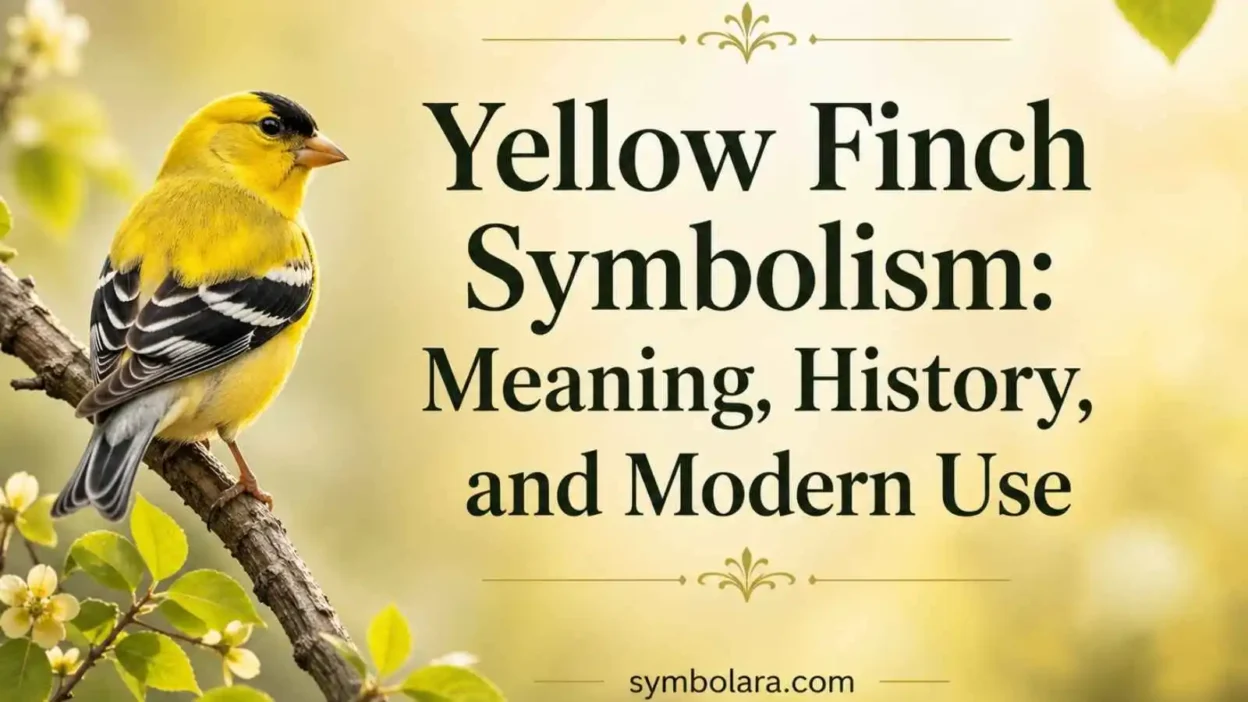
A yellow finch catches people’s attention for a simple reason: it looks like a small burst of sunlight. In the United States, when people talk about a “yellow finch,” they usually mean the American goldfinch, the bright backyard bird common at feeders, meadows, roadsides, and garden edges. It is not a strict species name in everyday speech, but it has become the bird most Americans picture when they hear the phrase.
People care about its symbolism because the bird feels familiar and readable. It is small, active, vocal, and visually cheerful, which makes it easy to turn into a sign of mood, season, and outlook. Unlike heavier bird symbols tied to power or mourning, the yellow finch usually belongs to a more domestic emotional world: yards, fences, wildflowers, seed heads, porch views, and ordinary moments that suddenly feel hopeful. This American reading grows naturally from how often the bird appears in everyday life and from the bright yellow breeding plumage that stands out in spring and summer.
That is also why its meaning matters now. In modern U.S. culture, bird symbolism often moves through personal style, tattoos, home decor, grief language, and social media captions. The yellow finch fits that world especially well because it suggests optimism without sounding grand, and renewal without becoming abstract.
Quick Answer
Yellow Finch Symbolism commonly points to joy, optimism, renewal, and the kind of hope people associate with sunlight, gardens, and seasonal return in modern American culture. Historically, goldfinch imagery has also carried older meanings tied to resilience, healing, Christian art, and the cycle of life, especially in European traditions.
TL;DR
- In the U.S., it usually means joy and lightness.
- Most people mean the American goldfinch.
- Its yellow color drives much of its symbolism.
- Older Christian art linked goldfinches with resurrection.
- Today it appears in tattoos, decor, and memorial language.
- Its seasonal color changes support meanings of renewal.
What A Yellow Finch Looks Like And Why That Matters
The symbol begins with the bird itself. The American goldfinch is a small finch with a short conical bill, a notched tail, and wing markings that contrast with yellow body feathers. In breeding season, males become strikingly yellow with black wings and a black forehead, while females and winter birds appear softer and more muted. That difference matters symbolically because most people respond not to an abstract bird category, but to a very specific visual effect: bright yellow against green fields or a backyard feeder.
Its voice shapes the symbol too. Goldfinches are known for light, musical contact calls and lively song, often heard as they rise and dip in flight. Because the bird is both visible and audible, it feels expressive in a way many backyard birds do not. People tend to interpret that combination as cheerfulness, sociability, and movement rather than stillness or solemnity.
What It Commonly Means In The United States
In present-day American usage, the yellow finch most often symbolizes happiness, good spirits, and emotional lift. That meaning is not random. It comes from the bird’s color, its quick motion, and its common appearance in ordinary outdoor settings. Americans are more likely to encounter it at a feeder or along a field edge than in a formal religious context, so the modern meaning tends to be personal and mood-based rather than doctrinal.
It also commonly suggests renewal. The bird’s bright plumage is strongest in the warmer part of the year, so it becomes linked with seasonal return, fresh energy, and recovery after a dull stretch. For many readers in the U.S., it signals not dramatic transformation but something gentler: feeling like yourself again, noticing beauty again, or sensing that life is opening back up. That is one reason it shows up so often in language about healing, encouragement, and emotional reassurance.
Why Yellow Changes The Meaning
If this bird were gray or brown, its symbolism would be different. Yellow carries strong emotional associations in American culture because it is visually tied to sunlight, warmth, energy, and alertness. That does not make every yellow symbol automatically positive, but it does explain why a yellow bird is usually read more optimistically than a darker one.
The color also gives the finch a mental meaning as well as an emotional one. Yellow often suggests brightness, clarity, liveliness, and quick attention. When those color associations combine with a small active bird, the result is a symbol of lightness, responsiveness, and everyday pleasure. In American decorative culture, that is exactly the kind of symbol people reach for when they want a room, image, or personal object to feel cheerful without becoming childish.
Ancient Roots And Earlier Bird Symbolism
The yellow finch does not arrive in symbolism from nowhere. Finches and goldfinches have long been noticed in Europe for their color, song, and feeding habits. Older traditions linked small bright birds to vitality, fertility, and the repeating cycle of seasons. Some of those associations were broad bird-symbol ideas rather than fixed rules, but they helped prepare the ground for later meanings.
Over time, the goldfinch gained a more distinct symbolic profile because it was recognizable and appeared often enough in art and lore to carry shared meaning. The key point is that its symbolism evolved from observed traits. People saw a vivid bird that fed on seed heads, survived seasonal change, and remained visually memorable, then attached ideas of persistence, animation, and return to it. That pattern is common in bird symbolism generally, but the goldfinch became one of the clearer examples.
Christian And Renaissance Meanings
One of the oldest well-known symbolic uses of the goldfinch appears in Christian and Renaissance art. In that setting, the bird could symbolize Christ’s Passion, redemption, healing, and resurrection. Part of this came from later legend, especially the story that a goldfinch tried to remove a thorn from Christ’s crown and was marked by blood, while part came from theological interpretation built around the bird’s behavior and appearance.
This older religious meaning is important, but it should not be confused with how most Americans use the symbol today. In museums or art history, a goldfinch can still point to sacrifice, suffering, and rebirth. In everyday U.S. life, though, most people are not reading a backyard yellow finch as a formal Christian emblem. They are more likely to experience it as a sign of cheer, comfort, or encouraging change. That split between art-historical meaning and ordinary modern meaning is one of the most useful distinctions to keep clear.
Why Americans Read It As A Backyard Sign Of Hope
In the United States, the yellow finch is not distant or exotic. The American goldfinch is common, visits feeders, and appears across much of the country in open habitats, gardens, parks, and brushy edges. It is also the state bird of New Jersey, Iowa, and Washington, which gives it a mild civic familiarity even outside birding circles.
That everyday presence shapes the symbolism. Americans often form meanings around animals they see in ordinary life, not just in stories. So the yellow finch becomes a symbol of good weather, home, neighborhood calm, and the relief of seeing something bright in the middle of routine. It belongs more to the emotional world of porches, feeders, and summer edges than to national power or heroic myth. That makes it especially appealing in memorial writing, small tattoos, greeting cards, and home accents.
What Does It Mean When You See A Yellow Finch?
Seeing a yellow finch is often interpreted as a positive and uplifting experience. In everyday American culture, people commonly connect this encounter with happiness, encouragement, and a reminder to appreciate simple pleasures.
Because the American goldfinch frequently appears near gardens, feeders, and natural spaces, many people associate it with peaceful surroundings and a closer connection with nature. A sudden sighting may feel meaningful because the bird’s bright color naturally attracts attention.
Some people interpret a yellow finch visit during a difficult time as a symbol of recovery or emotional support. Others simply enjoy it as a beautiful moment in nature. Both interpretations show how symbols work: their meaning comes from the relationship between the observer, the environment, and personal experience.
Rather than viewing the bird as a fixed message, it can be understood as an invitation to pause, observe, and appreciate moments of beauty in daily life.
Emotional And Psychological Meaning
Emotionally, the yellow finch often communicates uplift without intensity. It can suggest hope, but in a modest register. It can suggest happiness, but not necessarily triumph. That softer tone is part of its appeal. People who choose this symbol often want to express recovery, tenderness, resilience, or a return to joy after difficulty rather than dominance or dramatic reinvention.
Psychologically, it also works as a symbol of attention. A small bright bird interrupts the visual field. You notice it. Because of that, it can represent awareness, presence, and the ability to recognize small good things before they disappear. In American self-expression, that often translates into ideas like gratitude, being more awake to daily life, and finding steadiness in ordinary beauty. These are modern interpretive habits rather than ancient fixed rules, but they are consistent with how the bird is commonly discussed and used now.
Yellow Finch Spiritual Meaning And Symbolic Messages
The spiritual meaning of a yellow finch is often connected with hope, happiness, awareness, and emotional renewal. While symbolism depends on personal beliefs and cultural background, many people view this bright bird as a reminder to notice small moments of beauty and stay open to positive change.
The yellow finch’s connection with sunlight and seasonal growth makes it a natural symbol of encouragement. Its appearance can represent a fresh beginning, emotional healing, or the idea that difficult periods do not last forever. For many people, seeing a yellow finch feels like a gentle reminder to reconnect with gratitude and optimism.
In modern spiritual discussions, the bird is also linked with inner balance and personal growth. Because the finch is small but energetic, it often represents finding strength through simplicity rather than through power or control.
However, a yellow finch should not be treated as a guaranteed sign or prediction of future events. Symbolic meanings are personal interpretations shaped by culture, memories, and individual experiences. The most meaningful message often comes from what the bird represents to the person who notices it.
The Meaning Of Seasonal Change
One of the strongest symbolic layers comes from the goldfinch’s changing appearance across the year. Breeding males turn vivid yellow in spring and summer, then become much duller in winter. The species also has an unusual molt cycle that makes transformation especially visible.
That visible shift supports meanings of renewal, adaptation, and timing. The bird is not permanently golden. It brightens, fades, and brightens again. Symbolically, that makes it useful for people thinking about recovery, identity, aging, or seasons of life. The message is not constant brightness. It is that brightness can return. That is a more grounded and emotionally believable symbol, which may be why the yellow finch feels so relatable in modern culture.
Yellow Finch Symbolism In Dreams
In dream symbolism, a yellow finch is often associated with optimism, communication, freedom, and emotional renewal. Since birds commonly represent movement and perspective, a yellow finch appearing in a dream may suggest a desire for change, growth, or a lighter outlook.
The color yellow can add another layer of meaning. Many people connect yellow with confidence, creativity, energy, and awareness. When combined with a small songbird, these ideas can create a symbol of expressing yourself and noticing opportunities around you.
Dream interpretations are personal rather than universal. A yellow finch in one person’s dream may represent happiness and new beginnings, while for another person it may connect to a specific memory, relationship, or life event.
The most useful approach is to consider the emotions in the dream. A peaceful yellow finch may reflect comfort and hope, while a trapped or injured bird may represent concerns about freedom, energy, or personal growth.
Meanings Across Contexts
| Context | Meaning in the USA | Common Associations | Notes |
| Backyard sighting | Cheer, encouragement, simple hope | Feeders, gardens, summer mornings | Usually informal and personal |
| Tattoo | Resilience, return to joy | Healing, freedom, fresh start | Often chosen for gentle symbolism |
| Home decor | Warmth and liveliness | Kitchens, sunrooms, floral themes | Leans cheerful rather than solemn |
| Memorial use | Ongoing connection and comfort | Loved ones, signs, remembrance | More modern than traditional |
| Religious or art context | Redemption, sacrifice, resurrection | Renaissance paintings, Christian imagery | Older European meaning |
| Seasonal symbolism | Renewal and adaptation | Spring color, late-summer nesting | Tied to the bird’s life cycle |
Cross-Cultural Meaning Without Overstating It
Outside the United States, meanings connected to goldfinches often come through European art, Christian symbolism, and general bird folklore rather than one universal rule. In those settings, the bird has been associated with healing, the soul, and resurrection, especially when shown in sacred painting.
It is worth being careful here. Broad internet symbolism often treats every culture as if it agrees on one message, and that is usually not true. What can be said more safely is that bright songbirds are often linked with positive qualities such as vitality, beauty, or good fortune, while the goldfinch specifically has a documented place in Christian visual tradition. Beyond that, interpretations vary a lot by place and period.
Why It Appears In Tattoos And Personal Style
The yellow finch works well in tattoos because it carries meaning without feeling heavy-handed. A person can use it to represent healing, lightness, growth, or the return of joy, and the image still feels natural rather than slogan-like. Its small body and clean color contrast also make it visually adaptable, whether drawn realistically or more minimally.
In jewelry, prints, and clothing, it serves a similar purpose. It suggests brightness and personality, but with a softer emotional charge than symbols like phoenixes, eagles, or ravens. A yellow finch says, in effect, “I want life, warmth, and movement back,” not “I want to appear invincible.” That distinction explains why it appeals to people who want symbolism that feels intimate and human-scaled.
Social Media, Decor, And Pop-Culture Use
In modern use, yellow finch imagery often appears in seasonal posts, memorial captions, handmade crafts, nursery art, garden signs, and bird-themed decor. The appeal is immediate: it is visually bright, recognizable, and emotionally easy to read. Even people who know little about bird identification tend to understand what the image is doing. It is there to create warmth, reassurance, or a sense of welcome.
The symbol also benefits from overlap with the broader “little yellow bird” image in American culture. Even when users do not name the American goldfinch directly, they often use yellow bird imagery to mean light, good news, or uplift. That can blur species accuracy, but it strengthens the bird’s role in everyday symbolic language.
Common Misunderstandings About The Symbol
The biggest misunderstanding is treating “yellow finch” as if it always points to one ancient universal meaning. It does not. In American usage, the phrase usually refers loosely to the American goldfinch, and most modern meanings come from color, familiarity, and present-day emotional reading more than from a single inherited doctrine.
Another mistake is flattening all bird symbolism into positivity. Yellow finches are mostly read positively today, but older goldfinch symbolism in Christian art can involve suffering, sacrifice, and mortality as well as resurrection. On the other hand, modern internet language sometimes exaggerates the bird into a cosmic omen. A more grounded reading is better: it is a culturally flexible symbol whose meaning depends on context.
Yellow Finch Vs Goldfinch: Are They The Same Bird?
The terms yellow finch and goldfinch are often used interchangeably in everyday American conversation, but they are not exactly the same type of name. “Yellow finch” is a casual description based on the bird’s appearance, while “American goldfinch” is the recognized common name for a specific North American species.
When people discuss yellow finch symbolism in the United States, they are usually referring to the American goldfinch. Its bright yellow breeding feathers, black wings, and common presence around feeders make it the bird most connected with these symbolic meanings.
The word “goldfinch” can also refer to other finch species in different parts of the world, especially in European contexts. Those birds may carry their own cultural histories and meanings.
Understanding this difference helps explain why yellow finch symbolism has both modern American meanings and older European traditions connected to the goldfinch.
How The Meaning Has Changed Over Time
Earlier meanings were more tied to religion, art, and folklore. In those settings, the goldfinch could carry theological or allegorical weight. Modern American meaning is lighter, more personal, and more psychological. The bird now often stands for mood, resilience, gentleness, and seasonal return rather than formal doctrine.
That shift makes sense in a society where symbols move through lifestyle culture as much as through religion. A yellow finch seen at a feeder today is more likely to become part of a personal story than part of a fixed collective creed. Its symbolism has not disappeared; it has simply moved closer to everyday life.
FAQs
What does a yellow finch symbolize spiritually?
In modern spiritual language, a yellow finch usually symbolizes hope, emotional renewal, and a return to joy after a difficult period. In older Christian symbolism tied to the goldfinch, it can also point to suffering, redemption, and resurrection.
Is a yellow finch a sign of good luck?
Many people in the United States do read it that way, especially when the bird appears unexpectedly in a personal moment. That is a contemporary cultural interpretation, though, not a fixed rule shared by every tradition.
What does a yellow finch tattoo mean?
A yellow finch tattoo often means resilience, healing, brightness, or getting your sense of self back. Compared with stronger bird symbols, it usually suggests gentler recovery and hopeful movement rather than force or conquest.
Is yellow finch symbolism religious?
It can be, but it is not necessarily religious now. The older goldfinch tradition in Christian and Renaissance art is clearly religious, while most current American uses are secular and focused on mood, comfort, and renewal.
Why do people associate the bird with renewal?
Partly because of its yellow color and partly because the American goldfinch changes so visibly with the seasons. Its return to bright plumage after duller winter coloring makes it an especially natural symbol for recovery and reemergence.
Is a yellow finch the same as a goldfinch?
In everyday U.S. conversation, usually yes: people commonly mean the American goldfinch when they say yellow finch. But “yellow finch” is a loose descriptive phrase, not a precise formal name used the same way by ornithologists.
What does a yellow finch symbolize in love?
A yellow finch can symbolize happiness, affection, emotional warmth, and a joyful connection between people. Because the bird represents lightness and renewal, some people associate it with relationships that bring comfort and positivity.
What does a yellow finch feather symbolize?
A yellow finch feather is often interpreted as a symbol of hope, lightness, renewal, and connection with nature. Like other symbolic objects, its meaning depends on personal beliefs and the situation where it is found.
Conclusion
The clearest modern meaning of the yellow finch is simple: it stands for brightness returning. In American culture, that usually means joy, encouragement, renewal, and the kind of hope that feels close to daily life rather than far away. The bird’s color, song, backyard presence, and seasonal shifts all help explain why people keep reading it that way.
Older traditions gave the goldfinch heavier meanings connected to healing, sacrifice, and resurrection, especially in Christian art. Modern use has not erased those meanings, but it has softened and widened them. Yellow Finch Symbolism now lives most comfortably in the space between nature and feeling: a small, bright sign that life can look vivid again after a quieter season.
[…] birds may receive additional meaning because yellow is often connected with sunlight, warmth, and natural cycles. Interpretations should be understood […]