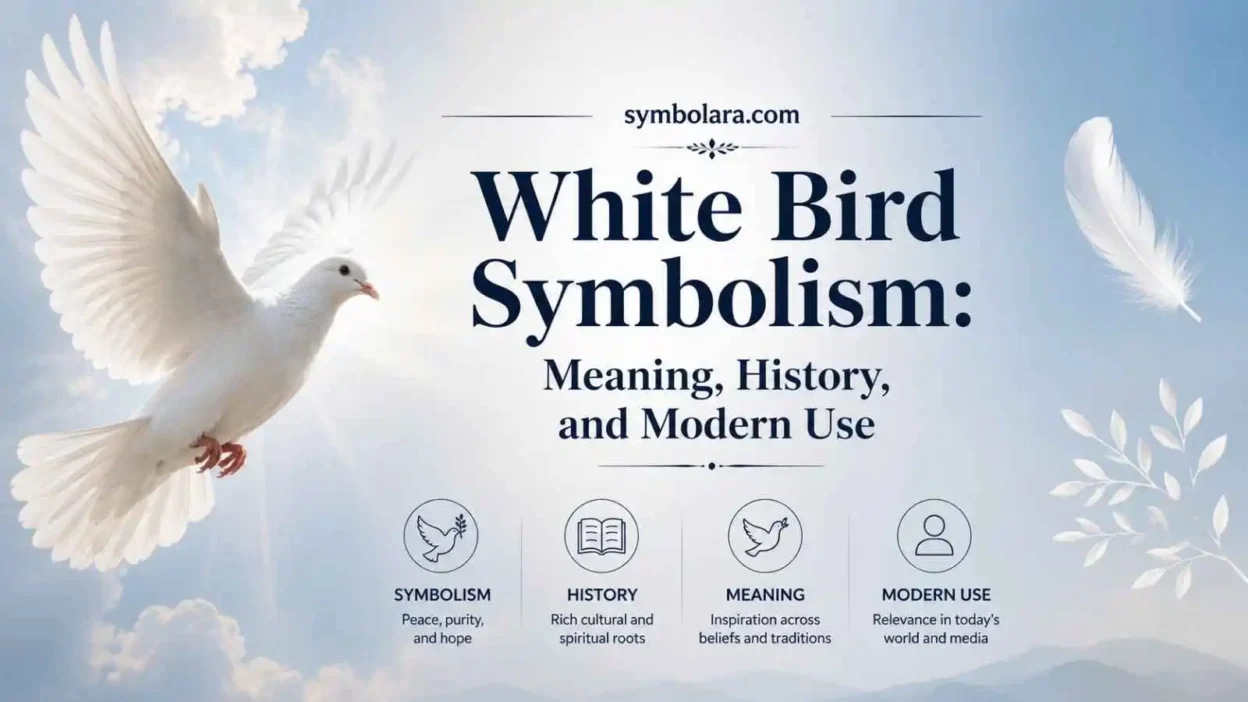
White Bird Symbolism usually represents peace, purity, hope, spiritual comfort, and emotional release. In the United States, many people first think of a white dove in flight, especially in weddings, memorial services, church art, peace posters, tattoos, and sympathy designs.
A white bird matters as a symbol because it gives a soft image to feelings that can be hard to explain. It can express love, grief, faith, forgiveness, remembrance, or the wish to begin again after a painful season.
Not every white bird carries the same message. A dove often feels peaceful and sacred, while a swan feels graceful and romantic. An egret may suggest patience, and a gull may point to freedom, travel, or the coast. Still, the shared image of a pale bird moving through open air creates a strong sense of calm and release.
Quick Answer
White Bird Symbolism commonly symbolizes peace, purity, hope, freedom, and emotional release in modern American culture, especially in weddings, funerals, religious art, tattoos, and peace imagery. Historically, white birds—especially doves—have also been connected with divine presence, love, reconciliation, and the soul’s journey.
TL;DR
- White birds often symbolize peace, purity, hope, and renewal.
- Doves are the strongest American symbol of peace.
- Christian art connects doves with the Holy Spirit.
- Weddings use white birds for love and new beginnings.
- Funerals use them for remembrance and emotional release.
- Meaning changes by bird species, culture, and setting.
What a White Bird Represents
A white bird brings together two familiar meanings: the symbolism of birds and the symbolism of the color white. Birds often suggest flight, freedom, distance, messages, transition, and movement between earth and sky. White commonly suggests innocence, peace, clarity, simplicity, cleanliness, and new beginnings.
Together, these meanings create an image that feels calm but expressive. A white bird flying upward may suggest that a burden is lifting. One resting quietly on a branch can feel protective, peaceful, or watchful. This is why the image appears so often in memorial art, wedding design, spiritual jewelry, and personal tattoos.
The meaning becomes more specific when the type of bird is clear. A dove usually points to peace, faith, love, or reconciliation. Swans add grace and devotion. Egrets and herons feel still, patient, and observant. Gulls bring a coastal sense of freedom, while snowy owls suggest silence, winter, and watchfulness.
What White Birds Commonly Mean in the United States
In the United States, white birds are usually understood as gentle and positive symbols. The most common meaning is peace, especially when the bird looks like a dove. People see this image in church logos, peace posters, memorial graphics, wedding programs, sympathy cards, and simple line-art tattoos.
Another common meaning is purity. This does not always mean moral perfection. In everyday American culture, purity may simply suggest honesty, softness, innocence, or a clean start. A white bird can make a design feel fresh, calm, and emotionally sincere.
Remembrance is also central to the symbol. At funerals and memorials, a white bird often represents farewell, release, and the hope that love continues after death. This meaning can be religious, but it can also be personal and secular. Many families use the image because it expresses grief without making the moment feel harsh.
White Bird Meanings by Context
| Context | Meaning in the USA | Common Associations | Notes |
| Weddings | Love and new beginnings | Doves, vows, white flowers | Often used in invitations and decor |
| Funerals | Release and remembrance | Flight, heaven, farewell | Can be religious or secular |
| Churches | Holy Spirit and peace | Dove, light, baptism | Common in Christian art |
| Tattoos | Healing and freedom | Wings, names, dates | Often tied to grief or growth |
| Home Decor | Calm and simplicity | Wall art, ceramics, nurseries | Usually peaceful, not always religious |
| Peace Imagery | Hope and nonviolence | Dove, olive branch, open sky | Widely recognized in public culture |
Why the Color White Matters
Color changes how people read a symbol. In American culture, white often suggests cleanliness, peace, innocence, light, simplicity, and sacredness. That is why it appears in wedding dresses, baptism clothing, candles, flowers, hospital spaces, and minimalist interiors.
When a bird is white, it usually feels softer than a dark or brightly colored bird. The image rarely suggests danger or aggression. Instead, it creates a mood of quiet movement, open space, and emotional relief.
Even so, white is not always joyful. At a wedding, it may feel romantic and hopeful. During a funeral, the same color can feel solemn and tender. In a stark painting or empty room, white may even suggest loneliness or silence. Context decides whether the symbol feels joyful, sacred, sad, or reflective.
Ancient Roots of White Bird Symbolism
White birds gained meaning long before modern cards, tattoos, and wedding graphics. In ancient Mediterranean cultures, doves were connected with love, beauty, fertility, and feminine divinity. Their gentle behavior and tendency to appear in pairs made them natural symbols of affection and devotion.
Birds also seemed to cross boundaries that humans could not. They moved through the sky, migrated across long distances, and appeared suddenly from places beyond sight. Because of this, many cultures treated birds as messengers, signs, or links between the human world and the divine.
A white bird stood out even more clearly. Its pale body against the sky, water, trees, or dark earth made it visually striking. Over time, that brightness helped connect white birds with light, special presence, spiritual meaning, and emotional clarity.
Biblical and Christian Meaning
For many Americans, the strongest religious meaning of a white bird comes from Christianity. In Christian art, the dove commonly represents the Holy Spirit. Images of Jesus’ baptism often show the Spirit descending like a dove, which helped make the bird a lasting sign of divine presence.
The dove also appears in the story of Noah’s ark. After the flood, the bird returns with a sign that the waters have gone down. Because of this, it became associated with peace, restoration, safety, and the end of danger.
Churches often use white dove imagery in stained glass, baptism materials, confirmation cards, prayer books, and religious jewelry. In these settings, the bird is not only decorative. It suggests blessing, comfort, renewal, and a connection between heaven and earth.
The White Dove as a Modern Peace Symbol
The white dove became one of the clearest modern images of peace. After periods of war and public violence, artists, churches, activists, and community groups used the dove to express hope for nonviolence and reconciliation.
Its message is easy to understand. A white bird flying with open wings suggests calm after conflict. Add an olive branch, a blue background, or a simple open sky, and the meaning becomes even clearer: peace, mercy, and the desire for a better future.
American public culture uses this image in many ways. It appears on posters, school projects, memorial programs, church banners, social media graphics, and community peace events. The symbol can be religious, political, or completely secular, which helps explain why it remains so recognizable.
White Birds in Weddings
At weddings, white birds usually symbolize love, unity, loyalty, and a hopeful beginning. A pair of white doves can suggest two lives moving forward together. The image fits naturally with vows, rings, candles, white flowers, veils, and soft ceremony decor.
Modern couples often use white bird designs on invitations, programs, table cards, signs, cake toppers, and digital announcements. In these settings, the bird usually means peace in the marriage, blessing over the couple, and the start of a shared life.
Live bird releases are less ideal than many people realize. Some ceremonies use birds that may become stressed, lost, injured, or vulnerable after release. Printed doves, paper birds, floral designs, bubbles, projected images, or symbolic artwork can express the same meaning in a more responsible way.
White Birds in Funerals and Memorials
During funerals and memorials, a white bird often represents release, remembrance, and farewell. The image of a bird rising into the sky gives people a gentle way to picture a loved one leaving pain, illness, age, or earthly limits behind.
Religious families may see the bird as a sign of heaven, the soul, prayer, or divine comfort. Others may read it more simply as peace after suffering or love that continues beyond physical presence. Both interpretations can be meaningful.
Memorial programs, sympathy cards, urn designs, keepsakes, gravestones, and slideshow graphics often use white birds for this reason. Rather than avoiding grief, the symbol gives grief a calm shape. It says goodbye with tenderness instead of final harshness.
Emotional and Psychological Meaning
Emotionally, a white bird often suggests relief. It can represent the feeling that something heavy has lifted or that a person is ready to move forward. That makes it useful in art connected with healing, forgiveness, grief recovery, sobriety, and personal change.
Flight is an important part of the meaning. A bird moving upward can suggest release from pressure, guilt, conflict, or sorrow. By contrast, a perched white bird may feel still, patient, protective, or reflective.
People often choose this symbol when they want softness without weakness. It can quietly say, “I survived,” “I remember,” “I forgive,” or “I want peace.” The message feels personal without being loud, which is why the image works well in tattoos, jewelry, memorial pieces, and private artwork.
White Bird Symbolism as a Sign of New Beginnings
Many people interpret white birds as symbols of new beginnings because birds naturally represent movement, change, and the ability to rise above difficult situations. A white bird taking flight can create an image of leaving the past behind and moving toward a fresh chapter.
This interpretation appears often after major life changes, such as recovery from illness, personal growth, grief, or emotional healing. Some people choose white bird artwork, jewelry, or tattoos to mark a turning point in their lives.
The idea of renewal also connects with older traditions. The dove returning with an olive leaf in the story of Noah’s ark became associated with safety and restoration after hardship. Over time, this helped strengthen the connection between white birds and peaceful transitions.
A white bird does not guarantee that change will be easy, but it often represents the hope that something better can come after a difficult period.
White Birds in Tattoos
White bird tattoos usually represent peace, healing, faith, freedom, or remembrance. A small dove tattoo may honor a loved one, mark a spiritual belief, or show that someone has moved through a difficult season.
Some designs include olive branches, flowers, crosses, names, dates, clouds, hands, or wings. Each added detail changes the meaning. A bird flying away from a name or date often suggests grief and release. A dove holding an olive branch usually points to peace and reconciliation.
Minimalist bird tattoos feel modern and private. More realistic designs often feel emotional, memorial, or faith-centered. Either style works because the symbol is easy to recognize without needing a long explanation.
White Birds in Jewelry, Fashion, and Home Decor
Jewelry often uses white bird imagery because it feels gentle, wearable, and meaningful. Dove pendants, wing charms, bird-shaped earrings, and white enamel pieces can suggest faith, protection, remembrance, or peace.
Fashion gives the symbol a wider range. A dove on a shirt can make a peace statement. Embroidered white birds may feel delicate, romantic, or artistic. Wing motifs can suggest independence, movement, and personal freedom.
Home decor uses white birds to create calm. You may see them in wall prints, ceramic figures, nursery art, garden ornaments, holiday decorations, and minimalist interiors. In those spaces, the meaning is usually peace, simplicity, and softness rather than formal religion.
White Birds in Digital Culture
Online spaces have made white bird imagery even more familiar. People use doves, wings, and flying bird graphics in profile pictures, memorial posts, wedding announcements, quote images, stickers, and simple reaction designs.
This symbol works well digitally because it reads quickly. A small white bird can suggest peace, grief, hope, or freedom without a long caption. That makes it useful when people want to respond respectfully to loss, conflict, or emotional news.
After personal tragedies or public mourning, white bird graphics often appear on social media. They allow people to show sympathy in a simple, quiet way. The image feels less heavy than many words, but it still carries care.
Cross-Cultural Meanings
White bird meanings vary across cultures. In many Western settings, white is connected with weddings, innocence, angels, peace, and new beginnings. Other traditions may connect white more closely with mourning, humility, funerals, or the afterlife.
Neither meaning is more correct in every situation. Symbols depend on cultural habits, religious background, and the occasion. A white bird at an American wedding may feel romantic, while the same image in a mourning context may feel solemn.
Care is also needed when discussing Indigenous traditions. Birds and feathers can hold important meanings in many Native American cultures, but those meanings are not the same across all nations. A white bird should not be given one universal Indigenous meaning without a specific cultural context.
White Bird Symbolism in Different Cultures Around the World
White bird symbolism changes depending on cultural background, religious traditions, and local beliefs. While many Western cultures connect white birds with peace and purity, other societies may give these birds different meanings based on history and customs.
In ancient Greek and Roman traditions, doves were linked with love, devotion, and certain goddesses. Their gentle nature and pair bonding helped create associations with affection and harmony. In Japanese art and literature, white birds can represent beauty, elegance, seasonal change, and a connection with nature.
In some Asian traditions, cranes are especially important symbols of longevity, good fortune, and hope. Although cranes are not always considered the same as white birds generally, white cranes often appear in artwork because of their graceful appearance and symbolic value.
In many Western cultures, the white dove remains the strongest example of a meaningful white bird. It represents peace, reconciliation, and spiritual comfort. These examples show that white birds do not have one universal meaning. Their symbolism develops through the stories, beliefs, and experiences of each culture.
Different White Birds and Their Meanings
A dove is the clearest white bird symbol for most Americans. It usually means peace, love, faith, purity, or reconciliation. Because of Christian art and peace imagery, the dove is instantly recognizable.
Swans carry a different tone. They often symbolize grace, beauty, devotion, loyalty, and transformation. Their long necks, paired movement, and elegant appearance make them common in wedding themes, ballet imagery, fairy tales, and luxury design.
Egrets and herons suggest patience, stillness, attention, and quiet observation. Gulls bring in coastal freedom, travel, survival, and open air. Snowy owls feel watchful, silent, wintery, and wild. These differences matter because “white bird” is a broad symbol, not one single meaning.
Common Misunderstandings About White Birds
One common mistake is treating every white bird as a dove. A church dove, a wedding swan, and a gull over the ocean do not communicate the exact same idea. They share lightness and flight, but their cultural associations are different.
Another misunderstanding is assuming the symbol is always happy. White birds can represent grief, mourning, farewell, and emotional distance. In a funeral setting, the image feels comforting because it honors loss rather than ignoring it.
A third issue is the use of live bird releases. Many people like the idea because it looks peaceful, but real birds can face stress and danger. Symbolic alternatives can preserve the meaning while avoiding harm.
How the Meaning Has Changed Over Time
The meaning of white birds has shifted across history. Ancient cultures often connected doves with love, fertility, beauty, devotion, and divine presence. Later Christian tradition gave the dove a strong association with the Holy Spirit, baptism, peace, and restoration.
Modern public culture expanded the symbol again. The white dove became a widely recognized image of peace, especially in art, activism, churches, memorials, and community events. Its meaning moved beyond religion into public life.Today, white birds appear in weddings, funerals, tattoos, logos, jewelry, social media graphics, and home decor. The symbol can be spiritual, romantic, emotional, political, or simply decorative. Its flexibility keeps it useful across many parts of American life.
White Bird Symbolism in Art and Literature
Artists and writers have used white birds for centuries because they can express emotions that are difficult to describe directly. A white bird may represent freedom, innocence, hope, longing, memory, or a connection between the human world and something beyond ordinary experience.
In literature, a white bird often works as a metaphor for transformation. A bird leaving the ground can suggest escape, personal growth, or freedom from suffering. A quiet white bird may represent peace, reflection, or a moment of emotional clarity.
Visual artists use white birds in similar ways. A dove against a dark background can create a strong contrast between conflict and peace. A white bird near water, flowers, or open skies can create feelings of calmness and renewal.
The meaning depends on the surrounding story or image. A white bird in a romantic painting may suggest love, while the same bird in a memorial artwork may represent remembrance. This flexibility is what keeps white birds meaningful across different forms of creative expression.
Positive and Serious Meanings
Most American uses of white birds are positive, but the mood depends on the setting. A bird flying through a bright sky may feel hopeful. On a memorial card, it may feel tender and sad. In a darker artwork, the same image could suggest loneliness or distance.
Positive meanings include peace, love, purity, healing, protection, freedom, and renewal. More serious meanings include farewell, surrender, mourning, emotional release, and the end of a life chapter.
Personal experience matters, too. Someone who connects doves with church may read the symbol spiritually. A person who saw white birds at a funeral may feel grief first. For someone raised near the coast, a white gull may bring up travel, sea air, and home.
White Birds in Dreams
Dreams about white birds are often interpreted as signs of peace, release, guidance, or change. A calm white bird may reflect a desire for emotional rest. When the bird flies away, the dream may suggest letting go or moving forward.
Seeing a trapped or wounded white bird can point to vulnerability, grief, or a damaged sense of hope. If the bird calls from far away, it may feel like a memory, message, or unresolved emotion trying to surface.
Dream meanings should stay personal and cautious. No single symbol has one guaranteed meaning for every person. The feeling of the dream matters most. Was the bird free, silent, near, distant, injured, or calm? Those details shape the interpretation.
What Does Seeing a White Bird Mean?
Seeing a white bird can have different meanings depending on personal beliefs, location, and the situation. In many modern interpretations, people connect a white bird with peace, hope, emotional healing, or a reminder to slow down and reflect.
Some people view a white bird appearing during an important moment as a meaningful personal sign. For example, someone experiencing grief may connect the sight of a white bird with remembrance or comfort. Another person may see it as a simple reminder of nature, beauty, and calm.
Traditional symbolism often gives white birds positive meanings because of their association with light, flight, and peaceful behavior. However, there is no proven universal message behind seeing one.
The most meaningful interpretation usually comes from the person’s own experiences, emotions, and cultural background.
FAQs
A white bird most often symbolizes peace, purity, hope, freedom, and emotional release. In American culture, this meaning is strongest when the bird resembles a dove.
A white bird tattoo usually represents healing, remembrance, faith, freedom, or peace. When the design includes a name, date, flower, cross, or olive branch, the meaning becomes more personal.
No, a white bird does not always have a spiritual meaning. It can also be a peaceful design, a nature image, a coastal symbol, or a sign of personal freedom.
In Christianity, a white dove is commonly associated with the Holy Spirit, peace, blessing, baptism, and divine presence. It often appears in church art, stained glass, prayer cards, and religious jewelry.
White birds are used at funerals because they suggest release, remembrance, peace, and farewell. The image of a bird rising into the sky gives grief a gentle visual form.
In most modern American contexts, white birds are seen as positive or comforting symbols. Still, the mood changes by setting, so they can feel joyful, solemn, peaceful, or sad.
A white dove is usually read as a symbol of peace, love, purity, or the Holy Spirit. A white pigeon may look similar, but the word “dove” carries softer and more sacred associations for many people.
A white bird in a dream is often interpreted as a symbol of peace, hope, freedom, or emotional change. The meaning depends on the bird’s behavior and the feelings experienced during the dream.
Conclusion
A white bird usually stands for peace, purity, hope, freedom, healing, and release. In the United States, the symbol is shaped most strongly by the white dove, though swans, egrets, gulls, and snowy owls each add their own tone.
White Bird Symbolism remains meaningful because it fits both joyful and painful moments. It can bless a wedding, soften a memorial, express faith, mark recovery, or create a calm feeling in art and design.
The image lasts because it is simple but not empty. A pale bird in open air can suggest what many people hope for during change: less heaviness, more peace, and a gentler way forward.