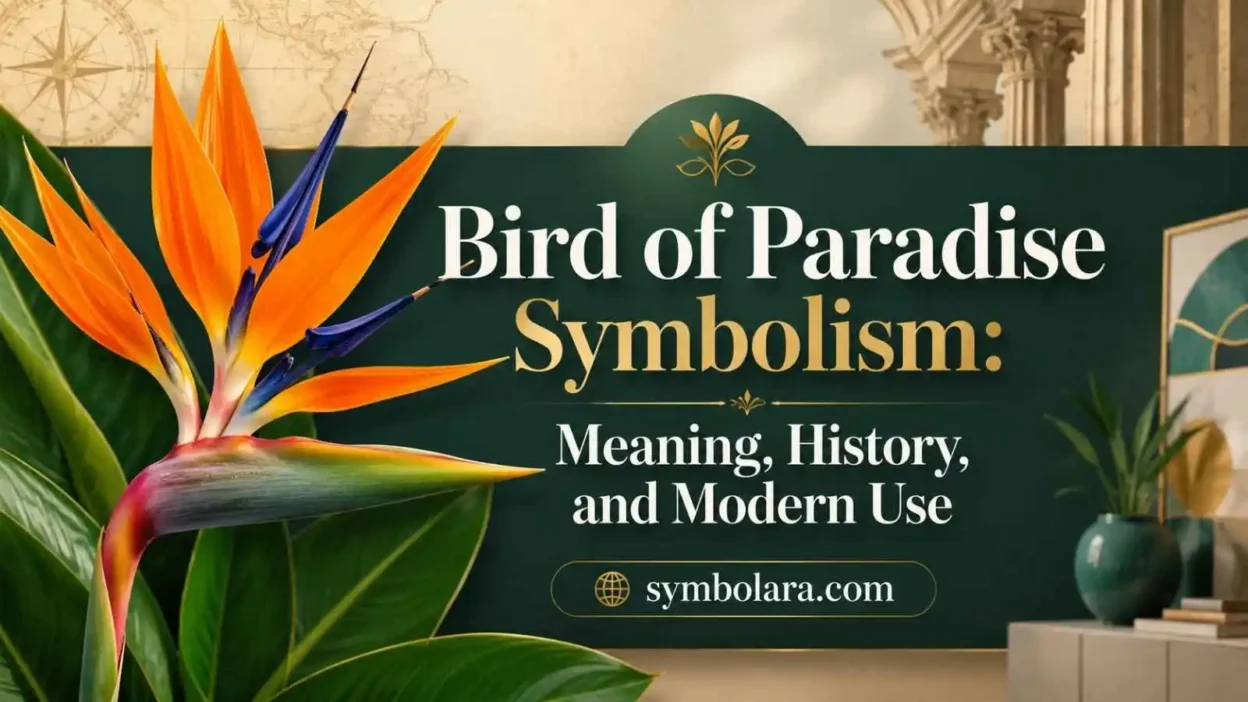
Bird of Paradise Symbolism usually begins with the flower’s unmistakable shape. Its orange and blue bloom rises from a pointed green bract like a tropical bird lifting its head or spreading its wings, which is why many people connect it with freedom, movement, beauty, and escape.
In the United States, the bird of paradise is often seen in warm-climate gardens, modern interiors, tropical flower arrangements, tattoos, resort design, and bold decorative art. It does not feel quiet or traditional in the way a rose, lily, or daisy might. It feels confident, architectural, and bright.
Its meaning comes from several places at once: the plant’s South African origin, its birdlike form, its royal botanical name, and its modern use as a symbol of sunshine, individuality, celebration, and paradise.
Quick Answer
Bird of Paradise Symbolism most commonly represents freedom, joy, and bright possibility in modern American culture, especially because the flower looks like a tropical bird in flight. Historically, it has also been associated with paradise, distinction, royalty, and celebration because of its South African origin, royal scientific name, and dramatic ornamental appearance.
TL;DR
- It mainly symbolizes freedom, joy, and possibility.
- Its flower shape suggests flight and movement.
- It has South African botanical roots.
- Americans connect it with tropical beauty and Los Angeles style.
- In tattoos, it often signals individuality.
- In decor, it suggests confidence and warmth.
What the Bird of Paradise Looks Like
The bird of paradise flower is one of the easiest flowers to recognize. Its most familiar form has upright orange petals, blue inner petals, and a long green bract that resembles a beak. The whole bloom looks less like a soft garden flower and more like a sculptural bird paused in motion.
That physical shape drives much of its symbolism. People do not usually read the flower as shy, delicate, or sentimental. They read it as lively, dramatic, and alert. It appears to be looking forward, rising upward, or preparing to move.
The plant itself adds to that impression. Many bird of paradise plants have large, paddle-shaped green leaves that create a tropical, architectural look. Even when the plant is not blooming, it can make a room or garden feel more open, sunny, and expressive.
Because of this appearance, the flower works as a symbol before anyone learns its history. A person sees it and immediately understands why it suggests paradise, flight, color, display, and freedom.
What It Commonly Means in the United States
In modern American culture, the bird of paradise most often symbolizes freedom, optimism, joy, tropical beauty, confidence, and a life that feels expansive rather than confined. It is popular in places where people want a visual connection to warmth, travel, creativity, or coastal living.
The flower also carries a celebratory meaning. It is not usually chosen for quiet sympathy or modest romance. It is more likely to appear in arrangements that feel bold, congratulatory, modern, or festive. A bird of paradise in a bouquet can suggest achievement, adventure, or a fresh start.
In home decor, the plant often communicates taste and confidence. A large bird of paradise in a living room or office suggests someone wants their space to feel bright, sculptural, and alive. It has become a common choice for people who like tropical plants but still want a clean, modern look.
In personal style, the meaning becomes more individual. A tattoo or print of the flower may represent independence, self-expression, transformation, or the desire to live outside narrow expectations.
Why Freedom Became Its Central Meaning
The flower’s strongest meaning comes from its resemblance to a bird. Birds already symbolize freedom in many American contexts because they fly, migrate, sing, and move between sky and earth. The bird of paradise flower borrows that language visually.
Its bloom appears to launch upward. The pointed bract looks like a beak, while the bright petals resemble feathers or wings. Even though the plant is rooted in the ground, the flower seems to be moving away from it.
That tension gives the symbol emotional force. It combines groundedness with aspiration. It suggests a person can be rooted in real life while still reaching for more space, color, and possibility.
This is why the flower is often interpreted as a symbol of breaking free, starting over, traveling, expanding one’s identity, or refusing to become small. Its freedom is not wild chaos. It is graceful movement toward a more vivid life.
South African Roots and Early Botanical Meaning
The bird of paradise flower is native to South Africa, where it grows in subtropical conditions and is also commonly associated with the name crane flower. Its original meaning was not created by American florists or modern tattoo culture. It began as a real plant with a striking form, growing in a specific landscape.
When European botanists encountered and classified the plant, its unusual shape made it memorable. The flower did not resemble many familiar European garden blooms. It looked exotic to European eyes, a word that should be used carefully today because it often says more about the viewer than the plant itself.
Over time, the flower traveled through botanical gardens, warm-climate landscapes, greenhouse collections, and the floral trade. As it moved, people attached meanings to it: beauty, rarity, royal distinction, travel, escape, and paradise.
That history explains why the flower can feel both botanical and symbolic. It is not only a decorative bloom. It also carries the story of plants moving across continents, being renamed, cultivated, admired, and used to express ideas far beyond their original environment.
The Royal Name and the Meaning of Distinction
The plant’s scientific name, Strelitzia reginae, adds another layer of meaning. “Reginae” is connected with queenship, and the genus name honors Queen Charlotte of Mecklenburg-Strelitz. This royal association helped shape later interpretations of the flower as a symbol of dignity, distinction, and noble bearing.
This does not mean the flower was always used as a royal emblem in everyday life. Most people today do not choose it because they know the Latin name. Still, the royal connection fits the plant’s visual personality. It stands tall. It looks formal without being stiff. Its shape is dramatic enough to command attention.
In floral symbolism, this has encouraged meanings such as excellence, success, honor, and magnificence. The bird of paradise is not a background flower. It tends to become the focal point of an arrangement.
That makes it a fitting symbol for recognition. It can say, “You stand out,” “You achieved something,” or “This moment deserves to be noticed.”
Paradise, Travel, and the Tropical Imagination
The word “paradise” is central to how Americans understand the flower. For many people in the United States, the bird of paradise evokes warm weather, resort landscapes, tropical gardens, and places that feel far from ordinary routine.
This meaning is partly visual. The plant’s large leaves and bright flowers resemble the kind of vegetation Americans associate with Hawaii, Southern California, Florida, Caribbean vacations, and tropical hotels. Even when the plant is grown indoors in a cold state, it can suggest escape.
The symbolism can be emotional as much as geographic. Paradise does not always mean a literal island or beach. It can mean rest, beauty, spaciousness, pleasure, or a life with more color in it.
That is why the flower often appears in travel-inspired decor, vacation branding, summer designs, and bright floral prints. It gives people a shorthand for warmth and possibility.
Color Meaning: Orange, Blue, Green, and White
Color shapes the bird of paradise’s meaning almost as much as its form. The classic orange and blue variety feels energetic, confident, and joyful. Orange often suggests warmth, enthusiasm, creativity, and social confidence. Blue adds contrast: calm, clarity, imagination, and depth.
Together, those colors make the flower feel balanced. It is vibrant without being frantic. It is expressive without losing elegance.
Green also matters because the plant’s leaves are large and visually dominant. Green connects the symbol to growth, renewal, freshness, and the natural world. In interiors, those leaves often matter more than the flower itself.
White bird of paradise varieties carry a slightly different mood. They still suggest tropical scale and upward growth, but they feel calmer, more architectural, and more refined. In decor, white bird of paradise plants often symbolize understated luxury, spaciousness, and modern simplicity.
| Context | Meaning in the USA | Common Associations | Notes |
| Flower arrangements | Celebration and achievement | Joy, success, recognition | Often used as a focal flower |
| Houseplants | Bold growth and modern style | Warmth, confidence, design | Popular in bright interiors |
| Tattoos | Freedom and individuality | Transformation, travel, self-expression | Meaning depends on personal story |
| Los Angeles imagery | Sunshine and civic identity | Southern California, creativity, color | Strong local association |
| Tropical decor | Escape and paradise | Resorts, summer, relaxation | Can feel playful or upscale |
The Bird Connection: Flight, Display, and Self-Expression
The flower’s name also points toward actual birds of paradise, a family of birds known for striking plumage and courtship displays. While the flower and the bird are different subjects, the connection matters symbolically because both are associated with display, color, and attraction.
Actual birds of paradise have long fascinated people because of their elaborate feathers and dances. In symbolic terms, they often represent beauty, performance, seduction, uniqueness, and the art of being seen.
The flower borrows some of that emotional language. It does not simply look pretty. It performs. Its shape seems staged, almost theatrical, like a living sculpture.
For modern readers, this makes the flower a useful symbol for self-expression. It suggests showing up fully, taking up space, and allowing one’s personality to be visible. It is not a symbol of blending in.
Meaning in Los Angeles and American Public Life
In the United States, the bird of paradise has a particularly strong connection with Southern California. It grows well in warm regions and has long appeared in Los Angeles landscapes, gardens, public spaces, and residential design.
This local association shapes its American meaning. In Los Angeles, the flower can suggest sunshine, creative ambition, cultural variety, modern glamour, and the dream of reinvention. It fits the city’s visual language: bright, architectural, and slightly cinematic.
The flower also suits public landscaping because it is memorable. A row of bird of paradise plants does not disappear into the background. It gives sidewalks, entrances, and gardens a sense of movement and identity.
For Americans outside California, the same plant often carries a borrowed West Coast feeling. It may suggest the ease of indoor-outdoor living, the appeal of warm climates, or the desire to bring a little California brightness into daily life.
Use in Flowers, Weddings, and Celebrations
The bird of paradise is not the most common wedding flower, but when people choose it, they usually want a specific effect. It can make an arrangement feel tropical, modern, confident, or unconventional.
In weddings, it may symbolize joyful partnership, adventure, and a shared life that does not feel overly traditional. It works especially well in beach weddings, destination ceremonies, summer celebrations, and bold modern floral designs.
As a gift flower, it can mark success, congratulations, retirement, travel, a new job, or a major life change. It feels more like a flower for movement than for nostalgia.
The flower can also suggest loyalty or faithfulness in some floral traditions, but in American use that meaning is less immediate than freedom, joy, paradise, and celebration. A reader should not assume everyone will understand it as a romantic symbol unless the context makes that clear.
Tattoos, Jewelry, and Personal Style
In tattoo culture, the bird of paradise often represents freedom, beauty, independence, transformation, and the courage to live visibly. Its shape makes it especially appealing for designs along the arm, shoulder, ribs, thigh, or back because it has natural direction and flow.
Some people choose the flower to mark a major change: leaving a restrictive situation, moving to a new place, recovering a sense of self, or embracing a more creative identity. Others choose it because it reminds them of a home region, a trip, a loved one, or a tropical landscape.
In jewelry and fashion, the meaning is usually lighter but still expressive. A bird of paradise print or pendant can suggest brightness, artistic taste, summer energy, or a love of unusual natural forms.
Because the flower is visually distinctive, it can also signal individuality. It tells the viewer that the wearer is not choosing the most expected floral symbol.
Home Decor and Houseplant Meaning
As a houseplant, the bird of paradise has become a modern design favorite because it offers height, structure, and a tropical feel without looking cluttered. Its large leaves can soften minimalist spaces while still fitting clean contemporary interiors.
Symbolically, this gives the plant a meaning tied to growth, confidence, and openness. It can make a room feel less closed-in. It suggests light, air, and upward movement.
Many people also associate it with aspiration. A large bird of paradise plant often appears in home offices, living rooms, entryways, and apartments where someone wants a sense of style and ambition. It says the space is cared for, but not overly formal.
There is also a practical side to the symbolism. The plant needs light, room, and attention. In that way, it can quietly remind people that growth requires the right conditions.
Emotional and Psychological Meaning
Emotionally, the bird of paradise often represents the desire for a wider life. It appeals to people who feel drawn to movement, color, sunlight, and self-renewal.
The flower can symbolize confidence without aggression. It stands upright and draws attention, but it does so through form and color rather than sharpness. That makes it a good symbol for people who want to express strength with grace.
Psychologically, it can also represent escape from emotional confinement. Someone may connect with the flower during a season when they want to leave behind fear, routine, grief, or self-doubt. Its birdlike shape makes that feeling easy to understand.
At the same time, the plant’s rootedness keeps the symbolism grounded. It does not suggest abandoning reality. It suggests growing toward light while staying connected to the earth.
Cross-Cultural Meanings and Respectful Context
The bird of paradise flower should not be treated as if it has one universal meaning in every culture. In the United States, its common meanings are shaped by floristry, landscaping, design, and tropical imagination. In South Africa, it is connected first to place, plant life, and local ecology.
The actual birds of paradise carry important cultural meanings in parts of New Guinea and nearby regions, where feathers have been used in ceremonial dress and social traditions. These meanings are not the same as American flower symbolism and should not be casually borrowed without context.
This distinction matters. A flower tattoo inspired by freedom and tropical beauty is different from using ceremonial feather imagery from a living cultural tradition. One is a broad floral symbol; the other may carry specific ancestral, social, or ritual meaning.
A respectful interpretation keeps these layers separate. It recognizes the flower’s botanical origin, its global decorative use, and the separate cultural importance of the birds that helped inspire its name.
Common Misunderstandings and Misuse
One common misunderstanding is that the bird of paradise flower is native to every tropical place where Americans see it. Because it appears in California, Florida, Hawaii-inspired decor, and resort landscapes, people sometimes assume it comes from those places. Its botanical roots are South African.
Another mistake is treating the flower as purely spiritual or mystical. While individuals may give it spiritual meaning, its most widely recognized symbolism comes from visible traits: its birdlike shape, vivid colors, upright growth, and association with warm climates.
A third misunderstanding is confusing the flower with the actual bird in every context. The two are connected by name and visual resemblance, but they do not share identical histories.
The symbol can also be misused when people reduce it to a vague “exotic” image. That word can flatten real places and cultures into fantasy. A better approach is to describe what the flower actually suggests: tropical beauty, movement, freedom, celebration, and distinction.
How Its Meaning Has Changed Over Time
The bird of paradise began as a plant rooted in a specific region. As it moved through botanical gardens and global horticulture, it became admired for its unusual form. Its royal scientific name added distinction, while its appearance made people connect it with birds, flight, and paradise.
In American culture, its meaning became more visual and lifestyle-based. It entered landscapes, hotel designs, flower shops, tattoos, and houseplant trends. The symbol shifted from botanical curiosity to a sign of warmth, modern taste, and personal freedom.
In recent years, the houseplant version has expanded the meaning again. Many people now encounter the bird of paradise not as a cut flower, but as a large indoor plant. That makes its symbolism less about a single bloom and more about creating an environment: bright, open, stylish, and alive.
Its meaning has not become weaker through this change. It has become more flexible. The flower can still mean paradise and freedom, but it can also mean home, ambition, design, and the wish to live with more light.
FAQs
The bird of paradise flower most often symbolizes freedom, joy, paradise, confidence, and possibility. Its birdlike shape makes people connect it with flight, while its vivid colors give it a celebratory and optimistic feeling.
Yes, it is usually a positive symbol. In American culture, it is more often linked with celebration, success, beauty, travel, creativity, and personal growth than with grief or warning.
A bird of paradise tattoo often means freedom, individuality, transformation, or the desire to live more boldly. Some people also choose it to represent travel, tropical memories, artistic identity, or a major personal change.
The flower does not have one fixed religious meaning in mainstream American culture. Some people may connect it with paradise, creation, gratitude, or spiritual freedom, but those meanings usually come from personal interpretation rather than a single shared doctrine.
It can be romantic, but it is not a classic romance flower like a red rose. When used romantically, it usually suggests an adventurous relationship, joyful partnership, passion, or admiration for someone distinctive.
It is called bird of paradise because the flower resembles a colorful bird, especially in the way its petals rise from a beak-like bract. The name also connects it visually to the dramatic birds of paradise known for brilliant feathers and display.
In home decor, it often symbolizes warmth, confidence, growth, and modern tropical style. A large bird of paradise plant can make a room feel brighter, more open, and more expressive.
Conclusion
The bird of paradise is a symbol of freedom, joy, paradise, and visible confidence. Its meaning comes directly from what people see: a flower shaped like a bird, rising from broad green leaves in vivid color and strong form.
Its history adds more depth. South African origins, a royal scientific name, American landscaping, Los Angeles identity, and modern design culture all shaped how people understand it today.
Bird of Paradise Symbolism remains appealing because it feels both grounded and aspirational. It reminds people that beauty can be bold, growth can be graceful, and a life with more color is often worth reaching toward.