
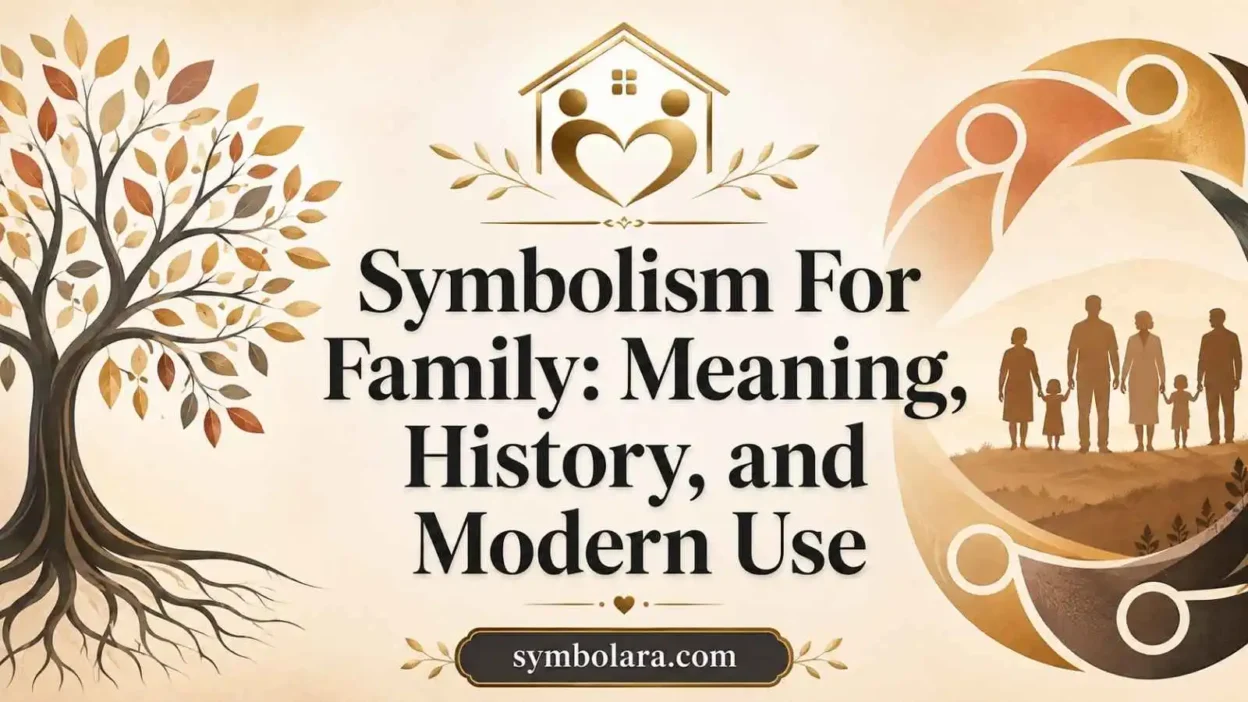
Family is one of the most personal ideas people try to express through symbols. Symbolism For Family usually points to love, belonging, protection, ancestry, loyalty, and the lasting bonds that connect people across generations.
In the United States, family symbolism appears everywhere: in tattoos, wedding jewelry, family trees, home decor, holiday traditions, memorial objects, birthstone necklaces, and even social media captions. Sometimes the symbol is obvious, like a heart with children’s names. Other times it is more layered, like a tree, circle, knot, house, or set of linked initials.
People care about these symbols because “family” is not only a legal or biological category. It is also emotional. It can mean the people who raised you, the relatives you inherited, the children you care for, the partner you chose, the friends who became home, or the ancestors whose stories shaped your identity.
Quick Answer: What Does Symbolism For Family Symbolize?
Symbolism For Family most commonly represents love, unity, protection, belonging, and connection across generations in modern American culture. Historically, family has also been symbolized through trees, circles, knots, homes, crests, and ancestral imagery because these forms express roots, continuity, loyalty, and shared identity.
TL;DR
- Family symbols express love, unity, and belonging.
- Trees often represent ancestry and generational roots.
- Circles and knots suggest lasting connection.
- Homes symbolize safety, shelter, and shared life.
- Tattoos and jewelry make family identity personal.
- Modern meanings include chosen family and blended family.
What Family Symbolism Means in the United States
In modern American culture, family symbolism usually centers on emotional connection. A family symbol says, “These are my people,” whether that means parents, children, siblings, grandparents, spouses, relatives, adoptive family, stepfamily, or close friends.
The most common meanings are love, loyalty, care, memory, and protection. A person might wear a necklace with children’s initials to keep them close, place a family tree on the wall to honor ancestry, or choose a tattoo that marks survival, grief, or commitment.
American interpretations are also broad. The idea of family now includes many forms: married couples with children, single-parent households, adoptive families, blended families, multigenerational homes, childfree couples, close friendship networks, and LGBTQ+ chosen families. Because of that, family symbols in the U.S. often carry a flexible meaning. They are less about one fixed household model and more about the people who create belonging.
This is why a symbol for family can be sentimental without being old-fashioned. It can honor tradition while still making room for complicated, modern, and chosen relationships.
Why People Use Symbols to Represent Family
Family can be difficult to describe plainly. A symbol gives shape to feelings that may be too private, too complex, or too emotional for everyday language.
For many people, family symbolism is about closeness. A mother may wear a birthstone ring for each child. Siblings may get matching tattoos after losing a parent. A couple may plant a tree when they buy their first home. These gestures turn relationships into visible reminders.
Symbols also help people carry family across distance. In a country where adult children often move away for school, work, marriage, or military service, family symbols become portable forms of attachment. A locket, tattoo, embroidered heirloom, recipe card, or framed genealogy chart can make absence feel less empty.
Family symbols can also help people repair or redefine belonging. Someone who grew up without a stable household may choose a house, anchor, or tree symbol to represent the family they built later. Someone adopted may use both roots and branches to honor birth family and adoptive family at the same time.
At their best, family symbols do not simplify family life. They give people a respectful way to hold love, history, gratitude, grief, and identity together.
The Family Tree and the Meaning of Roots
The family tree remains one of the clearest symbols of ancestry and connection across generations. Its roots represent origins, heritage, and the ancestors who shaped a family’s history. The trunk reflects continuity, stability, and shared identity, while the branches illustrate descendants, relationships, children, and the growth of future generations.
The image works because trees grow in ways that resemble family history. A tree begins from hidden roots, rises into a visible trunk, and spreads outward through branches. A family also begins before any one person can fully remember it. Names, stories, migrations, traditions, and hardships all become part of the structure that later generations inherit.
In the United States, family trees are especially common in genealogy, scrapbooking, memorial art, classroom projects, wall decor, and digital ancestry platforms. They appeal to Americans because they combine personal identity with historical curiosity. A tree can show where a family came from, how it changed, and how one person belongs inside a larger pattern.
The tree also has emotional meaning. It suggests that family is not only a list of names but a living connection. Branches may grow in different directions, but they remain tied to the same trunk. This makes the family tree useful for blended families, adoptive families, and families spread across different states or countries.
Popular Family Symbols and Their Meanings
Family symbols appear in many forms, and each design communicates a different idea. Some symbols focus on ancestry, while others highlight love, protection, unity, or personal connection.
| Family Symbol | Common Meaning | Modern Uses |
|---|---|---|
| Family tree | Roots, ancestry, generations | Genealogy charts, tattoos, wall art |
| Heart | Love, affection, emotional connection | Jewelry, gifts, memorial designs |
| Circle | Unity, protection, endless connection | Rings, pendants, logos |
| Knot | Loyalty, strength, lasting bonds | Tattoos, wedding designs |
| House | Safety, belonging, shared memories | Home decor, artwork |
| Hands | Care, support, guidance | Keepsakes, tattoos |
The meaning of a family symbol depends on the person using it. A tree may represent ancestors for one person and personal growth for another. A heart may symbolize children, a partner, or a loved one who passed away.
Modern family symbolism focuses less on one traditional meaning and more on the relationships behind the image. The most meaningful symbols are usually connected to personal memories, family stories, and shared experiences.
The Circle as a Symbol of Unity and Continuity
The circle is one of the simplest symbols for family, but it carries several meanings. It has no beginning or end, so it often represents continuity, wholeness, and lasting commitment.
In family symbolism, the circle can suggest that every member belongs inside a shared bond. No single point is more important than another. The shape feels protective because it encloses space. It can also represent the recurring cycle of birth, childhood, adulthood, caregiving, aging, and remembrance.
Americans often encounter this meaning through wedding rings, family pendants, unity ceremonies, wreaths, and circular logos used for reunions or family-owned businesses. A wedding ring does not only symbolize romantic love; it can also mark the beginning of a household, a shared name, a legal family, or a chosen life together.
Circular family symbols are popular in jewelry because they are subtle. A small ring pendant with names engraved around it can represent children, siblings, or generations without needing a large or obvious image. The circle’s quietness is part of its appeal.
Knots, Braids, and Interwoven Bonds
Knots and braided patterns symbolize family because they show separate strands becoming one connected form. Each strand remains distinct, but the pattern holds because the strands cross, support, and tighten around one another.
This symbolism appears in Celtic knots, trinity knots, braided bracelets, handfasting cords, and modern tattoo designs. The exact meaning depends on the tradition and the person using it, but the family-related themes are usually connection, loyalty, endurance, and interdependence.
A knot can be especially meaningful for families because family ties are rarely simple. People disagree, separate, reunite, forgive, grieve, and rebuild. A knot does not suggest a perfectly smooth bond. It suggests a bond that has been made through crossing paths.
In the U.S., Celtic-inspired knotwork is often used by people with Irish, Scottish, Welsh, or broader Celtic heritage. It also appears in wedding decor and family tattoos. The important distinction is that not every knot has one ancient or universal meaning. Many modern uses are personal interpretations built from older visual traditions.
The House and Home as Family Symbols
A house symbolizes family because it represents shelter, safety, daily life, and shared memory. Unlike a family tree, which points backward and forward across generations, the house points inward. It focuses on the lived experience of family: meals, arguments, holidays, chores, birthdays, grief, and ordinary routines.
In American culture, “home” often carries stronger emotional meaning than the physical building itself. A home can be a childhood house, an apartment, a grandparent’s kitchen, a military base residence, a farmhouse, a suburban living room, or any place where people feel known and protected.
This symbol also reflects the American ideal of homeownership, though family meaning is not limited to owning property. For many people, the home symbol is about stability rather than wealth. A small house tattoo, a key pendant, or a framed drawing of a childhood home can express gratitude for safety or longing for a place that no longer exists.
The house can also carry grief. After a parent dies, a family home may become a symbol of continuity and loss at the same time. That emotional mixture is one reason home imagery remains so strong in family symbolism.
Hearts, Hands, and Everyday Signs of Care
Hearts and hands are among the most common symbols associated with family because they focus on affection and care. The heart represents love, tenderness, and emotional attachment. Hands suggest guidance, protection, work, comfort, and support.
These symbols are easy to understand, which makes them popular in gifts and personal art. A parent may keep a child’s handprint in clay. A family may use linked hands in a memorial design. A grandparent may treasure a heart-shaped ornament with grandchildren’s names.
The heart is sometimes criticized as too simple or sentimental, but its directness is exactly why it works. In American culture, it is widely understood across age groups and backgrounds. It does not require specialized knowledge.
Hands add a more active meaning. They show love as something people do: holding, feeding, building, lifting, teaching, and caring. For families shaped by caregiving, illness, disability, parenting, or aging relatives, hand imagery can feel more accurate than a purely romantic heart.
Family Crests, Names, and Ancestral Identity
Family crests and coats of arms come from European heraldic traditions, where visual designs helped identify individuals, lineages, alliances, and property. In modern American use, they are usually treated as symbols of ancestry, surname pride, and inherited identity.
Many Americans display crest-like designs on wall art, jewelry, stationery, wedding decor, or reunion materials. These images often include shields, animals, helmets, crowns, mottos, or colors. Even when a design is more decorative than historically exact, it can still function as a family symbol because it gives a surname a visual identity.
The caution is that heraldry is often misunderstood. A coat of arms historically belonged to a specific person or line, not automatically to everyone who shares a last name. Commercial “family crest” products sometimes blur that distinction. For personal decor, this may not matter much, but for historical accuracy it does.
As symbolism, the crest speaks to pride, continuity, and belonging. It tells people that a family name has a story, even if that story needs careful research rather than easy assumptions.
Religious and Spiritual Family Symbolism
Family symbolism often appears in religious settings because many traditions treat family as a moral, spiritual, or covenantal relationship. In Christian American contexts, family may be symbolized through the Holy Family, wedding rings, baptismal garments, crosses with family names, family Bibles, or prayer images.
Judaism places strong emphasis on lineage, household ritual, remembrance, and intergenerational teaching. Symbols such as the menorah, Shabbat table, ketubah, and memorial candles can carry family meaning through practice rather than through a single image.
In many Indigenous, African diasporic, Asian American, and immigrant traditions, family symbolism may include ancestors, foodways, altars, clan relationships, naming customs, textiles, and objects passed through generations. These meanings vary widely and should not be flattened into one interpretation.
In the United States, religious family symbols often become part of major life events: weddings, funerals, baptisms, confirmations, bar and bat mitzvahs, quinceañeras, holidays, and memorial gatherings. They connect family identity to values, obligations, memory, and community.
Cross-Cultural Symbols Connected to Family
Family symbols vary across cultures, but several themes appear repeatedly: roots, continuity, protection, fertility, household identity, and respect for ancestors.
| Symbol or Image | Meaning in the USA | Common Associations | Notes |
| Family tree | Ancestry and generational connection | Roots, branches, heritage | Common in genealogy and decor |
| Circle | Unity and lasting bonds | Wholeness, marriage, protection | Often used in jewelry |
| Knot or braid | Interwoven relationships | Loyalty, endurance, connection | Popular in tattoos and wedding imagery |
| House | Safety and shared life | Shelter, childhood, belonging | Can symbolize both comfort and memory |
| Crest or surname | Ancestral identity | Lineage, pride, inheritance | Often used decoratively today |
| Heart and hands | Love and caregiving | Affection, support, protection | Easy to recognize across ages |
Cross-cultural symbolism should be handled with care. A symbol borrowed from another tradition may look beautiful, but it may also have meanings tied to religion, nationhood, mourning, marriage, or ancestry. Using it respectfully means learning what it means before turning it into decor, jewelry, or a tattoo.
Animal Symbols That Represent Family and Protection
Animals have represented family bonds for centuries because many species display strong connections between parents, offspring, and groups. In modern American culture, animal symbols often represent loyalty, care, protection, and togetherness.
The wolf is one example often associated with family because wolves live and cooperate in packs. In popular culture, wolf imagery can represent loyalty, teamwork, and protecting loved ones.
Elephants are also connected with family symbolism. Their strong social bonds and memory have made them a popular symbol of family connection, wisdom, and generations.
Bird symbols can represent family in different ways. A pair of birds may suggest partnership, while a nest can symbolize home, safety, and raising children. Swans are sometimes connected with devotion because of their association with lifelong pairs.
However, animal symbolism varies across cultures. A symbol that represents family in one community may carry a different meaning elsewhere. Personal experience often shapes the final interpretation.
Family Symbolism in American Holidays and Rituals
American holidays are full of family symbolism, even when people do not call it that. Thanksgiving tables, Christmas ornaments, Hanukkah menorahs, Easter gatherings, Mother’s Day cards, Father’s Day gifts, Veterans Day memorials, and family reunion T-shirts all use objects to express belonging.
Photographs are especially important. A framed family portrait, a graduation picture on the mantel, or an old black-and-white image of grandparents can become a household symbol. These images say, “This story matters here.”
Food is another major family symbol in the U.S. A recipe can represent immigration, regional identity, survival, affection, or continuity. A grandmother’s pie, a father’s barbecue, tamales at Christmas, gumbo at a reunion, or a birthday cake tradition may symbolize family more strongly than any formal emblem.
Holiday ornaments also carry family meaning because they accumulate over time. A tree decorated with handmade ornaments, baby’s-first-Christmas keepsakes, travel souvenirs, and memorial pieces becomes a visual record of the household’s history.
Tattoos, Jewelry, and Personal Style
Family tattoos are among the most visible modern uses of family symbolism. Common choices include names, birthdates, Roman numerals, portraits, handprints, footprints, trees, birds, hearts, infinity signs, coordinates, handwriting, and meaningful flowers.
These tattoos often mark devotion, grief, protection, or survival. A parent may tattoo a child’s name. Siblings may get matching symbols. Someone may preserve a loved one’s handwriting after a death. A family tree tattoo may show ancestry, while a small matching symbol may show loyalty among living relatives.
Jewelry works in a similar way but is easier to keep private. Birthstone rings, lockets, charm bracelets, engraved pendants, and fingerprint jewelry turn family bonds into wearable objects. In American gift culture, these pieces are common for Mother’s Day, weddings, graduations, new babies, anniversaries, and memorials.
Modern personal style also allows people to define family on their own terms. A tattoo for a chosen family can be just as meaningful as one for biological relatives. The symbol’s power comes from the relationship it represents, not from whether outsiders understand it immediately.
Family Symbolism Ideas for Tattoos and Gifts
Choosing a family symbol for a tattoo or gift usually starts with the relationship you want to honor. The strongest designs are personal because they connect to a specific memory, person, or family story.
Popular family tattoo ideas include:
- A family tree with names or birth dates
- Children’s initials or handwriting
- A fingerprint design
- Coordinates of a meaningful place
- A circle representing unity
- A knot showing an unbreakable bond
- A house representing home and belonging
- Birth flowers connected to family members
Family gifts often use similar symbols. Personalized necklaces, engraved bracelets, photo frames, quilts, and keepsake boxes can turn family memories into physical objects.
The best family symbol is not necessarily the most complicated design. A simple image with personal meaning often becomes more valuable because it represents a real relationship rather than just a popular trend.
Family Symbolism in Home Decor and Design
Home decor uses family symbols to create a feeling of belonging. Family name signs, gallery walls, framed recipes, monogrammed pillows, heirloom quilts, children’s artwork, and genealogy charts all make private relationships visible inside the home.
In American design, farmhouse, rustic, traditional, coastal, and modern minimalist styles all use family symbolism differently. A rustic home may display wood signs and family trees. A modern home may use black-and-white portraits or a single framed heirloom. A multicultural home may combine objects from several traditions, such as textiles, religious items, and inherited serving pieces.
The best family decor feels specific rather than generic. A framed recipe in a grandmother’s handwriting often carries more meaning than a mass-produced sign. A quilt made by a relative can symbolize care, labor, and continuity. A table handed down through generations can become a symbol of meals, arguments, holidays, and reconciliation.
Family symbolism in decor is strongest when it reflects real memory, not just a slogan.
Chosen Family, Blended Family, and Modern Identity
One of the biggest changes in modern family symbolism is the rise of chosen family as a widely understood idea. Chosen family refers to people who provide love, safety, and belonging even when they are not related by blood or law.
This matters in the United States because many people experience family outside traditional categories. LGBTQ+ communities have long used chosen family language to describe networks of care when biological relatives were absent, rejecting, or unsafe. Immigrants, military families, close friend groups, and people estranged from relatives may also build family through commitment rather than ancestry.
Blended families add another layer. Stepparents, half-siblings, adoptive parents, foster families, and co-parenting households often need symbols that do not rely only on bloodline. Trees with grafted branches, circles, puzzle pieces, linked rings, and custom family portraits can all express the idea that family is formed through care and time.
Modern family symbolism is therefore less rigid than older lineage symbols. It still honors roots, but it also honors the people who show up.
Emotional and Psychological Meaning
Family symbols often work because they meet emotional needs. They help people feel connected, remembered, protected, or anchored.
Psychologically, a family symbol can support identity. Knowing where one comes from can help a person understand names, traditions, values, and inherited stories. Even when family history is painful, symbols can help people choose what to carry forward and what to change.
Family symbols can also comfort people during grief. A memorial tattoo, keepsake necklace, framed photo, or planted tree can give loss a physical place. The object does not remove grief, but it can help organize memory.
For parents, family symbols often express responsibility. A child’s name tattooed on the body or worn on a pendant can represent devotion and daily motivation. For children, an inherited item may symbolize continuity with a parent or grandparent.
The emotional meaning is not always sweet. Family symbols can also bring up longing, conflict, absence, or complicated loyalty. That complexity is part of why they matter.
What Colors Symbolize Family?
Colors can add another layer of meaning to family symbols. Different colors may express emotions, values, or memories connected with family relationships.
| ColorFamily Symbolism Meaning | |
|---|---|
| Blue | Trust, loyalty, calm, protection |
| Green | Growth, renewal, connection to nature |
| Red | Love, passion, deep emotional bonds |
| Gold | Heritage, value, celebration |
| White | Peace, remembrance, purity |
| Purple | Honor, dignity, family traditions |
Color meanings are not universal rules. A family may choose a color because it represents a favorite memory, a cultural tradition, a birth month, or a personal experience.
In tattoos, jewelry, and home design, colors often make family symbols more personal. A tree with green leaves, a gold family crest, or a blue heart may communicate a feeling that the image alone does not fully express.
Misunderstandings and Misuse of Family Symbols
Family symbols are usually positive, but they can be misunderstood or misused. One common problem is assuming that a symbol has one universal meaning. A tree, knot, crest, or animal may mean different things depending on culture, religion, and personal context.
Another issue is historical inaccuracy. Family crests are often sold as if every person with a surname automatically owns the same coat of arms. In reality, heraldic traditions are more specific than that. Decorative use is common, but it should not be confused with verified genealogy.
Cultural borrowing can also be sensitive. Symbols tied to Indigenous nations, sacred rituals, or specific ethnic traditions should not be used casually as generic “family” imagery. Respect begins with understanding whether a symbol is open, sacred, ceremonial, or community-specific.
There is also the danger of idealizing family in ways that erase harm. Not every family is safe. For people who experienced abuse, rejection, or instability, family symbolism may be complicated. Modern interpretations increasingly make room for boundaries, healing, and chosen family rather than assuming all family bonds are automatically healthy.
How Family Symbolism Has Changed Over Time
Older family symbols often emphasized lineage, inheritance, marriage, legitimacy, and household continuity. Family names, coats of arms, genealogies, and patriarchal lines were tied to property, social status, and public identity.
Modern American family symbolism is more emotional and personal. It is less about proving rank and more about expressing attachment. A tattoo, necklace, home sign, or family photo wall usually says something about love, memory, and belonging rather than legal inheritance.
Technology has changed the meaning too. Digital ancestry tools, online memorial pages, DNA testing, shared photo albums, and social media tributes have made family symbolism more public and searchable. A family identity can now be built through images, captions, timelines, and archived messages as much as through heirlooms.
At the same time, Americans are more aware that family takes many forms. Symbols have adapted. The family tree remains important, but so do circles, constellations, fingerprints, coordinates, and custom designs that reflect nontraditional households.
Family symbolism has moved from fixed lineage toward lived connection.
How to Choose a Meaningful Family Symbol
The best family symbol is not always the most popular one. It is the one that matches the relationship, memory, or value you want to honor.
A family tree works well for ancestry, genealogy, and multigenerational identity. A circle fits unity, marriage, or lasting connection. A house suits themes of safety and belonging. A knot or braid works for interdependence and loyalty. A heart or handprint is direct and affectionate. A crest or surname design may fit heritage, especially when used with historical care.
Before choosing a tattoo, piece of jewelry, or decor item, it helps to ask what part of family you want to express. Is it gratitude? Protection? Grief? Adoption? Chosen family? Marriage? Children? Ancestors? Survival?
A meaningful symbol does not need to explain everything. It only needs to hold the part of the story that matters most.
FAQs
What is the most common symbol for family?
The family tree is one of the most common symbols for family because it clearly shows ancestry, roots, and generations. In everyday American use, hearts, circles, homes, and name-based jewelry are also widely recognized.
What does a family tree symbolize?
A family tree symbolizes ancestry, origin, growth, and connection between generations. Roots point to the past, while branches suggest children, descendants, and the way a family continues to change.
What family symbol is best for a tattoo?
The best family tattoo depends on the meaning you want. Names, birthdates, trees, knots, handprints, coordinates, and handwriting are popular because they can be made personal rather than generic.
What does a circle mean in family symbolism?
A circle usually means unity, protection, and lasting connection. Because it has no beginning or end, it is often used to represent commitment, marriage, and bonds that continue over time.
Can family symbols represent chosen family?
Yes. Modern family symbolism often includes chosen family, close friends, mentors, partners, and communities that provide care and belonging. Circles, knots, constellations, and custom symbols work especially well for this meaning.
Are family crests historically accurate?
Some are, but many commercial family crest products simplify heraldic history. A coat of arms traditionally belonged to a specific person or lineage, so it is best to treat generic surname crests as decorative unless verified through careful research.
Can family symbolism have negative meanings?
It can, depending on personal experience. For some people, family symbols bring comfort and pride; for others, they may raise memories of grief, conflict, absence, or harm. A symbol’s meaning depends on the story behind it.
What symbol represents ancestors and family roots?
The family tree is one of the strongest symbols for ancestors because its roots represent the past, while its branches represent future generations. It is widely used in genealogy and family history projects.
Conclusion
Family symbolism is strongest when it connects a visible image to a real relationship. Trees, circles, knots, homes, hearts, hands, crests, and heirlooms all help people express love, ancestry, protection, memory, and belonging.
In modern America, Symbolism For Family is no longer limited to bloodline or surname. It can honor biological relatives, adoptive families, blended households, spouses, children, ancestors, and chosen family.
A good family symbol does not need to be elaborate. It only needs to carry the truth of who has shaped you, who you care for, and where you feel at home.
[…] symbolized helplessness, grief, unexplained illness, and fear spreading through a household. That history is important because it reminds modern readers that behind the cape and fangs lies a much older association with disease, bodily decline, […]
[…] designs are often read as symbols of change, resilience, seasonal rhythm, or the repeated turns of family history. That reading is modern rather than provable ancient doctrine, but it is easy to understand from […]
[…] American culture, trees often appear in family history. The “family tree” is one of the clearest examples: ancestry is imagined as a living structure, […]