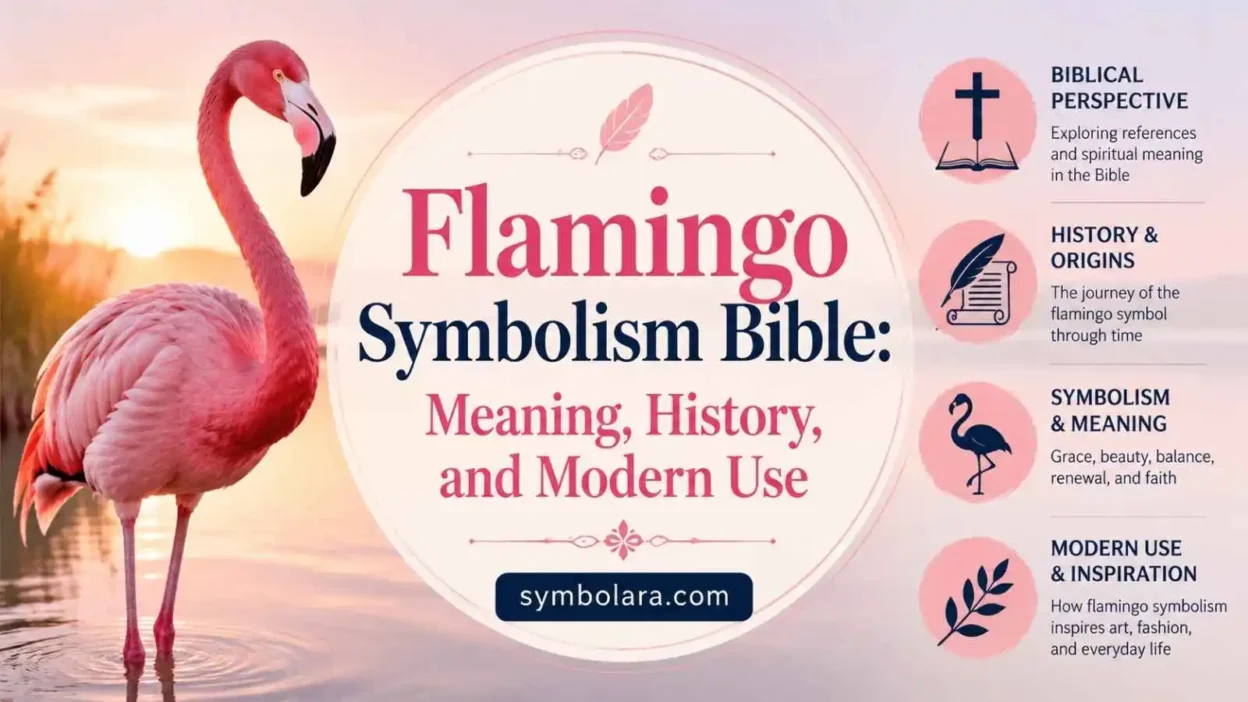
Flamingos are instantly recognizable: tall wading birds with pink feathers, thin legs, curved necks, and a posture that seems almost designed for symbolism. For many readers searching for Flamingo Symbolism Bible, the central question is simple: does this striking bird have a biblical meaning, or is its meaning mostly modern and cultural?
The honest answer is more nuanced than many quick explanations suggest. Flamingos are not a major named biblical symbol like doves, eagles, ravens, or lambs. Still, their appearance, behavior, color, and possible relationship to ancient bird categories can help readers think carefully about themes such as beauty, distinction, balance, community, provision, and spiritual discernment.
In the United States today, flamingos also carry a very different set of meanings. They are tropical, playful, pink, nostalgic, and often associated with lawns, pool floats, Florida, summer decor, camp style, and confident self-expression.
Quick Answer
Flamingo Symbolism Bible commonly points to beauty, grace, balance, and joyful individuality in modern American interpretation, especially because of the bird’s pink color and elegant posture. Biblically, flamingos are not directly established as a named symbol, though some readers connect them loosely to biblical themes of creation, purity, separation, and discernment through bird imagery and ancient dietary laws.
TL;DR
- Flamingos are not major named biblical symbols.
- Modern meanings center on joy, beauty, and confidence.
- Pink color adds warmth, love, and playfulness.
- Biblical meaning should be interpreted cautiously.
- U.S. culture links flamingos with summer and kitsch.
- Tattoos often express individuality and balance.
What the Flamingo Looks Like and Why It Feels Symbolic
A flamingo is hard to ignore. Its long legs, curved neck, hooked bill, and pink-to-coral feathers give it a silhouette unlike most birds Americans commonly see. Even from a distance, it appears poised, delicate, and slightly theatrical.
That visual distinctiveness is one reason the flamingo has become symbolic. Symbols often begin with physical traits. A dove suggests peace partly because of its softness and pale color. An eagle suggests authority partly because of its height, wingspan, and hunting strength. A flamingo suggests grace because it moves through shallow water with long, careful steps. It suggests balance because it often rests on one leg. It suggests visibility because its color stands out against water, sand, and sky.
The bird’s feeding posture also matters. Flamingos lower their heads into the water and filter food through specialized bills. That upside-down posture has encouraged some symbolic readings about seeing life differently, though that is a modern interpretation rather than an ancient biblical one.
In everyday American life, people usually encounter flamingos in images rather than in the wild. They appear on lawn ornaments, beach towels, party decorations, tropical prints, pool floats, phone cases, tattoos, jewelry, and vacation branding. The physical bird and the pop-culture image have become almost inseparable.
Does the Flamingo Appear in the Bible?
The flamingo does not appear as a clear, central, named symbol in most English Bible translations. When people speak of a “biblical flamingo meaning,” they are usually doing one of three things: interpreting the bird through general biblical themes, connecting it to uncertain ancient bird names, or applying Christian devotional meaning to its natural traits.
This distinction matters. Some online explanations treat the flamingo as though Scripture directly assigns it meanings such as purity, sacrifice, renewal, or divine beauty. That goes beyond what the biblical text plainly says.
The closest biblical discussion involves lists of birds in Leviticus and Deuteronomy that were considered unclean under ancient Israelite dietary law. Some bird names in these passages are difficult to identify with certainty because ancient Hebrew animal terms do not always match modern scientific categories. Older and newer translations vary, sometimes using words such as swan, owl, ibis, water hen, pelican, or heron-like birds.
Could a flamingo-like water bird have been known in the broader ancient Near Eastern world? Yes. But that is not the same as saying the Bible gives the flamingo a defined symbolic role. A careful interpretation should say: flamingos can be considered through biblical themes, but they should not be presented as a direct biblical emblem.
A Careful Biblical Interpretation
A responsible biblical reading begins with humility. The flamingo is not like the dove in the flood story, the raven fed by God’s provision, or the eagle used as an image of strength and renewal. Those birds have explicit biblical contexts. The flamingo does not.
Still, Christians and biblical readers often reflect on animals as part of creation. In that broader sense, a flamingo can invite reflection on God’s creativity, the variety of living creatures, and the beauty found in habitats that may seem harsh or unusual. Flamingos thrive in saline lakes, lagoons, mudflats, and shallow waters—places that are not always easy for other animals. Symbolically, that can suggest resilience and adaptation.
The flamingo’s color may also inspire devotional associations. Its pink and reddish tones come from diet, not birth. That natural fact can be read metaphorically: what a creature takes in shapes what it displays outwardly. In a biblical devotional context, some readers connect that idea to the moral and spiritual influence of what people consume, dwell on, or practice.
That interpretation can be meaningful, but it should be labeled as reflection, not direct biblical doctrine. The strongest biblical connection is not “the flamingo means X in Scripture,” but “the flamingo can remind modern readers of biblical themes such as creation, distinction, discipline, and visible transformation.”
Flamingo Symbolism in Christianity Today
Many Christian readers are interested in whether animals carry spiritual lessons. While the flamingo does not have an established Christian symbol in Scripture, some believers use its natural characteristics as a point of reflection.
The flamingo’s ability to thrive in challenging wetland environments can remind people of resilience and adaptation. Its unusual beauty can encourage appreciation for the creativity found throughout creation. Its social behavior can represent the value of community and connection.
However, these ideas should remain personal reflections rather than official biblical teachings. Christianity traditionally builds symbolism from Scripture, church history, and established theological interpretation. Since the Bible does not directly describe the flamingo, claims that it represents a specific doctrine should be treated carefully.
A balanced Christian view recognizes the flamingo as part of creation while avoiding meanings that the biblical text does not provide. The bird can inspire gratitude and reflection without requiring a hidden spiritual code.
Flamingos and the Biblical Theme of Clean and Unclean Birds
The Bible’s dietary laws classify certain birds as unclean for ancient Israel. These categories were not simply about modern hygiene, and they were not always based on the same animal classifications used today. They formed part of Israel’s covenant identity, shaping daily life through distinctions between permitted and prohibited foods.
Because flamingos are wading birds and feed in shallow waters, some readers wonder whether they belong near the category of unclean birds. The text itself does not clearly identify flamingos by name in common English translations. Some ancient bird names remain uncertain, and translators have made different choices across centuries.
Symbolically, this matters because “unclean” in the biblical setting does not mean ugly, evil, worthless, or cursed. It refers to ritual status within a specific religious system. A bird could be beautiful and still not be permitted as food under Israelite law.
For modern readers, the lesson is not that flamingos are spiritually negative. It is that biblical symbolism often depends on context. A bird’s religious meaning cannot be invented from its appearance alone. When discussing flamingos and the Bible, accuracy is more respectful than overclaiming.
What Flamingos Commonly Mean in the United States
In the United States, flamingos most commonly symbolize tropical fun, cheerful individuality, summer leisure, and playful style. The American flamingo image is less about ancient religion and more about color, vacation culture, and mid-century design.
A pink flamingo on a lawn can mean the homeowner has a sense of humor. On a pool float, it suggests relaxation and warm-weather pleasure. On clothing, it can signal boldness, femininity, retro taste, or Florida-inspired style. In party decor, flamingos usually create a mood of celebration rather than solemn meaning.
American flamingo symbolism is also shaped by contrast. A real flamingo is elegant and wild. A plastic flamingo is artificial and humorous. That tension gives the symbol its charm. It can be graceful and tacky at the same time, which is exactly why it became so memorable in American visual culture.
Unlike many symbols that are treated with seriousness, the flamingo often works because it does not take itself too seriously. It allows people to express joy without formality.
The Pink Flamingo as an American Cultural Icon
The plastic pink flamingo became one of the most recognizable lawn ornaments in the United States during the mid-20th century. Its rise was tied to suburban yards, mass-produced plastic goods, postwar consumer culture, and the growing American appetite for bright, affordable outdoor decoration.
At first, the pink flamingo suggested novelty and a touch of tropical glamour. Many Americans could not travel regularly to Florida, the Caribbean, or other warm destinations, but they could place a pink bird on the lawn and borrow a little of that imagined sunshine.
Over time, the object became associated with kitsch. Kitsch is art or decor that is considered overly sentimental, exaggerated, cheap, or deliberately tacky. The flamingo embraced that label and survived it. In fact, much of its modern appeal comes from its willingness to be playful.
By the late 20th and early 21st centuries, the pink flamingo had become more than a lawn ornament. It was a symbol of camp taste, retro humor, suburban rebellion, and cheerful excess. Americans used it both sincerely and ironically, sometimes at the same time.
Flamingo Color Symbolism: Pink, Coral, and Red
The flamingo’s color is central to its meaning. Pink is often associated in American culture with affection, softness, femininity, sweetness, romance, and play. Coral and salmon tones add warmth, energy, and a tropical mood. Deeper reddish feathers can suggest vitality and passion.
In nature, the flamingo’s color comes from carotenoid pigments in the algae and small crustaceans it eats. Young flamingos are not born bright pink; they develop their coloration over time through diet. This gives the bird a natural symbolism of gradual transformation.
That transformation should not be exaggerated into a mystical claim. It is biological. But biology often shapes symbolism. Because flamingos become visibly colored through what nourishes them, they can represent the idea that identity is formed slowly by environment, habit, and sustenance.
In modern design, flamingo pink is rarely neutral. It draws attention. It makes a room, outfit, or image feel lighter, warmer, and more expressive. For that reason, the flamingo often symbolizes visible joy rather than private emotion.
Balance, Posture, and Emotional Meaning
One of the flamingo’s most famous behaviors is standing on one leg. Scientists explain this behavior in practical terms, including rest, heat conservation, and bodily efficiency. Symbolically, however, people often read it as balance, patience, and calm self-possession.
This is one reason flamingos appeal to people during times of emotional transition. A flamingo tattoo, print, or piece of jewelry may represent staying composed while life feels unstable. Its posture suggests that balance does not always look rigid. It can be graceful, relaxed, and slightly unusual.
The flamingo also carries emotional associations with confidence. It is not a camouflaged bird. It stands out. In American symbolism, that visibility often becomes a message: do not shrink yourself to fit a dull background.
There is also a social dimension. Flamingos live and breed in groups. Their image can suggest community, shared rhythm, and belonging without losing individuality. A flock of flamingos is visually unified, but each bird remains distinct.
Flamingos in Tattoos and Personal Style
Flamingo tattoos are usually chosen for beauty, individuality, balance, humor, or a connection to tropical places. A minimalist flamingo may suggest elegance and poise. A bright pink design may express playfulness and self-confidence. A flamingo paired with palm leaves, waves, or a sunset often points to vacation memories, Florida roots, or a love of warm climates.
Some people are drawn to flamingos because the bird represents a sense of femininity that does not depend on fragility. Its graceful appearance exists alongside strength, confidence, and resilience rather than passivity. Although flamingos often live in groups, they remain visually distinctive and memorable. Their delicate appearance can contrast with their ability to survive and adapt in challenging wetland environments.
In fashion, flamingos often signal a person who enjoys color and does not mind being noticed. Flamingo prints appear on summer dresses, swimwear, pajamas, novelty socks, earrings, and beach accessories. The meaning is usually lighthearted, but that does not make it meaningless. Playfulness itself can be a personal statement.
For many Americans, flamingo style says: life does not always need to be beige, serious, or understated.
Flamingos in Home Decor and Party Symbolism
In home decor, flamingos create a specific atmosphere. They suggest warmth, leisure, humor, and a hint of retro charm. A flamingo print in a bathroom, patio, or guest room often makes the space feel informal and sunny. In nurseries or children’s rooms, flamingos may symbolize sweetness and imagination.
At parties, flamingos are common in summer themes, pool parties, bachelorette events, birthdays, and tropical gatherings. Their meaning is rarely solemn. They help set a mood: bright, social, relaxed, and photogenic.
The symbol also works because it is immediately readable. Guests do not need a complicated explanation. A flamingo-shaped cup or garland instantly says “fun,” “summer,” and “don’t be too formal.”
In American decor, that directness is part of the flamingo’s success. It is a symbol people understand quickly, even when they interpret it with different degrees of sincerity.
Meaning by Context
| Context | Meaning in the USA | Common Associations | Notes |
| Bible reflection | Creation, distinction, discernment | Birds, purity laws, beauty | Not a direct named biblical symbol |
| Lawn decor | Humor, kitsch, suburbia | Pink plastic, retro yards | Often playful or ironic |
| Tattoos | Balance, confidence, individuality | One-leg pose, tropical imagery | Meaning depends on style |
| Fashion | Boldness, fun, femininity | Pink prints, summer clothing | Usually cheerful and expressive |
| Home decor | Warmth, leisure, nostalgia | Patios, bathrooms, pool spaces | Creates a relaxed mood |
| Social media | Vacation energy, visual flair | Pool floats, beach photos | Often tied to lifestyle imagery |
Cross-Cultural and Historical Associations
Flamingos have lived around parts of Africa, the Mediterranean, the Middle East, South Asia, the Caribbean, and the Americas, so human beings have noticed them for a long time. In ancient Mediterranean settings, flamingos were admired for their unusual color and form. They were sometimes treated as exotic birds, and in Roman culture they were even associated with luxury dining.
In Egyptian visual culture, long-legged water birds appear in marsh scenes, though it is important not to claim every pink bird image as a flamingo without evidence. Marsh birds in general were connected with fertility, abundance, hunting, and the life of wetlands along the Nile.
In the Caribbean and parts of Latin America, flamingos are more directly connected to landscape and local ecology. Their meaning may be less “novelty decor” and more tied to place, wildlife, and natural beauty.
For American readers, cross-cultural awareness helps prevent oversimplification. The flamingo is not only a pool-party motif. It is also a real bird with ecological, regional, and historical presence.
Flamingos, Love, and Pair Bonding
Flamingos are often associated with love because of their pink color, courtship displays, and graceful movements. In groups, they perform synchronized displays that include head movements, wing flashes, and coordinated walking. To human observers, these behaviors can look ceremonial, almost like dance.
This has made the flamingo a natural fit for romantic symbolism, though it is not as traditional a love symbol as roses, doves, or hearts. Flamingos may appear in wedding decor when couples want a tropical, playful, or nontraditional mood.
Their symbolism is not usually about solemn lifelong devotion. It is more often about flirtation, charm, shared joy, and visible affection. A flamingo-themed wedding shower or invitation usually communicates warmth and personality rather than formal romance.
In this sense, the flamingo represents love with a smile. It is affectionate, but rarely heavy.
Spiritual Meaning Without Overstatement
Many people search for the spiritual meaning of flamingos because the bird looks unusual enough to feel significant. A grounded spiritual interpretation can focus on balance, community, beauty, patience, and transformation.
The flamingo’s one-legged stance can represent inner balance, patience, and stability. Its tendency to gather in flocks may reflect ideas of connection, community, and belonging. The way its pink color develops through diet can symbolize how experiences and influences shape identity over time. Living successfully in unique environments also allows the flamingo to represent adaptability and the ability to thrive where others may not expect it.
For Christian readers, the safest approach is to treat these meanings as reflective applications rather than direct biblical symbolism. The flamingo can remind a person of God’s creativity, but Scripture does not assign the bird a fixed theological message.
For nonreligious readers, the flamingo can still carry emotional and psychological meaning. It can stand for choosing brightness, staying balanced, and allowing personality to be visible.
Is Seeing a Flamingo a Sign or Symbol?
Seeing a flamingo often creates a strong emotional reaction because the bird looks unusual, colorful, and different from ordinary wildlife. In modern symbolism, a flamingo sighting is commonly connected with themes of confidence, joy, balance, and standing out.
From a grounded perspective, seeing a flamingo does not automatically carry a universal message or guaranteed spiritual prediction. Meaning usually comes from personal reflection, cultural background, and the situation in which someone encounters the symbol.
For some people, a flamingo may represent the reminder to embrace individuality. The bird does not blend into its surroundings; its bright color and unique shape naturally attract attention. This can inspire the idea of accepting personal differences instead of hiding them.
Others connect the flamingo with balance because of its famous one-leg posture. The image can encourage patience, emotional stability, and staying calm during periods of change.
For Christian readers, a flamingo sighting can be viewed as a personal reflection on creation and the diversity of life rather than a direct biblical message. The Bible does not assign a specific meaning to seeing a flamingo, but nature often encourages people to think about beauty, purpose, and gratitude.
The meaning of a flamingo sighting depends on the person. For one individual it may represent happiness and summer memories. For another, it may represent courage, transformation, or a reminder to live more openly.
What Does a Flamingo Symbolize in Dreams?
Dream interpretations involving flamingos often focus on the bird’s appearance, behavior, and emotional associations. Because flamingos are colorful and visually unique, they are commonly linked with confidence, creativity, happiness, and personal expression.
A pink flamingo in a dream may represent a desire for more joy, attention, or freedom in daily life. It can reflect a person’s wish to express themselves without worrying too much about outside opinions.
A flamingo standing alone may symbolize independence, self-confidence, or the ability to remain steady during difficult situations. A group of flamingos may represent friendships, community, cooperation, or the importance of social connections.
Water also plays an important role in flamingo imagery. Since flamingos live around lakes, wetlands, and shallow waters, dreams involving flamingos near water may connect with emotions, personal growth, or adapting to changing circumstances.
Dream symbolism is personal rather than universal. A flamingo dream does not have one fixed meaning for everyone. The strongest interpretation usually comes from the dreamer’s feelings, current experiences, and personal associations with the bird.
Common Misunderstandings About Flamingo Symbolism
The biggest misunderstanding is the claim that flamingos have a clearly defined biblical meaning. They do not. Any biblical interpretation should be cautious, especially when it depends on uncertain ancient animal names.
Another misunderstanding is that flamingos only mean tackiness. The plastic lawn flamingo did become a symbol of kitsch, but kitsch is not the whole story. The living bird also represents elegance, adaptation, and social behavior.
A third misunderstanding is that pink automatically means weakness or superficiality. In flamingo symbolism, pink often means visibility, warmth, delight, and emotional openness. Those are not trivial qualities.
Finally, some people treat flamingo symbolism as if it were universal. It is not. In the United States, the bird may suggest summer fun. In other regions, it may suggest wildlife, wetlands, migration, or local identity. Meaning changes with place.
Controversies, Misuse, and Distorted Meanings
Flamingo symbolism is generally low-conflict, but it has been misunderstood or used carelessly in a few ways. The first is religious overclaiming. Presenting the flamingo as a direct biblical symbol of a specific doctrine can mislead readers who are trying to understand Scripture accurately.
The second issue is cultural flattening. Some articles attach flamingos loosely to ancient Egypt, Indigenous traditions, or goddess symbolism without enough care. A respectful approach separates documented cultural history from modern speculation.
The third issue is taste-based class judgment. In American culture, plastic flamingos have sometimes been mocked as signs of bad taste, cheap decor, or lower-class aesthetics. That criticism says as much about social attitudes as it does about the object itself. Many people now embrace flamingos precisely because they challenge narrow ideas of “good taste.”
The fourth issue is environmental disconnect. Flamingo imagery is everywhere, but real flamingos depend on fragile wetland habitats. When the bird becomes only a decoration, people may forget the living animal behind the symbol.
How the Meaning Has Changed Over Time
The flamingo’s meaning has shifted from exotic bird to decorative icon to self-aware cultural symbol. In ancient and premodern settings, its meaning was tied to rarity, wetlands, color, and unusual bodily form. People noticed it because it looked different from ordinary birds.
In modern America, the flamingo became domesticated as an image. It moved from lagoons and salt flats into lawns, postcards, wallpaper, pool toys, and party supplies. That shift made it less remote and more humorous.
By the 21st century, the flamingo had become flexible. It can be elegant in wildlife photography, ironic on a lawn, stylish in fashion, cute in nursery decor, and expressive in tattoos. Few symbols move so easily between nature, humor, and design.
That flexibility explains why the flamingo remains popular. It does not carry one narrow meaning. It adapts to the setting while keeping its core associations: color, balance, social life, and visibility.
Why Americans Still Love the Flamingo
Americans continue to love flamingos because they offer permission to be bright. Much of American public life prizes productivity, seriousness, and restraint. The flamingo interrupts that mood with color and humor.
It also connects to fantasy. For people far from the tropics, flamingos suggest vacation, warmth, water, and escape. A flamingo object can make a backyard in Ohio, Pennsylvania, or Minnesota feel a little closer to Florida or the Caribbean.
There is also nostalgia. The pink lawn flamingo belongs to the visual memory of mid-century suburbia, roadside Americana, and older forms of mass-produced novelty. Even people who never owned one often recognize it instantly.
Most of all, the flamingo works because it balances opposites. It is graceful and ridiculous, natural and artificial, elegant and campy, social and individual. That combination feels surprisingly modern.
FAQs
What does a flamingo symbolize spiritually?
Spiritually, a flamingo often symbolizes balance, beauty, emotional openness, and the courage to stand out. For religious readers, it can also serve as a reminder of creation’s variety, though it should not be treated as a direct biblical symbol.
Is the flamingo mentioned in the Bible?
The flamingo is not clearly mentioned by name in most English Bible translations. Some ancient bird names in biblical dietary lists are uncertain, but there is no widely accepted passage where the flamingo functions as a defined biblical emblem.
What does a flamingo tattoo mean?
A flamingo tattoo often represents individuality, confidence, balance, playfulness, or love of tropical places. A simple outline may feel elegant, while a bright pink design usually leans more joyful, bold, or humorous.
Are flamingos a positive symbol?
In modern American culture, flamingos are usually positive symbols. They tend to suggest joy, warmth, beauty, leisure, and self-expression, though plastic lawn flamingos can also carry ironic or kitschy humor.
What does a pink flamingo mean in a yard?
A pink flamingo in a yard usually means playfulness, retro taste, summer spirit, or a willingness to ignore strict rules of tasteful decor. It may be sincere, ironic, nostalgic, or all three at once.
Do flamingos symbolize love?
Flamingos can symbolize love because of their pink color and graceful courtship behavior. Their romantic meaning is usually light, warm, and playful rather than solemn or traditional.
What is the biblical lesson of a flamingo?
A careful biblical lesson from the flamingo would be reflective rather than direct. The bird can remind readers of creation, visible transformation, and discernment, but Scripture does not assign it a specific official meaning.
What does a flamingo tattoo symbolize?
A flamingo tattoo commonly represents confidence, uniqueness, balance, tropical memories, or a playful personality. The meaning changes depending on the design and personal story behind the tattoo.
Conclusion
The flamingo is a symbol of color, poise, social life, and cheerful visibility. In modern American culture, it most often represents joy, tropical leisure, confidence, and playful individuality. In biblical discussion, however, its meaning should be handled with care: the bird is not a major named biblical symbol, even though it can inspire thoughtful reflection on creation and spiritual formation.
The most accurate reading of Flamingo Symbolism Bible is not that Scripture gives the flamingo a hidden code, but that modern readers are drawn to the bird because it makes visible several themes people care about: balance, beauty, transformation, and the courage to stand apart.
A flamingo does not need to be forced into ancient symbolism to matter. Its meaning is already clear enough in the way people respond to it: with recognition, warmth, humor, and a little more willingness to let life be bright.