A candle glowing in a dark room, sunlight passing through a stained-glass window, and a lighthouse guiding ships toward shore all communicate something beyond their physical purpose. Light helps people see, find direction, and recognize what is around them. For this reason, symbols of light often represent hope, knowledge, truth, guidance, and new beginnings.
People search for symbols of light when choosing tattoos, creating meaningful artwork, selecting jewelry, or looking for ways to express hope during a difficult period. In the United States, these images also appear in holiday celebrations, memorials, religious spaces, literature, and popular culture.
Although different traditions have given light their own meanings, many interpretations share a common idea: light makes something visible that darkness can hide.
Quick Answer
Symbols of light commonly represent hope, truth, knowledge, guidance, life, and new beginnings in American culture. Their historical meanings developed through natural experiences with sunlight and fire, as well as religious traditions, philosophy, literature, and celebrations that used light to represent understanding and renewal.
TL;DR
- Light commonly represents hope, clarity, knowledge, and fresh starts.
- Ancient fire provided warmth, protection, cooking, and community.
- Sunlight became associated with life, growth, and renewal.
- Candles often represent remembrance, prayer, and personal reflection.
- Lighthouses communicate safety, direction, and reassurance.
- Modern art and tattoos use light to express personal change.
What Do Symbols of Light Look Like?
Light symbolism appears in many forms. Some images show a natural source of illumination, while others use light itself as a visual effect.
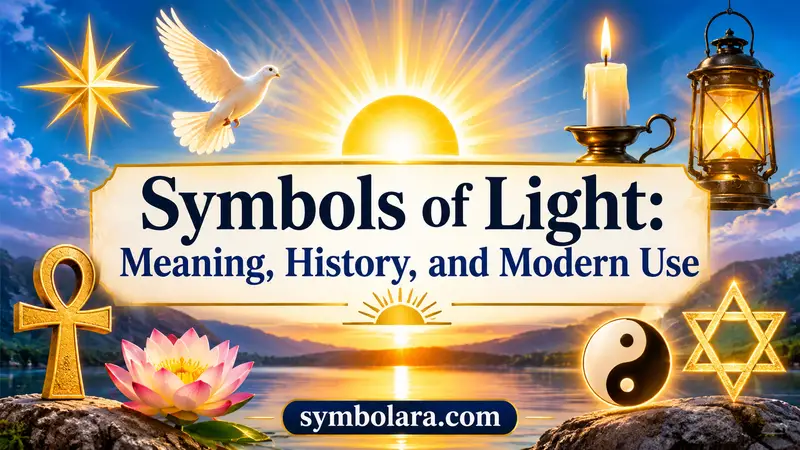
Common examples include:
- Sun: A round disk with rays extending outward, often representing life, growth, and vitality.
- Candle: A small flame above a wax body, associated with remembrance, hope, and reflection.
- Lantern: A portable light source traditionally used to guide people through dark places.
- Light bulb: An illuminated bulb commonly representing ideas, creativity, and discovery.
- Star: A bright point in the night sky associated with direction, aspiration, and inspiration.
- Lighthouse: A tall coastal structure that sends light across the water to guide ships.
- Torch: A handheld flame associated with freedom, knowledge, and public ceremonies.
- Dawn: The first light of morning, often connected with renewal and opportunity.
- Rainbow: A natural display of colors that can represent hope, promise, and positive change.
These images appear in paintings, architecture, jewelry, books, flags, tattoos, and public monuments. Their meanings depend partly on how they are presented. A burning candle at a memorial, for example, communicates something different from a bright light bulb in a business logo.
What Does Light Represent in Modern American Culture?
In the United States, light has several common meanings. The interpretation often depends on the situation, the object producing the light, and the message someone wants to communicate.
Hope during difficult times
A small light in a dark setting can represent the belief that circumstances may improve. People use candles, glowing stars, and sunrise images to express encouragement during illness, grief, personal struggles, or major life changes.
A candle placed in a window, for example, can communicate welcome and reassurance.
Knowledge and understanding
Light also represents the ability to recognize something clearly. A light bulb above a person’s head has become a familiar visual shorthand for an idea or sudden realization.
Schools, educational organizations, and technology companies often use this image to communicate learning and innovation.
Truth and honesty
Light makes objects visible. This physical quality helps explain why it is often connected with truth, openness, and discovering facts.
Expressions such as bringing something to light suggest revealing information that was previously hidden.
Guidance and protection
A lighthouse, lantern, or guiding star can represent help when someone faces uncertainty. These images are especially meaningful when people want to communicate support, direction, or reassurance.
Life and renewal
Sunlight supports plant growth and affects daily human activity. It is therefore commonly associated with health, natural cycles, warmth, and the beginning of a new stage.
These meanings are not fixed rules. Someone choosing a sunrise tattoo might be celebrating recovery, while another person may simply appreciate the beauty of a new morning.
Where Did the Historical Meaning of Light Begin?
The earliest associations between light and human life developed from practical experiences rather than from a single symbolic tradition.
Fire changed how early communities lived. It provided warmth, helped people cook food, offered protection, and allowed activities to continue after sunset. Shared fires also became places where people gathered, prepared meals, and passed knowledge between generations.
Over time, fire acquired meanings beyond survival. It appeared in ceremonies, religious practices, and stories about creation, destruction, transformation, and renewal.
Sunlight also shaped early beliefs. Agricultural communities depended on seasonal patterns and daylight for planting, harvesting, and organizing daily work. The Sun became important in many religious and cultural systems, although its meaning differed across societies.
In ancient Egypt, the Sun was closely connected with the god Ra, whose daily journey across the sky formed an important part of Egyptian religious thought. Ancient Greek traditions associated Apollo with light, music, prophecy, and other aspects of divine life, although these associations developed over time.
Light also became important in philosophical discussions. In Plato’s Republic, the allegory of the cave uses the movement from shadows toward sunlight to explain the difference between appearances and knowledge.
These examples show that the connection between illumination and understanding developed through several different paths. There was no single origin for every modern interpretation.
How Did Light Become a Religious and Spiritual Symbol?
Many religious traditions use physical light to communicate ideas about divine presence, guidance, goodness, or spiritual understanding.
In Christianity, light is associated with Jesus, divine truth, and the contrast between good and evil. Churches may use candles during worship, Christmas services, Easter celebrations, and memorial ceremonies. Stained-glass windows also use natural light to display biblical scenes and religious figures.
In Judaism, the Hanukkah menorah is a central example. During the eight-night celebration, families light candles or oil lamps to remember the rededication of the Second Temple in Jerusalem and the traditional account of the oil lasting eight days.
In Hindu traditions, Diwali is widely celebrated through lamps, candles, fireworks, and other displays of illumination. The festival has different meanings across regions and communities, but light commonly accompanies celebrations of hope, prosperity, and the victory of good over evil.
Buddhist traditions also use lamps and candles in ceremonies. In some settings, offering light represents wisdom and the removal of ignorance.
These traditions should not be treated as identical. A Hanukkah candle, a Diwali oil lamp, and a Christian church candle belong to different religious histories. Their shared use of illumination does not make their beliefs interchangeable.
Why Is Light Important in American Culture?
Light appears throughout American public life, from national celebrations to community events and personal traditions.
Christmas celebrations
During December, homes, streets, shops, and public spaces across the United States display strings of electric lights. These decorations are associated with Christmas traditions, celebration, family gatherings, and seasonal cheer.
Some displays also use stars to recall the Star of Bethlehem in Christian tradition.
Independence Day
On July 4, fireworks illuminate the night sky as part of Independence Day celebrations. Although fireworks are primarily entertainment, their bright displays have become associated with national celebration, public gatherings, and shared memories.
Memorials and remembrance
Candles are commonly used during vigils for people who have died, community tragedies, or public causes. A group of people holding small flames can create a visible expression of mourning and solidarity.
The September 11 memorial observances in New York have also included the annual Tribute in Light installation. Its two vertical beams recall the former World Trade Center towers and honor those who died in the attacks.
New Year’s celebrations
The illuminated ball drop in Times Square is one of America’s best-known New Year’s traditions. Its bright displays accompany the countdown and represent the arrival of a new calendar year.
Community festivals
Cities and neighborhoods organize holiday light displays, lantern events, and illuminated public installations. These activities turn ordinary streets and parks into shared spaces for celebration.
In these settings, light is not just decoration. It helps create an atmosphere and gives people a visual way to mark important occasions.
How Do Different Cultures Interpret Light?
Although light has common associations in many societies, specific traditions give it different meanings.
| Context | Meaning in USA | Common Associations | Notes |
| Christian traditions | Faith and divine guidance | Candles, halos, stained glass | Connected with biblical teachings and worship |
| Jewish Hanukkah | Religious remembrance and celebration | Menorah, candles, oil lamps | Eight nights of lighting |
| Hindu Diwali | Celebration and renewal | Diyas, lanterns, decorative lights | Meanings vary among communities |
| Buddhist ceremonies | Wisdom and understanding | Butter lamps, candles | Light offerings have different meanings across traditions |
| American memorials | Remembrance and solidarity | Vigil candles, illuminated monuments | Often used during public gatherings |
| Modern popular culture | Hope and personal growth | Sunrises, stars, glowing designs | Frequently used in art, fashion, and tattoos |
In Chinese cultural traditions, lanterns have connections with festivals, family celebrations, and good wishes. The Lantern Festival, which marks the end of Lunar New Year celebrations, features illuminated lanterns and public displays.
In Japanese traditions, lanterns appear in festivals, religious settings, and memorial practices. Their meaning depends on the event and the type of lantern being used.
These examples demonstrate why it is important to consider cultural context before assigning one universal meaning to an image.
Why Do People Emotionally Connect With Light?
People connect with light partly because it affects everyday experiences.
Bright daylight makes it easier to see surroundings, travel safely, recognize faces, and complete tasks. A dark environment can make ordinary activities more difficult. This difference helps explain why light is frequently associated with safety and reassurance.
Light also has a connection with memory.
Someone might remember a parent lighting a candle during a holiday, a grandparent keeping a lamp near the front door, or a family gathering around a fireplace during winter. Years later, these experiences can make similar images feel personal.
The emotional meaning can also come from a difficult experience. A person who has recovered from a challenging period may choose a sunrise as a reminder of progress. Someone grieving a loved one might light a candle on an anniversary.
In these cases, the object does not have to carry a universal meaning. Its personal history gives it importance.
What Do Different Light Sources Symbolize?
Different sources of illumination communicate different ideas. Understanding these distinctions can help when choosing an image for artwork, jewelry, or a personal project.
Sunlight: Life and natural growth
The Sun is associated with warmth, daylight, agriculture, and the changing seasons. It can represent vitality, confidence, and the ability to begin again.
A sunrise is particularly suitable for expressing a fresh start, while a midday Sun may suggest strength or activity.
Candles: Remembrance and reflection
Candles are often used in religious services, memorials, and quiet personal settings. Their small flames can represent continued remembrance, prayer, or a moment of reflection.
Stars: Direction and aspiration
Stars have helped people navigate the night sky for thousands of years. The North Star, also called Polaris, has been especially useful for finding direction in the Northern Hemisphere.
This practical role helps explain why stars are often associated with guidance and personal goals.
Lanterns: Welcome and safe passage
Lanterns provide portable illumination. They appear in festivals, historical settings, and home decorations.
Their symbolism often relates to hospitality, protection, and finding a way through unfamiliar surroundings.
Lighthouses: Safety and direction
A lighthouse sends a visible signal to ships approaching dangerous coastlines. As a symbol, it can represent reliability, guidance, and someone who offers support during uncertain times.
Light bulbs: Ideas and creativity
The light bulb became a popular visual symbol of invention and intellectual discovery. Its modern use is especially common in advertising, education, technology, and illustrations about problem-solving.
Why Do People Choose Light Tattoos?
Light-inspired tattoos appeal to people who want to represent personal progress, hope, or a significant life experience.
A tattoo can also combine several images to communicate a more specific message.
Common designs include:
- Sunrise over mountains: A new beginning after a difficult period.
- Candle with a small flame: Remembrance of a loved one.
- Lighthouse near the ocean: Guidance, stability, and protection.
- Light bulb with flowers: Creativity, learning, and personal development.
- Star surrounded by darkness: Direction and determination during uncertainty.
- Sun with fine-line rays: Life, warmth, and optimism.
Placement and artistic style can change how a tattoo feels. A small candle on the wrist may serve as a private reminder, while a large lighthouse across the forearm may communicate a more visible personal statement.
Before choosing a design connected with a religious tradition, it is worth understanding its original context. This is particularly important when using specific sacred objects or ceremonial symbols.
How Is Light Used in Jewelry, Fashion, and Home Decor?
Light-inspired designs are common in products that people use to express their interests, memories, and personal values.
In jewelry, stars, suns, and small flame pendants are popular choices. A star necklace might represent ambition, while a sun pendant can communicate optimism and an appreciation for nature.
Fashion designers also use reflective materials, metallic surfaces, sequins, and glowing patterns to create visual effects. These designs may suggest celebration, confidence, or futuristic ideas without carrying a specific historical meaning.
Home decorations provide another example.
- Candle holders: Often used to create a peaceful atmosphere or mark special occasions.
- Sun wall art: Can communicate warmth and an interest in natural design.
- Lanterns: Frequently used in outdoor spaces and seasonal decorations.
- Star-shaped lights: Popular in bedrooms, holiday displays, and children’s spaces.
- Light-up signs: Used to create a welcoming or playful atmosphere.
The meaning depends on the owner’s intention. A decorative star does not automatically represent a religious belief, and a candle does not always indicate mourning.
How Do Artists and Writers Use Light to Tell Stories?
Artists and writers often use illumination to help audiences understand a character, situation, or change.
In paintings, light can draw attention to a particular person or object. A bright figure surrounded by a darker background may appear important, isolated, or protected, depending on the scene.
Renaissance artists developed techniques such as chiaroscuro, which uses strong contrasts between light and shadow to create depth and emphasize forms. These techniques influenced later European and American art.
In literature, light frequently represents knowledge or discovery. A character moving from darkness into daylight may suggest that they have understood something important or escaped a difficult situation.
Film directors also use lighting to influence mood. A warm sunrise can make a scene feel hopeful, while a single lamp in a dark room can create tension or focus attention on a character’s expression.
For example, the ending of The Shawshank Redemption uses bright natural surroundings and an open landscape to communicate freedom and a new chapter in the main character’s life.
The meaning comes from the complete scene, not simply from the presence of brightness.
Are There Misunderstandings About Light Symbolism?
Some common assumptions about illumination can create confusion.
Misunderstanding 1: Light always represents something good.
Not necessarily. Bright light can reveal uncomfortable facts, expose wrongdoing, or create danger. In literature and film, intense artificial lighting can also represent surveillance, pressure, or loss of privacy.
Misunderstanding 2: Darkness always represents evil.
Darkness can also communicate rest, privacy, mystery, safety, or the natural nighttime environment. Many stories use darkness without suggesting that something bad is happening.
Misunderstanding 3: Every religious light symbol means the same thing.
Different traditions have their own histories, ceremonies, and beliefs. A Jewish Hanukkah menorah should not be treated as interchangeable with a Hindu diya or a Christian Advent candle.
Misunderstanding 4: A light bulb is an ancient symbol of intelligence.
The light bulb is a relatively modern invention. Its familiar association with ideas developed alongside modern electrical technology and visual advertising, rather than originating in ancient philosophy.
Misunderstanding 5: Light imagery has one fixed meaning in tattoos.
Personal experience matters. Two people may choose identical sunrise tattoos but connect them with entirely different memories.
Understanding these differences makes it easier to use such imagery accurately and respectfully.
How Has the Meaning of Light Changed Over Generations?
The interpretation of illumination has changed as technology and everyday life have developed.
In early societies, natural daylight and controlled fire were essential to survival. Their practical importance helped establish associations with warmth, safety, agriculture, and community.
Religious institutions later developed specific uses for candles, lamps, and other forms of illumination. These objects became part of ceremonies, seasonal celebrations, and memorial practices.
During the Enlightenment in the 17th and 18th centuries, light became closely connected with reason, education, scientific inquiry, and intellectual progress. The period’s name itself reflects the importance of illumination as a metaphor for understanding.
The 19th and 20th centuries brought major changes in artificial lighting. Gas lamps and electric lights transformed streets, homes, workplaces, and entertainment venues. The light bulb also became a familiar image for inventions and new ideas.
By the late 20th century, illuminated advertising, neon signs, television, and digital screens had made artificial light an everyday part of American visual culture.
From 2020 through 2026, LED technology, smartphone displays, digital artwork, and immersive lighting installations have expanded the ways people interact with illuminated images.
Younger generations also encounter light imagery through social media, digital illustrations, gaming, and personal branding. A glowing star or sunrise may be used as a visual expression of optimism without any specific religious connection.
The basic associations remain recognizable, but the objects and settings through which people express them continue to change.
How Can You Choose a Meaningful Light Symbol?
The best design depends on the message you want to communicate.
Start by identifying the idea that matters most to you. Different light sources can express different experiences, even when they share a general connection with hope or understanding.
Consider these examples:
- For a fresh start: Choose a sunrise, morning sky, or opening flower in sunlight.
- For remembrance: Consider a candle, memorial flame, or small lantern.
- For knowledge: A light bulb, open book under a lamp, or illuminated doorway may work.
- For guidance: A lighthouse or North Star can communicate direction.
- For family and welcome: A warm window light or lantern may be more suitable.
- For personal confidence: A Sun with clearly defined rays can represent vitality and self-expression.
Think about the setting as well. A religious symbol may have specific cultural responsibilities, while a simple natural image may communicate a more personal message.
The most suitable design is one that reflects your actual experience rather than simply following a popular trend.
FAQs
Are symbols of light positive or negative?
They are generally associated with positive ideas such as hope, knowledge, and guidance. However, their meaning can change in stories, artwork, and social settings where harsh illumination represents exposure, danger, or unwanted attention.
Does light have a meaning in dreams?
Dream interpretations vary, and there is no scientifically established meaning that applies to everyone. A bright room might remind one person of safety, while another might connect it with a recent memory or an experience of discovery.
What is the difference between sunlight and artificial light symbolism?
Sunlight is commonly connected with natural life, growth, and seasonal change. Artificial light often communicates human invention, civilization, learning, or the ability to create safety after sunset.
Why is light associated with education?
The connection became especially recognizable during the European Enlightenment, when illumination was used as a metaphor for reason and intellectual progress. Modern schools and educational organizations continue this tradition through light bulb illustrations and similar designs.
Can light represent a person who has died?
Yes. Families and communities sometimes use candles, stars, and illuminated memorials to remember people who have died. These images can represent the continuing importance of someone’s memory without making a specific claim about the afterlife.
What color of light represents hope?
White and warm yellow are commonly used to communicate hope, comfort, and reassurance in American design. However, color associations vary by culture and setting, so the surrounding imagery also matters.
Why do lighthouses represent guidance?
Lighthouses were built to help ships recognize coastlines and avoid dangerous waters. Their practical role made them natural images of dependable direction, protection, and support when someone faces uncertainty.
Conclusion
Symbols of light represent hope, knowledge, truth, guidance, remembrance, and new beginnings. Their meanings developed through practical human experiences with fire and sunlight, as well as religious traditions, philosophy, art, and cultural celebrations.
Today, symbols of light appear in American holidays, memorials, tattoos, jewelry, architecture, literature, and digital media. Their meanings may differ between individuals, but the connection between illumination and understanding remains easy to recognize.
Whether someone chooses a candle to remember a loved one, a lighthouse to represent guidance, or a sunrise to mark a fresh start, the image gives a visible form to something personal. Sometimes, a small light is enough to remind someone of what they want to carry forward.