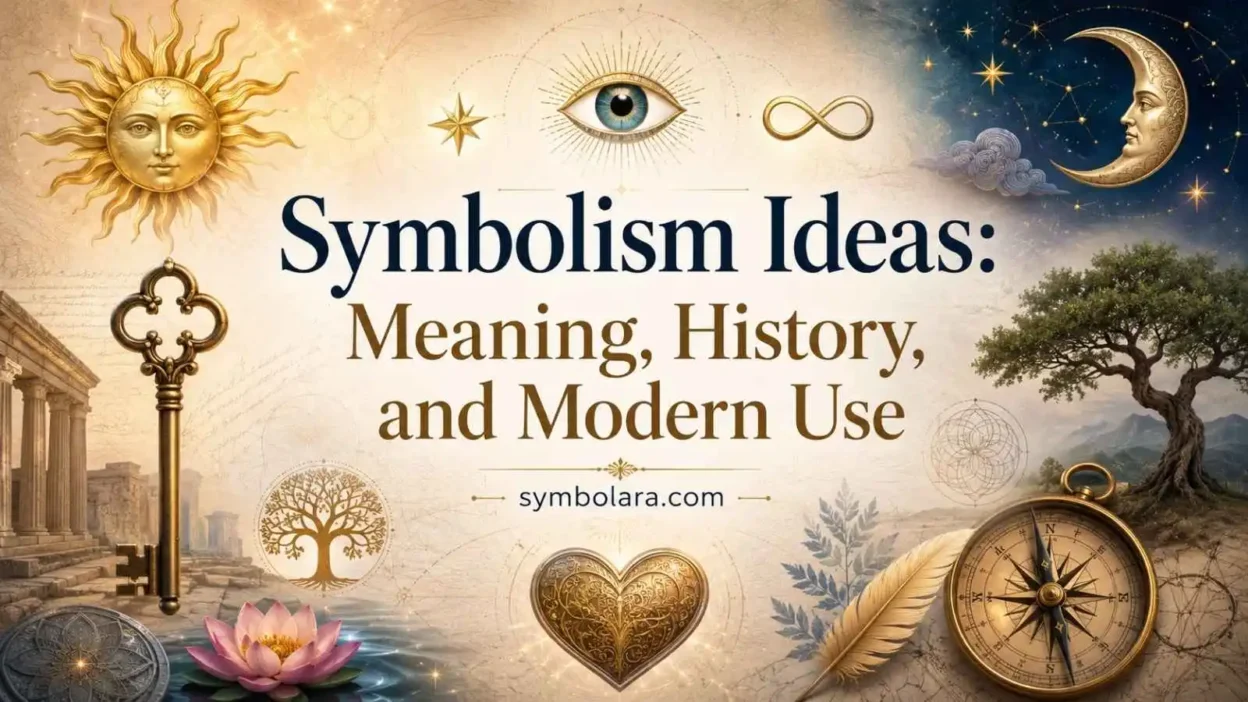
Symbolism gives ordinary things a second layer of meaning. A tree can suggest growth, a locked door can represent restriction, and a storm can stand for conflict or upheaval. Symbolism ideas draw on objects, colors, animals, plants, places, gestures, and natural events that people connect with larger concepts.
Americans encounter symbolic imagery constantly—in books and movies, tattoos, memorials, wedding flowers, religious art, political imagery, clothing, logos, social media, and home decor. Some meanings are widely recognized, while others depend heavily on culture, personal experience, or the surrounding story.
Understanding symbolism therefore involves more than memorizing that one object “means” one thing. The strongest interpretation considers the symbol itself, its historical associations, the setting where it appears, and the person or community using it.
Quick Answer
Symbolism ideas commonly use visible things such as animals, colors, plants, objects, and natural forces to represent abstract concepts like love, freedom, death, change, hope, identity, or protection. Their meanings may come from religion, mythology, literature, history, cultural traditions, or modern personal use, so context determines which interpretation fits best.
TL;DR
- Symbols turn physical images into ideas, emotions, values, or memories.
- Nature often represents change, growth, mortality, renewal, and resilience.
- American symbols frequently express freedom, unity, independence, and identity.
- Color meanings depend on culture, setting, design, and personal association.
- Tattoos and jewelry often turn traditional symbols into personal statements.
- A symbol’s meaning can change dramatically across cultures and generations.
What Symbolism Actually Means
A symbol is something perceptible that stands for or suggests something beyond itself. In literature, for example, a physical object or action can point toward an abstract idea that the writer wants readers to recognize.
That principle explains why a candle can function as more than a source of light. In one setting, it may represent remembrance. In another, it can suggest faith, hope, life, guidance, or time running out.
Context matters because symbolic meaning is rarely mechanical. Red may suggest romance on Valentine’s Day, danger on a warning sign, blood in a horror movie, or celebration in another cultural tradition.
A useful way to interpret symbolism is to ask three questions: What is literally shown? What associations does that object already carry? What does the surrounding context encourage the viewer to understand?
How to Interpret Symbolism Correctly
Interpreting symbolism requires more than finding a quick definition online. A symbol’s meaning depends on its appearance, location, history, and purpose.
A simple method is to examine four areas:
- Look at the literal object: Identify what is actually shown. A bird is still a bird before it becomes a symbol of freedom, hope, or escape.
- Research cultural background: Learn whether the symbol has historical, religious, or regional meanings.
- Study the context: Consider where the symbol appears. A rose in a wedding bouquet may communicate love, while a rose in a memorial setting may represent remembrance.
- Consider the creator’s intention: In art, literature, and design, the person who uses the symbol may give it a specific meaning.
Strong interpretations balance shared cultural meanings with the details surrounding the symbol. A symbol rarely has only one correct explanation, but some interpretations are better supported than others.
Why Symbolism Has No Single Historical Origin
Humans used symbolic images long before anyone defined “symbolism” as an artistic technique. Religious objects, royal insignia, burial imagery, plants, animals, celestial bodies, colors, and geometric forms have carried social or spiritual meanings in many societies.
That broad human practice should not be confused with Symbolism, the specific nineteenth-century artistic and literary movement. European Symbolist artists and writers emphasized subjective experience, dreams, emotion, imagination, and suggestive imagery rather than straightforward realism. The movement became especially influential in France and Belgium during the late nineteenth century.
Modern symbolism inherits both traditions. Creators can use an established cultural symbol, such as a dove, or invent a personal symbol whose meaning develops within a particular novel, film, painting, or relationship.
Common Symbolism Ideas at a Glance
The following meanings are useful starting points rather than fixed definitions.
| Symbol | Common Modern Association | Possible Secondary Meaning | Where It Often Appears |
| Tree | Growth, life | Family, endurance, roots | Tattoos, logos, memorial art |
| Water | Renewal, emotion | Danger, cleansing, change | Literature, dreams, visual art |
| Butterfly | Transformation | Freedom, fragility | Tattoos, jewelry, decor |
| Rose | Love | Beauty, grief, secrecy | Gifts, weddings, tattoos |
| Key | Access, opportunity | Knowledge, trust, freedom | Jewelry, fiction, tattoos |
| Moon | Cycles, change | Intuition, night, femininity | Art, fashion, spiritual imagery |
No item in this table has one universal interpretation. A dead tree and a flowering tree, for example, create very different impressions even though both use the same basic symbol.
Types of Symbolism: Major Categories and Examples
Symbolism appears in many forms because humans use different types of images and ideas to communicate meaning. The category of a symbol often helps explain why people connect it with a certain concept.
Common types of symbolism include:
- Animal symbolism: Uses creatures such as lions, wolves, owls, butterflies, and snakes to represent traits, emotions, or ideas.
- Nature symbolism: Uses trees, water, mountains, seasons, and weather to express growth, change, survival, or renewal.
- Color symbolism: Uses colors to communicate emotions, cultural values, warnings, identity, or mood.
- Religious symbolism: Uses sacred images and objects connected with faith, rituals, and spiritual traditions.
- Literary symbolism: Uses repeated objects, characters, places, or events to represent deeper themes in stories.
- Personal symbolism: Uses private images, memories, or objects that hold special meaning for an individual.
- Cultural symbolism: Uses symbols understood within a specific community, nation, or historical tradition.
These categories often overlap. A tree tattoo may combine nature symbolism, personal symbolism, and cultural symbolism at the same time. Understanding the category helps explain where a symbol’s meaning comes from and why different people may interpret it differently.
Nature Symbolism: Trees, Water, Fire, and Seasons
Nature provides some of the most flexible symbolism because natural processes already resemble human experiences.
Trees commonly suggest growth, continuity, family roots, stability, or endurance. Their seasonal changes can also represent mortality and renewal. A broken tree may instead suggest loss, disruption, or vulnerability.
Water often represents life, cleansing, emotion, movement, or transformation. Calm water can imply peace, while deep or turbulent water can communicate uncertainty, danger, or emotional pressure.
Fire can symbolize warmth, passion, purification, destruction, anger, or rebirth. Its meaning changes according to what the fire is doing. A hearth fire feels different from a burning building.
Seasonal symbolism follows a similar pattern. Spring naturally lends itself to beginnings and renewal, summer to abundance and activity, autumn to maturity or decline, and winter to dormancy, hardship, isolation, or rest.
These associations work because readers recognize the physical processes behind them without needing a lengthy explanation.
Popular Symbols and What They Represent
Many symbols become popular because their physical qualities naturally connect with human experiences.
Examples include:
- Anchor: Stability, hope, security, and staying grounded.
- Arrow: Direction, progress, ambition, and movement forward.
- Compass: Guidance, exploration, life choices, and finding a path.
- Feather: Freedom, communication, spirituality, or connection with nature.
- Mountain: Strength, challenges, achievement, and personal growth.
- Bridge: Transition, connection, change, and moving from one stage to another.
- Circle: Wholeness, cycles, unity, and completion.
- Tree of life: Growth, connection, family, and continuity.
These meanings are common associations rather than strict rules. The same symbol may communicate something different depending on the culture, artwork, personal experience, or story where it appears.
Animal Symbolism and the Traits People Project Onto Wildlife
Animal symbols frequently grow from a mixture of actual behavior, folklore, mythology, religious tradition, and human imagination.
An eagle may communicate authority, independence, vision, or national identity. A wolf can represent loyalty and family because of its association with packs, yet stories may also use wolves to represent danger, wildness, or predation.
Butterflies have become especially common symbols of transformation because their life cycle creates an obvious visual metaphor for change. Owls can imply wisdom in many American contexts, although owl meanings differ substantially in other traditions.
Snakes demonstrate how contradictory animal symbolism can become. Depending on the context, a snake may suggest danger, deception, healing, rebirth, medicine, sexuality, or transformation.
The strongest interpretation comes from examining the specific animal’s pose, behavior, setting, and cultural tradition rather than treating an online meaning list as a universal dictionary.
Flowers and Plants as Symbols of Emotion
Flowers communicate meaning particularly well because people already use them during emotionally important moments such as weddings, funerals, anniversaries, graduations, apologies, and romantic occasions.
The red rose remains strongly associated with romantic love in the United States. White flowers are often chosen for weddings, memorials, or understated ceremonial designs, although individual species have their own associations.
Lotus flowers can suggest purity, spiritual development, or emergence from hardship because of established religious traditions, particularly in Asian religions. Sunflowers frequently communicate warmth, optimism, loyalty, or an energetic personality in contemporary American designs.
Plants can also symbolize endurance. Succulents and desert plants, for instance, easily become metaphors for survival because they remain alive under dry conditions.
Flower symbolism becomes most meaningful when the species, color, occasion, and cultural background are considered together.
Color Symbolism Depends on Context
Colors are among the easiest symbolic tools to recognize and among the easiest to oversimplify.
In mainstream U.S. contexts, red may communicate love, passion, urgency, anger, danger, or physical intensity. Blue can suggest calmness, stability, sadness, authority, or trust. Green frequently connects with nature, environmentalism, growth, money, health, or envy.
Black may convey elegance, seriousness, mourning, rebellion, authority, or threat. White often suggests simplicity, cleanliness, innocence, peace, or ceremonial purity in American settings.
None of these meanings is automatic. Modern and contemporary artists may even use color as the primary subject rather than as a coded symbol.
That is why color symbolism should be interpreted through the complete visual environment. A black evening dress, black funeral clothing, and a black warning graphic use the same color for very different purposes.
Everyday Objects Can Become Effective Symbols
Objects make useful symbols because their ordinary functions provide clues to their metaphorical meanings.
A key opens something, so it can suggest access, knowledge, opportunity, trust, or liberation. A door separates spaces and may therefore represent transition, possibility, exclusion, or a decision.
A mirror can symbolize identity, self-examination, truth, vanity, distortion, or divided perception. A clock or hourglass naturally suggests time, mortality, deadlines, memory, or impermanence.
Chains usually communicate restriction, captivity, obligation, or control. Broken chains reverse the image and often represent release or liberation.
Authors and artists often strengthen object symbolism through repetition. When the same object appears during important moments, audiences learn to associate it with the story’s underlying theme.
Celestial and Weather Symbolism
The sky provides imagery for ideas that feel larger than ordinary human life.
The sun commonly represents vitality, warmth, clarity, authority, awakening, or life. A sunrise naturally suggests beginning again, while sunset can represent completion, aging, departure, or transition.
The moon lends itself to symbolism involving cycles because its visible phases repeatedly change. It may also communicate night, mystery, reflection, femininity, solitude, or emotional change depending on the tradition.
Stars can symbolize guidance, aspiration, destiny, excellence, distance, or hope. Storm clouds may communicate approaching conflict, while lightning can represent sudden insight, destruction, divine force, or dramatic change.
Weather symbolism works particularly well in storytelling because the external environment can mirror a character’s emotional condition without directly describing that emotion.
Religious and Spiritual Symbols Need Cultural Context
Religious symbols are not merely decorative designs. They may represent sacred beliefs, communal identity, theological teachings, ritual practices, or centuries of cultural history.
The Christian cross, for example, centers on the crucifixion of Jesus and, within Christianity, is closely connected with sacrifice, salvation, faith, and resurrection. Other traditions have their own sacred symbols whose meanings cannot be accurately reduced to generic ideas such as “spirituality.”
Lotus imagery in Buddhist or Hindu settings, Jewish symbols such as the menorah or Star of David, Islamic calligraphic and architectural forms, and Indigenous ceremonial imagery all require their own historical and cultural explanations.
A design can look visually appealing while carrying significance that an outsider does not immediately recognize. For tattoos, fashion, branding, and decor, learning that cultural context helps prevent accidental distortion or disrespect.
American National Symbols and Their Meanings
The United States has developed a particularly visible set of national symbols.
The American flag uses 13 stripes for the original colonies and 50 stars for the states. Official U.S. descriptions associate its red with valor and bravery, white with purity and innocence, and blue with vigilance, perseverance, and justice.
The bald eagle appears on the Great Seal of the United States. The eagle holds an olive branch and arrows, which represent the nation’s powers of peace and war; the seal was adopted in 1782.
The Statue of Liberty combines several symbols. Its torch represents enlightenment, its tablet bears the date July 4, 1776, and broken chains at its feet connect the monument with freedom from oppression and servitude.
American artists continue to reuse these images to discuss patriotism, freedom, immigration, political ideals, criticism, and national identity rather than simply repeating their official meanings. The Smithsonian American Art Museum notes that familiar icons such as the flag, eagle, and Statue of Liberty are used by artists to examine ideas about American society.
Symbolism in Literature, Film, and Visual Art
Creative works rarely need a symbol to have only one interpretation.
In literature, a recurring bird might gradually become associated with escape. A family house may represent security early in a story but later represent confinement. The audience learns the symbolic meaning through repetition, contrast, and changes in context.
Film adds visual and auditory tools. Lighting, costume colors, weather, mirrors, doors, music, framing, and repeated objects can all develop symbolic associations without dialogue explaining them.
Visual artists can create meaning through line, color, composition, subject matter, scale, and recognizable iconography. The Symbolist painters of the nineteenth century particularly emphasized the relationship between outward form and subjective feeling.
A useful rule is not to assume that every object is symbolic. Strong symbolism usually gains importance from repetition, unusual emphasis, historical association, or a meaningful relationship with the work’s themes.
Symbolism Ideas for Writing, Art, and Creative Projects
Writers and artists often use symbolism to communicate ideas without directly explaining them. A carefully chosen image can create emotion, suggest a theme, or reveal something about a character.
For creative projects, common symbolism ideas include:
- A fading flower: Change, aging, memory, or the passage of time.
- A locked door: Secrets, barriers, hidden opportunities, or unanswered questions.
- A storm: Conflict, emotional struggle, uncertainty, or transformation.
- A path or road: Choices, journeys, personal growth, or new possibilities.
- A broken object: Loss, change, damage, or rebuilding.
- A mirror: Identity, self-reflection, truth, or perception.
The strongest creative symbols usually connect naturally with the story or message. Instead of adding a symbol only because it looks meaningful, creators often achieve better results by choosing images that support the central idea.
Tattoos, Jewelry, and Personal Identity
Modern personal symbolism often combines public meaning with private biography.
Someone may choose a butterfly tattoo because transformation reflects a major life change. Another person may choose the same butterfly simply because it reminds them of a relative, childhood memory, or particular place.
A compass can represent travel for one person and moral direction for another. A snake tattoo might express rebirth, strength, danger, healing, or an appreciation for the animal itself.
Jewelry works similarly. Lockets, birthstones, religious pendants, initials, family heirlooms, rings, and charms can carry meanings invisible to anyone except the wearer.
Personal symbolism is therefore not less legitimate than historical symbolism. It simply operates at a different level. Public symbols rely on shared cultural recognition, while personal symbols depend on individual memory and identity.
Symbols in Social Media and Digital Culture
Digital communication has created an enormous symbolic vocabulary.
Emoji are pictorial symbols used within text to represent objects, actions, feelings, expressions, and ideas. Unicode describes them as characters that can represent faces, weather, animals, food, emotions, activities, and many other concepts.
Their social meanings often expand beyond their literal images. A flame emoji may praise something as impressive or attractive. A heart can communicate affection, support, agreement, friendship, or romantic interest depending on the conversation.
Memes work symbolically as well. A familiar reaction image can eventually communicate an entire attitude without requiring its original caption or context.
Digital symbolism changes quickly because communities continually create new associations. That makes online context especially important when interpreting emojis, abbreviations, images, colors, and visual trends.
Emotional and Psychological Meaning of Symbols
Symbols can communicate feelings efficiently because people connect concrete images with memories and experiences.
An empty chair may represent absence because people imagine the person who should occupy it. An abandoned house may feel lonely because homes are normally associated with human presence. A road disappearing into the distance suggests possibility because roads physically lead somewhere.
Personal experiences can override conventional interpretations. The ocean may represent freedom for someone who loves sailing but fear for someone who associates deep water with danger.
This explains why two viewers can understand the same artwork differently without either interpretation being irrational. Shared cultural associations provide one layer of meaning; individual memory provides another.
Good interpretation acknowledges both while still looking for evidence in the symbol’s context.
Cross-Cultural Meanings Can Conflict
A symbol that appears positive in one community may communicate something entirely different elsewhere.
Religious iconography, animals, hand gestures, colors, flowers, numbers, and clothing can all develop meanings within particular historical traditions. Even similar visual forms can acquire different meanings when cultures interact and reinterpret one another.
This is especially important in the United States because American culture includes communities with many religious, ethnic, national, and family traditions. A symbol encountered at a festival, ceremony, tattoo studio, temple, church, museum, or family gathering should not automatically be interpreted through mainstream American assumptions.
When researching unfamiliar symbolism, culture should come before aesthetic resemblance. Asking where a symbol comes from usually produces a more accurate explanation than asking only what it looks like.
When Symbols Become Controversial or Misused
Symbolic meanings can be altered by political movements, propaganda, discrimination, commercialization, or appropriation.
The swastika is one of the clearest examples. Versions of the symbol existed in numerous cultures for thousands of years and were associated with concepts such as well-being or good fortune. Nazi adoption in the twentieth century transformed its public meaning in Europe and the United States, where it became overwhelmingly associated with Nazism, antisemitism, racial ideology, and hate.
That history demonstrates why a claim such as “this symbol originally meant something positive” does not erase its later associations.
Controversies may also develop when sacred or culturally specific symbols are stripped of context and treated only as fashion. Responsible interpretation requires distinguishing the symbol’s historical tradition, its modern public meaning, and the intention of the individual using it.
How Symbolic Meaning Changes Over Time
Symbols survive because people continually reinterpret them.
An image may begin as a religious emblem and later enter art, fashion, advertising, or political culture. A national symbol may be used both patriotically and critically. A flower once associated with a narrow ceremonial tradition can become a popular tattoo representing a personal experience.
New media accelerate that process. A gesture or image can move from a small online community into mainstream culture within a short period, gaining new associations along the way.
Older meanings do not necessarily disappear. Instead, symbols often accumulate layers.
That is why the question “What does this symbolize?” usually has a better answer than “What is its one true meaning?” Symbolism is shaped by history, but meaning remains connected to the people who continue using the image.
How to Choose a Symbol for a Specific Meaning
Start with the idea you want to communicate rather than choosing an attractive image first.
For growth, consider trees, seeds, vines, sunrise, or unfolding leaves. For transformation, butterflies, snakes shedding skin, changing seasons, or doorways can work naturally.
For freedom, open skies, birds in flight, broken chains, roads, or unlocked doors provide recognizable imagery. For memory, photographs, candles, pressed flowers, clocks, heirlooms, or empty spaces can create quieter symbolism.
If the goal is resilience, choose something whose physical nature supports the idea—such as a plant surviving harsh conditions rather than an unrelated image given an arbitrary definition.
The best symbol usually creates an understandable connection between what the object actually does and what you want it to represent.
FAQs
Trees, seedlings, butterflies, sunrise, mountains, open roads, and snakes shedding their skin can all suggest growth or transformation. Choose the image whose natural qualities most closely reflect the type of change you want to express.
Common choices include lions, bears, mountains, oak trees, shields, anchors, and fire. Strength can mean physical force, emotional endurance, protection, stability, or survival, so the best symbol depends on the specific meaning.
Sunrise, spring flowers, seeds, eggs, open doors, butterflies, and newly formed leaves commonly suggest beginnings. Images involving movement from darkness into light can also communicate starting over.
Popular tattoo concepts include animals, flowers, celestial imagery, keys, compasses, trees, arrows, eyes, waves, and meaningful geometric forms. A tattoo’s strongest meaning usually combines established associations with the wearer’s own experience.
Yes. Fire can represent warmth or destruction, snakes can represent healing or danger, and darkness can suggest either rest or fear. Symbolic meaning depends on context rather than a fixed positive-or-negative classification.
Very few symbolic interpretations are truly universal. Religious traditions, regional customs, historical events, family experiences, and popular culture can give the same image different meanings.
Look for repetition, unusual emphasis, changes in the symbol, and connections with important characters or themes. Historical and cultural context can clarify the meaning, but evidence inside the work should guide the final interpretation.
No, symbolism meanings can differ between cultures, religions, and historical periods. A symbol that represents good fortune in one community may have a different meaning somewhere else.
Conclusion
Symbols work because physical things can carry ideas that would otherwise be difficult to show directly. A flower can communicate grief, a doorway can suggest opportunity, a storm can represent conflict, and an animal can embody qualities people admire or fear.
The most useful symbolism ideas connect the physical character of an image with its historical, cultural, or personal associations. That connection matters more than memorizing rigid definitions.
A symbol becomes meaningful not simply because someone assigns it a label, but because its form, context, history, and audience give that meaning something recognizable to hold onto.
[…] rediscovering older food traditions. This modern use is not the same as floral symbolism, but both meanings share one idea: something valuable can endure across […]