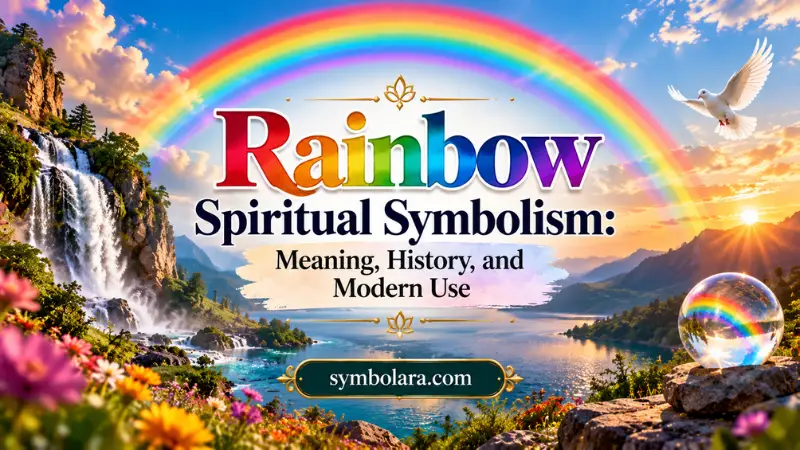
A rainbow appears when sunlight meets water droplets in the air, creating a colorful arc across the sky. It often follows a rainstorm, when dark clouds begin to clear and sunlight returns. That simple change in the weather helps explain why rainbows have become symbols of hope, renewal, and better days ahead.
Rainbow spiritual symbolism connects this natural event with ideas of divine promises, peace, personal growth, and new beginnings. Different religions and cultural traditions have given rainbows their own meanings, from a promise in the Bible to a bridge between worlds in Norse mythology.
In American life, rainbows appear on greeting cards, memorial artwork, religious decorations, jewelry, and flags. Some people see them as signs of encouragement during difficult times. Others appreciate their beauty or use them to express identity and belonging.
Although spiritual interpretations vary, the rainbow continues to represent something many people recognize: the possibility of light after a difficult period.
Quick Answer
Rainbow spiritual symbolism commonly represents hope, renewal, peace, and the promise of better days ahead. Its religious meaning is closely connected to the biblical covenant after Noah’s flood, while other traditions associate rainbows with communication between heaven and Earth. Today, Americans also use rainbows to express inclusion, personal growth, and encouragement during challenging times.
TL;DR
- Rainbows commonly symbolize hope, renewal, peace, and fresh beginnings.
- Genesis connects the rainbow with God’s covenant after the flood.
- Greek mythology associates rainbows with Iris, a divine messenger.
- Rainbows often represent encouragement following hardship or loss.
- Rainbow flags express LGBTQ+ pride, diversity, and inclusion.
- Spiritual interpretations depend on personal beliefs and cultural traditions.
What Does a Rainbow Look Like, and Why Does It Appear?
A rainbow is a colorful band of light that forms when sunlight interacts with water droplets in the atmosphere.
The familiar rainbow contains a continuous range of colors, traditionally described as seven:
- Red
- Orange
- Yellow
- Green
- Blue
- Indigo
- Violet
Red usually appears along the outer edge of a primary rainbow, while violet appears toward the inner edge.
Rainbows develop when sunlight bends as it enters water droplets, reflects inside them, and bends again as it leaves. Different wavelengths of light separate, allowing viewers to see distinct colors.
Most people notice rainbows after rainfall, although they can also appear near waterfalls, fountains, and ocean spray.
A rainbow is not a solid object located at one fixed point in the sky. Its appearance depends on the position of the observer, the sunlight, and the water droplets.
This temporary nature contributes to its emotional appeal.
A rainbow can appear suddenly, brighten the sky, and disappear minutes later. For people who attach spiritual meaning to natural experiences, that brief appearance may feel like a reminder to appreciate moments of beauty and possibility.
The Seven Spiritual Meanings Most Often Associated With Rainbows
Rainbows carry several meanings, but no single interpretation applies to everyone. Their significance depends on religious teachings, cultural background, and personal experience.
Hope After Difficult Times
Hope is among the most familiar rainbow meanings in American culture.
Because rainbows often appear as storms begin to pass, they naturally suggest that difficult circumstances can change.
Someone experiencing grief, disappointment, or uncertainty may find comfort in seeing a rainbow.
The weather itself does not predict what will happen next. Instead, the rainbow becomes a personal reminder that current difficulties do not necessarily last forever.
New Beginnings and Renewal
Rainbows can symbolize the start of a new chapter.
People sometimes choose rainbow images when celebrating recovery, moving into a new home, or making an important life change.
The symbolism comes partly from the transition between rain and sunlight.
A storm has passed, the sky has changed, and something beautiful has appeared.
Peace and Reconciliation
The rainbow’s many colors can represent different people or experiences existing together.
This makes it a fitting image for peace, cooperation, and reconciliation.
In religious settings, a rainbow may also suggest restored relationships or the possibility of forgiveness.
Divine Promises and Faithfulness
For many Christians and Jews, the rainbow has a specific connection to God’s covenant with Noah.
Rather than representing a general good feeling, it recalls a promise described in sacred scripture.
This interpretation remains especially familiar in American churches, children’s Bible lessons, and religious artwork.
Connection Between Heaven and Earth
Some mythological traditions portray rainbows as pathways between the human world and a divine realm.
This association helps explain why rainbows sometimes appear in artwork about spiritual journeys, heavenly messages, and the relationship between earthly life and religious belief.
Unity Through Differences
A rainbow displays several colors within one visible arc.
That combination has made it a symbol of diversity and shared belonging.
Different colors remain recognizable while contributing to the same overall image.
In modern America, this meaning appears prominently in community celebrations and LGBTQ+ pride imagery.
Personal Transformation
A rainbow may also represent emotional change.
Someone who has experienced hardship might choose it as a reminder of patience, healing, or personal progress.
This meaning is individual rather than a universal religious teaching.
A rainbow tattoo, painting, or keepsake can mark a turning point without suggesting that the natural event caused the change.
Rainbow Meaning in the Bible and Christianity
The Bible provides one of the best-known religious explanations for rainbow symbolism in the United States.
In Genesis 9:12–17, God establishes a covenant with Noah and all living creatures following the flood.
The rainbow serves as a visible sign of that covenant.
God promises that floodwaters will never again destroy all life on Earth in the manner described in the story.
This gives the rainbow several connected Christian meanings.
God’s faithfulness: The rainbow reminds believers of a promise that continues across generations.
Mercy: Its appearance follows a story involving judgment, survival, and a new beginning.
Reassurance: The rainbow offers an image of stability after destruction.
Covenant: It represents an enduring agreement between God and living creation.
The rainbow also appears in other biblical passages.
Ezekiel 1:28 compares the brightness surrounding a vision of divine glory to the appearance of a rainbow in clouds.
Revelation 4:3 describes a rainbow around God’s throne, while Revelation 10:1 portrays an angel with a rainbow above his head.
These passages use the rainbow in different settings, but all connect it with sacred imagery.
Christian interpretations are not identical across denominations. Some focus on God’s mercy, while others emphasize the covenant or divine glory.
Importantly, the Bible does not teach that every rainbow a person sees is a new prediction about their individual future.
Its scriptural meaning comes from the specific passages in which it appears.
How Rainbow Symbolism Developed in Early Cultural Traditions
Rainbow interpretations existed in several early civilizations, although their meanings were not always alike.
People observed the same natural phenomenon but explained it through different religious stories and cultural ideas.
Rainbows in Ancient Greek Mythology
In Greek mythology, Iris was the goddess associated with the rainbow and served as a messenger of the gods.
The rainbow’s position between the sky and Earth made it a fitting image for communication between divine and human worlds.
Iris appears in Greek literature as a messenger, especially in Homer’s Iliad.
This tradition helped establish the rainbow as an image of movement and communication between different realms.
Rainbows in Norse Mythology
Norse mythology describes Bifröst, a bridge connecting the world of humans, Midgard, with Asgard, the realm of the gods.
The bridge is commonly associated with the rainbow.
Unlike modern interpretations centered on emotional healing, Bifröst concerns the structure of the mythological universe and passage between worlds.
It also appears in accounts involving the final conflict known as Ragnarök.
Rainbows in Hindu Traditions
In some Hindu texts and traditions, the rainbow is associated with the bow of Indra, a deity connected with rain, storms, and kingship.
The image links a striking weather event to divine activity.
This interpretation differs from the biblical covenant and the Greek messenger tradition.
It shows why cultural context matters when discussing what rainbows represent.
Rainbows in Indigenous American Traditions
Rainbow meanings also appear in some Native American cultural traditions.
For example, rainbow imagery has a recognized place in Navajo (Diné) ceremonial art, where it may appear in sandpaintings connected with protection and sacred order.
The precise meaning depends on the ceremony and the cultural teachings surrounding it.
Native American nations have distinct beliefs, languages, and artistic traditions. It would be inaccurate to describe a single rainbow meaning as shared by all Indigenous peoples.
These examples show that rainbows have been understood through different religious frameworks rather than one continuous spiritual tradition.
Why Seeing a Rainbow After a Storm Feels Meaningful
A rainbow after rainfall offers a clear visual contrast.
Minutes earlier, the sky may have been gray. Wind and rain may have limited visibility. Then sunlight returns, and a colorful arc appears.
This sequence helps explain the common association between rainbows and hope.
People often understand emotional experiences through familiar scenes from nature.
Dark clouds can stand for worry, while returning sunlight can suggest relief.
A rainbow combines both conditions. Rain is still present, but sunlight is reaching through it.
That makes the scene especially suitable as a personal metaphor for recovery.
Someone facing a difficult decision might see a rainbow and remember that uncertainty can coexist with hope.
A person recovering from illness may associate the same image with gradual improvement.
Neither interpretation requires the rainbow to be supernatural.
The meaning comes from the relationship between the natural event and the observer’s experiences.
Rainbow Symbolism in American Culture and Daily Life
Rainbows appear in American culture far beyond religious settings.
They are common in children’s books, school decorations, clothing, greeting cards, and public celebrations.
In educational settings, rainbows often represent curiosity, creativity, and the beauty of nature.
Teachers use rainbow artwork to introduce weather science, color recognition, and themes of friendship.
In personal celebrations, rainbow decorations may suggest happiness and fresh beginnings.
Rainbow-colored party supplies, birthday cakes, and clothing often communicate playfulness rather than a specific spiritual belief.
American entertainment has also shaped rainbow associations.
In the 1939 film The Wizard of Oz, the song “Over the Rainbow” connects the image with longing for a happier place.
The song became widely recognized as an expression of hope and imagined possibilities.
Another major change occurred during the late twentieth century.
In 1978, artist Gilbert Baker and fellow volunteers helped create rainbow flags for San Francisco’s Gay Freedom Day celebration.
The original flags contained eight colored stripes, with meanings that included life, healing, sunlight, nature, and spirit.
Later versions used six stripes.
The rainbow flag became a widely recognized symbol of LGBTQ+ identity, dignity, and community.
This modern history is important because rainbow imagery now carries several meanings in American public life.
A rainbow on a church window, a child’s drawing, and a Pride flag may look similar while communicating different ideas.
Context determines how the image is understood.
Rainbow Colors and Their Common Spiritual Associations
People sometimes give individual rainbow colors symbolic meanings.
These interpretations can be useful for personal reflection, but they are not fixed religious rules.
Red often represents courage, life, love, or determination.
Orange can suggest warmth, creativity, enthusiasm, and encouragement.
Yellow is frequently associated with joy, optimism, sunlight, and happiness.
Green commonly represents growth, nature, balance, and renewal.
Blue may suggest calm, trust, peace, or emotional steadiness.
Indigo is sometimes connected with reflection, insight, and thoughtful awareness.
Violet often represents spirituality, imagination, dignity, or contemplation.
These associations draw from modern color symbolism and artistic interpretation.
They should not be confused with the original meanings assigned to the Pride flag’s colored stripes.
Likewise, there is no scientific evidence that seeing a particular rainbow color determines a person’s destiny or predicts future events.
The colors gain personal significance through experience, belief, and cultural use.
Rainbow Symbolism in Love, Relationships, and Family
Rainbows sometimes appear in artwork celebrating relationships.
Their different colors can suggest that people with distinct personalities or backgrounds can build meaningful connections.
For couples, rainbow imagery may represent acceptance, loyalty, and shared optimism.
It can also mark a relationship that has experienced difficulty but continued through mutual effort.
In family settings, rainbows often express encouragement and affection.
A parent might place a rainbow drawing in a child’s room to create a cheerful atmosphere.
Families may also exchange rainbow-themed cards after major life changes.
One especially meaningful American use involves the phrase rainbow baby.
A rainbow baby is a child born after a family has experienced pregnancy loss.
The term expresses hope following grief without suggesting that the new child replaces the baby who died.
For families who use this language, the rainbow can hold both sadness and happiness.
Its meaning comes from acknowledging loss while welcoming new life.
The Emotional Meaning of Rainbows During Grief and Healing
Rainbows can become especially meaningful when someone is mourning.
A person might notice a rainbow on the anniversary of a loved one’s death, during a memorial gathering, or after visiting a cemetery.
Because the experience happens during an emotional moment, it may become a lasting memory.
Some people interpret such rainbows as comforting reminders of the deceased.
Others see them as beautiful coincidences that help them feel connected to cherished memories.
Both responses can offer comfort, although neither establishes that a message has arrived from someone who died.
Rainbows are also common in memorial artwork.
A painting might show a rainbow above a familiar landscape. A handmade card may include one alongside a loved one’s name.
These images allow people to express feelings that are difficult to describe in words.
The rainbow does not remove grief.
Instead, it can hold a place for affection, remembrance, and the possibility of happiness alongside loss.
Double Rainbow Spiritual Meaning: Does Seeing Two Change the Message?
A double rainbow above the landscape
A double rainbow occurs when sunlight reflects twice inside water droplets, producing a second arc outside the primary rainbow.
The outer rainbow is usually fainter, and its colors appear in reverse order.
Some people give double rainbows additional personal meanings, such as:
- Two opportunities appearing together
- Balance between different parts of life
- Renewed confidence after hardship
- Support during an important transition
These interpretations belong to modern spiritual reflection rather than established scientific findings.
No reliable evidence shows that double rainbows predict unusual luck, a major relationship change, or a specific future event.
The second rainbow has a natural optical explanation.
Even so, its unusual appearance can make the moment memorable.
Someone who associates rainbows with hope may view two arcs as an especially encouraging scene.
That interpretation can be personally valuable without requiring a supernatural explanation.
How Americans Use Rainbow Symbols in Tattoos, Jewelry, and Art
Rainbow designs work well in personal objects because they are easy to recognize and can carry different meanings.
A simple curved line of colors may communicate optimism. A detailed rainbow surrounded by clouds may suggest recovery after hardship.
Tattoo designs often include small rainbows placed on the wrist, shoulder, ankle, or forearm.
Some people choose these tattoos after reaching an important personal milestone.
Others use them to express LGBTQ+ pride, remember a loved one, or celebrate family.
Jewelry offers another approach.
Rainbow-colored gemstones, enamel pendants, and beaded bracelets can serve as reminders of a meaningful experience.
Home decorations often feature watercolor rainbows, framed illustrations, or wall hangings.
The setting can affect what the design communicates.
| Context | Meaning in USA | Common Associations | Notes |
| Minimalist rainbow tattoo | Personal milestone | Resilience, confidence | Often chosen for private meaning |
| Rainbow jewelry | Everyday encouragement | Optimism, affection | Meaning varies by wearer |
| Rainbow nursery artwork | Warmth and welcome | Childhood, comfort | Often paired with clouds or stars |
| Rainbow memorial illustration | Loving remembrance | Grief, affection, continuity | Sometimes includes dates or names |
| Rainbow church decoration | Religious reassurance | Covenant, faithfulness | Interpretation follows the setting |
| Rainbow flag at public events | Visibility and belonging | Pride, equality, solidarity | Connected to LGBTQ+ history |
These uses show that the rainbow is not limited to one kind of personal expression.
A rainbow design may reflect faith, identity, remembrance, or simple appreciation of color.
Can Rainbows Be Considered Messages From Heaven?
Some people describe an unexpected rainbow as a message from heaven.
This belief often appears during times of grief, uncertainty, or prayer.
For example, someone might see a rainbow shortly after remembering a deceased family member and interpret the moment as reassurance.
That response is understandable as a personal or religious interpretation.
However, there is an important distinction between finding comfort in an event and knowing that the event was intentionally sent as a message.
Science explains how rainbows form through sunlight and water droplets.
It cannot establish the existence or intention of a supernatural message.
Religious traditions also approach the question differently.
Some believers interpret rainbows through established teachings, while others view individual sightings as ordinary parts of creation.
People who do not follow a religion may still find emotional meaning in the experience.
A rainbow does not need to predict the future to provide comfort.
Sometimes its value comes from encouraging someone to stop, reflect, and appreciate a brief moment of beauty.
Common Misunderstandings About Rainbow Symbolism
Because rainbows appear in many cultural settings, their meanings are sometimes oversimplified.
One misconception is that every rainbow represents a direct communication from God.
While Genesis gives the rainbow a specific covenant meaning, not every religious community teaches that individual rainbow sightings contain personal instructions.
Another misunderstanding is that rainbow imagery always represents LGBTQ+ pride.
The Pride flag has a clear history and established social meaning. However, rainbow designs also appear in religious art, children’s products, weather illustrations, and personal memorials.
Their meanings are not interchangeable in every setting.
A third misconception involves rainbow colors.
Some modern spiritual sources assign exact promises, personality traits, or future events to each color.
These claims are not universal teachings supported by a shared historical tradition.
Rainbows also do not always have positive meanings in every cultural setting.
Certain traditions have regarded them with caution or connected them with forces that require respect.
It is therefore inaccurate to treat all rainbow beliefs as identical.
Understanding a rainbow image requires attention to who is using it, where it appears, and what the surrounding tradition teaches.
How Rainbow Meaning Has Changed From Religious Stories to Modern Identity
Rainbow symbolism has changed as societies have developed new ways to use familiar images.
In biblical tradition, its meaning centers on a covenant between God and living creation.
Greek and Norse mythology used rainbow-related imagery to describe relationships between different worlds.
Later artistic and literary works frequently connected rainbows with hope, imagination, and places beyond ordinary experience.
During the twentieth century, these associations became more visible in American entertainment and popular culture.
The 1978 creation of the rainbow Pride flag marked a significant development.
A natural image already associated with variety and hope became an organized symbol of identity, visibility, and civil rights.
In more recent decades, rainbow imagery has also become common in personal wellness artwork, family memorials, clothing, and online expressions of encouragement.
By 2025–2026, Americans encounter rainbow symbols in many settings, including Pride Month celebrations, religious institutions, baby announcements, and social media posts.
Younger generations may first recognize the rainbow through community identity or childhood illustrations. Others may associate it primarily with religious teachings or family memories.
These interpretations can exist alongside one another.
The rainbow’s changing meaning reflects the different ways communities use a shared natural image to communicate their values.
FAQs
An unexpected rainbow may feel especially meaningful because the observer was not looking for it. Some people treat the moment as an invitation to reflect on their circumstances, although its appearance does not establish that a particular event will follow.
In some modern popular beliefs, a rainbow is considered a sign of good luck or favorable change. This is a cultural interpretation rather than a reliable way to predict success, money, or future happiness.
Some people interpret a colored ring around the sun as a symbol of protection or completeness. The appearance may actually be a solar halo caused by sunlight interacting with ice crystals, which is different from an ordinary rain-generated rainbow.
A rainbow in a dream may reflect personal hopes, emotional relief, or a wish for improvement. Dream interpretation is subjective, so the dreamer’s feelings and recent experiences matter more than a fixed meaning assigned to the image.
Some grieving people interpret rainbows as reminders of deceased loved ones. There is no verifiable evidence that rainbow sightings confirm communication from the dead, but the experience can still provide meaningful personal comfort.
A rainbow can appear even when rain is not falling where the observer stands. Rain may be occurring at a distance, or water droplets from mist, ocean spray, or fountains may create the necessary conditions.
Some people associate three rainbows with unusual blessings or important personal transitions. Triple rainbows are rare optical events, but no established scientific finding connects them with specific spiritual outcomes.
Conclusion
Rainbow spiritual symbolism brings together hope, renewal, faith, and the possibility of positive change. Its meanings have developed through biblical teachings, mythological traditions, artistic expression, and modern American culture.
No single interpretation explains every rainbow. For one person, it recalls God’s covenant. For another, it represents family, inclusion, or the memory of someone they loved.
A rainbow remains a natural event created by sunlight and water. Yet when its colors appear above a clearing storm, people may find a moment of reassurance in the sight. That combination of natural beauty and personal meaning helps explain why rainbows continue to appear in the objects, stories, and traditions Americans value.