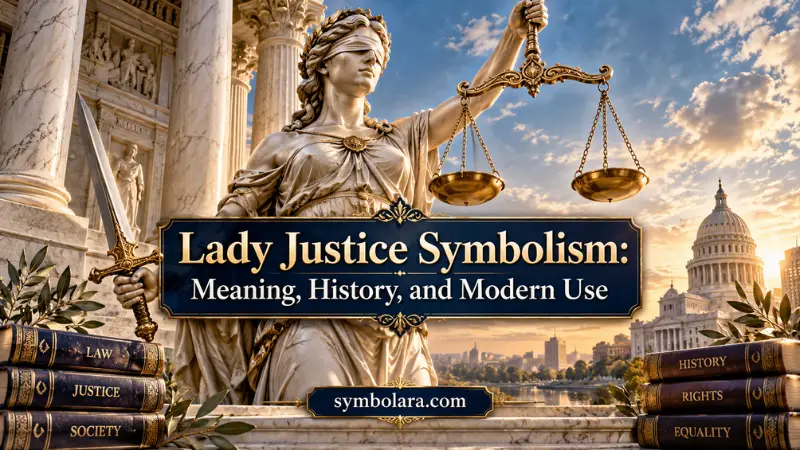
A blindfolded woman holding scales in one hand and a sword in the other is one of America’s most recognizable legal images. Her figure appears outside courthouses, on legal emblems, and in artwork about fairness. Each detail represents an important idea about how justice should work.
Lady Justice symbolism centers on fairness, impartiality, truth, and the responsible use of legal authority. The scales represent careful judgment, the blindfold suggests equal treatment, and the sword stands for the ability to enforce decisions.
Yet her appearance has changed considerably over the centuries. Early depictions showed justice figures without blindfolds, while later artists added details that reflected changing ideas about law and government.
Today, Americans recognize Lady Justice as both a symbol of their legal ideals and a reminder that institutions must work to fulfill them.
Quick Answer
Lady Justice symbolism represents fairness, impartial judgment, truth, and accountability under the law. Her scales symbolize weighing evidence, her blindfold represents freedom from bias, and her sword stands for legal authority. The figure developed from Greek and Roman representations of justice before becoming a familiar symbol of modern American courts.
TL;DR
- Lady Justice represents fairness, impartiality, and accountability.
- Her scales symbolize careful consideration of evidence.
- The blindfold represents judgment without favoritism.
- Her sword stands for lawful authority and enforcement.
- Greek and Roman traditions shaped her earliest forms.
- Americans use her image in courts, art, and personal expression.
What Does Lady Justice Look Like?
Lady Justice usually appears as a standing or seated woman wearing a long, flowing robe. She often holds a pair of balanced scales and an upright or downward-pointing sword. A cloth blindfold covers her eyes in many familiar versions.
These details make the figure recognizable even when artists change her clothing, posture, or facial features.
Courthouse statues often use stone, bronze, or other lasting materials. Their size and formal appearance help communicate the seriousness of legal decisions.
Smaller versions appear on office desks, legal awards, jewelry, and printed materials.
Her most familiar features include:
- Scales: Evidence, fairness, and balanced judgment.
- Blindfold: Impartiality and freedom from favoritism.
- Sword: Legal authority and enforcement.
- Robe: Dignity, tradition, and public responsibility.
- Upright posture: Confidence and commitment to justice.
Not every representation includes all these features. Some artists leave her eyes uncovered or replace the sword with another object.
The meaning depends partly on the objects she carries and the setting in which she appears.
Why the Scales Represent Fair Judgment
The scales are among the oldest visual symbols associated with justice.
In ordinary life, a balance scale compares the weight of two objects. In legal artwork, that familiar action becomes a way to explain fair decision-making.
Each side represents evidence, arguments, or competing claims that deserve careful consideration.
A judge should examine the facts before reaching a conclusion. The scales remind viewers that decisions require more than personal opinions.
They also communicate the importance of giving each party a reasonable opportunity to be heard.
However, balanced scales do not mean every legal dispute must end equally.
One side may have stronger evidence. A fair decision can favor that side without violating the ideal represented by the scales.
This distinction matters in American law, where fairness involves consistent procedures rather than identical outcomes.
The image encourages viewers to consider whether evidence, rather than wealth or social influence, determines a decision.
Why Lady Justice Wears a Blindfold
The blindfold is perhaps the most recognizable and frequently misunderstood part of her appearance.
In modern American culture, it represents impartiality.
Ideally, judges should apply the law without giving someone special treatment because of their wealth, reputation, race, political connections, or position in society.
The blindfold turns that principle into a visible image.
Yet the symbol raises an interesting question: How can someone deliver justice without seeing?
The answer is that the blindfold is not meant to represent literal blindness.
Instead, it suggests refusing to consider irrelevant personal differences when evaluating a case.
This interpretation also explains why the symbol appears in discussions about equal protection and fair treatment.
For people who have experienced discrimination, the image can express the hope that legal institutions will evaluate their circumstances without prejudice.
At the same time, some critics argue that justice must recognize real differences in people’s circumstances to produce fair outcomes.
That tension has become part of the blindfold’s modern meaning.
What the Sword Symbolizes in Lady Justice’s Hand
The sword represents the authority to make legal decisions meaningful.
A fair judgment accomplishes little if institutions cannot carry it out.
For that reason, the sword traditionally symbolizes enforcement, responsibility, and the consequences of unlawful behavior.
Its meaning differs from the scales.
While the scales concern evaluation, the sword represents action after a decision.
Artists sometimes show the sword pointing downward. In some interpretations, this suggests controlled authority rather than an immediate threat.
Other depictions show it upright, emphasizing readiness to uphold the law.
Neither position has one universally fixed meaning.
The sword can also raise concerns about punishment and government authority.
Americans may interpret it positively when legal power protects their rights. However, the same image can become troubling when authority appears excessive or unfair.
Together, the sword and scales express an important legal ideal: decisions should be carefully considered before institutions act.
The Meaning Behind Her Robe and Upright Posture
Lady Justice’s clothing connects her appearance to classical art.
Greek and Roman artists often represented important virtues through figures wearing long, draped garments. Later European artists continued this visual tradition.
Her robe therefore reflects the image’s historical roots rather than a specific modern courtroom uniform.
In American courthouse artwork, the clothing also communicates formality and dignity.
The woman’s posture adds another layer of meaning.
A standing figure may suggest readiness, responsibility, and confidence. A seated figure can communicate patience, reflection, or the careful consideration of a difficult question.
Facial expressions matter as well.
Lady Justice usually appears calm and serious rather than angry or joyful. This restraint supports the idea that legal decisions should not depend on sudden emotions.
Unlike a portrait of a particular judge, her appearance is intended to represent a principle that extends beyond one individual.
Greek Origins: Themis and Dike
The history of Lady Justice begins with several earlier representations of order and fairness.
In Greek mythology, Themis represented divine law, established customs, and the proper order of society.
She was associated with rules that helped communities function.
Another Greek figure, Dike, represented justice in human affairs. Greek tradition connected her with moral judgment and the distinction between right and wrong.
Although these figures influenced later artwork, neither was identical to the modern blindfolded woman familiar in American courthouses.
Their appearances varied across historical periods.
The scales became associated with justice through a broader history of Mediterranean and Near Eastern imagery. Ancient Egyptian religious art, for example, included the weighing of a deceased person’s heart against the feather associated with Ma’at, a figure connected with truth and order.
That Egyptian scene was not a depiction of modern Lady Justice.
Still, it illustrates how weighing could serve as a visual metaphor for judgment long before modern court systems developed.
Greek ideas about justice later helped shape Roman and European traditions.
Roman Justitia and the Development of a Legal Symbol
The Roman figure Justitia, also written Iustitia, provides the most direct connection to the familiar name and appearance of Lady Justice.
Romans treated justice as an important civic virtue.
Images of Justitia appeared in Roman imperial art, including coins that presented rulers as defenders of lawful government.
This imagery helped connect justice with the responsibility of political authorities.
Rather than representing a specific human judge, Justitia personified an ideal.
Roman versions sometimes carried scales or other objects associated with judgment and authority.
The complete modern combination of scales, sword, and blindfold did not appear in every early representation.
That distinction matters because the image developed gradually.
The name also connects with the Latin word iustitia, meaning justice.
As Roman ideas about government and law influenced later European societies, the female personification continued to appear in paintings, public buildings, and legal imagery.
Over time, her appearance became less closely tied to mythology and more closely associated with civic institutions.
How European Artists Changed the Blindfold’s Meaning
One of the most surprising developments occurred during the Renaissance.
A well-known early image of blindfolded Justice appeared in Sebastian Brant’s Ship of Fools, published in 1494.
In the satirical illustration, a fool places a blindfold over Justice’s eyes.
The image criticized foolishness and the obstruction of proper judgment. At that time, covering Justice’s eyes could suggest that she was being prevented from recognizing wrongdoing.
Later European artists gave the blindfold a different interpretation.
By the sixteenth and seventeenth centuries, it increasingly represented impartial judgment rather than ignorance.
Public sculptures helped spread this understanding.
The Fountain of Justice in Bern, Switzerland, created in the sixteenth century, became one example of the figure’s growing presence in civic artwork.
European traditions also continued to use versions without blindfolds.
Consequently, two related ideas developed: justice should remain free from favoritism, but it must also recognize facts clearly.
Both ideas survive in modern interpretations.
How Lady Justice Became Part of Early American Identity
European settlers brought familiar legal symbols to North America.
The English and Dutch traditions that influenced colonial government also carried representations of Justice as a female figure.
Following American independence, state governments adopted symbols expressing their political ideals.
New York offers a clear example.
Its state coat of arms, adopted in 1778, includes the figures of Liberty and Justice.
Justice appears with a sword, scales, and blindfold.
The pairing matters because liberty and justice represent different but related ideas.
Liberty concerns freedom, while justice concerns the fair application of laws and protection of rights.
During the nineteenth century, American courthouse architecture increasingly used classical columns, formal sculptures, and allegorical artwork.
Lady Justice suited these buildings because the public already associated her with lawful government.
Her image also appeared in court seals, murals, and other official decorations.
These visual choices helped establish the figure as part of the country’s civic identity.
Lady Justice at the United States Supreme Court
One of the clearest American examples
The United States Supreme Court building in Washington, D.C., contains several representations of justice.
One particularly notable sculpture is Contemplation of Justice, created by James Earle Fraser and installed in 1935.
The main seated figure does not wear a blindfold. Instead, she holds a smaller blindfolded figure of Justice with scales.
This design emphasizes reflection and judgment.
Elsewhere on the building, Justice appears holding scales and a sword while wearing a blindfold.
These different versions show that even one institution can present the symbol in several ways.
Above the building’s main entrance are the words “Equal Justice Under Law.”
Although the inscription is separate from the sculptures, it expresses the same central principle.
Visitors encounter a visual reminder that the country’s highest court is expected to uphold legal fairness.
The building demonstrates how architecture and symbolism can communicate public values without requiring a written explanation.
What Lady Justice Means in American Life Today
For many Americans, the figure represents a standard they expect courts and government institutions to meet.
That expectation involves fair hearings, equal legal protection, and decisions based on established laws.
The image can carry different emotions depending on someone’s experiences.
A person who successfully defended their rights in court may associate Justice with relief and protection.
Someone who believes they received unfair treatment may view the same figure as a reminder of promises that remain unfulfilled.
This difference helps explain why Lady Justice appears in both official ceremonies and public criticism.
Her symbolism also connects with American conversations about civil rights.
Movements seeking equal treatment under the law often use familiar legal imagery to communicate their concerns.
The figure does not belong to any single political movement.
Instead, people with different views may appeal to her ideals while disagreeing about whether particular laws or decisions are fair.
That flexibility keeps the image relevant to public discussions in 2025–2026.
Why People Choose Lady Justice Tattoos and Jewelry
Outside government buildings, Lady Justice has become a recognizable personal symbol.
People may choose her image to express commitment to fairness, honesty, accountability, or a career involving law.
For attorneys, judges, law students, and others working in legal fields, the figure can represent professional responsibility.
A tattoo may also carry a personal meaning.
Someone who has experienced a difficult legal dispute might choose the image to represent perseverance or a desire for fair treatment.
Others prefer the scales alone because they create a simpler design.
Jewelry often uses smaller details, such as miniature scales, swords, or silhouettes of the robed figure.
The selected design can change the message.
A complete statue may express respect for the legal system. Scales without a sword may place greater emphasis on balance and careful judgment.
These meanings are personal interpretations rather than fixed rules.
How the Symbol’s Meaning Changes by Setting
| Context | Meaning in USA | Common Associations | Notes |
| Law school graduation gift | Professional responsibility | Legal education, ethics | Recognizes entry into a legal career |
| Courtroom artwork | Institutional duty | Due process, public trust | Reminds viewers of expected standards |
| Scales pendant | Thoughtful judgment | Balance, integrity | May have no direct legal connection |
| Political cartoon | Questioning authority | Accountability, criticism | Altered features can reverse the message |
| Historical museum display | Changing legal ideals | Civic history, artistic tradition | Design details may identify a particular era |
Lady Justice in Political Cartoons and Protest Art
Artists often use Lady Justice to comment on current events.
Because viewers recognize her familiar objects, small changes can communicate criticism without lengthy explanations.
A cartoon might show her scales weighed down by money to suggest that wealth has influenced legal decisions.
Another illustration may show a damaged blindfold to question whether institutions are treating people equally.
These images do not establish that wrongdoing occurred. They express an artist’s interpretation of a public issue.
The figure also appears in demonstrations and campaigns concerning criminal justice, government accountability, and civil rights.
In these settings, she may represent hope for reform rather than approval of existing institutions.
Social media has made simplified versions especially common.
An image of tilted scales or a broken sword can quickly communicate concern about fairness.
The meaning depends on the accompanying message, however. The same altered image may support very different arguments.
How Other Cultures Interpret Lady Justice
Although Americans often associate Lady Justice with their own courts, the figure appears in other countries as well.
Many European legal traditions preserve versions of the classical female personification.
In Switzerland, historical public fountains present Justice as a civic ideal.
Britain also has a long tradition of using female figures to represent justice in legal architecture.
Some countries have adapted the image to reflect local clothing or legal priorities.
In 2024, a new statue installed at India’s Supreme Court showed Justice wearing a sari, without a blindfold, and holding the Indian Constitution instead of a sword.
The design emphasized awareness and constitutional authority.
This example illustrates how a familiar figure can change while retaining its connection to fairness.
However, Lady Justice is not a universal symbol used by every culture or legal system.
Different societies have their own traditions for representing judgment, law, and moral responsibility.
Her widespread presence reflects historical connections between legal and artistic traditions, not one shared interpretation across the world.
Common Misunderstandings and Modern Debates
Lady Justice’s familiar appearance can make her meaning seem simpler than it really is.
One common misunderstanding is that the blindfold means judges should ignore all personal circumstances.
In practice, relevant circumstances can matter greatly to fair legal decisions.
The ideal is to avoid improper bias, not to ignore important evidence.
Another misconception is that the scales guarantee equal results for everyone.
They represent careful consideration, which may lead to different conclusions in different cases.
The sword also attracts criticism.
Some viewers associate it with necessary legal authority, while others see it as a reminder that government institutions possess the ability to punish.
A broader debate concerns the difference between legal equality and actual fairness.
Applying the same rule consistently is important, but people may disagree about whether a particular rule itself is just.
Modern artists sometimes address these concerns by changing the traditional image.
They may remove the blindfold, place documents in her hands, or show her looking directly at the people before her.
Such changes are not necessarily rejections of the symbol.
Often, they represent efforts to reconsider what justice should require.
FAQs
The tradition comes largely from Greek and Roman art, where virtues and ideas were often represented through female figures. Her appearance does not mean that women are considered better judges; it reflects an artistic convention inherited from earlier cultures.
No. Lady Justice represents fairness and lawful judgment, while the Statue of Liberty primarily represents liberty and freedom. New York’s state coat of arms includes separate figures of Justice and Liberty, showing how the two ideas can complement each other.
Her historical background includes figures from Greek and Roman mythology. In modern American public life, however, she generally functions as a civic symbol rather than an object of religious worship.
Tilting scales may indicate that one side has stronger evidence or that a judgment has been reached. In political artwork, the same detail might suggest unfair influence, so the surrounding context determines the intended meaning.
Both Lady Justice and Libra use scales as important imagery. However, Libra belongs to an astronomical and astrological tradition, while Lady Justice developed through representations of law and civic virtues. Their similar symbols do not make them the same figure.
Some artists want Justice to appear observant rather than blindfolded. For example, an unblindfolded figure at Rochester’s former Monroe County Courthouse reflects a historical preference for showing Justice able to see clearly.
Yes, especially when artists deliberately damage or alter her traditional objects. Broken scales, a misplaced blindfold, or a sword directed at an innocent person can suggest that legal institutions have failed to meet their stated ideals.
Conclusion
Lady Justice symbolism represents the hope that laws will be applied fairly, evidence will receive careful attention, and authority will be exercised responsibly. Her scales, sword, and blindfold communicate different parts of that expectation.
From Greek and Roman traditions to American courthouse sculptures, her appearance has changed alongside public ideas about justice. Modern artists continue adapting the figure to express both confidence in legal institutions and concern about their shortcomings.
Her continued presence matters because fairness is something people expect to see demonstrated through real decisions. A statue cannot guarantee justice, but it can remind those who make and follow the law of the standards they are expected to uphold.