
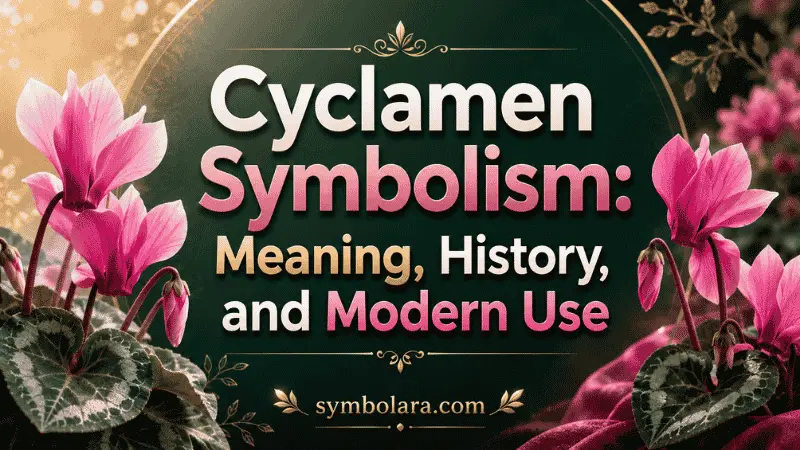
Cyclamen Symbolism combines an unusual mix of affection, farewell, modesty, and endurance. With heart-shaped leaves, swept-back petals, and a habit of flowering during cooler months, cyclamen has accumulated meanings that range from tender love to graceful separation.
In the United States, most people encounter cyclamen as a winter houseplant, holiday gift, garden flower, or alternative Valentine’s Day plant rather than as a flower carrying one rigid traditional message. Its older symbolism becomes clearer when the plant’s Mediterranean origins, historical folklore, and nineteenth-century flower language are considered together. Cyclamen cultivars are especially valued as cool-season flowering plants, often appearing in American homes and garden centers during winter.
Quick Answer
Cyclamen Symbolism most commonly suggests sincere affection, graceful farewell, and emotional endurance in modern American use. Older flower-language traditions gave cyclamen meanings such as resignation, diffidence, and goodbye, while its winter flowering and heart-shaped leaves now encourage associations with resilience and devoted love.
TL;DR
- Cyclamen traditionally represents farewell, resignation, and reserved emotion.
- Heart-shaped leaves encourage modern associations with affection and devotion.
- Winter flowering makes cyclamen a natural symbol of perseverance.
- Ancient Mediterranean beliefs sometimes treated the plant as protective.
- Americans commonly encounter cyclamen as a winter or Valentine’s gift.
- Its meaning depends strongly on occasion, color, and personal intention.
What Cyclamen Looks Like and Why Its Form Matters
Cyclamen is a tuber-growing perennial known for flowers whose petals bend sharply upward and backward. Depending on the species or cultivar, the blooms may be white, pink, red, purple, or combinations of these colors. Beneath them sit rounded or heart-shaped leaves, often patterned with silver or pale green.
That combination creates much of the plant’s modern symbolic appeal. The heart-like foliage easily suggests love, while the curved flower stems and swept petals can appear gentle, shy, or even slightly bowed.
Unlike a sunflower that visibly turns outward or a rose that opens around a prominent center, cyclamen often appears restrained. That physical quality helps explain why ideas such as modesty, reserve, tenderness, and diffidence became attached to it.
Its seasonal behavior adds another layer. Many cyclamen thrive and bloom during cool periods, while some enter dormancy during warmer months. To a modern observer, a plant blooming when many others are inactive naturally lends itself to ideas of perseverance and renewal.
The Core Meanings of Cyclamen Today
No single interpretation applies in every situation. Cyclamen carries several meanings that developed at different times and for different reasons.
| Context | Common Meaning in the U.S. | Association | Important Note |
| Romantic gift | Affection and devotion | Heart-shaped leaves, pink or red flowers | More modern than Victorian farewell symbolism |
| Farewell gift | Goodbye and lasting feeling | Traditional flower language | Can feel bittersweet rather than negative |
| Winter display | Resilience and hope | Flowers appearing in cooler seasons | Often symbolic by interpretation, not formal tradition |
| Memorial setting | Remembrance and acceptance | Older associations with resignation | Meaning depends on recipient |
| Home decor | Warmth, elegance, seasonal beauty | Colorful winter blooms | Often chosen without symbolic intent |
| Personal art | Change, endurance, private love | Combined historical meanings | Tattoo meaning is highly individual |
The most useful way to understand the flower is not to choose one definition and reject the others. Its symbolism works more like a family of related ideas: affection that lasts, separation handled with grace, quiet strength, and emotion expressed without excessive display.
Cyclamen vs Other Symbolic Flowers: How Its Meaning Is Different
Cyclamen has a more subtle symbolic identity than many famous flowers. A rose is commonly linked with romance and passion, while a lily often carries associations with purity, remembrance, or spiritual themes. Cyclamen combines several quieter ideas: affection, acceptance, farewell, and endurance.
Unlike flowers with one dominant public meaning, cyclamen often communicates emotions that are gentle or complex. It can represent love without being as direct as a red rose, and it can represent goodbye without carrying only sadness.
This balance makes cyclamen unique. Its symbolism often fits moments of transition, such as moving forward after a change, remembering someone, or showing care during a difficult season.
The flower’s winter blooming period also separates it from many traditional spring and summer flowers. Because it appears during colder months, people naturally connect it with persistence, patience, and finding beauty during challenging periods.
Why Cyclamen Became a Flower of Farewell
One of the best-established older meanings of cyclamen is resignation and goodbye. Flower-language references continue to preserve that interpretation, and nineteenth-century works were not entirely consistent: some associated cyclamen with resignation, while others used terms such as diffidence.
“Resignation” sounds harsher to modern American ears than it often does in this context. It does not necessarily mean defeat. It can suggest accepting an ending that cannot be changed.
That makes cyclamen especially suited to bittersweet transitions: a friend moving away, a colleague retiring, the conclusion of an important stage of life, or a relationship remembered without bitterness.
Its farewell symbolism differs from flowers associated mainly with grief. Cyclamen can communicate something closer to, “The situation is ending, but the feeling remains.”
This distinction explains why goodbye and affection can coexist within the same flower.
Love, Affection, and the Heart-Shaped Leaf
Cyclamen’s association with love is especially intuitive when viewed as a living plant. The leaves of many varieties have an unmistakably heart-like outline, while popular cultivars carry shades associated in American culture with romance and tenderness.
American horticultural sources even promote flowering cyclamen as alternatives to traditional Valentine’s Day bouquets. Their red, pink, and white flowers, combined with distinctive heart-shaped foliage, make the connection with affection easy to understand without knowing any historical flower code.
As a result, cyclamen today can express a quieter kind of love than the familiar red rose. A rose often communicates overt romance. Cyclamen may feel more appropriate for tenderness, steady affection, appreciation, or a relationship that has survived change.
This loving interpretation should not be presented as an ancient universal rule. Much of its modern appeal comes from visual association, gift culture, and the blending of older flower traditions with contemporary ideas about color and shape.
Ancient Associations With Protection
Cyclamen’s symbolic history reaches much farther back than Victorian flower dictionaries.
The Roman writer Pliny the Elder recorded a belief that the plant offered protection against harmful spells. In the tradition he described, cyclamen was associated with the idea of an amulet a protective object believed to ward off harmful influence.
This does not mean ancient Greeks or Romans universally treated every cyclamen as a spiritual protection symbol. Historical plant lore was often regional, practical, medicinal, magical, and religious at the same time.
Still, the record matters because it shows that cyclamen once belonged to a very different symbolic world. Before it became a polite floral message of farewell, people could understand it as a plant with protective properties.
Modern spiritual interpretations sometimes revive that history by presenting cyclamen as a symbol of boundaries or protection. Those ideas are best understood as contemporary reinterpretations of older folklore rather than scientifically measurable properties.
Why Winter Blooming Suggests Resilience
The resilience association is easy to understand from the plant’s actual life cycle.
Florist cyclamen commonly flowers during the colder part of the year, and its growing cycle makes it particularly suitable for winter and holiday displays. In the United States, it is frequently sold alongside other flowering seasonal plants when outdoor gardens are relatively quiet.
That timing creates an obvious visual metaphor: color appearing during a darker, colder season.
For this reason, cyclamen can represent persistence through difficult circumstances, returning vitality, and the ability to remain emotionally open during an austere period.
Its dormancy reinforces the interpretation. When foliage dies back, the plant may appear finished, yet the underground tuber remains capable of producing new growth under suitable conditions.
The symbolism does not require imagining the plant as literally “struggling.” It simply reflects a familiar human tendency to connect seasonal plant cycles with experiences of waiting, recovery, rest, and renewal.
Modesty, Reserve, and Quiet Emotion
Older flower-language traditions sometimes assigned cyclamen the meaning diffidence, a word describing modesty or lack of self-confidence.
The flower’s posture makes the association understandable. Many blooms rise on slender stems while the flower itself seems to bend or turn downward before its petals sweep upward.
To nineteenth-century eyes accustomed to reading plants as personalities, such a form could suggest shyness or reserve.
Modern readers might interpret the same quality less negatively. Instead of insecurity, cyclamen can represent privacy, emotional restraint, humility, or affection that does not need dramatic display.
This makes it useful in personal symbolism for people who identify with quiet loyalty rather than outward intensity.
What Cyclamen Means in the United States
Cyclamen does not have the same fixed public meaning in the United States as a red rose, funeral lily, Christmas poinsettia, or Memorial Day poppy.
Its American significance is primarily shaped by seasonal gardening and gift culture. Cyclamen appears in garden centers during winter, in holiday displays, as an indoor flowering plant, and occasionally as a Valentine’s Day alternative.
That matters because modern Americans usually encounter the plant visually before encountering its historical symbolism.
A person receiving a pink cyclamen is therefore more likely to read it as a thoughtful flowering gift than as a formal Victorian statement of resignation.
Context decides which meaning becomes strongest. Given to someone moving away, its farewell history becomes relevant. Given to a romantic partner in February, affection dominates. Placed on a winter windowsill, it may simply communicate warmth and life during the colder months.
This flexibility is central to its present-day meaning.
Mediterranean Roots and Cultural Identity
Cyclamen is strongly associated botanically with Europe and the Mediterranean region, although different species occupy different ranges. That geographical background helps explain why the plant appears in centuries of Mediterranean horticulture and folklore.
One particularly clear cultural example comes from Cyprus. Cyclamen cyprium, an endemic species, is recognized as the country’s national plant, giving cyclamen a role in national and botanical identity that goes beyond personal flower symbolism.
This is an important distinction. A plant can symbolize a personal emotion in one context and a landscape, homeland, or cultural heritage in another.
The Cypriot example also reminds readers not to treat “cyclamen meaning” as a single global code. Species, local history, folklore, horticulture, and national traditions all influence what a flower communicates.
Cyclamen Symbolism in Different Cultures and Traditions
Cyclamen symbolism changes depending on the culture and historical period where the plant appears. In Mediterranean regions, the flower has long been connected with local landscapes, traditional plant knowledge, and folklore. Its presence in gardens and wild habitats helped people associate it with the natural world and seasonal change.
In Cyprus, cyclamen has a special cultural connection because Cyclamen cyprium is recognized as the national plant. This gives the flower a meaning tied not only to emotion but also to identity, heritage, and place.
European flower-language traditions later added emotional meanings such as farewell, resignation, and modesty. These interpretations reflected the Victorian interest in using flowers as symbolic messages.
In modern American culture, cyclamen symbolism is usually more personal. Many people associate it with affection, winter beauty, resilience, or thoughtful gifting rather than a strict traditional message. The meaning often depends on the situation, relationship, and intention behind the flower.
What Different Cyclamen Colors Can Suggest
Color meanings are especially flexible. There is no universal historical system assigning one permanent message to every cyclamen color.
In modern American gifting and design, however, familiar color associations often influence interpretation.
Pink Cyclamen
Pink naturally lends itself to affection, tenderness, gratitude, and gentle romance. A pink plant can work for a partner, close friend, parent, or anyone receiving a warm personal gift.
Red Cyclamen
Red creates the strongest romantic impression. Combined with heart-shaped leaves, it can suggest passionate affection while remaining less conventional than a bouquet of red roses.
White Cyclamen
White can communicate simplicity, peace, remembrance, or elegance. In memorial settings, it may take on a quieter, more reflective character.
Purple Cyclamen
Purple tends to feel refined, creative, or contemplative. It works particularly well in decorative and personal symbolism where elegance matters more than a specific traditional message.
Color can adjust the tone, but the occasion and recipient matter more than any supposed fixed floral dictionary.
Farewell, Loss, and Memorial Meanings
Because older flower language links cyclamen with goodbye and resignation, the flower can work naturally in contexts involving separation.
That does not automatically make it a funeral flower.
A farewell may involve retirement, graduation, relocation, immigration, the end of a project, or any other transition in which two people care about one another but must part.
In bereavement, cyclamen can take on a more reflective interpretation: accepting loss while preserving affection. Its dormancy and return can also provide a visual image of memory continuing after visible presence has disappeared.
Still, cultural and family customs should come first. Some Americans may know nothing about cyclamen’s historical farewell meaning, while others may associate it entirely with cheerful winter decor.
When giving the plant during an emotionally sensitive event, a short personal note usually communicates more clearly than relying on flower symbolism alone.
Cyclamen in Tattoos and Personal Symbolism
Cyclamen is less common in tattoo culture than roses, lotuses, chrysanthemums, or cherry blossoms, which can make it attractive to someone who wants a less familiar floral motif.
A cyclamen tattoo may represent:
- accepting an ending without erasing its importance
- remaining loving after separation
- surviving a difficult emotional season
- quiet strength and reserved personality
- returning after a period of withdrawal
- attachment to Mediterranean or Cypriot heritage
The flower’s curved stems, backward petals, and patterned heart-shaped leaves also give artists more visual options than a simple five-petal flower.
No tattoo dictionary can determine the wearer’s meaning. A cyclamen included in memorial art, for example, may represent one specific person rather than the plant’s historical meaning.
Cyclamen in Homes, Gifts, and Seasonal Decor
Modern decor has softened many of cyclamen’s older associations.
In American homes, the flower commonly functions as a source of winter color. Pink, red, white, and purple cultivars provide an alternative to plants more strongly tied to a single holiday. American extension sources regularly discuss cyclamen among winter or holiday flowering houseplants.
As a housewarming gift, it may suggest warmth and care simply because it is a living plant intended to continue growing.
As a Valentine’s gift, the heart-shaped leaves and romantic colors make affection the obvious message.
In an office farewell, its historical goodbye association can become intentional again.
This illustrates how symbols evolve: people do not stop using the object when they forget its older meaning. Instead, new situations gradually add new associations.
Is Cyclamen a Good Gift? Symbolism Behind Giving This Flower
Cyclamen can be a meaningful gift because it combines beauty with a sense of lasting care. Unlike a cut bouquet that fades quickly, a potted cyclamen can continue growing when properly cared for, which makes it a thoughtful choice for many occasions.
As a romantic gift, cyclamen may express affection, appreciation, and gentle devotion. Pink or red varieties can feel especially personal because their colors and heart-shaped leaves naturally connect with love.
For someone experiencing a life transition, cyclamen can represent encouragement and emotional support. Its older association with farewell may fit situations such as retirement, relocation, or a meaningful goodbye.
However, the flower does not carry one guaranteed message. Adding a personal note is often the best way to explain the intended meaning and avoid relying only on symbolism.
How the Meaning Changed Over Time
Cyclamen’s symbolic history did not develop as one continuous tradition.
Ancient accounts connected the plant with protective folk belief. Centuries later, European flower-language traditions assigned emotional meanings such as diffidence, resignation, and goodbye. Modern horticulture then transformed cyclamen into a widely cultivated decorative plant, particularly valued for cool-season indoor color.
Today, these layers coexist.
Someone interested in historical floriography may see farewell first. A gardener may see winter endurance. A romantic partner may notice the heart-shaped leaves. A person from Cyprus may recognize a plant connected to national heritage.
That layered history explains why contradictory interpretations of cyclamen appear online. The meanings often come from different periods rather than from one authoritative symbolic system.
Common Misunderstandings About Cyclamen
One common mistake is claiming that cyclamen has one universally accepted spiritual meaning. It does not.
Another is presenting every modern association as ancient. Resilience, emotional healing, self-love, and renewal can all be reasonable personal interpretations, but they should not automatically be labeled ancient Mediterranean beliefs.
Victorian flower language also needs qualification. Flower dictionaries were never perfectly standardized. Cyclamen could be listed as resignation, goodbye, or diffidence depending on the source and period.
The reverse mistake is assuming that the old farewell meaning controls every modern gift. An American receiving a bright flowering cyclamen during winter is unlikely to assume that the giver is secretly announcing a separation.
Symbolism works through shared context. When that shared context changes, the meaning changes with it.
FAQ
Cyclamen can be either, but its meaning is usually more bittersweet than negative. Older traditions connect it with resignation and goodbye, while modern interpretations emphasize affection, resilience, and graceful acceptance.
The meaning depends on the occasion. It can express affection as a romantic or Valentine’s gift, while a cyclamen given to someone who is moving or retiring can deliberately carry its traditional farewell association.
A cyclamen tattoo can represent endurance, quiet love, transition, farewell, or acceptance after loss. It can also carry a personal connection to Mediterranean landscapes or Cypriot heritage.
Yes, it can. Heart-shaped leaves and pink or red flowers make love and affection natural modern interpretations, although historically documented flower-language meanings such as resignation and goodbye are older and more specific.
There is no universal spiritual definition. Ancient Roman writing records protective beliefs surrounding the plant, while present-day spiritual interpretations may use cyclamen to represent protection, emotional boundaries, renewal, or perseverance.
European flower-language traditions assigned cyclamen meanings such as resignation and goodbye. The idea works especially well for separations in which affection remains even though circumstances require people to part.
Yes, many people interpret cyclamen as a symbol of renewal and new beginnings because the plant can return after dormancy. This meaning is a modern interpretation based on its natural growth cycle rather than a universal ancient tradition.
Conclusion
Cyclamen Symbolism is best understood as a meeting point between affection and acceptance. Its older flower-language meanings emphasize resignation, reserve, and farewell, while its heart-shaped leaves, cool-season flowers, and ability to return after dormancy encourage modern associations with love, perseverance, and renewal.
In the United States, cyclamen usually carries no single compulsory message. A winter plant can represent hope, a Valentine’s gift can express affection, and a farewell plant can revive its historical association with goodbye. What remains consistent is the flower’s suitability for emotions that are genuine but understated care that can survive change without needing to be dramatic.