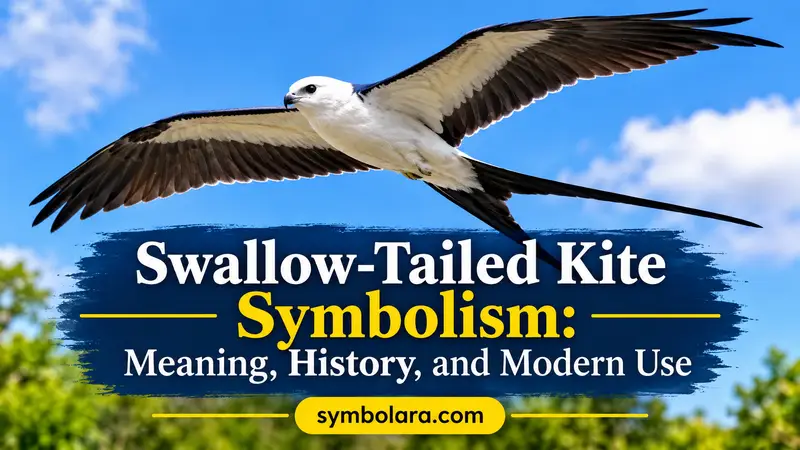
The swallow-tailed kite is one of the most recognizable birds of prey in the American Southeast. Its long, pointed wings, bright white body, dark flight feathers, and deeply forked tail make it easy to identify against a clear blue sky. Unlike many other raptors, it spends much of its time soaring with very few wingbeats.
For people who notice this bird, its unusual flight can bring to mind freedom, independence, adaptability, and the ability to move through life’s changes. These associations help explain why swallow-tailed kite symbolism interests bird lovers, nature photographers, artists, and people looking for meaningful animal designs.
In the United States, the bird has a particularly strong connection to Florida and other southeastern landscapes. Its seasonal migration, graceful movement, and history of habitat loss also give it a connection to renewal, environmental awareness, and the importance of protecting natural places.
Understanding its meaning requires looking beyond general bird symbolism. Its real behavior and place in American natural history offer the clearest starting point.
Quick Answer
Swallow-tailed kite symbolism most commonly represents freedom, independence, adaptability, and moving forward without losing direction. These modern interpretations come mainly from the bird’s effortless-looking flight, seasonal migration, and ability to adjust its movements while soaring.
TL;DR
- Freedom: Its soaring flight represents independence and personal choice.
- Adaptability: Its changing flight patterns suggest flexibility during difficult times.
- Renewal: Annual migration represents seasonal change and fresh beginnings.
- Perspective: Its high flight suggests seeing situations from a wider viewpoint.
- Resilience: Its recovery from historical population declines reflects environmental endurance.
- Conservation: Its dependence on healthy wetlands encourages respect for nature.
What Does a Swallow-Tailed Kite Look Like?
The swallow-tailed kite (Elanoides forficatus) is a medium-sized bird of prey found across parts of the Americas. In the United States, it is most closely associated with the southeastern states, particularly Florida.
Its appearance is the first reason people connect it with freedom and graceful movement.
An adult has a mostly white head, neck, chest, and underside. Its back, flight feathers, and long tail are black. The tail has a noticeable fork, with two narrow extensions that resemble the shape of a pair of scissors or a swallow’s tail.
Its wings are long and pointed, giving it a slim outline when viewed from below.
Unlike many hawks that rely on repeated wingbeats, this bird often glides through the air with little effort. It can make sharp turns, change direction quickly, and use its tail to control its movement.
Swallow-tailed kites are commonly found around:
- Cypress swamps and wetlands.
- Bottomland hardwood forests.
- Open pine forests.
- River corridors and wooded marshes.
- Areas with tall nesting trees and nearby feeding grounds.
In the United States, Florida offers some of the best opportunities to observe them. Their appearance is seasonal in much of their northern range, with birds arriving in late winter and early spring.
Their physical design explains several modern interpretations. The open wings suggest freedom, while the forked tail and controlled flight suggest balance and direction.
What Does the Bird Symbolize Today?
The most common modern interpretations are connected to the bird’s natural behavior rather than an established religious or mythological tradition.
Different people may connect with different qualities depending on what they notice about it.
Freedom and independence
The bird’s ability to travel across large areas without depending on a fixed location makes it a natural image of freedom. Its flight can represent independence, personal choice, and the desire to follow an individual path.
Someone going through a major life transition might see it as a reminder to make decisions based on personal values rather than outside expectations.
Adaptability
A swallow-tailed kite constantly adjusts its tail and wings to control its movement. It responds to changing air currents while searching for food.
This behavior provides a practical connection to adaptability. The bird can represent the ability to respond to changing circumstances without abandoning a clear direction.
Renewal and new beginnings
Its annual migration creates another association. Birds that leave the southeastern United States travel toward wintering areas in South America.
Their seasonal return can suggest a fresh start, a new opportunity, or the return of something that once seemed distant.
Grace and balance
Its smooth flight can represent calm movement through complicated situations. Rather than suggesting that life is always easy, this interpretation focuses on responding thoughtfully when circumstances change.
These meanings are personal interpretations, not universal beliefs. A person who connects the bird with independence may see something different from someone who associates it with conservation.
Where Did Its Symbolic Meaning Originate?
Unlike the eagle, raven, owl, or phoenix, the swallow-tailed kite does not have a widely documented body of ancient mythology or a single established symbolic tradition.
Its modern meaning is better understood through observation of its natural behavior.
For example, people watching the bird glide above Florida wetlands can easily associate its flight with freedom. Its long migration can suggest travel and seasonal renewal. Its ability to make sudden turns can bring to mind flexibility.
However, these associations should not be mistaken for documented historical beliefs.
The bird also has a history within American natural science. Swedish naturalist Carl Linnaeus formally described the species in 1758 under the scientific name Falco forficatus. Its classification later changed, and it became known as Elanoides forficatus.
Early naturalists and bird observers helped establish its place in American wildlife knowledge. Over time, its distinctive appearance made it a recognizable subject in bird illustration, wildlife photography, and conservation education.
There is no reliable basis for claiming that all early American communities assigned it a shared spiritual meaning.
Its symbolic interpretations developed more naturally from its appearance, seasonal behavior, and connection to southeastern landscapes.
Why Is It Associated With Freedom and Independence?
Freedom is one of the easiest associations to understand when watching this bird.
A swallow-tailed kite spends much of its active time in the air. It searches for insects, captures prey, and moves between trees and open spaces while maintaining remarkable control over its flight.
It often appears to glide without effort.
For a modern American audience, this can suggest a person who is comfortable making independent decisions and following a personal direction.
Consider someone leaving a familiar hometown to attend college, start a business, or build a different career. A bird that travels between distant places may represent the courage to move beyond familiar surroundings.
The association also works for people who value independence without rejecting their relationships or responsibilities.
Freedom does not always mean leaving everything behind. Sometimes it means having enough confidence to choose a different path while remaining connected to what matters.
The bird’s flight offers a useful visual expression of that idea.
How Does Migration Connect It With Renewal?
Migration gives the swallow-tailed kite a connection to seasonal change.
Birds that breed in the southeastern United States travel south toward Central America and South America as part of their annual movement. They return north when conditions become suitable for breeding.
This journey is not simply a symbolic act. It is a biological response to seasonal conditions, food availability, and reproduction.
Still, people often find personal meaning in natural cycles.
The bird’s return to familiar breeding areas can represent the idea that a difficult period does not have to last forever. A person may leave one stage of life, experience change, and eventually enter another with different opportunities.
This interpretation can be especially meaningful during:
- Starting a new job after unemployment.
- Moving to another state.
- Recovering from a difficult personal experience.
- Beginning a new educational program.
- Rebuilding a relationship or personal routine.
The important detail is that renewal does not mean returning to exactly the same circumstances.
The bird’s journey involves movement, changing environments, and seasonal needs. Its return is part of an ongoing cycle rather than a simple repetition of the past.
What Does It Represent in American Culture?
In American culture, the swallow-tailed kite has its strongest connection to the natural identity of the Southeast.
Florida, Georgia, South Carolina, Alabama, Mississippi, Louisiana, and eastern Texas provide important parts of its breeding range.
For people living in these regions, seeing one overhead can be a memorable wildlife experience.
Its appearance often connects with several aspects of American life.
Florida’s natural identity
Florida is particularly important because it supports a large share of the United States population of these birds. Their presence above wetlands, rivers, and open landscapes makes them recognizable parts of the state’s natural environment.
Wildlife photography
The bird’s contrasting black-and-white feathers and unusual tail make it attractive to wildlife photographers. Images often emphasize the shape of its wings against a bright sky.
These photographs can communicate grace, movement, and the beauty of southeastern ecosystems.
Environmental awareness
The species has experienced a major reduction in its historical American breeding range. This makes it relevant to conversations about wetland protection, forest management, and habitat preservation.
Regional pride
People who regularly observe the bird may connect it with their home state, local waterways, or childhood experiences outdoors.
Unlike a national emblem, however, the swallow-tailed kite does not have a universally recognized official meaning in American public life.
Its importance is more regional and environmental than political or national.
Does It Have a Connection to Native American Traditions?
It is important to approach this question carefully.
Birds have important places in many Native American traditions, but those beliefs differ among nations, communities, and individual cultural practices.
There is not enough reliable, widely documented evidence to assign one shared traditional meaning specifically to the swallow-tailed kite across Native American cultures.
It would therefore be misleading to describe it as a universal Native American symbol of freedom, protection, or spiritual guidance.
Some Indigenous communities have longstanding relationships with local birds and their habitats. These relationships may involve stories, ecological knowledge, artistic traditions, or ceremonial practices.
However, a general connection between birds and cultural traditions does not establish a specific historical belief about this species.
Modern writers and artists should distinguish between documented cultural knowledge and personal interpretations inspired by wildlife.
This distinction respects Indigenous traditions while allowing people to discuss their own connections with the bird.
What Is Its Emotional and Psychological Meaning?
People often connect with animals because their visible behavior reflects qualities they admire or want to develop.
The swallow-tailed kite offers several examples.
A desire for personal space
Its open-air movement can appeal to people who need room to think, make decisions, and develop their identities.
For someone who feels restricted by expectations, the bird may become a reminder of personal independence.
Confidence during change
Its ability to adjust its flight can represent staying composed when circumstances become uncertain.
This does not mean a person must control every situation. Instead, the bird can suggest that changing direction is sometimes a sensible response.
Appreciation of beauty
Some people simply admire its appearance. Its unusual tail and smooth movement offer a visual experience that feels elegant and distinctive.
Not every meaningful connection needs a complicated explanation.
A connection with nature
For birdwatchers and outdoor enthusiasts, the species may represent time spent in wetlands, forests, and other natural places.
Seeing one can bring back memories of a particular trip, family outing, or afternoon spent observing wildlife.
The emotional meaning often comes from the person’s experience rather than from an inherited belief.
Why Do People Choose It for Tattoos and Personal Artwork?
The swallow-tailed kite can work well as a tattoo because its shape is distinctive even when represented with a small number of lines.
Its long wings and forked tail create a recognizable outline.
People may choose this design to communicate independence, personal growth, travel, or appreciation for wildlife.
Several design approaches create slightly different impressions.
A bird in full flight
A full-flight design emphasizes movement and freedom. It may suit someone who associates the bird with a major life decision or a willingness to explore unfamiliar places.
A minimalist outline
A simple outline focuses on the recognizable forked tail and wing shape. This style can communicate personal meaning without requiring a large or complicated image.
A bird above a landscape
A landscape design may represent a connection to Florida, family memories, or a particular natural environment.
A realistic wildlife portrait
A realistic design is often more suitable for someone who admires the actual species and wants to celebrate its appearance.
A tattoo does not have one fixed meaning. The personal story behind the design matters more than any general interpretation.
How Is It Used in Jewelry, Fashion, and Home Decor?
The swallow-tailed kite’s recognizable outline gives artists several ways to use its image outside wildlife photography.
In jewelry, a small bird pendant or wing-shaped design can suggest independence, travel, or an appreciation for the natural world.
A forked-tail silhouette can also work as a subtle design detail on earrings, necklaces, and decorative accessories.
In home decor, the bird may appear in:
- Framed wildlife illustrations.
- Nature-inspired wall prints.
- Hand-painted ceramic decorations.
- Metal garden sculptures.
- Decorative pieces for outdoor living spaces.
Its black-and-white coloring makes it suitable for both traditional and modern interior styles.
For example, a framed illustration of a swallow-tailed kite above a desk might appeal to someone who enjoys birdwatching or has a personal connection to Florida.
Fashion uses are less established than the bird’s presence in wildlife art. It is better understood as a niche nature-inspired design than as a widely recognized fashion emblem.
What Does the Bird Mean in Dreams and Personal Reflection?
Some people interpret seeing a swallow-tailed kite in a dream as a reminder of freedom, change, or a desire for greater independence.
However, there is no scientifically established dream meaning for this particular species.
Dream interpretations depend on personal memories, emotions, and the situation in which the bird appears.
For example, a person who dreams of watching one fly above a familiar landscape might connect the image with childhood memories or a desire to return to a peaceful place.
Someone who dreams of following the bird across a wide sky might associate it with travel, ambition, or a new direction.
The emotional details matter.
- Was the bird flying freely or struggling?
- Did you feel calm, excited, or afraid?
- Was the setting familiar or unfamiliar?
- Did the bird remind you of a real experience?
These questions can help someone understand their own reaction without treating a dream as a prediction.
A useful approach is to view the bird as a personal reflection rather than a message with a guaranteed meaning.
What Misunderstandings Surround This Bird?
Several misconceptions can appear when people discuss the bird’s meaning or natural history.
It is not a type of swallow.
Despite its name, the swallow-tailed kite is a bird of prey belonging to the hawk family, Accipitridae. Its name describes its swallow-like tail shape, not its biological relationship to swallows.
Its forked tail does not have a universal spiritual meaning.
The tail is an important feature of its flight control. Connecting it with balance or direction is a modern interpretation, not an established belief shared across cultures.
It is not a symbol with one official American meaning.
The species has regional recognition and conservation importance, but it is not an official national symbol.
Its presence does not predict good or bad luck.
There is no reliable evidence that seeing one forecasts an event or reveals a person’s future.
A healthy global population does not mean every local population is secure.
The species is classified as Least Concern globally, but its American breeding distribution has experienced significant historical losses. Some states continue to consider it a conservation concern.
Separating biological facts from personal interpretations makes its meaning more accurate and useful.
How Has Its Meaning Changed Over Time?
The way Americans understand the swallow-tailed kite has developed alongside changes in wildlife observation and environmental awareness.
In the nineteenth century, naturalists and bird collectors were documenting the species and its distribution across North America.
At that time, it bred across a much larger part of the United States than it does today.
By the early twentieth century, its breeding range had contracted substantially. Historical records indicate that the bird had disappeared from many northern and interior parts of its former American range.
Habitat changes, wetland drainage, forest clearing, and shooting contributed to its decline.
The Migratory Bird Treaty Act of 1918 helped strengthen legal protection for migratory birds, including birds of prey.
During the twentieth century, conservation research and birdwatching also increased public awareness of species that depended on specific habitats.
By the late twentieth and early twenty-first centuries, the swallow-tailed kite had become an important subject in southeastern wildlife conservation.
Modern interpretations increasingly connect it with:
- Environmental responsibility.
- Protection of wetlands and forests.
- Seasonal movement and natural cycles.
- Respect for wildlife.
- Personal independence and adaptability.
Younger generations may encounter the bird through wildlife photography, nature videos, educational content, and social media.
These newer forms of exposure make the bird easier to recognize, even for people who have never seen one in person.
Its meaning has not followed a single organized historical tradition. Instead, it has grown through changing relationships with American wildlife and the natural environment.
What Different Settings Communicate About the Bird
The same image can communicate different ideas depending on where and how it appears.
| Context | Meaning in USA | Common Associations | Notes |
| Tattoo design | Personal independence | Freedom, confidence, new beginnings | Often connected with an individual life experience |
| Wildlife photography | Appreciation of nature | Beauty, movement, regional identity | Especially recognizable in Florida |
| Jewelry | Personal expression | Travel, individuality, simplicity | Small silhouettes emphasize the forked tail |
| Home decor | Connection with the outdoors | Natural beauty, peaceful surroundings | Works well in wildlife-themed spaces |
| Conservation artwork | Environmental responsibility | Habitat protection, resilience | Highlights the bird’s ecological importance |
| Personal reflection | Managing change | Flexibility, perspective, renewal | Meaning depends on individual circumstances |
The setting changes the message. A wildlife photograph may celebrate a natural encounter, while a tattoo may represent a personal decision to live more independently.
FAQs
Is the swallow-tailed kite a positive or negative symbol?
It is generally interpreted positively in modern personal symbolism. Its flight and migration make it suitable for representing independence, adaptability, and new opportunities rather than danger or misfortune.
Does seeing a swallow-tailed kite have a spiritual meaning?
Some people give personal or spiritual meaning to unexpected wildlife encounters, but there is no established religious rule connecting this species with a particular message. Its meaning depends on the observer’s beliefs and personal experiences.
Is the swallow-tailed kite associated with Florida?
Yes. Florida is one of its most important American breeding areas and supports a substantial portion of the country’s population. The bird is particularly associated with the state’s wetlands, river forests, and open landscapes.
What makes this bird different from other American hawks?
Its combination of long pointed wings, contrasting black-and-white feathers, and a deeply forked tail makes it especially distinctive. It also spends much of its time soaring and catching food while flying.
Is the swallow-tailed kite endangered?
It is classified as Least Concern globally by the IUCN, meaning it is not currently considered globally threatened under that assessment. However, its historical breeding range in the United States has contracted considerably, and habitat protection remains important.
Does a swallow-tailed kite represent travel?
It can represent travel in modern personal interpretations because of its long seasonal migration between North and South America. People may use its image to express a love of exploration, movement, and discovering unfamiliar places.
Why is its tail considered so special?
Its deeply forked tail is not simply decorative. The bird uses it to make precise adjustments while flying, helping it turn and maneuver through changing air currents. This physical feature is one reason people associate it with balance and control.
Conclusion
Swallow-tailed kite symbolism is mainly connected with freedom, independence, adaptability, renewal, and appreciation for nature. These meanings come from the bird’s distinctive flight, seasonal migration, and ability to move through changing environments.
In the United States, it has a particularly strong connection to Florida and the southeastern landscape. Its history also reminds people that beautiful wildlife depends on healthy forests, wetlands, and suitable nesting areas.
Whether someone chooses its image for a tattoo, displays it in wildlife artwork, or simply enjoys seeing it above a wetland, the bird offers a meaningful reminder: changing direction does not always mean losing your way. Sometimes, it is simply part of moving forward.