
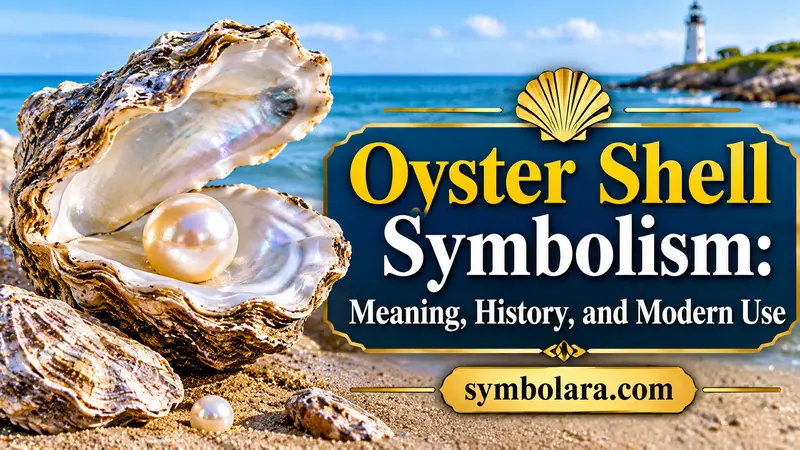
An oyster shell has a rough, uneven exterior and a smooth interior that once protected a living creature. Even after the oyster is gone, the shell remains, often showing layers, ridges, and marks left by years in the water. This contrast gives the shell several meanings, including protection, resilience, natural beauty, and hidden value.
People look up oyster shell symbolism for different reasons. Some find a shell along the beach and wonder whether it represents something personal. Others choose oyster shell jewelry, coastal decorations, tattoos, or artwork because of its connection to the ocean and the natural world.
In the United States, oyster shells are closely connected to coastal communities, seafood traditions, marine conservation, and beach life. Their meaning can be practical, emotional, or artistic, depending on where they appear and why someone chooses to use them.
Quick Answer
Oyster shell symbolism commonly represents protection, resilience, hidden beauty, patience, and the value of nature. These meanings come from the oyster’s protective shell, its ability to survive in changing marine environments, and the long relationship between coastal communities and oysters as a source of food and materials.
TL;DR
- Protection: The hard shell represents safety and personal boundaries.
- Resilience: Its lasting structure suggests endurance through difficult conditions.
- Hidden beauty: Its interior reflects beauty that may not appear immediately.
- Patience: The oyster’s slow growth connects it with gradual development.
- Coastal identity: Oyster shells represent ocean life and seaside traditions.
- Environmental care: Recycled shells can represent restoration and marine conservation.
What Does an Oyster Shell Look Like in Nature?
An oyster shell is usually irregular, rough, and uneven. Its shape depends on the species, the surface where the oyster grows, and the conditions in its environment. Some shells are rounded, while others have elongated shapes, wavy edges, and noticeable ridges.
The outside often appears gray, white, brown, cream, or slightly green. The inside is usually smoother and may have a white, pearly surface. This difference between the exterior and interior is one reason people associate the shell with hidden beauty.
Oysters attach themselves to hard surfaces, including rocks, other oyster shells, and artificial structures. Over time, groups of oysters can form large reefs in coastal waters.
In the United States, oyster shells are commonly found along the Atlantic and Gulf coasts, particularly in areas with established oyster fisheries. The Chesapeake Bay, Louisiana coast, and parts of New England have long relationships with oyster harvesting.
A shell collected from a beach can also show small holes, worn edges, mineral deposits, or other signs of marine life. These natural marks make each shell different.
Its appearance provides the foundation for many of its modern interpretations.
The Main Meanings Associated With Oyster Shells Today
There is no single universal definition for this shell. Its meaning depends on its physical qualities and the cultural setting in which someone uses it.
Five interpretations appear especially often.
Protection: The shell protects the soft body of the oyster. As a result, it can represent personal safety, emotional boundaries, and the importance of protecting what matters.
Resilience: Oyster shells withstand contact with saltwater, changing temperatures, and physical pressure. Their lasting structure makes them a natural representation of endurance.
Hidden beauty: The rough outside and smoother inside create a contrast between appearance and inner qualities. This can represent the idea that something valuable may not be obvious at first.
Patience: Oysters grow gradually, and their development depends on suitable environmental conditions. The shell can therefore represent steady progress rather than immediate results.
Connection with nature: Oyster shells are part of marine ecosystems and coastal food traditions. They can represent respect for the ocean, local heritage, and the natural resources people depend on.
These interpretations are not formal rules. A person decorating a beach house may see the shell as a reminder of summer, while someone choosing it for a tattoo may connect it with personal growth.
Where Did the Historical Meaning Come From?
The historical background begins with the practical importance of oysters rather than with a fixed symbolic tradition.
For thousands of years, coastal communities have collected oysters for food. Archaeological sites in different parts of the world contain large deposits of discarded shells, often called shell middens. These deposits provide evidence of long-term relationships between people and coastal environments.
Indigenous communities along the North American coast harvested oysters and other shellfish for generations. Shell remains from archaeological sites help researchers understand food practices, settlement patterns, trade, and environmental changes.
Oyster shells also had practical uses. Depending on the region and period, people used shells as tools, construction materials, and sources of lime. Their usefulness extended beyond the original animal.
During the colonial period, oysters became an important food source in parts of North America. Coastal settlements relied on local oyster beds, and the shells accumulated around processing areas and markets.
By the nineteenth century, oysters had become a familiar part of American urban food culture. New York City developed a major oyster industry, and oyster stands, cellars, and restaurants served customers from different economic backgrounds.
These historical connections help explain why the shell can represent nourishment, community, survival, and coastal identity. However, it would be inaccurate to claim that every historical community assigned it the same symbolic meaning.
Why Oyster Shells Represent Protection and Personal Boundaries
Protection is one of the most direct interpretations because it comes from the shell’s actual biological function.
An oyster has a soft body that needs protection from predators and environmental conditions. Its two-part shell provides a physical barrier around it.
People often connect this feature with the idea of personal boundaries.
For example, someone who has learned to protect their privacy after a difficult relationship might choose an oyster shell design as a personal reminder. The image can represent the decision to be more careful about who receives access to their feelings and personal life.
There is also an important difference between protection and isolation.
A shell does not have to represent shutting everyone out. It can suggest creating a safe space while remaining open to healthy relationships and new experiences.
In modern American art and personal jewelry, this interpretation can make the shell suitable for people who value privacy, independence, and emotional safety.
The meaning comes from the oyster’s natural structure, but the personal message belongs to the individual using it.
How Does an Oyster Shell Represent Resilience?
An oyster shell develops through a gradual process. The animal produces shell material as it grows, creating a structure that protects its body.
The finished shell can remain recognizable even after the oyster dies. It may become worn, chipped, discolored, or covered by other marine organisms, but parts of its original structure can survive.
This makes it a useful image for resilience.
In personal expression, resilience means continuing after setbacks without pretending that difficulties never happened. A damaged shell can therefore carry a different message from a perfectly preserved one.
Consider someone who has experienced a major life change, such as moving to another state, recovering from a personal setback, or starting over in a new career. An oyster shell might represent the ability to adapt while retaining a sense of identity.
Its natural imperfections also matter. The shell does not need to look flawless to have value.
This interpretation is particularly relevant in handmade crafts, coastal artwork, and personal keepsakes. It allows people to connect an ordinary natural object with experiences of change and endurance.
Why Does Its Rough Outside and Smooth Inside Matter?
The difference between the outside and inside is one of the most recognizable features of an oyster shell.
The exterior can look rough, dark, and irregular. The interior is often smoother, lighter, and more visually appealing.
This contrast supports the idea of hidden beauty.
People sometimes judge objects, places, or individuals based on their first appearance. An oyster shell offers a natural example of why an outside view does not always tell the whole story.
In American home design, this contrast appears in coastal decorations that display shells with their interiors facing outward. Artists may also use the two surfaces together to create visual interest.
For personal interpretation, the shell can represent self-acceptance, individuality, and the discovery of qualities that are not immediately visible.
It is important not to confuse this meaning with the belief that every oyster shell contains a pearl. Most oysters do not produce pearls, and the shell itself is not a pearl.
The shell and the pearl have separate meanings, even though both are associated with oysters.
What Do Oyster Shells Mean in American Coastal Culture?
In the United States, oysters have a strong connection with regional food traditions and coastal communities.
The Chesapeake Bay is especially associated with oysters. Maryland and Virginia have long histories of oyster harvesting, and the seafood remains part of the region’s culinary identity.
New England also has a recognizable oyster tradition. Raw oyster bars, seafood restaurants, and coastal festivals make oysters familiar features of local food culture.
Along the Gulf Coast, particularly in Louisiana, oyster dishes are part of regional cooking. Oyster roasts and seafood gatherings also bring people together around shared meals.
In these settings, an oyster shell can represent more than the ocean. It can suggest:
- Family meals and local food traditions.
- Memories of vacations near the coast.
- Fishing communities and working waterfronts.
- Regional identity and seafood heritage.
- Appreciation for marine environments.
For example, someone raised near the Chesapeake Bay might associate oyster shells with family seafood dinners and local traditions. A visitor from the Midwest might connect the same shell with a summer vacation.
Both interpretations are reasonable, but they come from different personal experiences.
How Do Oyster Shells Connect With Marine Conservation?
Oyster shells have an environmental role that goes beyond their use as decorations or keepsakes.
In suitable coastal waters, oyster reefs provide habitat for marine organisms. They can also help filter water as living oysters feed and contribute to the structure of underwater environments.
When oyster reefs decline, communities may lose important habitat and ecological benefits.
This has encouraged restoration projects in several American coastal regions. Some programs collect used oyster shells from restaurants and seafood businesses, clean and prepare them, and return them to suitable waters as part of reef restoration work.
For this reason, recycled oyster shells can represent environmental responsibility, renewal, and care for coastal ecosystems.
The Chesapeake Bay region is a well-known example of oyster restoration efforts. Louisiana and other Gulf Coast areas also have projects focused on rebuilding oyster habitat.
However, not every discarded shell can simply be placed back into the ocean. Restoration programs must consider disease control, water conditions, shell preparation, and local environmental rules.
The environmental interpretation is strongest when the shell is connected to a real conservation activity rather than used as a general decoration.
What Do Oyster Shells Mean in Jewelry and Tattoos?
Oyster shell designs appear in jewelry and body art because their natural shape works well with different styles.
In jewelry, small shell pieces may be used in necklaces, earrings, bracelets, and pendants. Some designs preserve the shell’s original color, while others use polished or decorative finishes.
The meaning often depends on the wearer’s reason for choosing it.
In necklaces: An oyster shell pendant may represent a connection with the ocean, personal memories, or protection.
In earrings: Small shell shapes can express a love of coastal fashion, natural materials, and simple design.
In bracelets: Shell charms may serve as reminders of a vacation, a special relationship, or a particular place.
In tattoos: A detailed shell drawing can represent resilience, individuality, patience, or a connection to the sea.
Tattoo designs may show an open shell, a closed shell, or a broken shell. Each version can suggest a slightly different message.
An open shell may represent discovery and openness. A closed shell can suggest privacy and boundaries. A broken shell may reflect change, vulnerability, or survival after hardship.
These meanings are personal interpretations, not established meanings shared by everyone.
How Are Oyster Shells Used in American Home Decor?
Coastal home design is one of the most visible places where oyster shells appear.
In beach houses and seaside apartments, people use shells to create a connection with the surrounding environment. Their natural colors work well with white walls, wooden furniture, linen fabrics, and blue or sandy color schemes.
Common decorative uses include:
- Framed shell collections displayed on walls.
- Oyster shell wreaths used for seasonal decorations.
- Shell-shaped bowls and small serving dishes.
- Table centerpieces for coastal-themed rooms.
- Handmade mirrors decorated with oyster shells.
- Natural shell arrangements displayed in glass containers.
In these settings, the shell often represents a relaxed coastal lifestyle rather than a specific spiritual belief.
Some people also reuse oyster shells in garden projects. Depending on local soil conditions and the intended use, processed shell material may serve as a source of calcium carbonate.
However, decorative and garden uses should be distinguished from marine restoration. Materials suitable for a home project are not automatically suitable for returning to a natural reef.
How Do Oyster Shell Meanings Change Across Generations?
The way Americans interpret natural objects changes with lifestyle, fashion, and environmental awareness.
For earlier coastal communities, oyster shells were closely connected with food, trade, and everyday work. Their practical value was often more important than their decorative appeal.
During the nineteenth and early twentieth centuries, oysters became closely associated with American restaurants and urban dining culture. Shells were commonly treated as leftovers from a popular food.
Later, coastal home design and beach-inspired fashion helped turn shells into decorative objects. Collecting shells during family vacations became a familiar activity for many Americans.
In more recent decades, environmental awareness has added another layer of meaning. Oyster reefs are now discussed in connection with habitat protection, water quality, and coastal restoration.
Younger generations may encounter shell designs through tattoos, handmade jewelry, social media photography, and sustainable home decor.
This does not mean that one generation has abandoned the previous meaning. Instead, practical, decorative, personal, and environmental interpretations now exist together.
What Is the Difference Between an Oyster Shell and a Pearl?
Oyster shells and pearls are connected biologically, but they are different objects with different physical characteristics.
An oyster shell is the hard outer structure that protects the animal. A pearl is a separate structure that forms inside certain mollusks when layers of material build around an irritant or other initiating material.
Not every oyster produces a pearl. In addition, commercially produced pearls often come from pearl-producing mollusks that are not the same as the oysters commonly harvested for food.
Their symbolic interpretations also differ.
| Context | Meaning in USA | Common Associations | Notes |
| Oyster shell jewelry | Coastal identity and individuality | Natural beauty, personal memories | Often chosen for its organic shape |
| Oyster shell tattoos | Personal resilience and protection | Boundaries, endurance, growth | The design’s condition can change its message |
| Coastal home decor | Relaxation and seaside living | Vacations, summer, simplicity | Common in beach-inspired interiors |
| Oyster shell restoration | Environmental responsibility | Renewal, habitat, conservation | Connected with actual reef restoration work |
| Pearl jewelry | Beauty and rarity | Elegance, achievement, refinement | A pearl is not the same thing as a shell |
A shell usually emphasizes protection and connection with the natural world. A pearl is more commonly associated with rarity, refinement, and beauty developed over time.
Although the two can appear together in artwork and jewelry, their meanings should not be treated as interchangeable.
Common Misunderstandings About Oyster Shell Symbolism
Several assumptions can make the meaning of these shells seem more complicated than it really is.
Misunderstanding 1: Every oyster shell represents wealth.
Oysters are sometimes connected with luxury dining and pearls, but an ordinary shell does not automatically represent money or financial success. Its meaning may be much closer to coastal life, protection, or personal memories.
Misunderstanding 2: An oyster shell always represents a pearl.
Most oysters do not contain pearls. The shell has its own biological purpose and can carry meanings that have nothing to do with jewelry or wealth.
Misunderstanding 3: Oyster shells have one universal spiritual meaning.
There is no single worldwide symbolic definition. Different people and communities interpret them according to their experiences, traditions, and surroundings.
Misunderstanding 4: A broken shell is always a bad sign.
A broken shell is a natural result of environmental conditions, handling, or age. In personal artwork, it may represent change or survival rather than loss.
Misunderstanding 5: All shells found on beaches are safe to collect.
Collection rules vary by location, and some beaches or protected areas restrict removing natural materials. Visitors should check local regulations before taking shells home.
Separating biological facts from personal interpretations helps prevent ordinary natural features from being presented as established cultural beliefs.
Why Do People Feel Emotionally Connected to Oyster Shells?
Natural objects can become meaningful because they remind people of places, experiences, and relationships.
An oyster shell may remind someone of a childhood beach trip, a family seafood restaurant, or a summer spent near the water. The object itself may be inexpensive, but the memory attached to it can make it valuable.
Its physical qualities also provide a reason for emotional connection.
A shell is protective but not indestructible. It can be damaged and worn while still retaining its recognizable shape. This makes it a useful personal image for people who want to acknowledge difficult experiences without defining themselves by those experiences.
There is also something appealing about its natural appearance. No two shells have exactly the same pattern, size, and surface condition.
For some people, that individuality reflects their own identity. They may prefer a natural shell pendant over a polished piece of jewelry because it looks less uniform and more connected to the environment.
Ultimately, the emotional meaning comes from the relationship between the object and the person who keeps it.
FAQs
Is oyster shell symbolism positive or negative?
It is generally interpreted positively, especially when associated with protection, resilience, natural beauty, and coastal life. A damaged shell can carry a more personal meaning, but it is not automatically a sign of something negative.
Does an oyster shell have a religious meaning?
An oyster shell does not have one widely recognized religious meaning across major American religious traditions. Its appearance in religious artwork or personal objects depends on the specific tradition and the artist’s intention.
What does finding an oyster shell on the beach mean?
Finding one usually means that an oyster shell has been carried or deposited along the shoreline by natural processes. Some people give the experience a personal meaning, such as a reminder of a peaceful day or a connection with nature, but there is no established rule that it predicts a future event.
What does a broken oyster shell represent?
In personal artwork or jewelry, a broken shell may represent vulnerability, change, or the ability to continue after a difficult experience. From a biological perspective, damage is simply part of the natural wear that shells experience over time.
Can an oyster shell represent love?
Yes, as a personal interpretation. Someone may associate it with love because of its protective structure, shared coastal memories, or a meaningful gift from a partner. However, it is not a universally established symbol of romantic love.
Why are oyster shells used in environmental restoration?
Oyster shells provide a suitable surface for young oysters to attach to in many restoration settings. Prepared shells can help rebuild reef structures, which support marine habitat and contribute to coastal ecosystem health.
Conclusion
Oyster shell symbolism brings together protection, resilience, hidden beauty, patience, and a connection with coastal life. Its meanings come from the oyster’s natural structure, its place in marine environments, and the long history of human communities using oysters for food and other practical purposes.
In modern America, the shell can appear as a tattoo, jewelry design, home decoration, vacation keepsake, or part of an environmental restoration project. Each setting gives it a slightly different meaning, from personal independence to regional heritage and environmental care.
An oyster shell does not need to be flawless or contain a pearl to have value. Sometimes, its ordinary shape, natural marks, and history along the shoreline are enough to make it worth keeping.