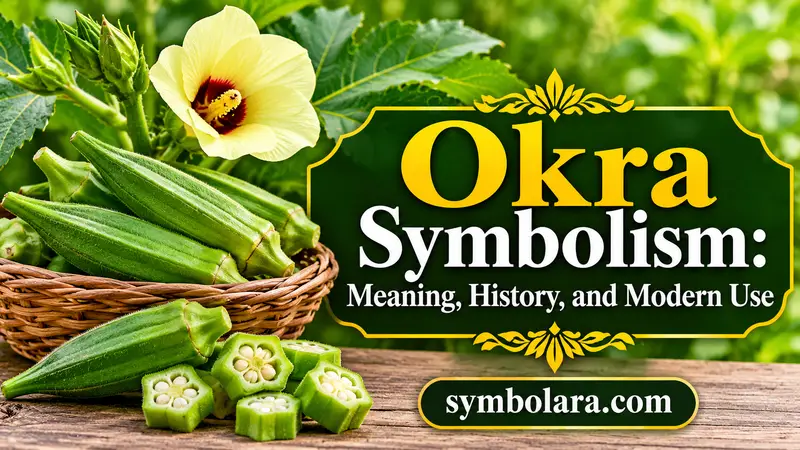
Okra is a green vegetable with long, ridged pods, small white flowers, and a familiar place in Southern American cooking. It appears in gumbo, fried vegetable dishes, pickled jars, and summer gardens. Although most people recognize it as food, its history carries connections to migration, family traditions, agriculture, and cultural identity.
Okra symbolism often centers on nourishment, resilience, cultural heritage, adaptability, and community. These associations did not come from one ancient belief or a single symbolic tradition. They developed through the vegetable’s African origins, its movement across the Atlantic, and its place in American food culture.
For many Americans, especially in the South, okra brings memories of family kitchens, backyard gardens, shared meals, and recipes passed between generations. Its meaning can also change depending on whether someone encounters it in a garden, a traditional dish, a work of art, or a personal design.
Quick Answer
Okra symbolism commonly represents nourishment, resilience, African heritage, adaptability, and family connection in modern American culture. Its historical associations developed through African agricultural traditions, the forced migration of enslaved Africans, and the vegetable’s lasting role in Southern American foodways.
TL;DR
- Okra represents nourishment, cultural heritage, resilience, and community.
- Its agricultural history has strong connections to Africa.
- Enslaved Africans helped establish okra in American food traditions.
- Gumbo connects the vegetable with Louisiana’s cultural history.
- Family recipes often make okra a symbol of belonging.
- Modern art and food culture celebrate its Southern roots.
What Does Okra Look Like, and Where Does It Grow?
Okra is a warm-season flowering plant known for its edible green pods. Its scientific name is Abelmoschus esculentus, and it belongs to the mallow family, which also includes hibiscus and cotton.
The pods usually grow upright or at an angle from the plant. They have narrow, pointed ends, ridged sides, and a slightly fuzzy surface. When cut open, they reveal small, round seeds arranged inside.
The plant also produces attractive flowers, often pale yellow or cream with dark reddish centers. These flowers make it recognizable in vegetable gardens even before the pods appear.
Okra grows best in warm weather and plenty of sunlight. In the United States, it is especially common in Southern states such as Georgia, Alabama, Mississippi, Louisiana, and South Carolina.
Its physical characteristics help explain some of its symbolic associations:
- Green pods: Growth, freshness, and agricultural life.
- Seeds: Continuity, reproduction, and future harvests.
- Flowers: Beauty, renewal, and the connection between nature and food.
- Harvested pods: Nourishment, work, and the rewards of cultivation.
These meanings are interpretations rather than fixed traditional definitions. Still, they offer a useful starting point for understanding why this ordinary vegetable can carry personal and cultural meaning.
What Does Okra Symbolize in Modern American Culture?
In the United States, the most common associations are connected to food, family, Southern identity, and African American heritage. The vegetable does not have one universally accepted symbolic meaning, but several themes appear repeatedly in the way people use and remember it.
Nourishment and care
Okra represents the ability to turn a garden harvest into a meal. For families who grow vegetables at home, it can remind them of practical care, cooking for relatives, and making good use of available ingredients.
Resilience and survival
Its connection to African agricultural knowledge and the difficult history of slavery gives it an association with survival and cultural continuity. The vegetable became part of food traditions that endured despite forced displacement and social hardship.
Heritage and identity
For many African American families, Southern dishes containing okra can connect present-day life with earlier generations. A familiar recipe may preserve family history more effectively than a formal record.
Adaptability
Okra works in soups, stews, fried dishes, curries, and pickled preparations. Its ability to fit different cooking traditions makes it a natural representation of cultural exchange and adaptation.
Community and hospitality
Many traditional preparations are made in quantities suitable for sharing. A pot of gumbo or a family meal containing okra can represent welcome, generosity, and the pleasure of eating together.
These interpretations depend on personal experience. Someone who grew up eating fried okra may associate it with childhood, while someone who first encountered it through Louisiana cuisine may connect it with regional food heritage.
Where Did Okra’s Historical Associations Begin?
Okra has a long history of cultivation, but its exact place of origin remains a subject of historical and botanical discussion.
Many accounts trace its early development to northeastern Africa, particularly areas around Ethiopia and neighboring regions. It was cultivated in parts of Africa before becoming established in other warm regions, including the Middle East and South Asia.
Over time, farmers selected plants for their useful pods and ability to grow in hot climates. The vegetable became part of everyday cooking rather than remaining a specialized crop.
Its spread involved trade, migration, and the movement of agricultural knowledge. People carried seeds, cooking practices, and farming skills between communities.
The Atlantic slave trade created another major turning point. Enslaved Africans were forcibly transported to the Americas, bringing knowledge of crops and food preparation with them. Okra became established in parts of the Caribbean and the American South.
This history matters because food traditions often survive through ordinary household practices. Growing a familiar plant, saving seeds, or preparing a traditional dish can preserve cultural knowledge even when people have been separated from their original communities.
The vegetable’s historical importance therefore comes from both agriculture and human experience.
How Did Okra Become Part of African American Food History?
Okra’s place in African American food history is closely connected to the forced migration of Africans during the colonial period.
Enslaved Africans brought agricultural knowledge and cooking traditions to the Americas. They helped shape regional food systems through their knowledge of crops, gardening, food preparation, and resource management.
Okra was particularly suited to warm climates, making it useful in Southern agricultural settings. Its pods could be cooked fresh, dried for later use, or added to soups and stews.
For enslaved communities, food knowledge was also a practical resource. Preparing meals with familiar ingredients helped maintain cultural practices under conditions in which personal freedom and family connections were often denied.
After emancipation, African American families continued developing and passing down regional cooking traditions. Okra remained part of many Southern kitchens, including those where vegetables were grown in home gardens.
This connection does not mean every African American family has the same relationship with the vegetable. Regional background, family history, and personal taste all matter.
However, its continued presence in traditional Southern dishes gives it an important place in the story of African American food culture.
Why Is Okra So Closely Associated With Southern Cooking?
Okra became one of the recognizable ingredients of Southern American cuisine because it grows well in warm climates and works in several familiar preparations.
Louisiana is especially important to its American food history. Gumbo, one of the region’s best-known dishes, often includes okra as an ingredient.
The word gumbo is commonly connected to West African terms for okra, particularly the Bantu-related word ki ngombo. The precise linguistic path is complex, but the connection reflects the African influence on Louisiana’s food vocabulary.
Okra is also prepared in other Southern styles:
- Fried okra, often served as a side dish.
- Stewed okra with tomatoes and onions.
- Okra cooked with corn, beans, or other garden vegetables.
- Pickled okra served alongside meals.
- Okra added to seafood or meat-based stews.
These dishes have different regional and family variations.
For many Southerners, the vegetable represents more than a particular flavor. It can bring back memories of summer gardens, farmers’ markets, church gatherings, family reunions, and meals prepared by older relatives.
Its association with Southern identity is therefore closely tied to everyday experiences rather than a formal symbolic tradition.
What Does Okra Represent in African Cultural Traditions?
Okra has documented agricultural and culinary connections across several African regions. Its meaning is best understood through these practical and cultural relationships rather than through claims of one universal African belief.
In West Africa, okra is widely used in soups and sauces. It can provide thickness and texture, helping create dishes served with foods such as cassava, yams, rice, and other staples.
In countries such as Nigeria and Ghana, okra preparations are part of everyday cooking. Different communities have their own recipes, names, and preferred combinations.
The vegetable also has agricultural value. It can grow in warm conditions, and its seeds allow farmers to continue planting future crops.
These connections can support several cultural interpretations:
- Provision: Food that supports households and communities.
- Continuity: Seeds and recipes passed from one generation to another.
- Practical knowledge: Farming and cooking skills preserved through experience.
- Shared identity: Familiar dishes that connect people with regional traditions.
It would be inaccurate to claim that all African cultures assign okra a specific spiritual meaning. Its cultural importance varies widely.
For many communities, its strongest connection is to food, agriculture, and daily life.
What Does Okra Mean in Louisiana Gumbo?
Gumbo deserves special attention because it gives okra a recognizable place in American food culture.
Louisiana gumbo reflects several culinary influences, including West African, French, Spanish, Indigenous, and other regional traditions. Its recipes differ between households and communities.
Okra is one of the ingredients used to thicken gumbo. When cooked, the pods release a natural substance that gives liquid dishes a thicker texture.
However, not every gumbo contains okra. Some versions rely more heavily on roux, while others use different combinations of ingredients.
As a cultural reference, gumbo can represent cooperation and the blending of traditions. Different ingredients come together in one dish, but each retains its own characteristics.
Okra’s presence also recalls African contributions to Louisiana cooking. The connection is especially meaningful because it links an everyday ingredient with the history of people whose knowledge helped shape regional cuisine.
A bowl of gumbo can therefore represent hospitality, local identity, cultural exchange, and family memory.
Why Do People Connect Okra With Family and Emotional Memories?
Food is closely connected to memory because people often experience it through repeated family activities.
A particular smell, taste, or cooking method can remind someone of a childhood home, a grandparent, or a family celebration. Okra can create these associations for people who grew up eating it regularly.
Consider someone who remembers helping a grandparent pick fresh pods from a backyard garden. Years later, seeing the same vegetable at a farmers’ market may bring back memories of those afternoons.
Another person might associate fried okra with Sunday dinners or summer visits to relatives.
These experiences create personal meanings that are not necessarily shared by everyone.
The vegetable can represent:
- Childhood memories and familiar routines.
- Care expressed through preparing meals.
- Connection with grandparents and older relatives.
- A sense of belonging to a regional community.
- Appreciation for family recipes and traditions.
This is one reason ordinary food items sometimes appear in family stories, photographs, paintings, and personal artwork. Their meaning comes from the memories attached to them.
What Does Okra Represent in Gardens and Homegrown Food?
A vegetable garden gives okra another set of associations.
The plant requires warm temperatures, regular attention, and timely harvesting. Its pods grow quickly, so gardeners often need to check the plants frequently during the growing season.
For people who grow their own vegetables, the plant can represent patience, responsibility, and the satisfaction of producing food.
Its seeds also provide a clear connection between one growing season and the next. Gardeners may save seeds from mature pods to plant in a future season, depending on the variety and growing conditions.
This process can suggest continuity and self-reliance.
In American communities where home gardening is part of family tradition, okra can also represent practical knowledge passed between generations. Someone may learn when to plant it, how to recognize ready pods, and how to prepare the harvest from an older family member.
A garden containing okra is therefore not simply decorative. It can reflect a relationship with the land, food production, and household traditions.
What Does Okra Symbolize Emotionally and Psychologically?
People often connect with familiar objects because they represent experiences that matter to them. A vegetable may seem like an unusual personal symbol, but its emotional meaning can be easy to understand when connected with someone’s background.
Okra can suggest several emotional ideas.
Comfort: Familiar dishes can provide a sense of routine and security. A meal that someone enjoyed growing up may feel reassuring during a difficult period.
Pride: People may feel proud of their regional or family traditions, especially when those traditions are overlooked in wider cultural conversations.
Persistence: Its agricultural history can remind people of the knowledge and effort required to preserve food traditions through changing circumstances.
Belonging: Sharing a dish can help people feel connected to relatives, neighbors, or a cultural community.
Gratitude: Growing, preparing, and sharing food can encourage appreciation for the work involved in producing everyday necessities.
There is no scientific rule that gives the vegetable a fixed psychological meaning. These associations develop through individual experience and cultural context.
For one person, it may represent family love. For another, it may simply be a favorite summer vegetable.
Both interpretations are valid.
How Is Okra Used in American Art, Tattoos, and Home Decor?
Okra is not as common a decorative symbol as flowers, birds, or trees. However, its distinctive shape makes it suitable for food-related art, botanical illustrations, and designs celebrating Southern heritage.
Its long green pods and visible seeds create recognizable visual details.
In botanical artwork, okra may appear as part of a garden illustration or a collection of Southern vegetables. These designs can celebrate agriculture, seasonal food, and the natural beauty of familiar plants.
In kitchen decor, drawings of okra sometimes appear on:
- Vintage-style food posters.
- Farmhouse kitchen prints.
- Recipe cards and cookbooks.
- Decorative tea towels.
- Farmers’ market signs.
- Southern-inspired kitchen artwork.
Some people may also choose an okra tattoo to express a personal connection with family cooking, gardening, or Southern food traditions.
A small green pod design can carry a private memory without requiring a complicated explanation. Someone might choose it because their grandmother grew okra, or because a particular dish reminds them of home.
The meaning of such a design depends on the person wearing it, not on a universal tattoo tradition.
What Are the Common Misunderstandings About Okra’s Meaning?
Several assumptions can make its cultural history less accurate.
Misunderstanding 1: Okra has one universal spiritual meaning.
There is no single established interpretation shared by all cultures. Its documented importance is mainly connected to agriculture, cooking, migration, and regional food traditions.
Misunderstanding 2: Okra is only a Southern American vegetable.
Although it is strongly associated with Southern cooking in the United States, it is also widely used in African, Middle Eastern, Caribbean, and South Asian cuisines.
Misunderstanding 3: Gumbo always contains okra.
Many recipes include it, but others use different thickening methods. A dish can still be gumbo without this vegetable.
Misunderstanding 4: Every African American family has the same food traditions.
African American food culture includes many regional and family differences. Okra is important in some households but is not equally familiar or meaningful to everyone.
Misunderstanding 5: Its cultural meaning began only in America.
The vegetable has a much longer history outside the United States. American interpretations developed through older agricultural traditions and later cultural exchanges.
Recognizing these differences makes it easier to appreciate its history without turning a diverse food tradition into a simplified story.
How Has Okra’s Meaning Changed Across Generations?
The way Americans interpret okra has changed as food traditions, family structures, and cultural conversations have developed.
Before the Civil War
During the colonial period and the era of slavery, okra became part of food systems in the American South. Its use reflected African agricultural knowledge and the wider movement of crops across the Atlantic.
After emancipation
African American families continued preparing traditional foods despite major changes in their social and economic circumstances. Cooking knowledge and family recipes helped preserve cultural connections.
During the twentieth century
Southern cooking became more visible through cookbooks, restaurants, regional festivals, and television. Okra remained a recognizable ingredient in home cooking, especially in the South.
From the late twentieth century into the 2000s
Growing interest in regional food history and African American culinary contributions encouraged more people to examine the cultural background of familiar dishes.
During the 2020s
Food heritage, local agriculture, home gardening, and traditional recipes have continued to attract attention. Younger Americans may encounter okra through farmers’ markets, cooking videos, restaurant menus, or family food stories.
The central association with food remains, but its cultural meaning can now include more direct conversations about migration, agricultural history, and the contributions of African communities to American cuisine.
What Do Different Uses of Okra Communicate Today?
The meaning of a familiar vegetable can change depending on where it appears. A garden plant does not necessarily communicate the same idea as a tattoo or a traditional meal.
| Context | Meaning in USA | Common Associations | Notes |
| Family cooking | Heritage and belonging | Grandparents, recipes, shared meals | Often connected to personal memories |
| Louisiana gumbo | Cultural exchange | African food traditions, regional identity | Okra is optional in many recipes |
| Home gardens | Self-reliance and growth | Harvesting, seeds, seasonal work | Especially familiar in Southern gardens |
| Botanical artwork | Appreciation of nature | Green pods, flowers, agriculture | Often used in kitchen and farm decor |
| Personal tattoos | Family connection | Childhood, ancestry, Southern pride | Meaning is chosen by the individual |
| Food festivals | Community identity | Local cooking and regional traditions | Can celebrate different culinary influences |
These examples show that its meaning is flexible. The same plant can represent family history in one setting and agricultural pride in another.
FAQs
Is okra a positive or negative symbol?
Okra is generally associated with positive ideas such as nourishment, family heritage, agricultural growth, and community. Some people may dislike its texture or connect it with an unpleasant food experience, but there is no widely established negative symbolic meaning.
Does okra have a religious meaning?
Okra is not universally recognized as a religious symbol in Christianity, Islam, or other major religious traditions. Individual communities may include it in meals associated with religious gatherings, but that does not make the vegetable a formal religious symbol.
Why is okra important in African American history?
Enslaved Africans brought agricultural knowledge and food traditions to the Americas, helping establish ingredients such as okra in regional cooking. Its continued presence in Southern dishes reflects the lasting influence of African food knowledge on American cuisine.
What does dreaming about okra mean?
There is no scientifically established meaning for dreaming about this vegetable. As a personal interpretation, it might remind someone of family meals, gardening, cultural traditions, or a recent experience involving food.
Why is okra associated with gumbo?
Okra is used in many gumbo recipes because it releases a natural thickening substance when cooked. The connection also has historical importance because the word gumbo is commonly linked to an African term for okra.
Is okra considered a symbol of African heritage?
It can represent African heritage, particularly through its agricultural history and influence on Southern American food traditions. However, it is better understood as one meaningful part of a much wider African contribution to American culture rather than a universal emblem of all African communities.
What does an okra tattoo represent?
An okra tattoo may express family memories, Southern identity, gardening interests, or appreciation for traditional cooking. Someone might choose the design because it reminds them of a relative, a childhood home, or a meaningful family recipe.
Conclusion
Okra symbolism is closely connected to nourishment, resilience, family heritage, adaptability, and community. Its story begins with African agricultural traditions and continues through the movement of crops, the forced migration of enslaved Africans, and the development of American Southern cuisine.
In modern America, the vegetable remains especially meaningful through dishes such as gumbo, family recipes, home gardens, and regional food traditions. Its significance is not identical for everyone, and it does not need to carry a formal spiritual meaning to matter.
Sometimes, a familiar green vegetable can represent something as personal as a grandparent’s garden, a shared Sunday meal, or a recipe that has stayed in a family for generations. That is how an everyday ingredient becomes part of a much larger cultural story.