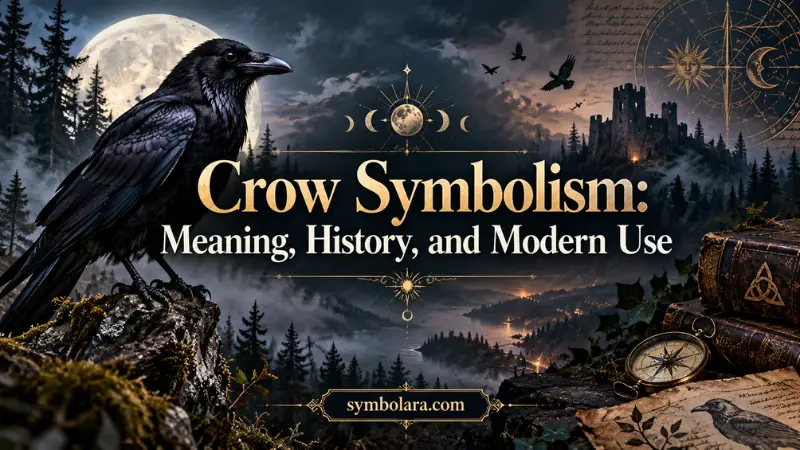
A black crow lands on a fence, tilts its head, and watches the street below. Its glossy feathers catch the sunlight while its sharp calls carry across the neighborhood. For some people, this familiar scene feels ordinary. Others see a bird connected with intelligence, change, or old stories about death.
Crow symbolism has several meanings because people have viewed these birds differently across cultures and generations. Their unusual behavior, dark appearance, and ability to survive near humans have shaped those interpretations.
In the United States, crows appear in Halloween decorations, tattoos, movies, artwork, and everyday wildlife encounters. Their reputation has also changed as scientists have learned more about their memory, communication, and social lives.
Understanding these connections helps explain why the same black bird can represent both an unsettling warning and an admired example of intelligence.
Quick Answer
Crow symbolism most commonly represents intelligence, adaptability, transformation, and awareness in modern American interpretations, although crows also remain associated with death and uncertainty. These meanings grew from older bird-omen traditions, European folklore, and observations of crow behavior, while modern wildlife research has encouraged more positive interpretations.
TL;DR
- Crows commonly represent intelligence, adaptability, awareness, and change.
- Older European traditions sometimes connected crows with death and warnings.
- American Halloween imagery emphasizes their dark appearance and loud calls.
- Crow families inspire interpretations of cooperation, loyalty, and protection.
- Cultural meanings differ; no single interpretation applies everywhere.
- Modern bird research has helped replace fear with admiration.
What Does an American Crow Look and Sound Like?
The American crow (Corvus brachyrhynchos) is a familiar bird across much of the continental United States. It has glossy black feathers, a sturdy bill, dark eyes, and a strong body built for walking, hopping, and flying.
Its familiar call sounds like a rough, repeated “caw.” Crows also make quieter rattles and other vocal sounds when interacting with nearby birds.
You might see them in city parks, open fields, suburban yards, or along roadsides. They often search the ground for insects, seeds, fallen fruit, and other available food.
Their appearance helps explain why they became recognizable symbols.
Against a bright sky, a crow’s black outline is easy to notice. Its movements can seem deliberate, especially when it pauses to examine something before approaching.
Crows are sometimes confused with ravens. However, the American crow is usually smaller and has a more rounded tail in flight. Common ravens generally have heavier bills, lower calls, and wedge-shaped tails.
That distinction matters because stories about ravens are frequently presented as crow stories, even when the original tradition identifies a different bird.
Why Crows Symbolize Intelligence and Clever Thinking
Intelligence has become one of the most recognizable modern meanings attached to crows.
Unlike birds that rely on a narrow range of food or habitats, crows adjust their behavior to changing conditions. They investigate unfamiliar objects, remember useful locations, and learn from other birds.
Scientists have documented particularly interesting examples of their abilities.
Researchers at the University of Washington found that American crows could recognize people associated with threatening experiences. Other crows also learned to respond to those individuals, showing how information can spread through a group.
This behavior gives the bird an association with memory, observation, and practical judgment.
A crow image can therefore suggest someone who pays attention before making decisions. It may also represent a person who finds solutions when circumstances become difficult.
These are human interpretations, of course. Crows do not deliberately teach people life lessons.
Still, the connection is understandable. Watching a crow figure out a problem offers a visible example of learning through experience.
For Americans who admire curiosity and independent thinking, the crow can serve as a fitting personal symbol.
What Crow Families Reveal About Loyalty and Cooperation
A crow calling loudly from a tree may appear to be acting alone. Often, however, nearby relatives are paying attention.
American crows have unusually cooperative family lives.
Young birds sometimes remain with their parents for several years instead of leaving immediately after becoming independent. During that time, they may help feed and protect younger siblings.
Family members also respond to threats together.
When a hawk or owl enters an area, several crows may gather and call repeatedly. This behavior, known as mobbing, can help drive a potential predator away.
Such actions have encouraged people to associate crows with loyalty, teamwork, and protection.
A design featuring two crows may suggest companionship. A larger group can represent family support or the importance of working together.
However, those meanings are not fixed rules. A pair of birds does not automatically symbolize marriage, and a flock does not always represent family unity.
The important connection is behavioral: crows maintain social relationships and often benefit from cooperating.
For someone choosing a symbol of resilience during a difficult period, that cooperation may be more meaningful than the bird’s older reputation for bad luck.
How Crow Symbolism Developed in Ancient Greece and Rome
Some of the oldest surviving written associations between crows and human events come from societies that closely watched birds for signs.
In ancient Greece, birds appeared in poetry, religious practices, and stories about predicting events.
The Greek poet Hesiod, writing around the seventh century BCE, included references to interpreting the calls of birds. Later traditions also connected the appearance or calling of crows with possible changes in human affairs.
Roman religious officials practiced augury, which involved interpreting certain bird calls and movements.
Crows and ravens were among the birds considered in these practices.
Importantly, a bird’s meaning depended on the circumstances. Its direction, behavior, and place within a particular ritual could affect the interpretation.
There was no single rule that every crow meant something terrible.
During the Iron Age and Roman periods in Britain, archaeological evidence also suggests that crows and ravens sometimes held ceremonial importance. Researchers have examined deliberately buried birds, although the exact beliefs behind every burial remain uncertain.
These examples show that people were assigning meaning to crow behavior long before modern American folklore developed.
The bird became important partly because it was noticeable, vocal, and often present near human settlements.
Why European Folklore Connected Crows With Death
The association between crows and death developed through several overlapping traditions.
One important reason was their feeding behavior.
Crows sometimes eat carrion, including animals that have already died. In places where people regularly encountered animal remains, these birds could appear near scenes of death.
Their black feathers and harsh calls also suited the unsettling atmosphere described in certain stories.
Across parts of Europe, folk beliefs connected crow calls with approaching misfortune. Some regional traditions treated a crow calling near a home as a warning that someone might die.
Other communities interpreted similar encounters differently.
These beliefs were cultural explanations rather than reliable predictions.
The connection grew stronger through stories about battlefields, loss, and supernatural events. Over time, crows became convenient figures in tales designed to create suspense.
European settlers carried some of these ideas to North America.
However, their beliefs existed alongside Indigenous American traditions, which had their own histories and interpretations of birds.
Today’s American association between black birds and death is partly inherited from these European stories, but it is not the only available meaning.
Why Crows Appear in American Halloween Decorations
During October, crow decorations become especially noticeable across the United States.
Artificial black birds sit on pumpkins, porch railings, bare branches, and decorative fences. Their silhouettes appear alongside scarecrows, skeletons, and old-fashioned lanterns.
The visual effect is easy to understand.
A black bird against orange autumn leaves creates strong contrast. Its pointed beak, dark wings, and watchful posture also fit the atmosphere of a spooky display.
Halloween imagery draws from several traditions involving darkness, spirits, and unsettling encounters.
Crows contribute to that mood without needing a single religious or supernatural explanation.
A homeowner might place three artificial crows on a porch simply because the arrangement looks dramatic.
Another person may use the same birds to suggest an abandoned farmhouse or a scene from a ghost story.
In modern American holiday decorating, the crow is often an artistic choice rather than a statement of belief.
Its appearance has become familiar enough that even a simple black silhouette can suggest Halloween.
How American Literature and Movies Changed the Crow’s Image
American storytelling has helped turn black birds into recognizable figures of sorrow, memory, and unusual events.
One influential example is Edgar Allan Poe’s 1845 poem The Raven.
The poem features a raven rather than a crow. Its repeated appearance and speech reflect the narrator’s struggle with grief and loss.
Although the species matters, the poem helped strengthen a broader association between dark birds and unsettling thoughts in American literature.
A more direct example is the 1994 film The Crow.
In the movie, a crow guides Eric Draven after his death as he returns to confront the people responsible for killing him and his fiancée.
Here, the bird represents a connection between death, memory, and unfinished business.
Unlike older warning stories, this version gives the crow an active role in the character’s journey.
The image also became closely connected with gothic fashion and alternative popular culture.
These works show how a symbol can change depending on the story. A crow might suggest danger in one scene but determination or remembrance in another.
What Crows Mean in Native American Traditions
Crows and ravens appear in the cultural traditions of several Indigenous peoples of North America. However, their meanings cannot be reduced to one universal Native American interpretation.
Different nations have distinct languages, stories, beliefs, and relationships with local animals.
In some Pacific Northwest traditions, Raven plays an important role as a creator, transformer, or trickster. Those stories concern Raven specifically and should not automatically be rewritten as crow legends.
Stories about clever or troublesome birds may teach lessons about human behavior, choices, and consequences.
Yet the details belong to particular communities.
Another important distinction concerns the Apsáalooke people, commonly known in English as the Crow Nation.
The Apsáalooke are a living Native American nation with their own language, government, history, and cultural practices. Their English name should not be treated as proof that all crow images share one tribal religious meaning.
Even popular stories require careful attribution. The familiar Rainbow Crow story is sometimes presented as an old Lenape legend, but that claimed origin has been disputed.
For modern readers, respecting the specific community behind a story is more useful than assuming every Indigenous tradition gives crows the same message.
Why Japanese Tradition Associates Crows With Guidance
Japanese mythology offers an interpretation that differs from the familiar American image of a frightening black bird.
An important figure is Yatagarasu, a legendary crow connected with guidance.
In the early Japanese chronicles Kojiki and Nihon Shoki, Yatagarasu helps guide the legendary Emperor Jimmu through unfamiliar territory toward the region of Yamato.
Later artwork often depicts this bird with three legs.
Interestingly, the earliest accounts do not clearly describe those three legs. The familiar image developed through later traditions, influenced in part by older East Asian sun-bird imagery.
Yatagarasu remains recognizable in Japan.
Its image appears at certain shrines in the Kumano region and in the emblem associated with Japanese national soccer teams.
In these settings, the crow suggests direction, safe passage, and finding a way forward.
This example demonstrates why cultural context matters.
A bird associated with fear in one setting can represent helpful guidance in another.
Why Crows Are Connected With Ancestors in South Asian Customs
In parts of South Asia, particularly within certain Hindu traditions, crows are associated with remembering deceased relatives.
During Pitru Paksha, a period devoted to honoring ancestors, some families prepare food offerings as part of remembrance rituals.
Crows may be fed or included in these practices because they are traditionally associated with departed ancestors.
Interpretations differ by family, region, and religious community.
The practice does not establish that every crow is literally an ancestor. Instead, it reflects a belief expressed through a particular ritual.
This tradition gives the bird a role that differs from frightening European omens.
Here, its presence can form part of an act of respect toward previous generations.
In the United States, people with South Asian family backgrounds may recognize these associations alongside the more familiar American images of Halloween and gothic artwork.
The same animal can therefore carry different meanings within a single modern society.
What Crow Tattoos and Jewelry Say About Personal Identity
Crow tattoos are often chosen for their appearance as much as their meaning.
A flying crow creates a strong silhouette, while a perched bird can produce a quieter, more thoughtful design.
The symbolism usually depends on the person wearing it.
For some, a crow represents intelligence and the ability to solve problems. Others choose it to remember someone or mark a change in their lives.
A crow with spread wings may suggest independence or movement beyond old limitations.
Meanwhile, an image of a bird resting on a branch can communicate patience and observation.
Jewelry offers another way to use the symbol.
Small crow pendants, dark metal charms, or engraved bird designs can appeal to people who admire wildlife, alternative fashion, or unusual animal imagery.
However, there is no official meaning attached to every crow necklace or tattoo.
A person may simply like the design.
Before choosing artwork based on a particular cultural tradition, it helps to understand the source. A general crow silhouette is different from copying a specific ceremonial image without knowing its purpose.
Personal meaning works best when it is informed rather than assumed.
What Does Seeing a Crow Mean in Everyday Life?
Seeing a crow outside your home does not establish that an unusual event is about to happen.
In most situations, the bird is simply carrying out its daily activities.
It might be searching for food, watching another animal, returning to a familiar location, or communicating with nearby crows.
Because these birds recognize useful places and return to them, repeated encounters are not necessarily surprising.
A crow may appear outside the same window for several days because it has found a dependable food source nearby.
Some people interpret these encounters personally.
They may connect the bird with awareness, an important memory, or a need to pay closer attention to their surroundings.
That interpretation can have emotional value without being a prediction.
There is also no dependable rule stating that one crow means bad luck while two crows promise happiness.
Such counting traditions vary widely, and they cannot reliably forecast real events.
Observing what the bird is actually doing offers a clearer understanding of the encounter.
How Crow Meanings Change Across American Settings
The meaning of a crow image often depends on where it appears and what surrounds it.
A design on a memorial card communicates something different from the same bird printed on a wildlife poster.
| Context | Meaning in USA | Common Associations | Notes |
| Graduation artwork | Learning and resourcefulness | Books, feathers, open sky | Not a traditional graduation emblem |
| Garden decorations | Watchfulness and outdoor life | Branches, leaves, rooftops | Often more seasonal than frightening |
| Memorial artwork | Personal remembrance | Names, dates, quiet landscapes | Meaning depends on family preference |
| Alternative music artwork | Independence and outsider identity | Black ink, distressed lettering | Often chosen for visual style |
| Community nature posters | Living alongside urban wildlife | Streetlights, parks, city trees | Emphasizes the bird’s place in shared spaces |
These differences show why context is more useful than assigning a fixed interpretation to every picture.
The placement, design, and personal intention all influence what viewers understand.
How Modern Wildlife Research Changed the Crow’s Reputation
Older stories often emphasized the crow’s frightening appearance. Modern research has encouraged people to look more closely at its behavior.
One important area of study concerns how crows respond to dead members of their species.
Researchers have observed crows gathering, calling, and becoming alert near dead birds.
These encounters are sometimes called “crow funerals.”
However, the name can be misleading.
Research suggests that such gatherings help crows identify possible dangers. Scientists have not established that the birds conduct funeral ceremonies with the same intentions as humans.
This distinction has changed how people understand an unsettling sight.
A noisy group of crows near a dead bird may be gathering information rather than performing a supernatural ritual.
By 2025–2026, birdwatching videos and online discussions had also made crow behavior more visible to American audiences.
People could watch examples of crows learning routines, interacting with familiar humans, and solving practical problems.
These observations encouraged a shift from treating the crow only as a frightening figure toward appreciating it as an adaptable urban animal.
The older associations have not disappeared. Instead, modern interpretations increasingly exist alongside them.
Why Crow Symbolism Can Feel Personal During Grief or Change
People sometimes become especially aware of animals during periods of uncertainty or loss.
A familiar crow outside a window may remind someone of a relative who enjoyed watching birds.
Another person may associate the bird’s ability to survive changing environments with a difficult personal transition.
These connections are meaningful because of memory and experience.
They do not require proof that the bird arrived with a message.
Psychologically, symbols help people express feelings that may be difficult to describe directly.
Someone who has recently moved to a new city might choose crow artwork to represent adaptability. A person grieving a loved one may connect the bird with remembrance because it appeared during an important moment.
Neither interpretation has to apply to everyone else.
Misunderstandings arise when personal symbolism is presented as a universal fact.
For example, claiming that every crow sighting announces death ignores the animal’s ordinary behavior and the many cultures that interpret it differently.
The most useful approach is to distinguish three things: documented cultural traditions, observable bird behavior, and individual meaning.
Each can contribute something without being confused with the others.
FAQs
Some European folk traditions treated black crows as warning signs, but many modern Americans view them as intelligent wildlife. Their dark feathers are normal coloring, not evidence that a negative event will occur.
Different counting rhymes and folk traditions assign different meanings to groups of crows. There is no consistent historical rule or scientific evidence that seeing three birds predicts a particular event.
Crows sometimes gather at communal sleeping sites called roosts, especially during colder months. These groups can contain hundreds or even thousands of birds, providing opportunities for social interaction and potential safety benefits.
Some people report finding small objects near places where they regularly feed crows. Although deliberate exchanges may occur, scientists caution that many supposed gifts could be objects left behind during ordinary exploration or feeding.
A white crow may be interpreted personally as a symbol of individuality or rarity. In nature, unusual white coloring can result from pigment conditions such as leucism, rather than a supernatural cause.
Biblical passages sometimes feature ravens, which are related to crows but are not the same birds. For example, ravens appear in the stories of Noah and Elijah; those references should not automatically be treated as specific teachings about crows.
A crow may call to communicate with nearby birds, warn of a threat, or respond to another animal. Although crows can recognize familiar people, a call alone does not prove that a particular person is being singled out.
Conclusion
Crow symbolism reflects the many ways people interpret an intelligent and highly adaptable bird. In modern American life, crows can represent awareness, loyalty, change, and resourcefulness, while older traditions continue to connect them with warnings, death, and remembrance.
Their meanings have developed through cultural stories, artistic choices, personal experiences, and scientific discoveries. No single interpretation applies to every crow or every person who encounters one.
A crow watching from a neighborhood tree may simply be looking for its next meal. Yet its presence can still remind someone of a favorite story, a family member, or a difficult experience they have overcome. That connection between an ordinary animal and a specific human memory is what keeps the symbol relevant today.