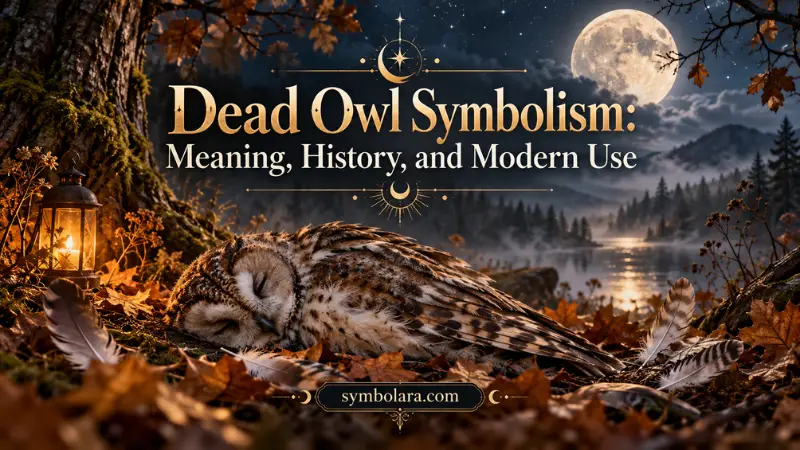
A dead owl lying beneath a tree or beside a quiet road can be an unsettling sight. Its rounded face, patterned feathers, and still body create a striking contrast with the alert bird people usually imagine. For some, dead owl symbolism raises questions about death, change, warnings, and the end of an important chapter.
Owls have carried different meanings across cultures. Greek traditions connected them with wisdom, while some Roman and Mesoamerican beliefs linked their nighttime calls with misfortune. These associations help explain why discovering a deceased owl can feel especially meaningful.
In modern American life, interpretations vary. Some people see a reminder of life’s fragile nature. Others connect the experience with personal loss, changing circumstances, or the need to pay attention to their surroundings.
Understanding these meanings requires separating historical beliefs, personal interpretations, and the natural reasons owls die.
Quick Answer
Dead owl symbolism commonly represents endings, loss, change, and awareness of life’s fragile nature. These interpretations draw partly from older traditions that associated living owls with wisdom, nighttime activity, and warnings of death or misfortune. In modern America, finding a dead owl may inspire personal reflection, but it does not predict future events.
TL;DR
- A dead owl often symbolizes endings, loss, and personal change.
- Greek traditions associated living owls with Athena and wisdom.
- Some Roman and Mesoamerican beliefs connected owls with death omens.
- American Halloween imagery reinforces the owl’s unsettling reputation.
- Modern interpretations may emphasize grief, reflection, or environmental concern.
- Finding a dead owl does not predict tragedy.
What Does a Dead Owl Look Like in Nature?
Owls have several features that make them easy to recognize, even when they are no longer alive.
Their large heads, rounded facial disks, hooked beaks, and patterned feathers distinguish them from many other birds. Some species also have feather tufts that resemble ears, although these are not their actual ears.
In the United States, familiar species include the great horned owl, barred owl, eastern screech-owl, and barn owl.
A deceased great horned owl may have brown and gray feathers, prominent head tufts, and broad wings. A barn owl looks different, with its pale, heart-shaped face and lighter body.
People sometimes discover dead owls in places such as:
- Roadsides near open fields
- Wooded areas and hiking trails
- Farms and rural properties
- Suburban yards with mature trees
- Areas near barns and abandoned buildings
The location matters more for understanding what happened to the bird than for assigning a spiritual meaning.
An owl beside a highway may have been struck by a vehicle. One discovered beneath a tree could have died from illness, injury, or another cause that cannot be identified by sight alone.
Because owls are usually associated with movement, sharp vision, and nighttime hunting, their lifeless appearance can leave a lasting impression.
Why Does Finding a Dead Owl Feel Like a Warning?
For many Americans, seeing a dead owl feels different from finding a deceased pigeon or sparrow.
Part of that reaction comes from the owl’s reputation.
These birds often hunt after sunset, move with little noise, and make calls that carry across otherwise quiet areas. Their unusual appearance and behavior have inspired stories about warnings and unseen dangers.
When a person encounters a dead owl, those established associations can influence the experience.
Someone who grew up hearing that owls bring bad news may interpret the sight as a warning. Another person might see it as a sad but ordinary wildlife encounter.
The feeling of danger comes from learned associations, not from evidence that the bird predicts future harm.
Context also shapes the response.
Finding an owl after receiving difficult news may cause someone to connect the two events. However, two experiences occurring close together does not establish that one caused or predicted the other.
Modern interpretations often focus on three ideas: an ending, uncertainty about the future, and the need to reconsider something important.
These are personal meanings rather than fixed rules.
How Can a Dead Owl Represent Endings and New Beginnings?
Death is one of the clearest visual symbols of an ending.
A dead owl can therefore represent the close of a relationship, a change in identity, or the loss of something once familiar.
The owl adds another layer because many people already associate it with wisdom and observation.
When those qualities are combined with an image of death, some interpret the result as the end of an old way of thinking.
For example, an artist might use a deceased owl to represent a character who has lost confidence in beliefs they once trusted.
Someone creating a personal journal illustration might use the same image to mark the end of a difficult period.
The symbolism can also suggest:
- Acceptance: Recognizing that certain experiences cannot be repeated.
- Change: Leaving behind habits or expectations that no longer fit.
- Reflection: Looking at past decisions with greater honesty.
- Loss: Acknowledging the absence of someone or something valued.
These interpretations do not require belief in supernatural forces.
They reflect how people use visible objects to express emotional experiences that are sometimes difficult to describe.
A dead owl does not automatically promise a new beginning. Rather, the idea of starting again comes from the person interpreting the image.
How Did Greek Traditions Connect Owls with Wisdom?
One important source of modern owl symbolism comes from classical Greece.
The goddess Athena was associated with wisdom, skill, and thoughtful judgment. The owl became one of her recognized symbols.
This connection is visible in surviving Greek artwork and currency.
During the fifth century BCE, Athens produced silver coins showing Athena on one side and an owl on the other. Some included an olive branch and a crescent moon beside the bird.
These coins were used in trade and helped establish the owl as a recognizable emblem of Athens.
The association continued through paintings, sculpture, and later European art.
However, there is an important distinction.
The Greek connection between Athena and the owl concerned the living bird, not a standard belief about finding a dead owl.
Greek traditions also included other associations with owls, including nighttime activity and death. The bird did not carry a single meaning in every setting.
Still, Athena’s association with wisdom became especially influential in later Western culture.
This history helps explain why a modern image of a dead owl might suggest lost judgment or the passing of knowledge.
That interpretation combines an established historical symbol with a modern response to death.
Why Were Owls Associated with Death in Roman and English Traditions?
Not every European tradition treated owls as symbols of good judgment.
In parts of Roman culture, an owl’s appearance or unusual call could be interpreted as an omen of misfortune.
Accounts of Roman omens sometimes described owls appearing near important buildings or public spaces before troubling events.
These stories reflected beliefs about signs and predictions. They do not establish that owls could actually forecast death.
The connection between owls and danger remained visible in later European literature.
William Shakespeare used owl calls and appearances to create tension.
In Julius Caesar, an owl appearing and calling during the daytime forms part of a series of unusual events before Caesar’s assassination.
In Richard III, owls also appear in language connected with death and unwelcome news.
For Shakespeare’s audiences, such references could suggest that ordinary life had been disturbed.
These examples concern living owls or their calls rather than dead birds.
Over time, however, repeated literary associations between owls and misfortune helped shape the way later readers understood owl imagery.
This is one reason a dead owl may seem especially ominous in a modern story.
The bird already carries an established connection with unsettling events, while its death adds another sign of loss.
What Did Owls Represent in Mexica and Maya Traditions?
Some Mesoamerican traditions also connected owls with death, although their beliefs developed in different cultural settings.
Among the Mexica, often called the Aztecs, owls could be associated with Mictlantecuhtli, a deity connected with the underworld.
Certain accounts describe owls as messengers associated with death or misfortune.
Artwork provides additional evidence of these connections.
A surviving Mexica wooden slit drum from approximately 1325–1521 features a carved horned owl. Scholars have suggested that its imagery may have been connected with funerary practices, although its exact use is not certain.
Owl stories also appear in Maya communities.
A K’iche’ Maya oral account recorded in 1968 tells of an owl understood to be a messenger of the lord of the cemetery. In the story, a man harms the owl and later experiences a family tragedy.
The account reflects the importance of respecting a messenger within that storytelling tradition.
It should not be treated as a belief shared by every Maya community.
These examples help explain how owls became associated with death in some cultural settings.
Yet they do not establish a single historical meaning for a dead owl.
Most importantly, the beliefs were part of particular communities and traditions, not universal rules about wildlife encounters.
Why Do Owl Beliefs Differ Across American Communities?
The United States brings together people whose families, religions, and cultural traditions assign different meanings to animals.
That diversity matters when discussing owls.
Some Americans know the owl mainly as a symbol of education. Others grew up with stories connecting its nighttime call to misfortune.
People with family traditions from Mexico or Central America may recognize owl stories that differ from those found in European literature.
Indigenous traditions within what is now the United States also vary considerably.
It would be inaccurate to claim that all Native American nations interpret owls as symbols of death.
Each nation has its own histories, teachings, and cultural practices. Some knowledge is also specific to families or communities and is not intended as a general explanation for outsiders.
A belief documented in one tradition should not automatically be assigned to another.
In everyday American life, people may also blend inherited beliefs with their own experiences.
For example, someone might appreciate the Greek connection between owls and wisdom while also remembering a family story about owl calls being warnings.
These views can exist together without forming a single agreed meaning.
When interpreting a deceased owl, the person’s cultural background may therefore matter as much as the image itself.
How Did Halloween Shape Owl Symbolism in America?
American Halloween traditions have helped make owls familiar symbols of nighttime fear.
Owls often appear alongside bats, black cats, witches, and full moons in Halloween decorations.
Their association with darkness makes them a natural fit for the holiday’s visual style.
This connection was already visible in American popular culture around the turn of the twentieth century.
A 1906 American newspaper story about a Halloween party, for example, described invitations decorated with owls, bats, black cats, and brooms.
The images helped create an atmosphere of suspense and playful fear.
Today, owl designs appear on October greeting cards, porch decorations, costumes, and seasonal illustrations.
A black owl silhouette against an orange moon may suggest Halloween without showing anything frightening directly.
A deceased owl, however, is not a standard Halloween symbol in the same way a black cat or carved pumpkin is.
When it appears in darker seasonal artwork, the image usually adds themes of mortality, abandonment, or sadness.
The difference matters.
A living owl on a Halloween decoration may communicate playful suspense, while a dead owl in a painting can create a more serious response.
American audiences generally recognize the difference through the surrounding design.
What Do Dead Owl Tattoos, Artwork, and Jewelry Express?
Modern artists sometimes combine owl imagery with skulls, fading flowers, or other signs of mortality.
These designs can communicate personal experiences without including written explanations.
An owl skull, for example, may represent the study of nature, remembrance, or an interest in animal anatomy.
A tattoo showing an owl beside a wilted rose could suggest lost love or the passing of time.
Still, these meanings depend on the individual.
A person might choose an owl-related memorial design because the bird reminds them of someone who died, rather than because they follow a particular historical belief.
Jewelry and home decorations present a slightly different situation.
Most owl-shaped pendants, rings, and figurines feature living birds and are commonly associated with wisdom, observation, or personal taste.
Items that specifically show a dead owl or its skull are less conventional.
They may appeal to people interested in nature illustration, Gothic design, or reminders of mortality.
The following table shows how meaning can change depending on the setting.
| Context | Meaning in USA | Common Associations | Notes |
| Memorial tattoo | Remembrance and personal loss | Grief, love, memory | Meaning often relates to the wearer’s experience |
| Gothic illustration | Mortality and uncertainty | Darkness, decay, isolation | Lighting and surrounding objects shape the message |
| Owl skull artwork | Interest in nature and life’s cycle | Anatomy, mortality, observation | Not necessarily religious or supernatural |
| Fictional storytelling | Loss of guidance or knowledge | Failed judgment, danger, change | Meaning depends on the character and plot |
| Wildlife photography | Awareness of animal mortality | Conservation, human impact, empathy | Often intended to document a real event |
One important concern involves the use of actual owl remains.
Wild owl feathers, skulls, and other body parts are generally protected under US wildlife laws. Buying or collecting them for decoration is not the same as purchasing an illustration or replica.
For most people who want this imagery, drawings, photographs, and artificial materials provide safer choices.
Why Can Seeing a Dead Owl Bring Up Grief or Anxiety?
A surprising encounter with a dead animal can trigger sadness, concern, or discomfort.
Owls may cause a particularly strong reaction because of their recognizable faces and expressive appearance.
Their forward-facing eyes can make them seem more familiar than many other birds.
When those eyes are closed or the bird is motionless, people may experience a strong sense of loss.
Personal circumstances also influence the reaction.
Someone grieving a family member might connect the encounter with memories of that person.
Another individual facing an important decision may interpret it as a reminder that life can change unexpectedly.
Psychology offers a useful explanation for these responses.
People naturally look for patterns and meaning, especially during stressful or uncertain periods.
When an unusual event happens, the mind may connect it with whatever already feels important.
This does not mean the experience is imaginary or unimportant.
The emotional response is real, even when the proposed supernatural explanation lacks evidence.
A helpful distinction is between asking what an event predicts and asking what it brings to mind.
The first question assumes the encounter contains information about the future.
The second allows someone to recognize their feelings without treating a wildlife death as a warning.
For many people, that distinction makes the experience easier to understand.
Why Do Owls Die in the Wild?
A dead owl is first a wildlife event, regardless of the meaning someone gives it.
Like other birds, owls face natural threats and hazards created by human activity.
Some common causes of owl mortality include:
- Vehicle collisions: Owls hunting rodents near highways can be struck by traffic.
- Rodent poisoning: Owls may consume prey that has eaten certain pesticides.
- Illness: Infectious diseases can affect wild birds, including birds of prey.
- Physical injuries: Collisions, falls, and other accidents may cause fatal harm.
- Environmental pressures: Habitat changes and limited food can affect survival.
Rodent poison is a particularly important example.
Certain products used to kill rats and mice can also harm predators that consume poisoned rodents.
In 2024, Audubon Connecticut described how these poisons can cause serious injury or death in birds of prey.
The problem has encouraged discussions about safer pest management and wildlife protection.
Vehicle strikes are another documented concern.
Owls may hunt along roads because small mammals gather in nearby grassy areas. Low-flying birds can then encounter passing vehicles.
These explanations show why a dead owl should not automatically be connected with an omen.
Sometimes the most meaningful response is to consider whether human activity contributed to the bird’s death.
That approach turns an unsettling discovery into an opportunity to think about local wildlife.
What Should You Do If You Find a Dead Owl?
Discovering a deceased owl may raise both emotional and practical questions.
The safest first step is to avoid touching the bird.
Wild birds can carry infectious diseases, and a person usually cannot tell why an owl died simply by looking at it.
The Centers for Disease Control and Prevention advises people to avoid direct contact with sick or dead wild birds whenever possible.
If you discover one in your yard, park, or neighborhood, consider these steps:
- Keep children and pets away from the bird.
- Avoid touching its feathers, wings, or body.
- Contact your state wildlife agency or local health department for reporting advice.
- Report unusual numbers of dead birds or suspected poisoning.
- Follow local instructions for safe disposal when necessary.
US law also affects what people can do with owl remains.
Most native owl species receive protection under the Migratory Bird Treaty Act.
A federal authorization effective December 31, 2024, allows certain forms of collecting and handling dead migratory birds for approved disposal or donation without an individual salvage permit.
However, it does not allow people to keep protected birds or their parts as personal souvenirs.
Additional rules may apply depending on the species and location.
This means finding an attractive owl feather or skull does not automatically give someone permission to take it home.
A photograph taken from a safe distance can preserve the memory of the encounter without disturbing the bird.
If the experience has personal meaning, reflection does not require collecting any physical remains.
FAQs
Some folk beliefs treat an encounter with a dead or unusual bird as unlucky. However, there is no scientific evidence that finding a dead owl changes a person’s future or increases the chance of misfortune.
The Bible mentions owls or owl-like birds in passages concerning unclean animals and desolate places, including Leviticus 11 and Isaiah 34. Biblical translations differ in identifying some birds, and the text does not establish a specific prophetic meaning for discovering a dead owl.
A dead owl in a dream may reflect concerns about change, losing guidance, or leaving behind an old belief. Dream interpretation is personal, and there is no reliable evidence that such a dream predicts an actual death.
Some people associate white with peace, innocence, or remembrance, which can influence their interpretation. However, an owl’s pale coloring comes from its species and natural plumage, not a special message attached to its death.
A dead owl may prompt thoughts about mortality, while a naturally shed feather may remind someone of the bird’s appearance or behavior. Neither carries a universal message, and protected owl feathers generally cannot be kept for personal use without legal authorization.
Repeated images may stand out more after an unusual encounter because your attention has become focused on that subject. This common pattern of selective attention does not mean the images are predicting an event.
Conclusion
Dead owl symbolism most often centers on loss, endings, change, and reflection. Its meaning comes partly from older associations between owls and wisdom, nighttime activity, death omens, and cultural storytelling.
Modern Americans interpret the image in different ways. Some connect it with grief or a changing stage of life, while others see a reminder of wildlife vulnerability. Neither interpretation requires treating the bird as a prediction of future events.
A deceased owl beside a rural road may inspire sadness, personal reflection, or concern about vehicle collisions. The lasting meaning often comes from how someone responds to the encounter rather than from any message the bird was believed to carry.