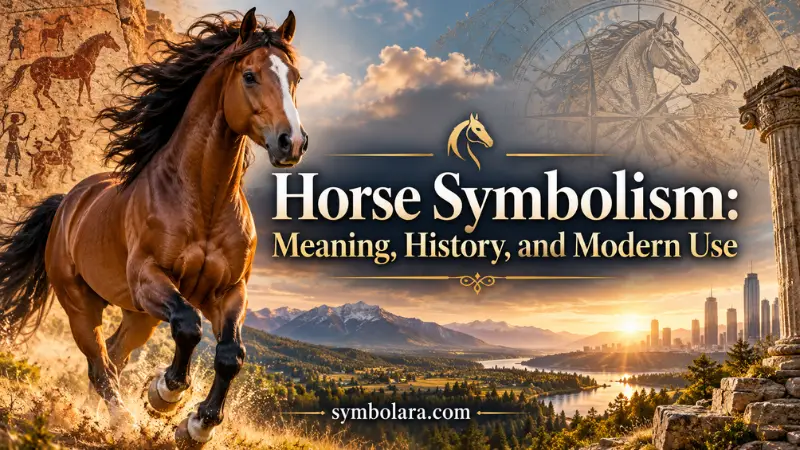
A horse can carry a rider across open land, pull heavy loads, compete at high speed, or work closely with people through subtle signals. Those real traits help explain why the animal has acquired so many meanings.
In the United States, horse symbolism is most often connected with freedom, strength, independence, movement, endurance, and partnership. The exact message changes with the image. A running wild horse suggests something different from a saddled ranch horse, a racehorse, or a quiet mare with a foal.
Horse imagery remains visible in Western art, sports, tattoos, jewelry, clothing, business logos, films, ranch culture, and public monuments. Its meaning comes from both the animal itself and the many roles horses have played in human societies.
Quick Answer
Horse symbolism most commonly represents freedom, strength, independence, endurance, movement, and the bond between people and animals. These meanings developed partly from the horse’s historical roles in travel, farming, warfare, trade, sport, and the expansion of communities across large distances.
TL;DR
- Horses commonly represent freedom, strength, motion, and independence.
- Working horses can symbolize loyalty, service, and endurance.
- Wild horses often represent life without restraint.
- American horse imagery is strongly tied to the West.
- Meanings differ among cultures, religions, and historical periods.
- A horse’s pose, setting, and color can change its message.
What Makes the Horse Such a Recognizable Symbol?
A horse is easy to identify even in a simple silhouette. Its long legs, muscular body, upright neck, mane, and flowing tail create a shape associated with movement.
Artists often use posture to communicate meaning. A horse standing calmly can suggest stability or patience. One shown galloping across open ground may suggest speed, freedom, or escape. A rearing horse can communicate excitement, resistance, aggression, or dramatic action depending on the setting.
The relationship between horse and rider also matters. A mounted rider can suggest control, partnership, authority, travel, or military status. A horse without a saddle often feels less controlled and more closely associated with the natural landscape.
These visual differences explain why two images of the same animal can communicate very different ideas.
What Horses Commonly Represent in the United States
Freedom is probably the best-known American interpretation, especially when the horse is shown running without a rider. Images of mustangs crossing plains or desert landscapes have helped create this association.
Strength is another common meaning. Horses have long performed physically demanding work, from pulling farm equipment to carrying riders over difficult ground. Because their strength is combined with speed, the horse can represent both capability and forward movement.
Other common meanings include independence, determination, endurance, confidence, and companionship.
There is also a quieter side to the symbol. People who work closely with horses often describe the relationship in terms of trust and communication. Riding depends on cooperation between animal and human, so horse imagery can also represent partnership rather than simple control.
From Domestication to Travel, Farming, and Warfare
The horse did not acquire one fixed meaning at a single moment.
Research into horse domestication continues to develop, but archaeological and genetic evidence places major changes in horse use on the Eurasian steppes thousands of years ago. Domestic horse lineages that became widespread expanded rapidly during the Bronze Age.
Once horses became important for transportation, they changed how quickly people, goods, messages, and armies could move.
That practical role affected their symbolic importance. Owning horses could indicate wealth or social position because feeding, breeding, training, and maintaining them required resources. Chariots and mounted warriors also linked horses with military power and political authority in many societies.
At the same time, ordinary working horses became associated with agriculture, hauling, travel, and survival. As a result, the animal could represent status in one setting and labor in another.
How the Horse Became an American Icon
Few American settings are as closely linked with the horse as the West.
Spanish colonization brought domestic horses back to parts of North America beginning in the late 15th and 16th centuries. Horses later spread through trade, exchange, capture, breeding, and other forms of contact. Many Indigenous nations incorporated horses into travel, hunting, trade, warfare, and community life, but their traditions were not identical.
European settlers also relied on horses for farming, transportation, ranching, military service, and communication.
By the 19th century, the horse had become central to popular images of cowboys, ranches, stagecoaches, cavalry units, and frontier travel. The Pony Express, which operated in 1860 and 1861, later became one of the most recognizable examples of the horse as a symbol of speed and long-distance communication.
Westerns in film and television strengthened those associations during the 20th century. As a result, many Americans now connect the horse with open land, personal independence, ranch life, and the mythology of the West.
Horse Meanings Across Different Cultures
Horse meanings vary considerably across societies.
In the ancient Mediterranean world, horses could be associated with warfare, athletic competition, social status, and divine figures. Greek stories connected horses with several gods and heroes, while chariot racing became an important public spectacle in Greek and Roman life.
Among Celtic peoples, the horse also had religious and social importance. Epona, a horse-associated goddess whose worship became widespread in the Roman world, was linked with horses and their care.
In Chinese tradition, the horse has long been associated with movement, ability, travel, and achievement. It is also one of the twelve animals of the Chinese zodiac, although interpretations of the zodiac Horse involve a specific cultural system rather than a universal meaning.
Indigenous North American traditions require extra care. There is no single “Native American horse meaning.” Different nations developed their own relationships with horses after the animal spread across the continent. In some communities, horses became important to hunting, wealth, mobility, exchange, ceremony, or warfare.
Treating all of those traditions as one belief system erases important differences.
Why People Connect Horses With Freedom
The freedom association comes partly from what people actually see.
A galloping horse can cover ground quickly without roads or machinery. When the animal appears without fences, reins, or a rider, the image becomes an easy visual shorthand for unrestricted movement.
In the United States, wild mustangs strengthen this idea. Free-roaming horses of the American West have become cultural symbols as well as real animals involved in continuing land-management debates.
The emotional appeal is easy to understand. Someone who feels limited by work, expectations, routines, or a difficult period may use a running horse image to express a wish for independence or change.
That interpretation does not require a supernatural belief. It works because movement and lack of restraint are visible in the image itself.
Does Horse Color Change the Meaning?
Color can influence interpretation, but there is no universal code.
White horses may suggest victory, ceremony, purity, heroism, or otherworldly imagery depending on the culture and story. Religious texts, legends, paintings, and fantasy fiction have all contributed to these associations.
Black horses can suggest elegance and strength, but fiction also uses them for danger, secrecy, death, or an intimidating character. That does not mean a black horse automatically has a negative meaning.
A chestnut, bay, gray, palomino, or spotted horse may have little symbolic meaning at all when the artist is simply showing a realistic breed or coat.
Context should come before color. A white racehorse, a white horse in a religious painting, and a white horse in a fantasy film may communicate completely different ideas.
Why Horses Appear in Tattoos, Jewelry, and Home Decor
Horse designs work well as personal symbols because they can be adapted to very different messages.
A running horse tattoo may represent independence, travel, or starting over. A horse and rider can mark someone’s connection with equestrian life. A mare and foal design may focus more on protection or family bonds.
Some people choose a specific horse rather than the animal as a general symbol. A tattoo of a childhood horse, for example, may be a memorial rather than a statement about freedom.
Horse jewelry often works in the same way. A small horse pendant may signal an interest in riding, racing, ranching, or simply affection for the animal.
Home decor takes several forms. Western interiors may use horse photography, ranch scenes, saddles, or metal silhouettes, while modern homes may use more minimal horse artwork because the animal’s shape creates a strong sense of motion.
Horses in Sports, Movies, and Brand Identity
Modern Americans encounter horse imagery even if they have never ridden one.
Horse racing gives the animal associations with speed, competition, breeding, prestige, and athletic performance. Events such as the Kentucky Derby have also made the horse part of American sporting tradition and fashion.
Rodeos use horses in a different setting, where the animal may be connected with ranch skills, competition, regional identity, and Western heritage.
Movies have probably done as much as any medium to shape the modern image of the horse. Westerns turned horses into visual companions of cowboys, lawmen, outlaws, settlers, and Indigenous characters. Fantasy stories often use horses to signal journeys, battles, royal status, or escape.
Companies also use horses because the animal can quickly communicate speed or performance. The Ford Mustang and Ferrari’s prancing horse are familiar examples, though each brand has developed its own identity around the image.
Common Misreadings and Cultural Cautions
One mistake is assuming that every horse image means freedom.
A mounted military figure may instead communicate authority or historical memory. A draft horse can suggest labor and reliability. A racehorse may communicate competition, speed, or status.
Another mistake is describing Indigenous horse traditions as though all Native American nations shared the same beliefs. They did not. Meanings varied by place, nation, period, and use.
It is also misleading to describe horses as part of an unchanged pre-contact horse culture across the Americas. The modern domestic horse spread widely after European arrival, although horses had much earlier evolutionary ancestors in North America before becoming extinct on the continent thousands of years ago.
Finally, internet lists sometimes assign fixed spiritual meanings to every horse color, pose, or encounter. Such interpretations may reflect modern personal beliefs, but they should not be presented as established historical facts.
How Horse Meaning Changed as Daily Life Changed
For much of history, horses were practical parts of everyday life.
They transported people, delivered messages, pulled carts and plows, supported armies, and helped manage livestock. A horse was not simply an image on a wall. It could determine how far someone traveled, how much work could be completed, or how quickly information arrived.
That changed rapidly with railroads, automobiles, tractors, trucks, and other machines.
By the 20th century, fewer Americans depended on horses for daily transportation or farm labor. Their cultural role moved increasingly toward recreation, racing, ranching, sport, therapy programs, ceremony, entertainment, and companionship.
As horses became less common in ordinary transportation, their symbolic side became more visible. Freedom, nostalgia, Western identity, athleticism, and personal connection now often matter more than their former role as essential working animals.
How Context Changes the Meaning
The same horse image can communicate something different depending on where it appears.
| Context | Meaning in USA | Common Associations | Notes |
| Memorial tattoo | Remembrance and attachment | A named horse, dates, portraits | Often refers to one real animal rather than a general symbol |
| Equestrian award | Skill and achievement | Competition, training, discipline | Meaning comes from rider-and-horse performance |
| Political or civic statue | Leadership or military memory | Command, public service, historical events | The rider usually matters as much as the horse |
| Children’s room decor | Affection and imagination | Ponies, riding, countryside themes | Usually less connected with historical meanings |
| Sports merchandise | Competition and identity | Racing, school teams, regional pride | Meaning depends heavily on the organization using it |
FAQs
In modern American use, usually yes. Horses are often associated with freedom, ability, endurance, companionship, and confidence, although threatening or war-related images can give them a more serious meaning.
A frightened, injured, or riderless horse can also signal loss or disorder in visual storytelling.
A running horse often represents movement, independence, speed, or release from restrictions. Several running horses together can also suggest collective motion or the scale of an open landscape.
The direction of movement can matter visually. A horse moving toward the viewer can feel more confrontational than one disappearing toward a distant horizon.
Yes, but the meaning depends on the religion and text involved. Horses appear in Christian, Hindu, Buddhist, Greco-Roman, Celtic, and other religious or mythological traditions in very different roles.
A religious horse image should therefore be interpreted within its own tradition rather than assigned one general spiritual definition.
No. The horseshoe developed its own folklore and is commonly associated with luck and protection in Western popular culture.
Although it comes from horse equipment, someone displaying a horseshoe may have no intention of referring to freedom, riding, or the other meanings associated with the animal itself.
There is no scientifically established dictionary that gives every horse dream one fixed meaning. A dream may reflect recent experiences, memories, fears, interests, or personal associations.
Someone who owns horses may interpret the image very differently from someone whose main exposure comes from Western movies.
In American art and popular culture, a wild or free-roaming horse commonly represents independence and resistance to confinement. The image is closely tied to landscapes of the American West.
Real free-roaming horse populations, however, are also part of practical debates involving land, wildlife, grazing, adoption, and population management.
Conclusion
Horse symbolism remains strongly associated with freedom, strength, endurance, movement, independence, and partnership, but none of those meanings applies automatically to every image. A wild mustang, a racehorse, a cavalry horse, and a child’s pony can each communicate something different.
The horse’s changing place in American life helps explain why the symbol has lasted. Once essential for transportation and work, horses are now encountered more often through recreation, sport, ranching, art, personal memories, and popular culture.
That gives the animal an unusual role: it can represent a historical way of life while still expressing very current ideas about independence, achievement, companionship, and the desire to keep moving forward.


