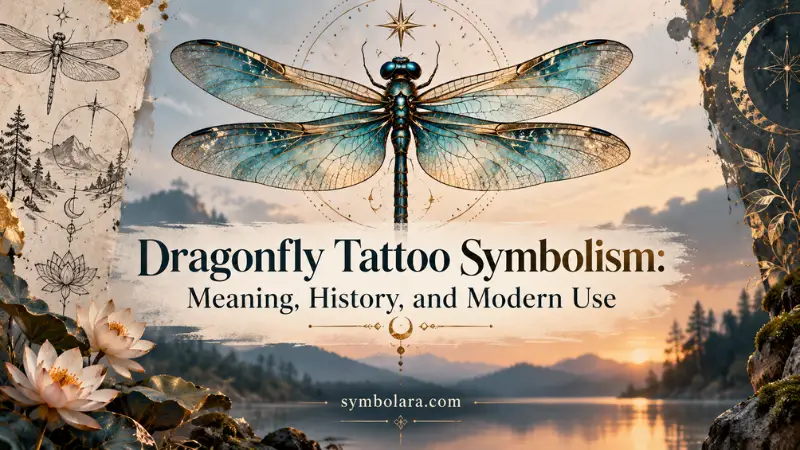
A dragonfly is easy to recognize: four clear wings, a long narrow body, large eyes, and a flight pattern that can change direction almost instantly. Dragonfly tattoo symbolism usually builds on those physical traits and on the insect’s unusual life cycle, turning a small creature into a personal sign of change, freedom, adaptability, and moving into a new stage of life.
For many Americans, the tattoo marks something specific rather than an abstract idea. It may celebrate recovery after a difficult period, the end of a relationship, independence, personal growth, or the memory of someone who died.
Yet there is no single historical meaning shared by every culture. Japanese art, several Pueblo traditions of the American Southwest, European folklore, and modern tattoo culture have treated the dragonfly differently. Understanding those differences makes the design more meaningful and avoids turning separate traditions into one invented story.
Quick Answer
Dragonfly tattoo symbolism most often represents change, adaptability, freedom, maturity, and beginning a new chapter in modern American tattoo culture. Much of that interpretation comes from the dragonfly’s transition from an aquatic juvenile to a winged adult, while older cultural meanings vary by place and tradition.
TL;DR
- Dragonfly tattoos commonly represent change, freedom, and personal growth.
- Their aquatic-to-air life cycle encourages transformation symbolism.
- Japanese traditions connect dragonflies with bravery, victory, and autumn.
- Some Pueblo traditions give dragonflies specific agricultural or ceremonial meanings.
- Memorial designs can represent carrying someone’s memory forward.
- No color or tattoo placement has one universal meaning.
What a Dragonfly Tattoo Actually Shows
A dragonfly has two pairs of wings extending from a compact thorax, a long segmented abdomen, six legs, and unusually large compound eyes. Tattoo artists can reduce that shape to a few clean lines and still keep it recognizable.
That flexibility explains why the subject works in many tattoo styles. A small fine-line dragonfly may fit on a wrist, ankle, collarbone, or behind the ear. Larger versions can show wing veins, reflective colors, flowers, water, or landscape details.
The actual insect is closely tied to freshwater. Dragonflies lay eggs in or near water, and their immature stages live underwater before adults emerge and take flight. Smithsonian sources describe dragonflies spending much of their life cycle in water before becoming winged adults.
That visible shift between two very different environments helps explain why modern people so easily connect the insect with life changes.
What Dragonfly Tattoos Usually Mean in the United States
In contemporary American tattoo culture, the most common interpretation is personal change.
That change does not have to involve one dramatic event. A person might choose the design after graduating, becoming a parent, leaving an unhealthy relationship, moving across the country, changing careers, or simply recognizing that they no longer see themselves the way they once did.
Freedom is another common association. A flying dragonfly can suggest independence and the ability to choose a new direction. Someone who recently rebuilt life after a divorce, for example, might use the insect as a reminder that an ending created room for a different future.
Adaptability also fits the image. Dragonflies maneuver quickly in flight, while their life cycle requires them to function first underwater and later in the air.
For that reason, the tattoo often communicates something close to: I changed, I adapted, and I kept going.
Why Change Became Its Main Modern Meaning
The connection between dragonflies and transformation is partly a modern interpretation of real biology.
A young dragonfly does not begin life flying over a pond. Its juvenile stage lives underwater. When development is complete, it leaves the water, sheds its old outer covering, expands its wings, and enters a completely different adult environment.
That makes the dragonfly an especially useful visual metaphor for a transition that changes how a person lives.
However, it is worth separating biological metaphor from historical tradition. There is little reason to assume every earlier culture that used dragonfly imagery automatically viewed it as a symbol of personal transformation.
The transformation meaning familiar in American tattoos today is better understood as a modern interpretation built from observation of the insect.
That distinction matters. A symbol can acquire a newer meaning without that meaning needing to be thousands of years old.
Japanese Dragonflies Could Represent Victory and Bravery
Japanese history gives the dragonfly one of its clearest documented cultural associations.
Dragonflies appeared on objects connected with samurai culture. The Metropolitan Museum of Art describes the dragonfly as a favored samurai emblem known as kachi-mushi, often translated as “victorious insect.” An 18th-century Japanese helmet in the museum’s collection is topped by a large dragonfly.
The association was linked to the insect’s direct movement toward prey, which made it suitable as an image of determination in a warrior setting. Dragonflies also appeared on sword fittings and other decorative objects, where they could represent bravery.
Japanese visual culture also connects dragonflies with the seasons. Historic paintings show them among autumn plants, and later decorative arts treated them as signs of autumn.
A Japanese-inspired dragonfly tattoo therefore does not need to mean transformation at all. Depending on its design, bravery, victory, resolve, or autumn may be closer to its historical background.
Indigenous Meanings Should Not Be Treated as One Tradition
Statements such as “the dragonfly means this to Native Americans” are too broad.
Hundreds of Indigenous nations have distinct histories, languages, stories, and artistic traditions. A meaning documented among one Pueblo community should not automatically be assigned to another nation.
There are, however, specific examples from the American Southwest.
A Smithsonian record connected with contemporary Acoma Pueblo art describes the dragonfly as a favorable sign associated with planting. Smithsonian collections also preserve Hopi pottery fragments carrying dragonfly imagery. Zuni material includes dragonflies on a water vessel used in connection with ceremonial water gathering, while Zuni storytelling includes a narrative in which a dragonfly assists children.
These examples show that dragonflies have genuine cultural importance in particular communities. They do not support a single universal “Native American dragonfly meaning.”
Someone drawing inspiration from a specific Indigenous design should therefore identify the community and tradition rather than using a generic label.
Why the Tattoo Often Appears After a Life Transition
Permanent body art can turn a private milestone into something visible.
A dragonfly works especially well for people who do not want their tattoo to describe the event literally. Someone recovering from a painful breakup may not want a date, name, or written statement on their skin. A dragonfly can represent the life that came afterward instead.
The same approach can apply to recovery from hardship, moving away from home, becoming financially independent, returning to school, or starting over after losing a job.
What matters is the direction of the story. The dragonfly is usually not chosen to say that life never became difficult. It tends to represent the ability to function differently after circumstances changed.
That makes it less about erasing the past and more about acknowledging movement.
For many wearers, that distinction is exactly why the insect feels appropriate.
Dragonflies as Memorial Tattoos
Dragonflies can also appear in remembrance designs.
In these tattoos, the insect may represent a loved one’s memory continuing to accompany the wearer. The design might include initials, handwriting, a birth flower, a date, or another small detail associated with that person.
This interpretation is personal rather than a fixed historical rule. There is no universal tradition stating that seeing a dragonfly means a deceased relative is visiting.
People can still choose that meaning for themselves. Personal symbolism does not require a claim that everyone else shares the same belief.
That difference is useful when discussing memorial tattoos. Saying “my dragonfly reminds me of my mother” describes an individual relationship with the image. Saying “dragonflies always mean dead relatives are nearby” turns a personal belief into an unsupported general claim.
The first approach leaves room for memory without presenting speculation as fact.
How Color, Style, and Placement Change the Impression
Tattoo design can alter the emotional tone even when the basic subject remains the same.
A black fine-line dragonfly often looks restrained and simple. Detailed black-and-gray work can emphasize wing structure and realism. Watercolor versions may use loose blues, greens, purples, or reds to create movement around the wings.
None of those colors has a universal dragonfly code.
A blue dragonfly does not automatically have one historical meaning, nor does a red one. Color meanings usually come from the wearer, the artist’s visual plan, or broader color associations rather than a fixed dragonfly tradition.
Placement works the same way. A wrist tattoo can remain visible as a daily reminder, while a rib, shoulder, or back tattoo may feel more private. Behind-the-ear and ankle designs work well for smaller silhouettes.
The location changes how the tattoo is experienced, but it does not automatically change what the dragonfly means.
How Other Images Can Shift the Message
Adding another object can make the symbolism more specific.
Flowers may connect the dragonfly with a person, season, birth month, or memory. Water can emphasize its biological life cycle. A landscape can turn the tattoo into a reminder of a particular place.
Names and dates move the design toward memorial or family meaning.
Geometric shapes can make it feel more contemporary without necessarily adding a traditional interpretation. A realistic dragonfly may focus attention on the animal itself, while an illustrative design can tell a larger personal story.
The most useful question is not “What does every dragonfly with a flower mean?” There is rarely one answer.
Instead, ask what each component contributes.
A dragonfly representing adaptation beside a flower connected with a grandmother, for example, creates a personal message that cannot be found in a standard symbol dictionary.
How Context Can Change the Tattoo’s Message
| Context | Meaning in USA | Common Associations | Notes |
| Dragonfly with compass | Finding direction after change | Travel, independence, decisions | Usually a modern personal combination |
| Dragonfly above water | Moving between stages of life | Emergence, adaptation, transition | Visually references the insect’s life cycle |
| Dragonfly with handwritten initials | Keeping someone present in memory | Family, friendship, remembrance | Meaning depends on the person represented |
| Dragonfly with autumn grasses | Seasonal change or Japanese influence | Autumn, resolve, natural cycles | Can echo established Japanese imagery |
| Two dragonflies together | Shared journey or relationship | Partnership, siblings, friendship | No universal historical rule governs pairs |
Misunderstandings About Dragonfly Tattoos
One common mistake is assuming the symbol has one definition everywhere.
It does not.
Japanese warrior imagery, Acoma cultural associations, Zuni traditions, and contemporary American tattoo meanings developed in different settings. Combining them into a sentence such as “dragonflies have always meant transformation, victory, and good luck worldwide” removes the differences that make those traditions worth understanding.
Another mistake involves assigning fixed meanings to every design feature. Internet lists sometimes claim that each dragonfly color, direction, wing position, or body placement has a standard message. In most cases, those rules are modern interpretations rather than widely established traditions.
Cultural borrowing also deserves some care.
Using the natural shape of a dragonfly is different from copying a culturally specific Pueblo design, ceremonial image, or recognizable traditional artwork without understanding where it comes from.
The safer approach is simple: distinguish general insect imagery from designs tied to a particular community.
How the Meaning Shifted From Historic Motif to Personal Symbol
Older dragonfly imagery often appeared inside wider cultural systems rather than as an individual statement about self-development.
Japanese warriors could use the insect within traditions of martial symbolism. Pueblo communities incorporated dragonfly forms into art, stories, agricultural associations, and ceremonial settings according to their own local customs.
Modern American tattoo culture works differently.
Tattoos are often used as personal autobiography. An image can mark a divorce, birth, recovery, move, loss, identity change, or private promise without needing to belong to an inherited symbolic system.
That change helps explain why transformation has become such a common interpretation.
The biology already provides an easy visual story: life below water, emergence, then flight. Modern tattoo wearers can connect that story to their own transition.
The result is a newer personal meaning layered onto an insect that already carried very different associations elsewhere.
Choosing a Dragonfly Design That Actually Means Something to You
A meaningful tattoo does not require a complicated symbolic system.
Start with the event or idea you want the design to represent. If the tattoo marks a transition, decide what changed. If it remembers a person, identify one detail that belongs specifically to that relationship.
Then let the visual elements support that idea.
Someone celebrating independence might choose a single dragonfly in open flight. A person marking recovery could incorporate the date when a new chapter began. Someone remembering a parent might use the parent’s handwriting rather than adding several unrelated symbols.
Historical inspiration deserves the same attention. If you want a Japanese-style dragonfly because of its connection with bravery or victory, learning about its appearance in samurai equipment creates a clearer reason for the choice.
The goal is not to collect as many meanings as possible.
A tattoo often works better when it carries one or two meanings that genuinely belong to the wearer.
FAQs
In modern American tattoo culture, it is generally interpreted positively, especially when connected with freedom, adaptation, or starting again. European folklore did give dragonflies unsettling folk names such as “devil’s darning needle,” so negative associations have existed in some places even though they are uncommon in contemporary U.S. tattoo use.
There is no single standard dragonfly meaning shared across Christianity, Judaism, Islam, or other major religious traditions. An individual may connect the insect with personal faith, but that interpretation should be described as personal rather than a universal religious teaching.
Blue has no official dragonfly meaning. A wearer may associate it with water, calmness, sky, or a favorite person’s color, but those meanings depend on the design and individual rather than a fixed historic rule.
Two dragonflies can represent a relationship, siblings, friendship, shared change, or two important periods in someone’s life. There is no established rule stating that a pair must mean romantic love or soulmates.
No. The insect has appeared in warrior imagery, decorative arts, contemporary tattoos, and personal designs without being limited to one gender. Fine-line versions may be marketed more often toward women, but style and symbolism are not gender requirements.
Not by any widely accepted rule. An artist may point the dragonfly upward or forward to strengthen a personal idea of movement, but claims that left-facing and right-facing dragonflies have fixed opposite meanings are usually modern inventions.
Conclusion
The dragonfly works as a tattoo because its real life already involves dramatic change: an underwater juvenile eventually emerges into the air as a winged adult. Modern Americans frequently turn that biological transition into a personal symbol of adaptation, independence, remembrance, and entering a different stage of life.
At the same time, dragonfly tattoo symbolism becomes more accurate when its histories remain separate. Japanese bravery and victory imagery, specific Pueblo traditions, and modern transformation tattoos do not come from one universal belief.
A good dragonfly tattoo therefore does not need to claim every meaning ever attached to the insect. It can simply connect a recognizable creature, a carefully chosen design, and one experience the wearer wants to carry forward.