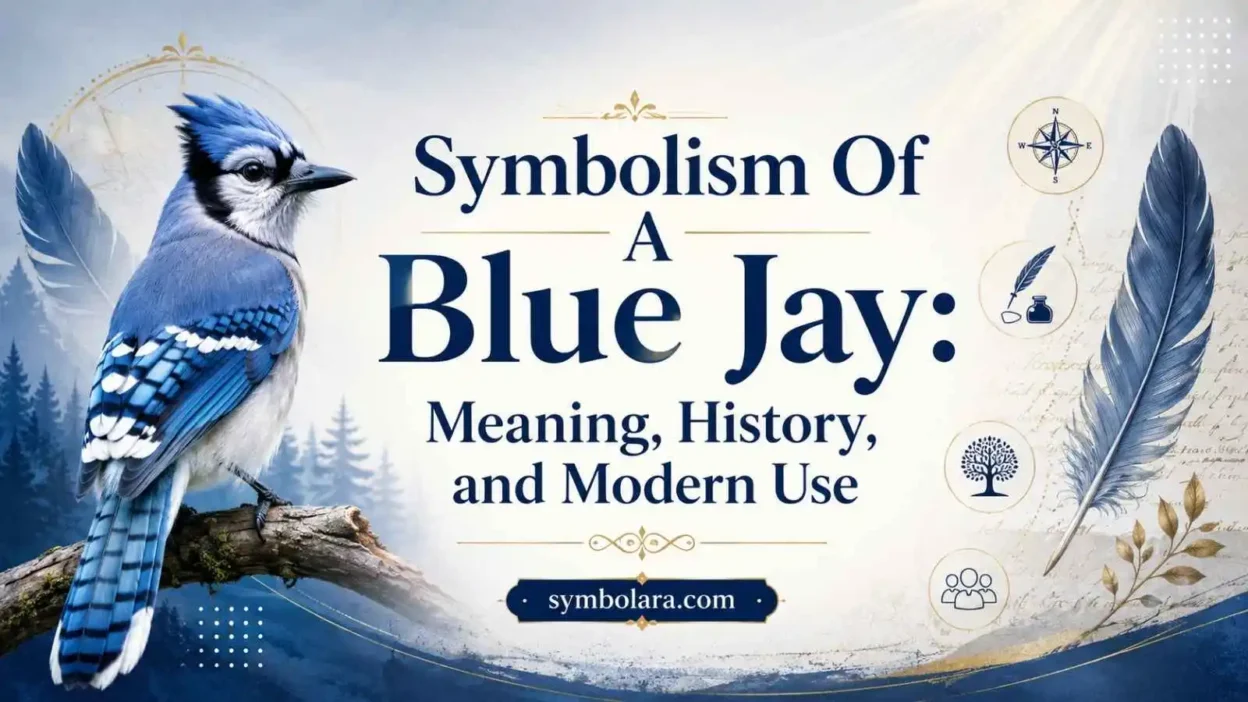
Blue jays are difficult to overlook. Their bright blue wings, raised crests, black-and-white markings, and loud calls make them some of the most recognizable backyard birds in eastern and central North America. The symbolism of a blue jay has grown largely from those visible traits: an alert bird that communicates loudly, protects its space, adapts readily, and behaves with unmistakable confidence.
In modern American culture, blue jays are often associated with communication, intelligence, courage, loyalty, and assertiveness. At the same time, their reputation is not entirely gentle. Their noisy calls, food competition, mimicry, and bold behavior have also inspired associations with trickery, aggression, curiosity, and mischief.
That combination matters. Unlike symbols that carry one dominant message, the blue jay can represent both speaking up and knowing when confidence becomes confrontation.
Quick Answer
The symbolism of a blue jay most commonly centers on communication, confidence, intelligence, alertness, and standing your ground in modern American culture. Older North American traditions are more varied, with blue jays appearing in some Indigenous stories as clever or troublesome figures and in American folklore as noisy, mischievous birds.
TL;DR
- Blue jays commonly symbolize communication, confidence, intelligence, and alertness.
- Their territorial behavior can represent boundaries and self-protection.
- Indigenous traditions give blue jays varied, tribe-specific roles.
- American folklore sometimes portrays the jay as mischievous or troublesome.
- Tattoos often emphasize courage, individuality, loyalty, or speaking openly.
- A blue jay sighting has no scientifically established supernatural meaning.
What Makes the Blue Jay Such a Recognizable Symbol
The blue jay (Cyanocitta cristata) is a large songbird in the crow and jay family. Its appearance combines blue wings and tail, white areas, black markings, a prominent crest, and a long tail. It is especially familiar in eastern backyards, forests, parks, and suburban landscapes.
Its voice may be even more noticeable than its color. Blue jays produce harsh calls, whistles, rattles, and other vocalizations, and they can imitate hawks, particularly Red-shouldered Hawks. Ornithologists have suggested that this mimicry may warn other jays about predators in some circumstances or create confusion among competing birds in others.
These characteristics give people obvious material for symbolism. A bird that announces itself loudly becomes connected with communication. One that watches its surroundings and reacts rapidly becomes associated with awareness. A bird willing to confront threats easily becomes a metaphor for confidence or defense.
What Blue Jays Commonly Mean in the United States
There is no official or universally accepted symbolic dictionary for blue jays. Their modern meanings usually emerge from a mixture of actual bird behavior, color associations, folklore, personal spirituality, and artistic interpretation.
| Context | Common U.S. Meaning | Why the Association Fits |
| Communication | Speaking clearly, honesty, self-expression | Blue jays are highly vocal |
| Confidence | Assertiveness, courage, visibility | Their behavior is bold and conspicuous |
| Intelligence | Curiosity, strategy, resourcefulness | Jays show complex social and feeding behavior |
| Protection | Boundaries, vigilance, defending loved ones | Jays may respond strongly to threats |
| Adaptability | Persistence and practical problem-solving | They thrive around varied habitats |
| Mischief | Trickery, gossip, disruption | Folklore reflects their noisy, opportunistic reputation |
These meanings can overlap. Someone choosing a blue jay tattoo, for example, might see the bird as a reminder to use their voice while another person might focus on loyalty to family or the courage to protect personal boundaries.
Communication and the Courage to Speak Up
Communication is probably the easiest modern symbolic connection to understand.
Blue jays are famously vocal. Their calls range from sharp alarms to whistles and quieter sounds, and they can reproduce calls resembling those of certain hawks.
Because of that behavior, the bird works naturally as a symbol of using your voice. In personal symbolism, it may represent saying something that needs to be said, communicating confidently, or refusing to remain invisible.
That does not automatically make the blue jay a symbol of perfect honesty. Its capacity for mimicry gives the communication theme another side: words can clarify, warn, persuade, confuse, or manipulate.
For that reason, the bird can symbolize not only speaking loudly but also thinking carefully about how communication affects others.
Intelligence, Curiosity, and Resourcefulness
Blue jays belong to the corvid family, which also includes crows, ravens, and magpies. Cornell describes them as intelligent birds with complex social systems and close family relationships. Captive blue jays have even been observed using strips of newspaper to pull otherwise inaccessible food closer, although tool use has not been documented in wild blue jays.
Those traits support modern associations with cleverness, observation, curiosity, and problem-solving.
A blue jay image may therefore appeal to someone who values thinking independently rather than following the obvious route. In this interpretation, boldness is paired with mental flexibility.
Their food-storage behavior strengthens the association. Jays carry and cache acorns, sometimes transporting them away from the original tree. Forgotten caches can eventually germinate, making jays important participants in oak dispersal.
Symbolically, that behavior can suggest preparation, foresight, or actions whose consequences extend beyond the present moment.
Courage, Assertiveness, and Personal Boundaries
A blue jay rarely gives the impression of being timid.
These birds can challenge competitors around food and respond aggressively when threats approach nesting areas. Their conspicuous calls also help make them seem unusually confrontational compared with quieter backyard birds.
That reputation has encouraged a modern symbolic connection with standing your ground.
For someone using the bird as a personal emblem, the meaning may be less about aggression than about boundaries: deciding what deserves protection, refusing to be pushed aside, or becoming comfortable taking up space.
There is an important distinction, however. Confidence and hostility are not identical. Because blue jays can also appear pushy or disruptive, the symbol can serve as a reminder that defending yourself effectively does not require dominating everyone around you.
Loyalty, Family, and Protection
The blue jay’s social life creates a gentler interpretation.
Blue jays maintain social relationships, and Cornell notes both complex social systems and tight family bonds. Their crests also change with social context; birds feeding peacefully with family members or tending nestlings typically lower them.
That behavior has helped people associate the bird with family loyalty, companionship, protection, and commitment.
In jewelry or memorial art, a pair of blue jays may therefore represent partnership or enduring connection. A parent might interpret the bird as an emblem of protecting children, while siblings may use it as a symbol of family identity.
These are modern personal interpretations rather than fixed zoological meanings, but they fit the bird’s observed social behavior better than claims that blue jays universally signify romantic love.
Adaptability, Persistence, and Making Use of Opportunity
Blue jays live successfully in forests, woodland edges, parks, suburbs, and other human-influenced environments. They also eat a varied diet and readily visit feeders. Audubon characterizes the species as intelligent and adaptable.
That adaptability makes the bird a useful symbol of persistence without rigidity.
In this reading, the lesson is not simply to endure difficult circumstances. It is to notice available resources and adjust your behavior when conditions change.
Blue jay migration adds another interesting layer. Some individuals migrate while others remain within their range year-round, and even the same bird may migrate in one year and remain north in another. Scientists still do not fully understand what determines these movements.
Symbolically, that unpredictability fits themes of flexibility better than fixed ideas about the bird representing travel or permanent migration.
Why the Color Blue Changes the Interpretation
Part of the bird’s appeal comes from its color.
In Western design and color symbolism, blue often suggests calmness, trust, openness, clarity, or seriousness. Those associations can influence how people interpret blue jay artwork even though the bird’s actual behavior is often loud and assertive.
That contrast makes the symbolism more interesting. A blue jay can visually suggest calmness while behaviorally suggesting confrontation and activity.
Even its blue coloration contains a surprising detail: blue jay feathers do not contain blue pigment. The visible blue is structural color produced as light interacts with microscopic structures in the feathers; the underlying pigment is brown melanin.
That fact occasionally inspires modern artistic interpretations about perception or appearances, although such meanings should be understood as creative metaphors rather than traditional blue jay symbolism.
Blue Jay Symbolism Compared With Other Blue Birds
Blue jays are not the only birds connected with blue color symbolism. However, their meanings often differ from other blue-colored birds because of their behavior and personality.
A bluebird is commonly associated with happiness, hope, peace, and emotional renewal. Its gentle appearance and pleasant song often create a softer symbolic image.
A blue jay usually carries stronger themes of confidence, communication, intelligence, and protection. Its loud calls and bold behavior make it a symbol of visibility and self-expression.
| Bird | Common Symbolic Associations |
|---|---|
| Blue Jay | Confidence, communication, intelligence, boundaries |
| Bluebird | Happiness, hope, peace, renewal |
| Blue Heron | Patience, independence, reflection |
| Indigo Bunting | Beauty, individuality, transformation |
These differences show why symbolism often develops from both appearance and behavior. The blue jay’s meaning comes not only from its color but also from its noticeable personality in nature.
Blue Jays in Indigenous North American Traditions
Claims about “the Native American meaning of a blue jay” require particular caution because Indigenous nations do not share one mythology or symbolic system.
Blue Jay figures appear in traditions from several communities, but their roles differ. Collections of Native stories describe blue jays in some traditions as noisy, selfish, thieving, or gossiping characters. In parts of the Northwest, Bluejay can appear as a trickster who is troublesome and humorous but sometimes helpful. Blue Jay also appears as a clan animal in some communities, including among the Hopi.
A recorded story associated with the Northern Rockies, for example, includes Bluejay alongside Crow and Magpie as daughters of Thunderbird. That is a specific story connected with a particular cultural and geographic setting, not evidence for a universal Indigenous meaning.
The safest interpretation is therefore plural: Native North American blue jay traditions include different roles, personalities, and relationships rather than one shared spiritual definition.
Blue Jay Symbolism in Native American Art and Cultural Representation
Blue jay symbolism in Native American and Indigenous contexts cannot be reduced to one meaning because traditions differ between nations, regions, and storytelling systems.
In some Indigenous stories, Blue Jay appears as a character connected with cleverness, humor, noise, or troublesome behavior. These portrayals often highlight the bird’s personality rather than presenting it as simply good or bad.
In some communities, animals may also have relationships with clans, family histories, or cultural teachings. However, these meanings belong to specific traditions and should not be generalized across all Indigenous peoples.
Modern artwork inspired by Indigenous themes should be approached carefully and respectfully. Understanding the specific cultural source behind a symbol is more accurate than applying a single broad interpretation.
The blue jay remains meaningful because its real characteristics its intelligence, strong voice, and bold behavior create many possible interpretations across different cultures.
The Blue Jay in American Folklore and Literature
The bird also developed an unusual reputation in American folk culture.
Folklore recorded from the plantation South included stories in some African American communities connecting the jaybird with the Devil. One belief held that jays disappeared on Fridays because they were carrying materials or information to him before returning afterward. These stories belong to a particular historical folk tradition and should not be treated as a general modern belief about the species.
Blue jays also entered American literature as clever and talkative characters. Mark Twain famously used a jay in a humorous story involving a bird repeatedly placing acorns into a hole without realizing where they were going.
Such portrayals strengthened associations with chatter, persistence, foolishness, and intelligence—all qualities that can coexist within trickster-style characters.
Spiritual and Religious Interpretations
Modern spiritual writing frequently gives blue jays meanings such as guidance, awakening, truth, messages, or protection. These interpretations may be personally meaningful, but they are not universal religious teachings.
There is also no standard biblical symbolism specifically assigned to the blue jay. The species is native to North America, so claims that Scripture defines blue jays as a particular divine sign should be treated as modern interpretation rather than biblical doctrine.
A religious person can still use an encounter with the bird as a personal reminder to pay attention, communicate honestly, remain courageous, or appreciate creation. The distinction is between personal reflection and claiming an established teaching that does not exist.
This distinction helps keep symbolic interpretation grounded without dismissing the emotional meaning people attach to wildlife encounters.
Blue Jay Tattoos, Jewelry, and Personal Style
Blue jay imagery works especially well in tattoos because its colors, crest, wings, and facial markings remain recognizable in many artistic styles.
Common tattoo interpretations include:
- confidence and speaking openly
- intelligence and independence
- loyalty to family
- protection and personal boundaries
- persistence after hardship
- connection to a place where blue jays are familiar
The surrounding design changes the message. A blue jay in flight may emphasize independence or movement. One perched on an oak branch can suggest stability, preparation, or connection with nature. A pair may emphasize partnership or family.
Memorial tattoos are more personal still. Someone may choose a blue jay because it reminds them of a deceased parent, childhood home, favorite season, or shared bird-feeding ritual. In those cases, personal history matters more than any general symbolism guide.
What Does a Blue Jay Feather Symbolize?
A blue jay feather is often interpreted as a symbol of communication, confidence, protection, and awareness. Because feathers are commonly viewed as meaningful objects in many cultures, people often connect a found blue jay feather with personal reflection or inspiration.
In modern symbolic interpretations, a blue jay feather may represent:
- Using your voice: A reminder to express thoughts clearly and honestly.
- Courage: Encouragement to approach challenges with confidence.
- Protection: A personal symbol connected with boundaries and safety.
- Intelligence: A reminder to think carefully and adapt.
The meaning of finding a feather depends heavily on personal beliefs and cultural background. There is no scientific evidence that a blue jay feather predicts an event or carries a universal message. Many people simply appreciate it as a beautiful reminder of the bird’s qualities and their own experiences.
What Seeing a Blue Jay May Mean Emotionally
People often search for meaning after a blue jay appears during an emotionally important moment.
Psychologically, striking events are easy to connect with whatever we are already thinking or feeling. A conspicuous bird arriving during a period of grief, uncertainty, or decision-making can therefore feel unusually significant.
There is nothing wrong with using that encounter as a personal prompt. Seeing a blue jay might remind you to speak more clearly, protect a boundary, contact someone, remain observant, or face a problem confidently.
The important distinction is that such reflection is personal meaning, not proof that the bird objectively predicts an event.
Blue jays are common visitors to suitable yards, feeders, parks, and woodland edges, so ordinary ecological explanations should remain part of the picture.
Blue Jay Symbolism in Dreams: Common Interpretations
Dreams about blue jays are often interpreted through the qualities people already associate with the bird: communication, awareness, confidence, and personal expression.
A blue jay appearing in a dream may represent a need to speak honestly, pay attention to a situation, or become more confident about a decision. Because blue jays are highly noticeable birds, some people connect them with moments when something important needs their attention.
Common symbolic interpretations include:
- A flying blue jay: freedom, change, independence, or moving toward a personal goal.
- A singing or calling blue jay: communication, an important message, or expressing thoughts clearly.
- A blue jay near a home: protection, family connections, or awareness of personal boundaries.
- A blue jay attacking or acting aggressively: possible reflection of conflict, defensiveness, or feeling challenged.
Dream meanings are personal rather than scientifically proven predictions. The emotions in the dream, the surrounding details, and the dreamer’s own experiences usually matter more than any fixed symbol dictionary.
Is a Blue Jay a Good Sign or a Bad Sign?
It can be interpreted either way because the bird has accumulated both favorable and unfavorable associations.
Positive meanings emphasize intelligence, courage, communication, loyalty, adaptability, and protection. Negative readings focus on aggression, excessive talking, deception, selfishness, or intrusion.
The bird’s real behavior helps explain that split. Blue jays can loudly warn about danger, maintain social bonds, and distribute acorns, but they can also dominate feeders, imitate hawks, and occasionally consume the eggs or nestlings of other birds. Research summarized by Cornell indicates that nest predation occurs but is probably less central to their diet than their reputation suggests; one extensive feeding study found bird material in only a small proportion of examined stomachs.
That makes the blue jay an unusually balanced symbol: admirable qualities and difficult ones appear side by side.
How Blue Jay Symbolism Has Changed Over Time
Blue jay meaning did not develop from a single ancient source.
Different Indigenous communities created their own stories and relationships with birds long before modern American popular symbolism emerged. Later folklore added new portrayals of jaybirds as noisy, troublesome, clever, or even supernatural characters. American literature continued that tradition by turning their recognizable behavior into personality.
Modern interpretation has shifted toward more individualized meanings. Tattoos, artwork, jewelry, social media, and personal spirituality now emphasize qualities such as confidence, truth, resilience, communication, and protecting one’s boundaries.
Scientific knowledge has also changed the way the bird can be understood. People now know more about blue jay mimicry, food caching, social behavior, unusual migration, and ecological relationships with oak trees.
As a result, today’s symbolism often combines folklore with direct observation rather than relying on inherited superstition alone.
Common Misunderstandings About Blue Jay Meaning
One common mistake is assuming every blue jay encounter is an omen. No scientific evidence establishes the bird as a predictor of death, money, romance, or future events.
Another is treating all Indigenous traditions as one belief system. Blue Jay stories differ among nations and communities, so claims such as “Native Americans believed the blue jay always meant good luck” erase important cultural differences. Available traditions include both negative and more complex trickster portrayals.
It is also misleading to describe the species simply as a vicious nest robber. Blue jays can take eggs and nestlings, but Cornell notes that the behavior’s frequency is uncertain and that insects and nuts made up most of the diet in a major feeding study.
Good symbolism begins with the real animal rather than exaggerating its behavior to fit a dramatic interpretation.
FAQs
In modern personal spirituality, a blue jay often represents communication, awareness, confidence, protection, or paying closer attention to your surroundings. These meanings are interpretive rather than universal spiritual rules.
A visit does not have a scientifically established supernatural meaning. Symbolically, you might use the encounter as a reminder to communicate clearly, remain alert, defend a boundary, or notice something you have been overlooking.
Blue jays are sometimes treated as positive signs, particularly when people associate them with courage, intelligence, or opportunity. However, there is no universal historical tradition identifying every blue jay as a good-luck omen.
A blue jay tattoo commonly represents confidence, individuality, communication, intelligence, family loyalty, or protection. Personal memories can completely change the meaning, especially when the tattoo commemorates a person or place.
There is no single Native American interpretation. Different Indigenous communities have different traditions, with some stories portraying Blue Jay as troublesome, selfish, clever, humorous, helpful, or trickster-like.
Some people personally associate blue jays with deceased relatives, especially when the bird appears during grief or after a loss. That interpretation can serve as a meaningful memorial tradition, but it is not an established universal meaning of the species.
In modern symbolic interpretation, two blue jays can suggest partnership, family bonds, cooperation, or mutual protection. There is no fixed traditional rule, however, so the context and the observer’s personal associations matter more than the number itself.
Blue jays are strongly connected with communication because they use many vocal sounds and are known for their loud calls. Their behavior has inspired the idea of speaking clearly and using one’s voice.
Conclusion
The symbolism of a blue jay is best understood as a reflection of the bird’s unusually noticeable character. Its loud voice supports associations with communication; its intelligence suggests curiosity and resourcefulness; its defensive behavior evokes confidence and boundaries; and its social life encourages interpretations involving family and loyalty.
Older traditions complicate that positive picture. Indigenous stories vary considerably, while American folklore sometimes depicts the jaybird as mischievous, selfish, deceptive, or troublesome. Those contrasting meanings are part of the reason the bird remains such a flexible symbol.
Rather than treating every sighting as a supernatural prediction, the blue jay can be understood more usefully as an image of alert, intelligent confidence—a creature noticeable enough to remind people that having a voice also means deciding how to use it.