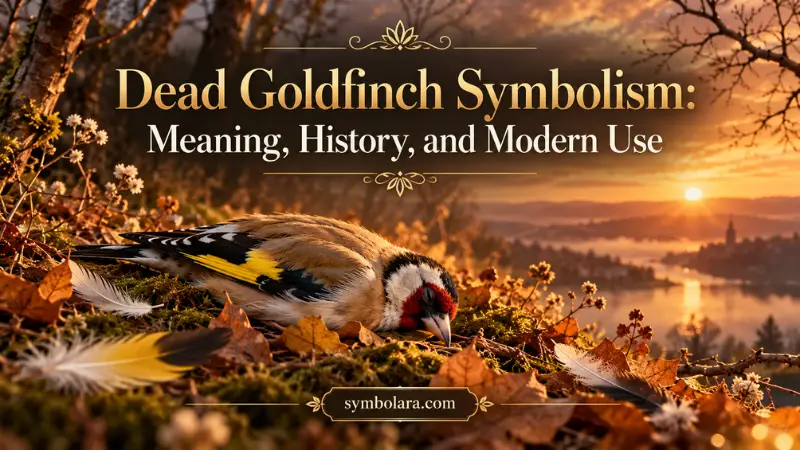
An American goldfinch is a small songbird known for its bright yellow summer feathers, black wings, and lively movements. Finding one motionless on the ground can feel upsetting, especially when you regularly watch these birds visit your backyard.
Dead goldfinch symbolism is often interpreted as lost happiness, an ending, or the fragile nature of life. Some people also connect the image with remembrance, personal change, or the need to appreciate ordinary moments.
In the United States, goldfinches are familiar backyard visitors and state birds. Their appearance in gardens, artwork, and personal memories helps explain why finding one dead may carry emotional meaning beyond the event itself.
There is no single traditional interpretation that applies to everyone. The meaning depends on the setting, personal beliefs, and the difference between established cultural symbolism and individual experience.
Quick Answer
Dead goldfinch symbolism commonly represents interrupted happiness, grief, life’s temporary nature, or the end of a meaningful chapter. These modern interpretations draw partly from the bird’s cheerful appearance and older European Christian artwork, where living goldfinches represented suffering and sacrifice. Finding a dead goldfinch is not established evidence of an approaching tragedy or supernatural message.
TL;DR
- Main meaning: Lost happiness, grief, change, and remembrance.
- Historical roots: European religious paintings connected goldfinches with suffering.
- American context: Goldfinches are familiar backyard birds associated with spring and summer.
- Personal interpretation: The image may recall someone or something lost.
- Modern use: Bird imagery can appear in memorial tattoos and artwork.
- Important distinction: A dead bird does not predict future events.
What Does an American Goldfinch Look Like?
The American goldfinch (Spinus tristis) is a small North American songbird, usually measuring about 4.3 to 5.1 inches long.
During spring and summer, adult males develop brilliant yellow feathers, black wings, and a black forehead. Females have softer yellow and olive coloring. In winter, both sexes appear more subdued, with brownish or olive feathers.
Their appearance changes with the seasons, which has helped make goldfinches appealing subjects for nature photography and seasonal artwork.
These birds commonly visit:
- Backyard bird feeders stocked with sunflower or nyjer seeds
- Open fields containing thistles and other seed-producing plants
- Parks, gardens, and suburban green spaces
- Roadside vegetation and meadow edges
Goldfinches are active birds. Their bouncing flight pattern, small calls, and habit of clinging to seedheads make them easy to notice.
A dead goldfinch looks strikingly different because its familiar movement is absent. Its wings may be folded against its body, and its feathers can remain bright even after death.
That contrast between appearance and stillness helps explain why people may connect the sight with loss.
Why a Dead Goldfinch Can Symbolize Lost Happiness
One common personal interpretation is the loss of joy.
Yellow is widely associated with sunlight, warmth, and optimism in American visual culture. A living male goldfinch fits naturally into that picture, especially when it appears among summer flowers.
When the bird is dead, the contrast becomes the central feature of the image.
A person might interpret it as representing:
- A happy period that has ended
- The absence of someone who brought laughter into their life
- A friendship or relationship that has changed
- A disappointing turn after a hopeful beginning
Imagine someone who grew up watching goldfinches outside a grandparent’s kitchen window. Years later, finding one dead might bring back memories of that home and the person who lived there.
The bird does not carry those memories on its own. The observer creates the connection through personal experience.
This distinction matters. Although goldfinches can represent happiness in modern personal symbolism, there is no established American rule stating that a dead goldfinch always means happiness will disappear.
Sometimes the sight is simply sad because a beautiful animal has died.
How a Dead Goldfinch Can Represent the End of a Season
Goldfinches change their appearance as the year progresses.
A male’s yellow breeding plumage becomes much duller after the summer. This seasonal change offers a natural comparison with the different stages of human life.
A dead goldfinch may therefore suggest that something has reached its conclusion.
For example, someone moving away from a childhood home might associate the image with leaving familiar places behind. Another person might connect it with retirement, graduation, or the end of a long relationship.
Not every ending is negative.
The image can also express acceptance: a period was meaningful even though it could not last.
However, the bird’s death and its ordinary seasonal molt are different biological events. Goldfinches do not die as part of their yearly color change.
That difference is worth remembering when creating artwork or interpreting an encounter.
A seasonal reading is a personal comparison rather than a traditional scientific or cultural explanation.
For some people, this interpretation encourages appreciation for what remains. A familiar garden may change, but new flowers and birds can still appear there.
How Goldfinches Became Symbols in European Christian Art
The goldfinch had an established symbolic role in European Christian painting centuries before it became a familiar American backyard image.
During the late Middle Ages and Renaissance, artists sometimes included goldfinches in paintings of the Virgin Mary and the infant Jesus.
The bird was associated with Christ’s future suffering and crucifixion, traditionally called the Passion.
One explanation came from the European goldfinch’s habit of feeding on thistle seeds. Thistles have sharp spines, which artists and viewers associated with the crown of thorns.
A religious legend also connected the European goldfinch’s red facial markings with Christ’s blood. According to the story, the bird tried to remove a thorn during the crucifixion and received its red coloring.
This is a devotional legend, not a biological explanation.
A well-known example is Raphael’s Madonna of the Goldfinch, painted before February 1506.
The painting shows the young John the Baptist offering a goldfinch to the infant Jesus while Mary watches. The bird anticipates suffering within an otherwise tender family scene.
Importantly, the goldfinch in this artwork is alive.
The historical tradition therefore supports an association between goldfinches and suffering, but it does not establish a separate, universal meaning for finding one dead.
Why European and American Goldfinches Have Different Symbolic Backgrounds
The bird depicted in Renaissance religious art is generally the European goldfinch (Carduelis carduelis).
It has a distinctive red face, black-and-white head markings, and yellow wing patches.
The American goldfinch is a different species. Its breeding males are mostly yellow, without the European bird’s red facial markings.
This difference affects how the birds became meaningful in different settings.
In Renaissance Europe, religious imagery helped establish the goldfinch as a recognizable symbol of suffering.
In the United States, everyday encounters with American goldfinches more commonly provide the starting point for personal associations.
An American gardener might connect the bird with sunny mornings, wildflowers, or a feeder outside the kitchen.
Someone familiar with Renaissance painting might instead remember religious scenes involving sacrifice.
Both interpretations have understandable backgrounds, but they should not be presented as one uninterrupted tradition.
There is also no reliable basis for assigning a single dead-goldfinch meaning to all Native American cultures. Indigenous nations have distinct traditions, and claims about a specific community require evidence from that community.
A careful interpretation respects those differences rather than inventing a shared belief.
What Finding a Dead Goldfinch Means in American Backyard Life
In American neighborhoods, goldfinches are ordinary parts of the natural landscape.
They feed on seeds, visit gardens, and sometimes gather at backyard feeders. The species is also recognized as the state bird of Iowa, New Jersey, and Washington.
Finding one dead can therefore feel personal, even when the observer has no particular spiritual belief.
Consider a homeowner who sees a motionless goldfinch beside a living-room window.
The immediate reaction may be sadness or concern. After noticing the glass, the homeowner might wonder whether the bird struck the window.
Other possible causes include predators, illness, weather, and accidents.
The location alone cannot confirm what happened.
Some people interpret the encounter as a reminder that life is uncertain. Others focus on preventing another bird from being injured.
Both responses can exist together.
The emotional meaning comes from how someone understands the event, while the physical cause remains a separate question.
A practical response may include examining nearby windows for reflective surfaces and considering bird-safe exterior markers.
If the bird appears dead, avoid touching it with bare hands and keep pets away. Local wildlife guidance can help determine whether it should be reported or removed.
Why the Image Can Bring Up Grief, Guilt, or Gratitude
A small bird can stir surprisingly strong feelings.
People often become familiar with backyard birds through repeated encounters. They may recognize the sound of a species, notice its favorite feeding spot, or look forward to its return each spring.
Over time, these everyday experiences can become connected with comfort and routine.
Seeing a dead bird interrupts that familiarity.
For someone grieving a family member, the image might recall an earlier loss. Another person may feel guilty after discovering a bird beneath a window they recently installed.
Neither response proves the bird was carrying a message.
Instead, the encounter provides a moment when feelings become easier to recognize.
Gratitude is another possible reaction.
A person may remember how much they enjoyed watching goldfinches during the summer and decide to plant more native seed-producing flowers.
This changes the experience from an upsetting discovery into a reason to care for the surrounding habitat.
There is no requirement to find a positive lesson in every sad event. Feeling disappointed or upset about a dead animal is a normal response.
The image becomes symbolic when someone connects it with experiences beyond the bird itself.
How the Meaning Changes Depending on the Setting
The circumstances surrounding a dead goldfinch can influence its personal interpretation.
A photograph, tattoo, dream, or real backyard discovery does not carry exactly the same meaning.
| Context | Meaning in USA | Common Associations | Notes |
| Near a home window | Concern and personal reflection | Fragility, responsibility | May prompt a check for window collisions |
| In a memorial painting | Remembering someone lost | Affection, remembrance | Meaning depends on the person commemorated |
| In a tattoo design | Acceptance of an ending | Change, identity, grief | No standardized tattoo meaning |
| In a dream | Personal emotional reflection | Memory, uncertainty, sadness | Not a reliable prediction |
| In nature photography | Awareness of wildlife mortality | Conservation, vulnerability | May document an environmental concern |
| Beside spring flowers | Contrast between life and death | Passing seasons, renewal | An artistic interpretation rather than established folklore |
These interpretations are possibilities, not fixed definitions.
A photographer may use the bird to document a conservation issue, while an artist may use the same image to remember a family member.
The surrounding details help explain the intended meaning.
Why People Might Choose a Goldfinch Memorial or Tattoo
Goldfinch designs can work well in personal memorial artwork because the bird has a recognizable shape and color.
A small yellow bird sitting on a branch may remind someone of a relative who loved gardening. A more somber design might show a bird resting beneath fallen leaves.
The second image can suggest absence without needing graphic details.
Possible design choices include:
- A goldfinch with a broken branch: A personal symbol of an interrupted chapter.
- A bird beside a memorial date: A tribute to someone remembered.
- A yellow feather near a wildflower: A reminder of ordinary moments of happiness.
- A goldfinch beneath autumn leaves: An artistic reference to change and endings.
- A bird with a small sunrise: A personal expression of hope after loss.
These are potential design ideas rather than established symbols with universal definitions.
Jewelry can serve a similar purpose.
Someone may wear a small goldfinch pendant because the bird reminds them of a family garden or a particular person.
Home decor and framed illustrations can preserve those associations without showing the bird dead.
For many people, depicting a living goldfinch is a gentler way to remember someone they miss.
In American personal expression, the intended story usually matters more than any supposed fixed meaning attached to the design.
Does a Dead Goldfinch Have a Religious or Spiritual Meaning?
There is no widely established Christian teaching that finding a dead goldfinch predicts death or misfortune.
The documented Christian association concerns the goldfinch as a symbol in religious artwork, particularly its connection with Christ’s suffering.
That association should not be confused with a belief that a dead bird is a warning.
Some individuals may connect the discovery with prayer, grief, or reflection on mortality. Such responses are personal rather than required by religious doctrine.
People who hold other spiritual beliefs may interpret the encounter differently.
For example, someone mourning a loved one might view the bird as a comforting reminder of that person.
Others may see no spiritual significance at all.
Neither interpretation can be established as a universal fact.
A helpful distinction is between cultural history and private belief.
Cultural history can show why a goldfinch appeared in a particular painting. It cannot prove that a bird found beside a modern American home has a supernatural purpose.
People can appreciate the meaning of an experience without claiming certainty about its cause.
Common Misunderstandings
Several claims about dead birds circulate in informal symbolism discussions.
One is that a dead goldfinch means someone nearby will die.
There is no reliable evidence supporting that prediction.
Another claim is that finding one means a relationship must end or that bad luck is approaching.
Such ideas may reflect personal fears or general folklore about dead birds, but they are not established meanings specific to goldfinches.
A third misunderstanding involves color.
Some descriptions suggest that all goldfinches are brilliant yellow throughout their lives. In fact, females and winter birds often have much duller feathers.
A brownish bird is not necessarily old, sick, or near death.
People also sometimes assume that every still bird is dead.
After a window collision, a bird may be stunned and temporarily unable to move. If it is alive, a licensed wildlife rehabilitator can advise on appropriate care.
Finally, a bird appearing in a dream should not be treated as proof that something will happen.
Dreams may reflect recent experiences, memories, concerns, or emotions.
Distinguishing observation from interpretation allows people to respond thoughtfully instead of becoming frightened by unsupported claims.
How Conservation Has Changed the Meaning of a Dead Goldfinch
Older European images often placed the goldfinch within religious stories.
In modern American life, the bird can also represent concern for wildlife and the environments people share with it.
This shift reflects the importance of backyard birdwatching, wildlife photography, and bird conservation.
During the 2020s, public discussions about window collisions and habitat protection have continued to draw attention to preventable bird deaths.
A dead goldfinch found beneath a large window may therefore become a reminder that familiar homes can present dangers to wild animals.
People can respond in specific ways.
Exterior window markings can help birds recognize glass as a barrier. Effective patterns use closely spaced dots or lines rather than relying on one isolated sticker.
Gardens containing suitable native plants can also provide feeding habitat for goldfinches.
Sunflowers, asters, and certain thistles produce seeds the birds eat.
However, conservation involves more than finding a symbolic lesson.
If several birds are discovered dead in the same area, contacting a state wildlife agency may help identify a disease or other problem. Avoid direct contact with dead wildlife.
The modern interpretation can therefore combine sadness with practical responsibility.
Instead of viewing the bird solely as a personal omen, an observer may see it as evidence that even common wildlife needs protection.
This interpretation is especially relevant in neighborhoods where nature and buildings exist close together.
FAQs
There is no established American tradition proving that a dead goldfinch brings bad luck. Some individuals may feel uneasy after discovering one, but the event does not determine what will happen to them.
The location may feel meaningful because a front door marks the entrance to a home. However, nearby windows, landscaping, and natural hazards are more useful clues when trying to understand why the bird died.
No. American goldfinches remain in many parts of the United States during winter, although some populations move south. Their brownish winter feathers can make them harder to recognize.
American goldfinches are protected under federal migratory bird laws. Keeping their feathers or remains generally requires legal authorization, even when the bird died naturally.
Two dead birds do not have a recognized symbolic meaning based on their number. If multiple birds are found near the same location, consider reporting the discovery to a local wildlife authority, especially if illness or repeated collisions may be involved.
Use clear language and explain that wild birds, like other animals, eventually die. If the child feels sad, talking about the bird’s life and the role birds play in gardens can help them understand the experience without frightening predictions.
Conclusion
Dead goldfinch symbolism most often reflects a personal response to loss, interrupted happiness, change, or remembrance. The interpretation combines modern associations with the cheerful American goldfinch and older European artwork that connected the bird with suffering.
The image does not carry one meaning for every culture, religion, or individual. A dead goldfinch may inspire grief, a memorial design, or concern for local wildlife, depending on the circumstances.
For someone who has watched goldfinches feed among summer sunflowers, the sight may simply be a reminder to value those familiar moments and help protect the birds that make them possible.