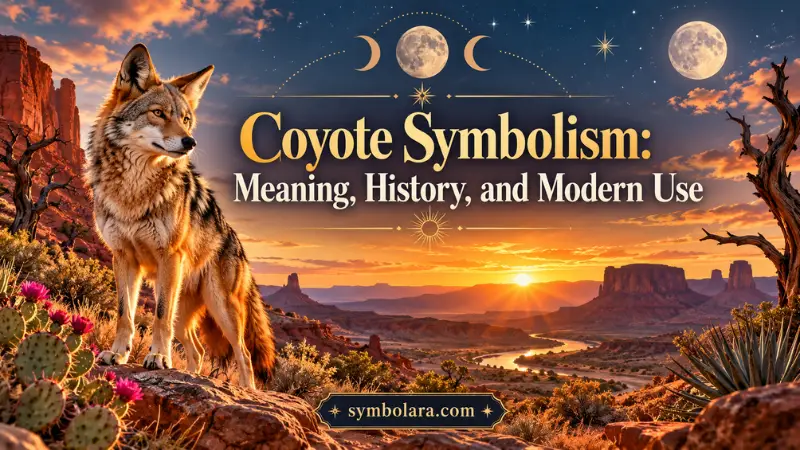
A coyote moving quietly across a desert road is a familiar sight in the American Southwest. Its pointed ears, watchful eyes, and careful movements have inspired stories about cleverness, survival, and unexpected change.
Coyote symbolism commonly represents adaptability, intelligence, resourcefulness, and the ability to overcome difficult situations. However, the animal’s meaning is not always positive. In some stories, the coyote causes trouble through selfish behavior, poor judgment, or dishonesty.
Long before coyotes appeared in cartoons and modern artwork, they held important roles in the storytelling traditions of several Indigenous nations. Those meanings remain culturally significant and cannot be reduced to one universal interpretation.
Today, Americans encounter coyote imagery in wildlife photography, tattoos, regional artwork, literature, and conversations about living alongside wild animals. Each setting can bring a different meaning to the same familiar creature.
Quick Answer
Coyote symbolism most commonly represents adaptability, cleverness, survival, and learning from mistakes. These associations partly come from Indigenous North American storytelling traditions, where Coyote appears in different roles, including trickster, teacher, and creator, depending on the community.
TL;DR
- Main meaning: Adaptability, intelligence, survival, and resourcefulness.
- Historical roots: Coyote appears in numerous distinct Indigenous storytelling traditions.
- Trickster role: Clever actions can teach lessons about mistakes and consequences.
- Emotional meaning: Independence, curiosity, humor, and resilience.
- Modern uses: Tattoos, Southwestern artwork, literature, and wildlife imagery.
- Important distinction: Coyote does not carry one universal cultural or spiritual meaning.
What Does a Coyote Look Like, and Where Is It Found?
The coyote (Canis latrans) is a wild canine native to North America. It resembles a small wolf but usually has a slimmer body, narrower muzzle, and relatively large, pointed ears.
Its coat often combines gray, brown, tan, and reddish shades. A bushy tail, long legs, and alert expression make the animal easy to recognize once you know its features.
Coyotes once had a stronger association with open western landscapes in the American imagination. Today, they inhabit nearly every part of the continental United States.
You may encounter them in:
- Southwestern deserts and dry grasslands
- Rocky mountain valleys and forests
- Midwestern farmland and open fields
- Suburban parks and wooded neighborhoods
- Urban green spaces around cities such as Chicago and Los Angeles
Unlike animals that depend on a narrow range of habitats, coyotes can adjust their diets and behavior when conditions change.
They eat rodents, rabbits, insects, fruit, and other available foods. Their willingness to use different food sources helps explain their success near human communities.
This real-world flexibility provides a natural basis for their modern association with survival.
A coyote does not need ideal conditions to continue living. It responds to the environment it finds.
Why Coyotes Symbolize Adaptability, Intelligence, and Survival
The strongest modern association with the coyote comes from its ability to adjust.
A coyote can survive in a desert, travel through farmland, or raise its young near a busy city. It changes its habits depending on food, shelter, human activity, and potential threats.
For many Americans, these behaviors suggest three important qualities.
Adaptability represents the willingness to change when old methods stop working. Someone starting a new job, moving to another city, or rebuilding after a setback may identify with this quality.
Resourcefulness reflects the ability to use what is available. Coyotes do not rely on a single hunting method or food source. Likewise, resourceful people find practical solutions with limited resources.
Intelligence describes careful observation and quick responses. The coyote’s alert posture and flexible behavior make it an appealing image for people who value creative thinking.
However, intelligence has another side.
In traditional trickster stories, cleverness may become selfishness. A character who outsmarts others can still create problems through pride or poor decisions.
This contrast makes the coyote more interesting than a simple symbol of success.
It can represent knowing when to act, when to change direction, and when confidence has gone too far.
The animal’s appeal comes partly from this imperfect nature. People can recognize both their strengths and their mistakes in its stories.
Where Did Coyote Symbolism Originally Come From?
The coyote’s cultural importance in North America reaches back to Indigenous oral traditions that existed long before European colonization.
Because many of these stories were passed from one generation to another through spoken storytelling, assigning them one exact starting date is not possible.
Different communities developed their own accounts of Coyote’s behavior, relationships, and role in the world.
In some narratives, Coyote helps shape the environment. Elsewhere, he steals, deceives, ignores advice, or accidentally creates problems.
These stories often explain why certain features of the natural world exist or show what can happen when someone breaks accepted rules.
The animal’s actual behavior likely contributed to its selection as a storytelling character.
Coyotes are observant, curious, vocal, and capable of finding food in unexpected places. Such characteristics provide useful material for stories involving cleverness and misbehavior.
During the nineteenth and twentieth centuries, collectors, writers, and researchers recorded many Indigenous stories in English.
Those publications made Coyote more familiar to outside audiences. Yet written versions sometimes shortened narratives, changed their wording, or separated them from their cultural settings.
As a result, modern summaries do not always reflect how a community understands its own traditions.
The most accurate approach is to examine specific Indigenous nations rather than treating every Native American Coyote story as identical.
Why Coyote Is More Than a Trickster in Diné Traditions
Among the Diné, also known as the Navajo people, Coyote is commonly called Mąʼii or Ma’ii.
He appears in important traditional narratives, including accounts connected with the ordering of the world.
Although outsiders frequently describe him as a trickster, that label captures only part of his character.
Coyote can show intelligence and creativity. He can also behave impatiently, ignore instructions, or create trouble through his own actions.
These contrasting behaviors help stories communicate lessons about choices and their consequences.
One well-known Diné narrative describes Coyote scattering stars across the sky while other beings are arranging them. Versions of this account connect his actions with the appearance of stars and constellations.
The story gives Coyote a role in explaining the world rather than simply presenting him as a dishonest character.
Traditional storytelling also follows cultural customs.
In many Diné communities, Coyote stories are associated with winter. The appropriate season and circumstances for telling them can carry importance beyond entertainment.
This cultural setting matters.
A Coyote image used in a commercial design does not automatically carry the same meaning as Coyote within Diné teachings.
For the Diné, these narratives belong to a living cultural tradition, not merely a collection of animal fables.
How Different Indigenous Nations Understand Coyote
Coyote also appears in traditional narratives among several Indigenous nations of the western United States, including communities in Oregon, California, and the Great Basin.
However, the details vary considerably.
Some stories present Coyote as an important figure in creating or arranging features of the world. Others emphasize his selfish behavior, failures, or encounters with other animals.
For example, traditional accounts from Oregon include stories involving Coyote and salmon.
Such narratives reflect local environments where salmon have long played important ecological and cultural roles.
That setting differs from the desert Southwest, where stories may involve other landscapes, animals, and relationships.
Coyote’s character can change as well.
He may help people in one account and cause serious problems in another. Sometimes he learns from a mistake. At other times, his foolishness becomes the lesson for the audience.
These differences challenge the popular idea that all Indigenous nations share one fixed interpretation of Coyote.
They do not.
Certain nations feature other animal or humanlike characters in roles that outsiders might compare with Coyote.
Even when two stories contain similar behavior, their cultural meanings may not be interchangeable.
For readers interested in Indigenous interpretations, identifying the nation and the particular narrative is more useful than relying on broad claims about Native American beliefs.
What the Coyote Represents in Nahua Culture
The coyote also has a documented cultural history in Mexico.
The English word coyote comes through Mexican Spanish from the Nahuatl word coyōtl.
Nahuatl was spoken by the Mexica, often called the Aztecs, and continues to be spoken by communities in Mexico today.
In precolonial Nahua traditions, the figure Huehuecoyotl, meaning “Old Coyote,” was associated with music, dance, and song.
Historical representations sometimes depict this figure with the head or appearance of a coyote.
This connection offers a meaning that differs from the common American emphasis on survival.
Here, the animal also relates to performance, amusement, and expressive behavior.
The character’s playful qualities fit the wider use of coyote imagery in stories involving unusual conduct and clever actions.
However, Huehuecoyotl belongs to a particular religious and cultural setting.
He should not be treated as interchangeable with Coyote figures found in Diné or other Indigenous North American narratives.
Modern viewers sometimes combine these traditions because they feature the same animal. Doing so can erase the differences between their histories.
The Nahua example shows that a coyote can carry associations with creativity and entertainment, not only trickery or endurance.
How Coyotes Became Symbols of the American West
A coyote standing beneath a desert sky has become a recognizable image of the American West.
Paintings, photographs, travel illustrations, and regional souvenirs often place the animal among cactus plants, rocky hills, and wide horizons.
These visual settings contribute to its association with independence and open landscapes.
The coyote also appears frequently in descriptions of the Southwest’s nighttime sounds.
Its howls, yips, and barks can carry across quiet valleys. For visitors unfamiliar with these calls, the experience may feel unusual or memorable.
Writers and artists have used those sounds to establish a sense of place.
In New Mexico, for example, coyotes are part of the wildlife found around Bandelier National Monument. Their presence connects a recognizable regional animal with the actual landscape.
Yet the coyote’s reputation has never been entirely positive.
For generations, livestock owners and rural communities have also viewed coyotes as predators that may threaten domestic animals.
This creates two competing images.
One presents the coyote as a survivor that belongs in the landscape. The other describes it as a troublesome animal that requires management.
Both perspectives have influenced American attitudes.
The coyote’s role as a Western icon therefore includes admiration, conflict, and practical concerns about sharing land with wildlife.
How Wile E. Coyote Changed the Animal’s Popular Image
For many Americans, the most familiar fictional coyote is Wile E. Coyote.
The character appeared with the Road Runner in the 1949 animated short Fast and Furry-ous.
Created by Chuck Jones and Michael Maltese, the cartoon character repeatedly tries to catch the Road Runner using complicated inventions and elaborate plans.
His efforts usually fail.
Rockets explode, traps malfunction, and carefully arranged schemes produce unexpected results.
This portrayal transformed the coyote into a widely recognized symbol of determination mixed with bad judgment.
Wile E. Coyote is clever enough to build elaborate devices but rarely learns the simplest lesson: his approach is not working.
That contradiction makes the character funny.
It also creates a familiar human comparison.
People sometimes continue using a failed strategy because they have already invested so much effort in it.
The cartoon presents that habit in exaggerated form.
Unlike traditional Indigenous narratives, these episodes belong to modern American entertainment. Their purpose, storytelling style, and cultural background are different.
Nevertheless, the character helped establish a popular association between coyotes, persistence, failure, and comic misfortune.
What Seeing a Coyote Can Mean Emotionally
Seeing a coyote in the wild may create excitement, surprise, curiosity, or concern.
The emotional response depends on the person’s experiences and surroundings.
Someone watching a coyote from a safe distance on a desert trail may admire its movement and independence.
A person discovering one near a backyard may instead worry about pets.
Neither response establishes a universal symbolic meaning.
People who enjoy personal symbolism sometimes interpret a coyote encounter as a reminder to stay alert or adjust to changing circumstances.
Others connect it with independence because the animal is often observed traveling alone.
These are personal interpretations rather than scientifically established messages.
A coyote crossing your path does not provide evidence that a particular event will happen.
Its behavior has ordinary explanations. It may be moving between feeding areas, avoiding people, or traveling through its territory.
The same distinction applies to dreams.
A person who dreams about a coyote might associate the image with humor, danger, cleverness, or uncertainty. The interpretation depends partly on the dreamer’s memories and feelings.
There is no reliable scientific rule that assigns every coyote dream one fixed meaning.
Still, animal images can help people reflect on their experiences.
A coyote may encourage someone to think about how they respond to change, especially if adaptability is a quality they already admire.
Why People Choose Coyote Tattoos, Jewelry, and Artwork
Coyote imagery offers artists several recognizable features.
A narrow muzzle, pointed ears, long tail, and lean body can create a clear silhouette, even in a small design.
Tattoo artists often use the animal in profile or standing on rocky ground.
Some designs feature a coyote lifting its head as though calling. Others show a simple outline without a detailed background.
These choices can communicate different personal ideas.
A solitary coyote may suggest independence. A running animal can represent movement or determination. A coyote shown with pups may express family care and protection.
None of these meanings is automatic.
The person choosing the design gives it personal significance.
Jewelry and decorative artwork often take a similar approach.
A small coyote pendant may appeal to someone who grew up in Arizona or New Mexico. A framed wildlife photograph might remind another person of camping trips or time spent outdoors.
Coyote images also appear in contemporary illustrations and clothing influenced by Southwestern landscapes.
However, cultural respect is important when choosing designs.
A general wildlife illustration is different from copying ceremonial imagery or claiming that an invented pattern represents a particular Indigenous nation.
People interested in culturally specific designs should learn about the relevant community and the artwork’s background.
Personal expression does not require assigning the animal a false traditional meaning.
How Coyote Meaning Changes Across Modern Settings
A coyote does not communicate exactly the same idea in every setting.
Its meaning depends on the design, the audience, and the surrounding context.
| Context | Meaning in USA | Common Associations | Notes |
| Minimalist tattoo | Personal independence | Self-direction, individuality | Meaning depends on the wearer’s intention |
| Wildlife photography | Respect for wild animals | Observation, conservation | Often emphasizes the animal’s real behavior |
| Children’s stories | Learning through mistakes | Humor, curiosity, consequences | Fictional characters may exaggerate actual behavior |
| Southwestern home decor | Regional identity | Desert landscapes, local wildlife | May express attachment to a particular place |
| Sports or brand mascots | Competitive determination | Speed, agility, persistence | Associations depend on the organization’s presentation |
These examples show why visual details matter.
A realistic wildlife photograph usually invites a different response from a cartoon mascot.
Likewise, a tattoo chosen to remember a family trip may have little connection to traditional stories.
Modern symbolism often develops through personal experiences rather than a shared set of rules.
That flexibility helps explain why coyote imagery appears in many forms of American visual culture.
How Americans Are Rethinking Coyotes in 2025–2026
American attitudes toward coyotes continue to reflect a debate between wildlife protection and concerns about safety.
For much of modern American history, coyotes have frequently been treated as unwanted predators, particularly where livestock are raised.
Wildlife management efforts have included hunting, trapping, and other methods intended to reduce conflicts.
Meanwhile, growing coyote populations in urban and suburban areas have made everyday encounters more common in many communities.
This has encouraged a different conversation.
Rather than viewing every coyote as a problem, wildlife agencies and conservation groups increasingly discuss ways to reduce conflict while allowing the animals to remain in suitable habitats.
In January 2025, the conservation organization Project Coyote announced a model plan for helping communities coexist with urban coyotes.
The plan reflected a broader interest in practical methods that reduce unwanted encounters.
Federal wildlife research published in 2025 also examined how coyotes respond when people use nonlethal methods to discourage close approaches.
These developments do not mean every community agrees about coyote management.
Livestock losses, pet safety, and concerns about unusual animal behavior remain important.
Still, discussions in 2025 and 2026 include more attention to the animal’s role in local ecosystems and the consequences of feeding wildlife.
For homeowners, coexistence usually involves ordinary precautions.
Pet food should not be left outdoors, garbage should be secured, and small pets need supervision in areas where coyotes are present.
Coyotes should never be intentionally fed.
The common belief that coyotes howl specifically at the moon is also misleading. Their vocalizations serve communication purposes, including contact between family members and territorial signaling.
These facts are important because symbolic admiration should not lead people to approach or encourage wild animals.
A coyote can represent survival while remaining a predator that deserves distance and respect.
Modern interest in the animal increasingly includes both ideas: appreciation for its adaptability and responsibility for living safely alongside it.
FAQs
It can be either, depending on the cultural or personal context. Positive interpretations often emphasize resourcefulness and clever thinking, while negative ones focus on deception, greed, or careless behavior. A story’s outcome usually helps determine which interpretation fits.
There is no universal rule connecting a coyote sighting with good or bad luck. Some people give encounters personal meaning, but a sighting does not predict future events. Location, food availability, and normal animal movement offer more dependable explanations.
In artwork or fiction, a nighttime coyote call may suggest wilderness, distance, or separation. In nature, coyotes howl and make other calls to communicate, and several animals calling together can sound like a much larger group. The sound itself is not evidence of a supernatural warning.
Coyotes are often associated with flexible thinking and making use of limited resources. Wolves are more commonly used in modern imagery to represent loyalty, family bonds, and group cooperation. These are popular associations rather than fixed meanings, and both species have complex social behavior.
No. Coyote has important cultural and sometimes sacred roles in particular Indigenous traditions, but Native American nations do not share one belief system. Other figures, including Raven and Spider characters, hold important roles in different communities.
Coyotes can use a wide range of habitats and food sources, making them a familiar example of environmental flexibility. Their expansion into areas altered by human activity has strengthened that reputation. However, survival depends on many behaviors, including avoiding hazards and caring for young, not cleverness alone.
Conclusion
Coyote symbolism brings together adaptability, resourcefulness, cleverness, and the consequences of poor decisions. Its cultural history includes distinct Indigenous storytelling traditions, while modern American interpretations also draw from wildlife observation, regional art, and popular entertainment.
The coyote can be admired as an adaptable survivor without ignoring its more complicated reputation. Different communities and individuals recognize different qualities in the same animal.
Whether appearing in a Southwestern painting, a personal tattoo, or a city park, the coyote remains recognizable because its behavior is familiar and surprising at the same time. Watching how it responds to a changing landscape offers a practical reason for its continuing place in American stories and imagery.