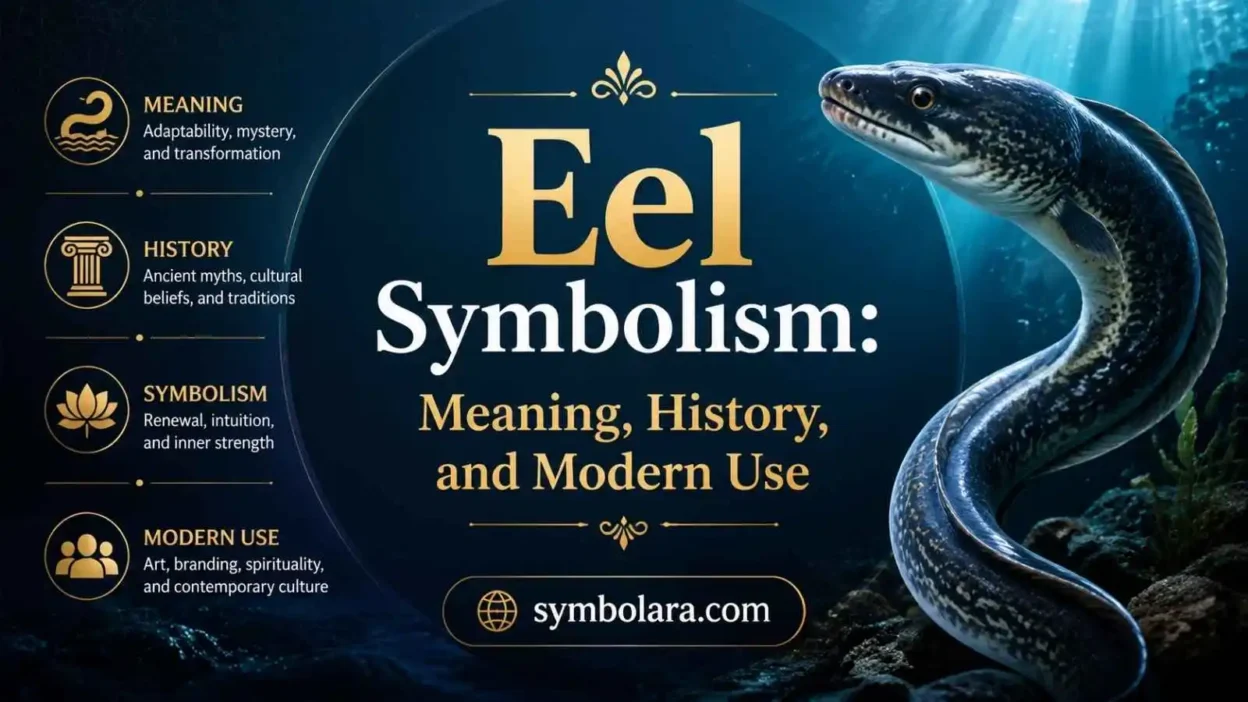
Eel Symbolism is unusual because the animal itself feels hard to classify at first glance. An eel looks like a fish, moves like a snake, lives in water, hides in mud or rock crevices, and in some species travels extraordinary distances between rivers and the open ocean.
That mixture of traits is exactly why people attach meaning to it. The eel often represents what is hidden, adaptable, difficult to control, and not easily understood. In modern American culture, it can suggest slippery behavior or unease, but it can also symbolize survival, transformation, instinct, and the ability to move through difficult environments.
Unlike a rose, eagle, dove, or butterfly, the eel is not usually treated as a pretty or comforting symbol. Its meaning is more complicated. It belongs to the shadowy side of nature: secretive, flexible, ancient-looking, and strangely resilient.
Quick Answer
Eel Symbolism commonly represents adaptability, hidden knowledge, survival, and slippery or hard-to-read behavior in modern American culture. Historically, eels have also been associated with mystery, transformation, fertility, migration, food traditions, and sacred waterways in several cultures.
TL;DR
• Eels are often seen as symbols of adaptability and survival.
• Their hidden life cycle contributes to associations with mystery.
• In American culture, they can suggest slipperiness or unease.
• Tattoos frequently portray eels as representations of resilience and transformation.
• Certain cultures regard eels as sacred or connected to ancestry.
• Modern interpretations highlight ecology, migration, and the health of waterways.
What an Eel Represents at First Sight
An eel’s body explains much of its symbolism. Long, smooth, flexible, and often dark-colored, it does not fit the familiar image of a typical fish. It bends through water with a wave-like motion, disappears into tight spaces, and often lives near riverbeds, reefs, mud, or submerged roots.
That physical form creates several immediate associations:
| Context | Meaning in the USA | Common Associations | Notes |
| Everyday speech | Slipperiness | Evasion, cleverness, dishonesty | Often negative or suspicious |
| Nature symbolism | Adaptability | Survival, movement, flexibility | Based on how eels live and migrate |
| Tattoos | Transformation | Resilience, mystery, self-protection | Often chosen for personal symbolism |
| Folklore | Hidden forces | Water spirits, fertility, danger | Varies widely by culture |
| Conservation | River health | Migration, ecological connection | Common in environmental education |
The eel is not simply “a water animal” in symbolic terms. It is a creature of movement between places: river and sea, darkness and visibility, fear and fascination. That in-between quality gives it much of its meaning.
What Eels Commonly Mean in the United States
In the United States, eels usually carry two very different symbolic meanings.
The first is negative and comes from language. Calling someone “slippery as an eel” suggests that the person is evasive, hard to pin down, or untrustworthy. This meaning comes naturally from the animal’s slick body and quick movement. It appears in everyday speech, crime fiction, political commentary, and casual conversation.
The second meaning is more ecological and personal. People who pay attention to rivers, wildlife, tattoos, or ocean life often see the eel as a symbol of persistence. The American eel begins life in the ocean, moves into coastal and freshwater habitats, spends years growing, and eventually returns to the sea. That life cycle makes it a strong image of endurance, instinct, and return.
So the American meaning depends heavily on context. In a joke or insult, the eel may mean deceit. In a tattoo, artwork, or nature essay, it may mean survival through complexity.
Adaptability and Survival
The eel’s strongest positive meaning is adaptability. Eels survive by moving through spaces that would stop many other animals. They hide, travel, wait, and adjust. Some live in rivers, some in estuaries, some in the ocean, and many pass through more than one habitat during their lives.
This is why the eel can symbolize a person who does not need perfect conditions to keep going. It suggests quiet endurance rather than showy strength. An eagle dominates the sky; a lion confronts openly. An eel survives by reading the environment and moving when the time is right.
In personal symbolism, this can feel especially relevant to people who have had to adapt to unstable circumstances. The eel does not represent loud confidence. It represents flexible intelligence, patience, and the ability to survive without being fully seen.
Mystery, Secrecy, and the Hidden Life
For centuries, eels were difficult for people to understand. Their reproduction was especially puzzling because mature reproductive organs are not obvious for much of their lives, and their spawning happens far from the rivers and coasts where people usually encounter them.
This biological mystery shaped their symbolic meaning. Eels became linked with hidden origins, secret knowledge, and the unseen parts of life. People saw them emerge from mud, weeds, or dark water and wondered where they came from. That uncertainty made them feel almost supernatural.
Today, science has explained much more about eel migration, but the emotional impression remains. Eels still feel secretive because they are not easily observed. They are most often glimpsed briefly: a movement in water, a flash in a trap, a shape under the surface.
As a symbol, the eel often points to the part of reality that exists below ordinary attention.
Transformation and Life Changes
Eels go through dramatic changes over a lifetime. Young eels can be nearly transparent, often called glass eels. As they grow, they change color, body structure, habitat, and behavior. Mature eels eventually become silver eels before their long return journey to spawn.
Because of this, the eel can symbolize transformation that happens gradually rather than suddenly. Unlike a butterfly, which is associated with visible beauty after metamorphosis, the eel suggests a quieter kind of change. It grows in hidden places. It changes while moving through difficult environments.
That makes it a fitting symbol for personal reinvention, recovery, migration, or identity shifts that outsiders may not fully see. The eel says: change does not always look graceful while it is happening.
Ancient Curiosity and Early Interpretations
In ancient and medieval thought, eels were often surrounded by speculation. Greek natural philosophy treated them as strange because their reproduction did not match what observers expected from other animals. Later writers repeated different theories about where they came from, including ideas connected to mud, moisture, and spontaneous generation.
These older beliefs matter symbolically because they show how people made meaning from uncertainty. When a creature’s life cycle could not be seen, imagination filled the gap. The eel became a creature of hidden creation, watery birth, and natural processes beyond human control.
In some ancient Mediterranean and Near Eastern contexts, eel-like or serpent-like water creatures could blur together symbolically. That does not mean every snake symbol was an eel symbol, but it does show why eels were often pulled into broader ideas about fertility, danger, water, and the life-giving power of rivers.
Eels in Indigenous and North American Contexts
In North America, the American eel has long been important to Indigenous communities, especially in eastern regions connected to rivers, estuaries, and Atlantic migration routes. Eels have served as food, medicine, material, and cultural presence. In some communities, eel skin and eel harvests were historically part of practical and ceremonial life.
For a U.S. audience, it is important not to reduce Indigenous eel meanings to one simple symbol. Meanings differ by nation, region, language, and relationship to local waterways. In many cases, the eel is less an abstract “symbol” than a living relative, resource, or sign of ecological continuity.
This is a more grounded way to understand eel meaning: not as a decorative motif, but as part of a relationship between people and water. Where eels disappear, something larger has changed in the river system. Where they return, they can represent renewal and connection.
Polynesian Stories and the Eel as a Transforming Figure
In Polynesian traditions, eels appear in memorable stories, including versions of the well-known tale of Sina and the Eel. In this story family, an eel is connected to transformation, desire, death, and the origin of the coconut tree. Versions differ across islands, so it is best understood as a living story tradition rather than one fixed myth.
The eel’s role in these stories reflects several symbolic patterns. It can be intimate and unsettling, helpful and dangerous, animal and more-than-animal. Its body and movement make it a natural figure for crossing boundaries.
For American readers, this is a reminder that eel meanings are not always negative. In some Pacific contexts, the eel is part of origin stories and food relationships. It may carry meanings of fertility, nourishment, sacrifice, or the continuing bond between humans and the natural world.
Japanese Food Culture and the Meaning of Strength
In Japan, eel, especially unagi, has a strong food-cultural meaning. It is commonly associated with nourishment, stamina, and summer eating traditions. Eel dishes are often treated as strengthening food, especially during hot weather.
This meaning has influenced how many Americans encounter eel today, especially through Japanese restaurants and sushi culture. For some diners in the United States, eel is less a mysterious river creature and more a flavorful dish connected to comfort, richness, and culinary tradition.
Still, there is a modern tension here. Eel consumption is also connected to sustainability concerns because several eel populations have faced serious pressure from habitat loss, barriers to migration, illegal trade, and overharvesting. As a modern symbol, eel can therefore represent both cultural nourishment and the need for ecological responsibility.
The Eel as a Shadow Symbol
The eel often carries a shadow meaning because people tend to distrust what they cannot easily see. Its dark habitat, slick body, snake-like motion, and sudden appearance can create discomfort. In horror, fantasy, and dark folklore, eel-like creatures often signal hidden danger.
This does not mean eels are evil. It means human imagination often treats hidden water animals as symbols of unease. Muddy water, night movement, and serpentine bodies trigger old associations with threat and uncertainty.
In psychological symbolism, the eel may represent feelings that are difficult to name: suspicion, discomfort, desire, fear, secrecy, or instinct. It can also represent parts of the self that remain hidden for protection.
That is why eel imagery can feel more emotionally complex than many animal symbols. It rarely says only one thing.
Eel Symbolism in Dreams: Meaning and Common Interpretations
Dreams about eels are often connected with emotions, hidden situations, and changes that are difficult to control. Because eels move through water and remain partly hidden, many interpretations associate them with feelings that exist below conscious awareness.
Common dream interpretations include:
- Seeing an eel in water: may represent emotions, intuition, or something happening beneath the surface.
- A moving eel: can symbolize change, adaptability, or a situation that keeps shifting.
- Catching an eel: may represent trying to understand or control something difficult.
- A slippery eel escaping: can reflect feelings about uncertainty, avoidance, or missed opportunities.
- A large or unusual eel: may represent a powerful emotion, hidden concern, or major life transition.
Dream symbolism is personal, and there is no universal meaning for every eel dream. A person’s experiences, emotions, and cultural background often influence how they interpret the image.
From a symbolic perspective, the eel in dreams often represents something that asks for attention but cannot be easily grasped.
Slipperiness, Deception, and American Idioms
The most common negative meaning of the eel in American English comes from slipperiness. A “slippery eel” is someone who avoids accountability, escapes direct answers, or cannot be trusted to stay still long enough to be confronted.
This meaning appears because the animal is physically difficult to hold. The body is smooth, muscular, and coated in mucus, making it almost impossible to grip firmly. From that real experience came a moral metaphor: what cannot be held becomes what cannot be trusted.
This is a good example of how symbolism forms from the body of the animal itself. People did not randomly assign evasiveness to eels. They felt it in their hands, saw it in movement, and turned that experience into language.
Still, this is only one layer of meaning. A slippery creature can also symbolize escape from danger, clever survival, and refusal to be trapped.
Tattoos and Personal Style
Eel tattoos are less common than snake, koi, dragon, or shark tattoos, but that makes them more distinctive. People may choose an eel design to represent resilience, secrecy, transformation, or comfort with being misunderstood.
An eel tattoo can suggest someone who has survived by adapting rather than fighting openly. It can also represent a connection to water, fishing, coastal life, marine biology, or Pacific and Japanese-inspired imagery. In some designs, the eel is shown twisting around waves, plants, bones, knives, or moon shapes.
Electric eel imagery adds another layer, though electric eels are not true eels biologically. In tattoo and pop culture, they often symbolize intensity, nervous energy, shock, personal power, or emotional charge. The symbolism is real in modern design, even if the animal name is biologically misleading.
Electric Eel Symbolism: Power, Energy, and Protection
Electric eel symbolism has developed its own meaning in modern culture because of the animal’s unusual ability to generate electricity. Although electric eels are not true eels biologically, their popular image creates strong symbolic associations.
Electric eels are often connected with:
- Personal power: the ability to create impact and defend yourself.
- Energy and intensity: strong emotions, creativity, or a powerful presence.
- Protection: using inner strength when facing challenges.
- Unexpected ability: hidden talents that others may not notice.
In tattoos and artwork, electric eels are sometimes chosen by people who want a symbol of strength that feels unusual rather than traditional. The imagery suggests that power does not always look obvious from the outside.
Like other eel symbolism, electric eel meanings depend on context. Some people focus on danger and shock, while others focus on resilience, energy, and survival.
Eels in Jewelry, Decor, and Visual Design
Eels are not mainstream symbols in American home decor, but they do appear in ocean-themed art, aquarium culture, scientific illustration, coastal branding, and bold fashion. Their shape works well in design because it creates movement. A long curving eel can guide the eye across a poster, tattoo, necklace, or mural.
In jewelry, eel-like forms may suggest fluidity and elegance, while darker designs can convey gothic, unusual, or protective qualities. In educational spaces, eel imagery often highlights migration, river restoration, and the hidden life of waterways. Designers and educators alike use the eel’s distinctive shape to guide attention and communicate movement or resilience.
The eel’s design strength is its line. It does not need wings, antlers, or bright feathers to stand out. Its body is already a symbol of motion.
Pop Culture and Digital Meanings
In modern American pop culture, eels often appear as strange, comic, dangerous, or unsettling creatures. Movies, animation, fantasy games, and internet humor use eel-like forms to suggest surprise, weirdness, or underwater threat. Moray eels, electric eels, and fictional giant eels are especially common in visual storytelling.
Digital culture also turns the eel into a symbol of awkward fascination. People share videos of glass eels, garden eels, morays, and electric eels because they look unfamiliar. The reaction is often a mix of “gross,” “cool,” and “how is that real?”
That mixed response is part of the eel’s modern symbolism. It occupies the space between fear and curiosity. It reminds people that nature is not designed only to be cute, symmetrical, or easy to understand.
Ecological Symbolism and River Health
In environmental contexts, the eel has become a symbol of connected waterways. Because many eels migrate between ocean and freshwater habitats, their presence depends on open passage. Dams, culverts, pollution, drained wetlands, and blocked streams can disrupt their movement.
For conservation groups, students, and river communities, eels can represent the health of an entire water system. A single young eel moving upstream suggests that ocean currents, estuaries, rivers, and migration corridors are still linked.
This is one of the most important modern meanings in the United States. The eel is no longer only a strange creature in folklore or an idiom for evasiveness. It is also a living indicator of whether rivers remain passable and alive.
Common Misunderstandings About Eels
One common misunderstanding is that all eels are the same. In reality, “eel” can refer to many species, and some animals with eel in their common name are not true eels. Electric eels, for example, are commonly treated as eels in popular culture, but biologically they belong elsewhere.
Another misunderstanding is that eels are symbols of evil because they resemble snakes. This is too simple. Eels can be unsettling, but their symbolism is not automatically sinister. Across cultures, they may represent food, fertility, endurance, sacred water, or transformation.
A third misunderstanding is that eel symbolism must be mystical. It does not have to be. Many of its meanings come directly from observable facts: migration, hidden movement, flexible bodies, muddy habitats, and hard-to-grip skin.
The eel’s meaning is strongest when kept close to the animal itself.
How the Meaning Has Changed Over Time
Older eel meanings often grew from mystery. People did not know where eels reproduced, why they appeared seasonally, or how they moved between waters. That uncertainty encouraged myths, strange theories, and associations with hidden creation.
Modern meanings are more divided. Science has made the eel less mysterious in one sense, but more impressive in another. Its migration, life stages, and ecological vulnerability give it new symbolic weight. The eel now represents not only secrecy but also connectivity, survival, and environmental fragility.
In the United States, the everyday insult of “slippery” still exists. But alongside it, a newer view is emerging: the eel as a survivor of damaged waterways, a strange but necessary part of river life, and a reminder that overlooked creatures can carry major ecological meaning.
Is the Eel a Positive or Negative Symbol?
The eel can be either positive or negative depending on use.
As a positive symbol, it stands for adaptability, instinct, endurance, transformation, and the ability to survive in hidden or difficult places. It can honor people who move quietly, protect themselves, and keep going without needing attention.
As a negative symbol, it suggests evasion, discomfort, secrecy, or behavior that cannot be trusted. This is the meaning behind many American idioms and casual descriptions.
The most balanced interpretation is this: the eel symbolizes what slips beyond easy control. That can be threatening when linked to dishonesty, but admirable when linked to survival.
FAQs
Spiritually, an eel often symbolizes adaptability, hidden knowledge, emotional depth, and movement through uncertain situations. Because it lives beneath the surface and migrates through difficult waters, it can represent trusting instinct during change.
An eel is not automatically good or bad. It can symbolize resilience and transformation, but it can also suggest secrecy, evasiveness, or discomfort depending on the context.
An eel tattoo often means survival, flexibility, mystery, or personal transformation. Some people choose it to show that they have adapted to difficult circumstances without losing their identity.
Eels are associated with mystery because their life cycle was difficult for people to observe for centuries. Their hidden habitats, long migrations, and unusual body shape made them seem secretive and hard to explain.
In American culture, eels often suggest slipperiness, evasion, or strangeness in everyday language. In nature writing, tattoos, and conservation, they more often represent survival, migration, and the hidden life of rivers.
In some cultural traditions, eels have been connected to fertility, sexuality, food, and life-giving water. This meaning usually comes from their shape, watery habitat, and role in origin stories or nourishment.
Snake symbolism is usually tied to land, shedding, danger, healing, or temptation. Eel symbolism is more connected to water, hidden movement, migration, adaptability, and life beneath the surface.
Spiritually, an eel often represents adaptability, intuition, hidden emotions, and transformation. Many interpretations focus on its ability to move through unseen environments and survive change.
Conclusion
The eel is a symbol of what moves below the surface. It can be unsettling because it is difficult to hold, hard to observe, and easy to misunderstand. But those same traits also make it a meaningful image of adaptation, survival, secrecy, and transformation.
In modern American culture, Eel Symbolism sits between suspicion and respect. The eel can describe someone evasive, but it can also represent a person or creature that survives by being flexible, alert, and patient.
Its meaning is not soft or decorative. It reminds us that some forms of strength are quiet, hidden, and shaped by the long journey home.