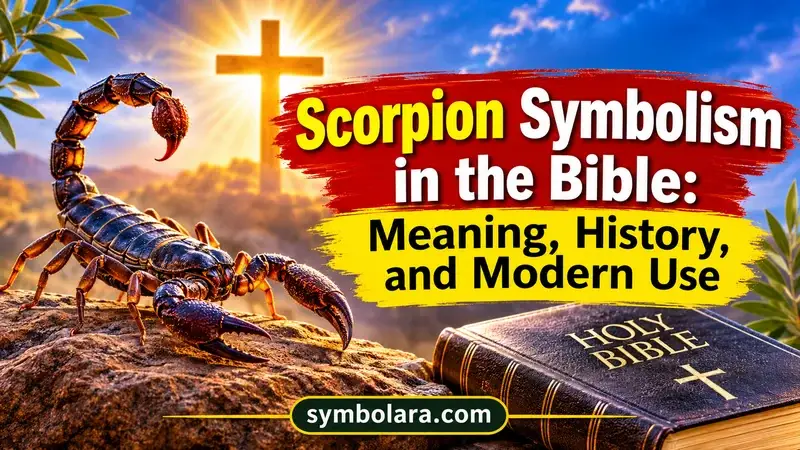
A scorpion is a small creature with eight legs, two pincers, and a curved tail ending in a venomous stinger. In the Bible, it appears in descriptions of dangerous wilderness areas, warnings about suffering, and passages about spiritual authority. Its presence often reminds readers of the risks people faced in the natural world.
People searching for scorpion symbolism in the bible usually want to understand whether this creature represents evil, danger, spiritual attacks, punishment, or protection. The answer depends on the passage. Most biblical references connect scorpions with pain, hostility, and hardship, although Jesus also uses the creature when teaching about the authority given to his followers.
In modern American Christianity, scorpions appear in Bible discussions, religious artwork, tattoos, sermons, and personal interpretations of difficult experiences. Understanding the original passages helps separate biblical meaning from modern assumptions.
Quick Answer
Scorpions in the Bible most commonly represent danger, suffering, hostility, and painful experiences. Their meaning comes from the real threat posed by venomous scorpions in the ancient Near East, while passages such as Luke 10:19 also use the creature to illustrate spiritual authority over dangerous forces.
TL;DR
- Scorpions commonly represent danger, suffering, and hostility in biblical passages.
- Deuteronomy connects them with the harsh conditions of the wilderness.
- Ezekiel uses scorpions to describe hostile and difficult people.
- Jesus mentions scorpions when discussing spiritual authority in Luke.
- Revelation uses scorpion-like tails to describe painful judgment.
- Modern Christians interpret the creature through biblical context and personal faith.
What Does a Scorpion Look Like in Biblical References?
A scorpion is an arachnid, not an insect. It has eight legs, a pair of front pincers, and a segmented tail that curves over its body. At the end of its tail is a stinger that can inject venom.
Scorpions live in warm, dry environments and often hide beneath rocks, inside cracks, or in other sheltered places. These habits made them a familiar danger in parts of the ancient Near East, including desert regions and rocky landscapes.
The biblical world included areas where scorpions were a real concern for travelers, shepherds, and people living in rural communities.
Their physical characteristics help explain why biblical writers used them as examples of danger:
- The stinger: Represents the ability to cause sudden pain and injury.
- The pincers: Suggest the creature’s ability to grasp and defend itself.
- The curved tail: Makes its defensive strike visually recognizable.
- Its hidden behavior: Connects it with unexpected encounters and unseen threats.
These characteristics do not automatically give every scorpion a separate biblical meaning. Instead, they help explain the creature’s role in passages about danger and human vulnerability.
What Is the Main Spiritual Meaning of a Scorpion?
The most common biblical association is danger that can cause pain or suffering. A scorpion is small compared with many other animals, but its sting makes it something people should take seriously.
This difference between its size and its ability to hurt gives the creature a useful place in biblical comparisons.
Several related meanings appear across Scripture.
Danger and physical suffering: A scorpion’s venom makes it an understandable example of something that can injure a person. Biblical writers use the creature to describe threatening conditions.
Hostility and opposition: Scorpions appear in passages where people face resistance, cruelty, or difficult circumstances. Their sting provides a picture of the pain caused by hostile behavior.
Hardship and testing: The wilderness references connect scorpions with uncomfortable and dangerous living conditions. They help readers understand the difficulties experienced by the Israelites.
Judgment and torment: Revelation describes creatures with scorpion-like tails. Their stings become part of an apocalyptic picture of suffering.
Authority over danger: In Luke 10:19, Jesus mentions scorpions while speaking to his disciples about authority over hostile forces. This gives the image a different role from its usual negative associations.
The surrounding passage matters more than the animal alone. A scorpion in a wilderness description does not communicate exactly the same idea as one in an apocalyptic vision.
Why Do Scorpions Appear in the Old Testament?
Scorpions appear in several Old Testament passages because they were part of the natural environment in which biblical communities lived.
The creature was not simply an invented religious image. People understood the danger of being stung, particularly when traveling through rocky and dry areas.
One important reference appears in Deuteronomy 8:15.
Moses reminds the Israelites that God led them through a great and dangerous wilderness, a place described as having fiery serpents and scorpions, along with dry ground where water was scarce.
The passage looks back on the Israelites’ difficult journey through the wilderness. Scorpions help communicate the physical risks of that experience.
Another important reference appears in 1 Kings 12:11 and 12:14.
After Solomon’s death, his son Rehoboam faces a request from the people to reduce their heavy burdens. Instead of accepting the advice of older counselors, he follows the suggestions of younger advisers.
He tells the people that while Solomon disciplined them with whips, he would discipline them with scorpions.
The comparison communicates harsher treatment and greater suffering. The exact physical object intended by the word has been discussed by interpreters, but the statement clearly expresses Rehoboam’s threat to increase the people’s hardship.
These passages establish two important uses: scorpions as real wilderness dangers and as images of painful treatment.
What Does a Scorpion Represent in Deuteronomy 8:15?
Deuteronomy 8:15 is one of the clearest biblical references to the creature.
The verse describes the wilderness through which the Israelites traveled after leaving Egypt. It mentions dangerous snakes, scorpions, and a dry land without ordinary sources of water.
The main point is not that scorpions have a secret spiritual meaning. Moses is reminding the Israelites of the difficult conditions they experienced during their journey.
Three ideas stand out.
The danger of the wilderness: The Israelites faced environmental threats that could affect their survival. Scorpions were among the hazards of traveling through unfamiliar territory.
Dependence on God: The surrounding chapter reminds the people that their survival depended on God’s provision. The wilderness experience was connected with learning humility and trust.
Remembering difficult experiences: The verse encourages the Israelites not to forget what happened during their journey. Their hardships were part of the larger story of their relationship with God.
For modern readers, this passage can serve as a reminder that difficult periods are not always signs of abandonment. In the context of Deuteronomy, the wilderness was a place of danger, but also a place where the Israelites experienced provision.
What Does the Scorpion Mean in Ezekiel 2:6?
Ezekiel 2:6 provides another important example, but this time the creature is used figuratively.
God calls Ezekiel to deliver a message to the people of Israel. The prophet is warned that he will face resistance from rebellious people. The passage describes them through images of thorns and scorpions.
The comparison emphasizes how difficult his audience may be.
Scorpions represent the hostility and danger Ezekiel could encounter while carrying out his responsibility. Their sting creates an image of people whose actions and attitudes can cause pain.
The important point is that Ezekiel is not promised an easy task.
He is told not to be afraid, even when people reject his message or respond aggressively.
This passage connects the creature with several ideas:
- Opposition to an important message.
- Hostile attitudes toward a messenger.
- The emotional difficulty of facing rejection.
- Courage when dealing with threatening people.
For American Christian readers, the passage is sometimes discussed in sermons about remaining faithful during criticism or opposition.
However, it should not be used carelessly to label every person who disagrees with a religious message as dangerous. Ezekiel’s warning belongs to a specific prophetic setting.
Why Does Jesus Mention Scorpions in Luke 10:19?
Luke 10:19 gives the creature a different role.
Jesus tells his disciples that he has given them authority to tread on serpents and scorpions and over the power of the enemy, and that nothing will harm them.
This statement appears after the seventy-two disciples return from their mission. They are excited because they have experienced authority over hostile spiritual forces.
Jesus acknowledges their experience but also redirects their attention toward a more important reason for joy: their relationship with God.
The scorpion in this passage is part of a comparison involving danger and hostile power.
Unlike the wilderness references, where the animal illustrates physical risk, Luke uses it within a statement about spiritual authority.
There are several important details to understand:
Authority over hostile forces: The image communicates that the disciples have been given authority to face opposition associated with their mission.
Protection within their calling: The language expresses confidence in the authority Jesus gives them.
A reminder about priorities: Jesus tells the disciples not to make their abilities the main source of happiness. Their standing with God matters more.
Christian interpretations differ on how literally to understand the promise of protection. The passage should not be treated as a guarantee that believers will never experience physical injury or danger.
Its central message concerns the authority given to the disciples in the context of their mission.
What Do Scorpion-Like Creatures Mean in Revelation 9?
The Book of Revelation uses some of the Bible’s most striking descriptions of scorpion-like creatures.
In Revelation 9:3–10, John describes a vision involving locust-like creatures that emerge from the smoke of the Abyss. They are given authority to torment people who do not have God’s seal on their foreheads.
Their appearance is unusual, and their tails are compared to scorpions.
Verse 10 specifically describes their tails and stings as instruments of torment. The vision also mentions a period of five months.
This passage belongs to Revelation’s apocalyptic imagery. It uses dramatic pictures to communicate judgment, suffering, and conflict.
Several details are worth noticing:
- The creatures are described as locust-like, not ordinary scorpions.
- Their tails resemble those of scorpions.
- Their stings represent the suffering they inflict.
- Their actions take place within a larger vision of divine judgment.
Readers and Christian traditions interpret Revelation differently. Some understand its imagery symbolically, while others connect particular visions with future events or historical periods.
It is important not to treat the creatures as a direct description of ordinary scorpions or assume that every modern scorpion sighting has a connection to Revelation.
The text uses a familiar dangerous animal to make the vision’s suffering understandable.
How Did Scorpion Imagery Develop in the Ancient World?
The biblical references developed in a region where scorpions were familiar animals.
People living in ancient Egypt, Mesopotamia, and surrounding areas encountered them in dry landscapes, agricultural settings, and settlements. Their venom made them a natural subject for stories, protective practices, and religious imagery.
Ancient Egyptian tradition provides an interesting comparison.
The goddess Serqet, also spelled Selket, was associated with scorpions and protection against venomous creatures. Her imagery included a scorpion, and she was connected with protection from dangerous stings.
This is useful historical context, but it does not mean biblical writers adopted the same religious beliefs.
The biblical passages generally use scorpions to describe physical danger, painful treatment, hostile opposition, or judgment. Their purpose differs from Egyptian protective imagery.
In the ancient Near East, an animal could have different meanings depending on the religious tradition and the setting in which it appeared.
That distinction helps prevent modern readers from combining unrelated beliefs into one universal interpretation.
What Does Scorpion Imagery Mean in American Christian Culture?
In the United States, scorpions are usually associated with danger, resistance, and spiritual opposition when discussed in a biblical setting.
Their interpretation often depends on the church tradition, the passage being studied, and the message a speaker wants to communicate.
In sermons, the creature may appear in discussions about:
- Remaining faithful during difficult experiences.
- Facing opposition without fear.
- Understanding the Israelites’ wilderness journey.
- Recognizing the difference between physical and spiritual danger.
- Interpreting the imagery in Revelation.
American Bible study groups may compare Deuteronomy 8:15 with Luke 10:19 to understand how the same animal can appear in different contexts.
There is also a geographical connection. Scorpions are familiar to many people living in the American Southwest, including Arizona, New Mexico, and parts of Texas.
For someone living in Phoenix, for example, a scorpion may first bring to mind a real household or outdoor safety concern. For someone reading Luke 10:19 during a church study, it may bring to mind Jesus’ teaching about spiritual authority.
The biblical meaning does not replace the animal’s ordinary meaning in everyday American life.
How Do Christians Interpret Scorpion Tattoos and Jewelry?
Scorpion tattoos and jewelry are popular design choices because the animal has a recognizable shape and strong visual character.
However, not everyone choosing a scorpion design is making a religious statement.
In American culture, a scorpion tattoo may communicate several different ideas.
Survival: Some people choose the design to represent their ability to move through difficult experiences without giving up.
Self-defense: The stinger can represent personal boundaries and a willingness to protect oneself.
Strength and independence: The animal’s defensive nature makes it a suitable choice for people who value self-reliance.
Faith and spiritual resistance: Some Christians connect the design with Luke 10:19 and the idea of facing hostile forces through faith.
A religious design may include a Bible verse, a cross, or a small reference to Luke 10:19.
The placement and surrounding details can change the message. A scorpion beside a Bible verse communicates something different from a standalone scorpion tattoo chosen for its appearance.
There is no single biblical rule that gives every scorpion tattoo a religious meaning.
What Emotional Meaning Do People Associate With Scorpions?
People often connect with scorpion imagery because it combines vulnerability with self-protection.
A scorpion is not a large animal, yet it can defend itself against much larger threats. This makes it an understandable image for people who have experienced difficult situations or felt the need to protect themselves.
In a biblical setting, that emotional connection may develop through the stories of the Israelites, Ezekiel, or the disciples.
Someone who has experienced rejection may relate to Ezekiel’s difficult assignment. A person going through a challenging period may connect with the wilderness description in Deuteronomy.
Others may find reassurance in Luke 10:19 because of its message about authority over hostile forces.
Still, personal feelings should not be confused with the original meaning of a passage.
A person may see a scorpion and think about survival, while the biblical writer may have been describing physical danger or judgment. Both interpretations can exist, but they are not identical.
How Has Scorpion Symbolism Changed Over Time?
The meaning of the creature has developed as people have encountered biblical passages in different settings.
The following timeline shows some important stages.
| Context | Meaning in USA | Common Associations | Notes |
| Old Testament wilderness | Physical danger and hardship | Survival, difficult journeys | Connected with Deuteronomy 8:15 |
| Rehoboam’s threat | Cruel treatment and suffering | Oppression, harsh leadership | Found in 1 Kings 12 |
| Ezekiel’s prophetic mission | Hostility and resistance | Courage, rejection, opposition | Found in Ezekiel 2:6 |
| Jesus’ teaching | Authority over hostile forces | Faith, spiritual protection | Found in Luke 10:19 |
| Revelation imagery | Judgment and torment | Apocalyptic suffering | Found in Revelation 9 |
| Modern tattoos and artwork | Personal strength or religious faith | Survival, boundaries, resistance | Meaning depends on design and intention |
During the biblical period, scorpions were primarily recognizable as dangerous creatures. Their physical threat made them useful comparisons for suffering and hostile behavior.
Later Christian teaching placed greater attention on their appearance in Luke and Revelation.
In modern America, personal expression has added another layer. Tattoos, illustrations, jewelry, and online discussions allow people to connect the image with their own experiences.
The original biblical passages remain important, but modern personal meanings are not necessarily direct biblical teachings.
What Are Common Misunderstandings About Scorpions in the Bible?
Several popular interpretations go beyond what Scripture actually says.
Understanding these differences helps readers avoid confusing personal beliefs with biblical statements.
Misunderstanding 1: Every scorpion represents Satan.
The Bible does not say that every appearance of a scorpion directly represents Satan. Luke 10:19 connects the image with authority over the enemy, but Deuteronomy uses it to describe a real wilderness hazard.
Misunderstanding 2: Seeing a scorpion means something bad will happen.
There is no biblical teaching that an ordinary scorpion sighting predicts a future event. A scorpion is an animal, and its presence does not establish a personal spiritual warning.
Misunderstanding 3: Scorpions always represent spiritual attacks.
Some Christian interpretations connect them with spiritual opposition, particularly in Luke. Other passages focus on physical danger, harsh treatment, or judgment.
Misunderstanding 4: Luke 10:19 promises complete physical safety.
Jesus’ statement occurs in the context of the disciples’ mission and authority. It should not be used to suggest that Christians can never be injured or face dangerous situations.
Misunderstanding 5: Revelation describes ordinary scorpions.
Revelation 9 describes unusual locust-like creatures with scorpion-like features. It is a visionary description, not a natural history account.
These distinctions make the biblical interpretation more accurate and prevent unnecessary fear.
Why Does Scorpion Imagery Still Matter to American Readers?
Scorpion imagery continues to appear in religious discussions because the biblical passages address experiences people still recognize.
Fear, opposition, unfair treatment, physical hardship, and the need for courage are not limited to the ancient world.
An American reader studying Deuteronomy may relate to the idea of remembering a difficult period and recognizing the help received along the way.
Someone reading Ezekiel may think about the challenge of standing by a belief when other people disagree.
A reader studying Luke may focus on the reassurance Jesus gives his disciples before they continue their work.
Revelation offers another reason for continued interest. Its unusual creatures and dramatic descriptions encourage discussion about judgment, suffering, and the meaning of apocalyptic literature.
On social media, short Bible explanations often remove verses from their original setting. This can make the scorpion appear to have one fixed meaning when the biblical passages actually use it in several ways.
Reading the complete passage gives the image a clearer place within the story.
FAQs
Is a scorpion a symbol of evil in the Bible?
Not in every passage. Scorpions often appear in negative settings involving danger, suffering, or hostility, but Luke 10:19 uses the image while discussing the authority given to Jesus’ disciples.
What does it mean to dream about a scorpion according to the Bible?
The Bible does not provide a universal interpretation of dreaming about a scorpion. Although biblical books contain dreams and visions, there is no specific scriptural rule stating that a scorpion dream always predicts betrayal, danger, or spiritual opposition.
Does the Bible connect scorpions with demons?
Luke 10:19 mentions scorpions alongside serpents and the power of the enemy. Some Christians understand the comparison as referring to spiritual opposition, but Scripture does not identify every scorpion as a demon or evil spirit.
Why did Rehoboam compare punishment to scorpions?
In 1 Kings 12:11, Rehoboam uses the comparison to threaten harsher treatment than his father Solomon had imposed. The statement communicates increased suffering and severe leadership rather than offering a lesson about the animal itself.
Are scorpions mentioned in the New Testament?
Yes. They appear in Luke 10:19, where Jesus discusses authority over serpents and scorpions, and in Revelation 9, where unusual creatures have scorpion-like tails. Both passages use the animal within different religious and literary settings.
Does a scorpion tattoo have a Christian meaning?
It can, but the meaning depends on the person wearing it. Some Christians connect the design with Luke 10:19, while others choose it to represent survival, self-defense, or personal independence without intending a religious message.
Is the scorpion a symbol of protection in Christianity?
Some Christians associate it with protection because Jesus mentions authority over scorpions in Luke 10:19. However, the Bible does not establish the scorpion itself as a protective object, charm, or item that believers should carry.
Conclusion
Scorpion symbolism in the bible is mainly connected with danger, suffering, hostility, and judgment. Deuteronomy describes the creature as a wilderness hazard, Ezekiel uses it to illustrate opposition, and Revelation includes scorpion-like creatures in a vision of torment. Luke 10:19 offers a different perspective by using the animal in a statement about spiritual authority.
For modern American readers, the scorpion can also represent survival, self-defense, and the courage to face difficult circumstances. These personal associations may be meaningful, but they should remain separate from the original context of Scripture.
The most useful way to understand this creature is to read the passage in which it appears. A scorpion in a wilderness journey, a prophetic warning, and a teaching from Jesus does not communicate exactly the same message.