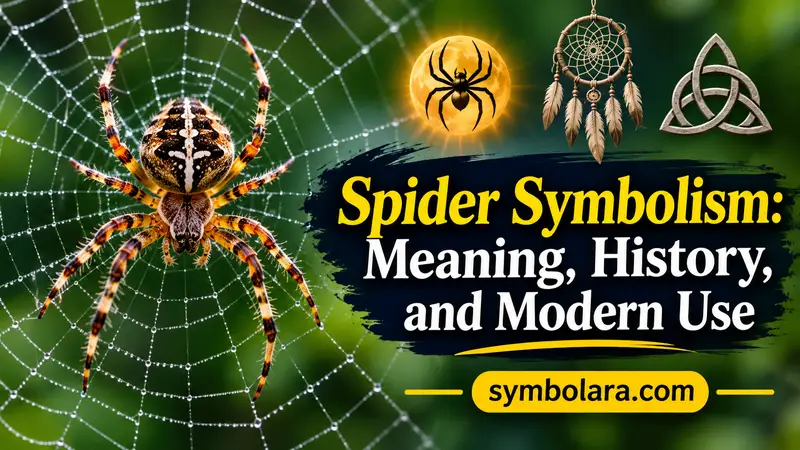
A spider can build a web across a window in a single night, hang quietly from a ceiling, or appear unexpectedly in a garden. Its ability to create intricate webs from its own body makes it different from most creatures people encounter around the home. Even a small spider can attract attention because of the way it moves and the careful patterns it leaves behind.
Spider symbolism often centers on creativity, patience, independence, and the ability to shape one’s own path. At the same time, spiders can represent fear, danger, mystery, or feeling trapped. These different meanings help explain why people use spider images in tattoos, artwork, jewelry, stories, and Halloween decorations.
In American culture, a spider might represent artistic skill in one setting and something frightening in another. The meaning often depends on the design, the situation, and the person’s own experiences.
Quick Answer
Spider symbolism most commonly represents creativity, patience, independence, and the ability to build something through careful effort. These meanings developed partly from the spider’s web-building behavior and partly from cultural stories that connected spiders with weaving, storytelling, and cleverness.
TL;DR
- Spiders commonly represent creativity, patience, and careful planning.
- Their webs are associated with connection, construction, and personal effort.
- Greek mythology connects spiders with the story of Arachne.
- Some Indigenous traditions feature important spider figures in their own stories.
- American Halloween culture often presents spiders as frightening creatures.
- Modern tattoos use spider designs to express individuality and resilience.
What Does a Spider Look Like, and Why Does It Attract Attention?
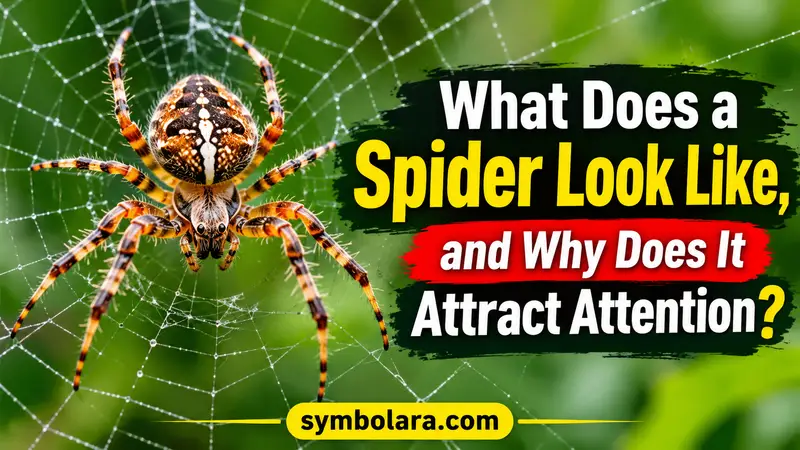
Spiders are eight-legged arachnids with two main body sections. Unlike insects, they do not have antennae or six legs. Most spiders also have several eyes, although the number and arrangement vary by species.
Their webs are often the first feature people notice. Some species create circular webs with carefully arranged lines, while others build tangled webs in corners, bushes, or dark spaces. Not every spider makes a traditional web. Wolf spiders, for example, hunt by moving across the ground rather than waiting for prey in a web.
A few familiar examples help explain why people associate spiders with different qualities:
- Garden spiders: Their large, patterned webs can suggest patience and careful construction.
- Jumping spiders: Their quick movements and ability to judge distances can suggest alertness and curiosity.
- Orb-weaver spiders: Their circular webs often inspire ideas about balance, order, and creativity.
- Black widow spiders: Their appearance and venom have made them common images of danger and caution.
The spider’s unusual body and behavior provide the starting point for many cultural interpretations.
What Does a Spider Symbolize Today?
In modern American culture, spiders have several common symbolic meanings. Their most familiar associations come from their ability to create webs, survive in different environments, and move independently.
Creativity and artistic skill
A spider produces a web through a natural process that creates a complex structure. People often compare this behavior to making art, writing stories, designing buildings, or developing a new idea.
A spider image may therefore represent someone who enjoys creating things or solving problems in original ways.
Patience and persistence
Building a web takes effort. When a web breaks, many spiders repair it or construct another one. This behavior makes the animal a natural image of persistence.
Someone might choose a spider tattoo after completing a difficult personal goal or rebuilding their life after a setback.
Independence and self-reliance
Many spiders live and hunt alone. Their ability to find food, build shelters, and adapt to different surroundings can represent independence.
Connection and relationships
A web contains many connected strands. This makes it a useful visual comparison for family relationships, friendships, communities, and the connections people create throughout life.
Fear and caution
Spiders also trigger fear in many people. Their sudden movements, unusual appearance, and association with venomous species have made them common symbols of danger.
These interpretations can exist together. A spider can represent creativity and fear without either meaning being incorrect.
Where Did Spider Symbolism Begin?
The exact beginning of spider symbolism is difficult to identify because different societies developed their own stories and interpretations.
One of the best-known historical connections comes from ancient Greek mythology. The story of Arachne describes a talented mortal weaver who challenges Athena, the goddess associated with wisdom and crafts, to a weaving contest.
Arachne produces an impressive piece of work, but the story ends with her transformation into a spider. Different versions emphasize different parts of the tale, including pride, artistic skill, punishment, and the relationship between human talent and divine authority.
The story helped connect spiders with weaving, craftsmanship, and artistic ability in Western cultural traditions.
Spiders also appear in traditional stories outside Europe. Some Indigenous communities in North America have spider figures connected with creation, knowledge, and teaching. However, these stories belong to distinct cultural traditions and should not be treated as one universal belief.
Over time, spiders became familiar figures in folklore, literature, decorative art, and popular entertainment.
What Does the Spider Represent in Greek Mythology?
The story of Arachne is one of the clearest examples of a spider receiving symbolic meaning through mythology.
According to the familiar Greek account, Arachne was an exceptionally skilled weaver. She became confident in her abilities and challenged Athena to compete against her.
The two produced beautiful woven works. Arachne’s skill was remarkable, but the contest ended with her transformation into a spider.
The story has several possible interpretations.
First, it connects spiders with artistic talent. The web becomes a symbol of weaving, design, and the ability to create something from individual strands.
Second, the story raises questions about pride and competition. Arachne’s confidence becomes part of the conflict, making the tale a warning about arrogance in some interpretations.
Third, it connects creative ability with consequences. The story does not simply celebrate artistic skill; it also examines how talent, authority, and personal behavior can come into conflict.
This myth remains relevant in Western art and literature because the spider offers a visual connection between natural web-building and human craftsmanship.
What Does a Spider Mean in Native American Traditions?
Spider figures appear in several Indigenous traditions across North America, but their meanings differ between communities.
One well-known example is Spider Woman, a figure found in certain Hopi and other Southwestern Indigenous traditions. She is associated with creation, teaching, and the transmission of knowledge in particular stories.
In some Hopi accounts, Spider Woman helps guide the emergence and development of human life. Other versions connect her with practical knowledge, weaving, and guidance.
The Navajo tradition also includes Spider Woman, known as Na’ashjé’ii Asdzáá. She is associated with weaving and is connected to teachings about the craft in Diné tradition.
These cultural connections make the spider more than a frightening creature. It can represent skill, instruction, creativity, and the passing of knowledge between generations.
It is important not to combine these stories into one general Native American interpretation. Hopi and Diné traditions have their own histories, teachings, and cultural meanings.
Why Is a Spider Connected With Creativity and Weaving?
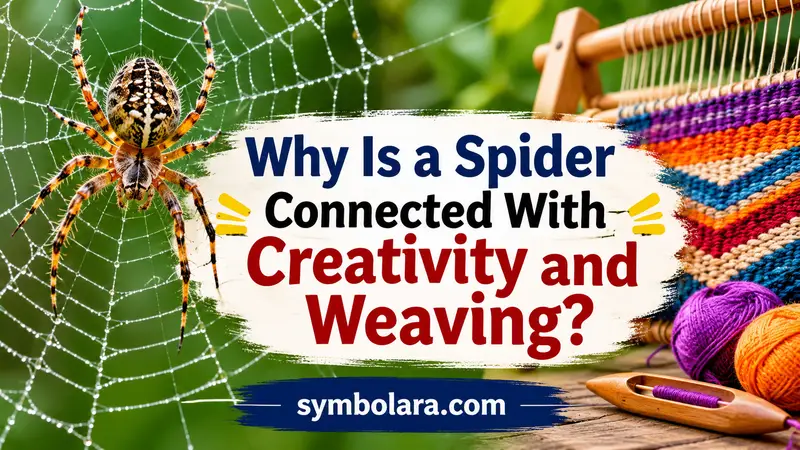
The connection between spiders and creativity comes naturally from their web-building behavior.
A spider does not collect ready-made materials and assemble them like a person building a chair. It produces silk and uses it to create structures that serve different purposes, including catching prey, protecting eggs, and moving between surfaces.
This behavior has inspired comparisons with human creative work.
A writer connects individual words to form a story. An artist combines lines, shapes, and colors to produce an image. A person building a business brings together ideas, skills, and resources.
The spider’s web provides an easy way to picture this process.
In American culture, this association appears in several settings:
- Art: Spiderweb patterns appear in illustrations, paintings, and decorative designs.
- Crafts: Web-inspired patterns are used in embroidery, knitting, and handmade decorations.
- Literature: Charlotte, the spider in Charlotte’s Web, uses words in her web to communicate messages.
- Personal expression: Spider tattoos can represent artistic identity or the desire to create something independently.
The connection is especially clear in E. B. White’s children’s novel Charlotte’s Web, published in 1952. Charlotte’s ability to weave words into her web makes her a symbol of intelligence, communication, and friendship.
What Does a Spider Web Symbolize?
A spider and its web are related symbols, but they do not always communicate the same idea.
The spider often represents the individual creator, while the web can represent what that individual builds.
| Context | Meaning in USA | Common Associations | Notes |
| Spiderweb tattoo | Personal history and identity | Experience, patience, individuality | Meaning can depend on placement and design |
| Decorative web | Creativity and connection | Art, handmade work, Halloween | Often used as a seasonal decoration |
| Web in literature | Communication and relationships | Friendship, storytelling, intelligence | Charlotte’s Web is a familiar example |
| Broken web | Change and rebuilding | Setbacks, recovery, persistence | Often used as a personal metaphor |
| Web across a doorway | Neglect or abandonment | Empty spaces, old buildings, forgotten places | A common visual in horror settings |
A complete web can suggest structure, planning, and connection. A damaged web may suggest disruption or the need to rebuild.
However, a web is not always positive. The same structure that catches insects can also represent a trap.
This contrast gives the web several possible meanings in art and personal expression.
Why Do Spiders Represent Fear and Danger?
Spiders are among the creatures that commonly trigger fear in people. This reaction is often connected to their unusual appearance, unpredictable movement, and association with venom.
In the United States, black widows and brown recluse spiders are especially familiar examples in discussions about dangerous spiders.
The black widow is recognizable by its dark body and red marking, which is often shaped like an hourglass. Its appearance has made it a frequent symbol in horror artwork, clothing designs, and fictional stories.
The brown recluse is another medically important species, although it is often confused with harmless spiders.
These associations have helped shape the spider’s darker cultural meaning.
In horror movies and Halloween decorations, spiders often appear alongside cobwebs, abandoned houses, skeletons, and dark spaces. Their presence helps create an uncomfortable atmosphere.
Fear also has a psychological side. A person who has experienced a frightening encounter with a spider may associate the animal with danger even when the species involved is harmless.
For this reason, spider symbolism is not always a reflection of cultural history. Sometimes it simply reflects an individual’s emotional response.
What Does a Spider Mean in American Culture?
American culture presents spiders in both positive and negative ways. Their meaning changes depending on the setting.
Halloween traditions
Spiders are common Halloween decorations. Plastic spiders, hanging webs, and large artificial arachnids appear in yards, shops, haunted attractions, and party decorations.
In this setting, spiders represent fright, suspense, and the appearance of abandoned places.
Children’s literature
Charlotte from Charlotte’s Web presents a very different image. Rather than frightening people, she uses her web to help a friend.
The story has introduced generations of American readers to a spider associated with loyalty, intelligence, and kindness.
Fashion and personal style
Spider designs appear on shirts, jackets, necklaces, rings, and accessories. Some people choose them because they enjoy gothic or alternative fashion, while others appreciate the animal’s appearance.
Sports and entertainment
Spider imagery also appears in comic books, superhero costumes, video games, and fantasy stories. The spider can suggest agility, danger, intelligence, or unusual abilities.
Home decoration
Spiderweb patterns appear in seasonal decorations and handmade crafts. During October, they are especially common in American homes and businesses.
These examples show why there is no single American interpretation. A spider on a Halloween window decoration communicates something different from a spider printed on a piece of jewelry.
What Does a Spider Tattoo Symbolize?
Spider tattoos can communicate several ideas, depending on the design and the person’s reason for choosing one.
Some people select a spider because they admire its ability to survive and adapt. Others prefer the connection with creativity, independence, or personal transformation.
Common design choices include:
Spiderweb tattoos
A web tattoo can represent personal experiences, relationships, or the idea of building a life through individual decisions.
Black widow tattoos
A black widow design may communicate confidence, caution, independence, or an interest in gothic imagery.
Realistic spider tattoos
Realistic designs often focus on the animal’s appearance, including its legs, body markings, and detailed textures.
Small spider tattoos
A small spider behind the ear, on the wrist, or near the ankle may be chosen for its appearance rather than a specific cultural meaning.
Spider and web combinations
These designs can represent the relationship between a person and the life they have built.
Spiderweb tattoos also have associations with prison and gang imagery in some settings, including certain historical tattoo traditions. Those associations vary by region, design, and time period. A web tattoo does not automatically indicate a criminal background or a particular personal history.
Anyone considering this design should understand that people may interpret it differently depending on the surrounding imagery and placement.
What Does Seeing a Spider in Your House Mean?
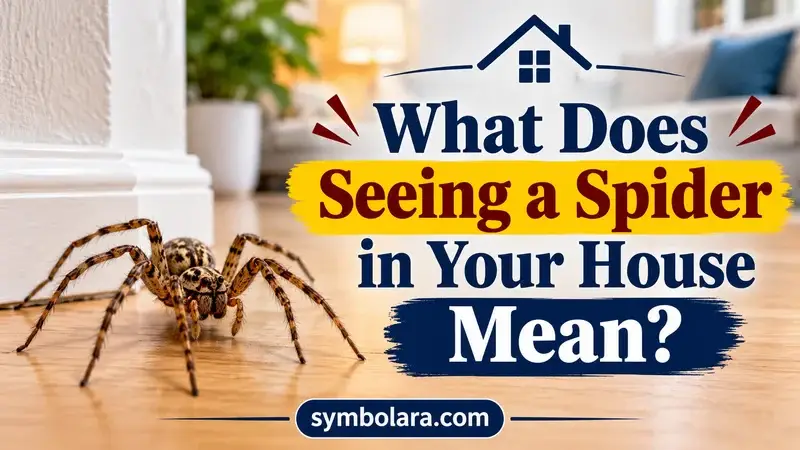
Finding a spider inside your home can produce different reactions. Some people see it as an ordinary part of nature, while others connect the encounter with personal or cultural symbolism.
From a practical standpoint, spiders enter homes while looking for food, shelter, or suitable conditions. They may appear near windows, ceilings, basements, garages, and other quiet spaces.
In personal symbolism, a spider inside the home can suggest several ideas:
- Creativity: Its web may remind someone to work on a personal project.
- Patience: The encounter may encourage a person to slow down and focus.
- Awareness: Seeing a spider can prompt someone to pay attention to their surroundings.
- Fear: For someone uncomfortable with spiders, the experience may bring up anxiety or concern.
Some folk beliefs attach good or bad meanings to finding spiders indoors. However, there is no scientific evidence that a spider entering a house predicts money, visitors, bad news, or future events.
The most reliable explanation is usually an ordinary one: the spider found a place where it could live.
Why Do Spiders Appear in Dreams and Stories?
Spiders are common figures in dreams, fiction, and storytelling because they can represent several contrasting ideas.
In a dream, a spider might remind someone of a situation that feels uncomfortable, a task that requires patience, or a relationship that seems complicated.
A spiderweb may also bring up thoughts about feeling connected to other people or becoming caught in an unwanted situation.
However, dream meanings are personal. A person who enjoys studying spiders may have a very different dream experience from someone who has a strong fear of them.
In literature, spiders are often used to create suspense or represent cleverness.
For example, Charlotte’s web in Charlotte’s Web becomes a communication tool. In contrast, the giant spider Shelob in J. R. R. Tolkien’s The Lord of the Rings represents a threatening presence.
Both characters use spider imagery, but their roles are very different.
This contrast shows how storytelling can change the meaning of an animal without changing its recognizable physical features.
How Has Spider Symbolism Changed Over Time?
The meaning of spiders has developed through mythology, traditional storytelling, literature, entertainment, and everyday experience.
In ancient Greek mythology, the Arachne story connected spiders with weaving, skill, and the consequences of pride.
In various Indigenous traditions, spider figures became associated with creation, instruction, and weaving. These meanings developed within their own cultural settings rather than from one shared origin.
During later periods in Europe and North America, spiders became familiar figures in folklore and household beliefs. Their presence in dark corners and old buildings helped connect them with fear and neglect.
The 19th and 20th centuries brought new forms of spider imagery through printed stories, illustrations, and popular entertainment.
The publication of Charlotte’s Web in 1952 gave American audiences a widely recognized positive spider character. The book helped establish an association with friendship and intelligence.
By the late 20th century and into the 2000s, spiders were also common in superhero stories, horror movies, video games, alternative fashion, and tattoo culture.
Today, their meanings can be highly personal. A spider might represent an artistic personality, a favorite fictional character, a childhood fear, or a connection to a particular cultural story.
Common Misunderstandings
Several misunderstandings can make spider symbolism seem more complicated than it needs to be.
Every spider represents something negative.
This is incorrect. Spiders appear as helpful, clever, creative, and frightening figures in different cultural settings.
A spiderweb always represents a trap.
A web can represent a trap, but it can also suggest artistic skill, structure, communication, or connection.
All Indigenous traditions share the same Spider Woman story.
Different communities have distinct traditions. Their stories should be understood in their own cultural settings rather than combined into one general belief.
A spider entering your home predicts an event.
There is no reliable scientific evidence that ordinary spider encounters predict future events.
A spider tattoo has one fixed meaning.
Tattoo meanings depend on the individual, design, placement, and cultural context. A spiderweb tattoo does not automatically communicate a specific personal history.
Understanding these differences helps separate documented cultural traditions from personal interpretations and popular myths.
FAQs
Is a spider a positive or negative symbol?
A spider can have either positive or negative associations. It may represent creativity, patience, and independence, but it can also suggest fear, danger, or feeling trapped. The surrounding design and cultural context help determine its meaning.
Does a spider have a biblical meaning?
Spiders appear in the Bible, including a reference to a spider’s web in Job 8:14 and a mention of a spider in Proverbs 30:28 in some English translations. These passages use the creature in different comparisons, so their meaning depends on the passage and translation rather than one universal religious interpretation.
What does a black spider symbolize?
A black spider may represent mystery, caution, strength, or fear in modern artwork. Its meaning can also depend on the species shown, since a black widow has different cultural associations from an ordinary house spider.
What does a white spider symbolize?
In personal and artistic interpretations, a white spider may represent clarity, creativity, change, or something unusual. These are modern symbolic associations, not meanings shared by every culture or supported by a universal tradition.
What does a spiderweb symbolize in a relationship?
A spiderweb can represent the connections between two people, including shared experiences and emotional ties. A damaged web may be used as a metaphor for a relationship that needs attention, although this is a personal interpretation rather than an established rule.
Why are spiders associated with Halloween?
Spiders became familiar Halloween images because their webs and sudden movements help create the appearance of haunted or abandoned places. Their use alongside bats, skeletons, and artificial cobwebs became part of modern American Halloween decoration.
Does a spider symbolize patience?
Yes, patience is one of its common modern interpretations. The time and effort involved in building and repairing webs provide a natural comparison with long-term projects and goals that require repeated work.
Conclusion
Spider symbolism brings together several ideas, including creativity, patience, independence, connection, and fear. Its meanings come from a combination of the animal’s behavior, historical stories, cultural traditions, and modern entertainment.
In the United States, spiders can represent artistic ability through the story of Arachne, friendship through Charlotte’s Web, or fear through Halloween decorations and horror films. Their meaning changes with the situation and the person interpreting the image.
A spider’s web is perhaps its most recognizable feature. Each strand contributes to a larger structure, reminding us that even small actions can help build something that lasts.