
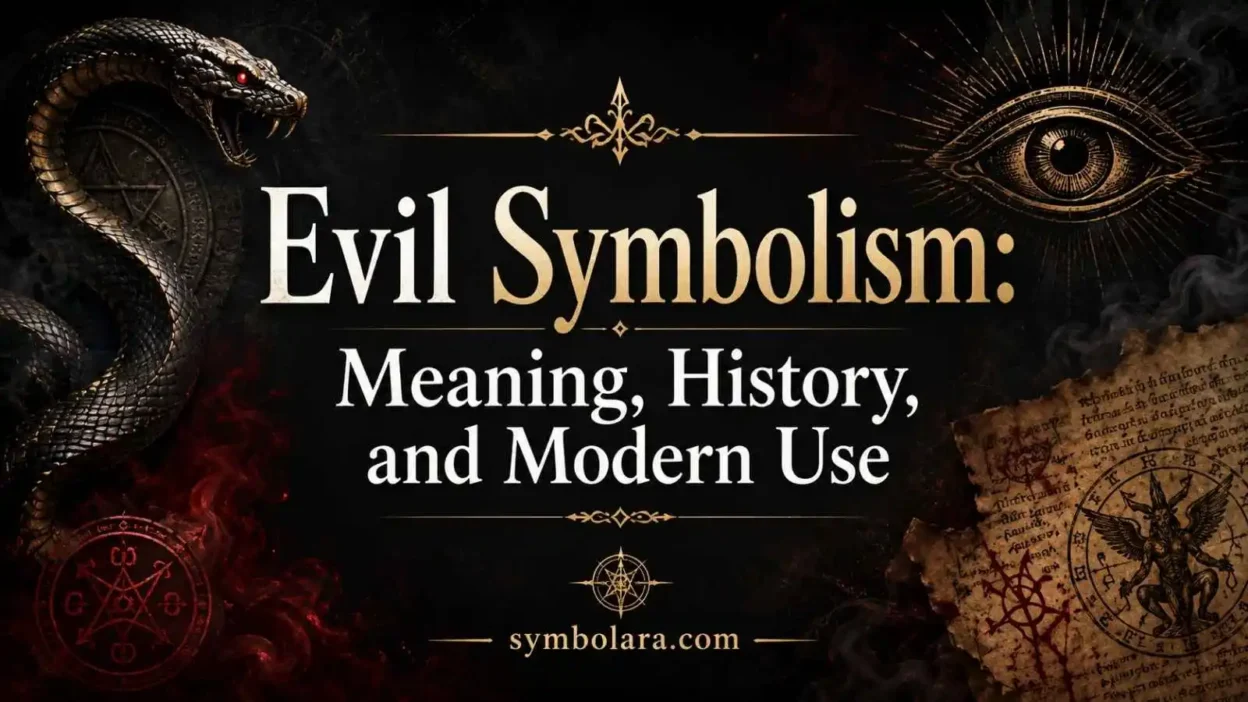
Evil Symbolism refers to the images, colors, creatures, gestures, and objects people use to represent harm, danger, corruption, cruelty, temptation, or moral disorder. In American culture, these symbols appear everywhere from horror movies and Halloween decorations to tattoos, protest imagery, religious art, video games, fashion, and warning signs.
People care about these symbols because they do more than decorate a scene. They tell us what a culture fears, condemns, jokes about, resists, or tries to control. A skull on a poison bottle, a devil costume at Halloween, and a swastika painted on a wall do not carry the same kind of meaning, even though all may be described as “dark” or threatening.
The meaning of evil-related symbols depends heavily on context. Some images became frightening through religion, some through folklore, some through real historical violence, and some through modern entertainment. Understanding the difference helps readers avoid careless assumptions.
Quick Answer
Evil Symbolism commonly symbolizes danger, moral corruption, harm, fear, and destructive intent in modern American culture, especially in horror, religion, warning imagery, and extremist contexts. Historically, symbols associated with evil often came from religious stories, death imagery, folk beliefs, disease, night, predatory animals, and real acts of violence.
TL;DR
- Evil symbols often mark danger, harm, or moral corruption.
- Religious traditions shaped many Western evil images.
- Halloween softened some frightening symbols into entertainment.
- Context determines whether a symbol is playful or threatening.
- Some symbols were distorted by hate groups.
- Modern style often uses dark imagery for rebellion.
What Evil Commonly Means in the United States
In the United States, evil is usually understood as intentional harm, cruelty, corruption, deception, or a force that violates basic moral boundaries. It can be religious, as in Satanic or demonic imagery; social, as in symbols of hate; psychological, as in the “dark side” of human behavior; or fictional, as in villains and monsters.
Americans often use evil imagery in two very different ways. In serious settings, it may point to hatred, violence, trauma, or spiritual danger. In playful settings, it may simply create a spooky mood, as with Halloween skeletons, haunted-house props, vampire costumes, or cartoon devils.
This split is important. A plastic skull in October usually means seasonal fun. A skull used by a violent group, a threatening message, or a political extremist movement means something much more serious. The same image can shift from comedy to warning depending on location, audience, and intent.
What Evil Symbols Usually Look Like
Symbols of evil often rely on visual cues that humans already associate with danger or discomfort. Common features include darkness, sharp angles, glaring eyes, fangs, horns, flames, blood-like red, decay, masks, bones, snakes, claws, and distorted human faces.
These features work because they suggest threat. Sharp teeth imply a predator. Darkness suggests hidden danger. Fire suggests destruction or punishment. Bones remind people of death. Masks imply deception or concealed identity.
In American media, evil is often made visible through contrast: light versus darkness, clean versus decayed, human versus monstrous, sacred versus profane. A haunted house looks abandoned. A villain may wear black. A demon may combine animal and human features. These patterns are not universal, but they are common enough that audiences recognize them quickly.
A Quick Guide to Common Evil-Associated Symbols
| Context | Meaning in the USA | Common Associations | Notes |
| Skull | Death, danger, mortality | Poison, pirates, horror, rebellion | Can be serious or decorative |
| Serpent | Temptation, threat, hidden danger | Eden, deception, venom, transformation | Also positive in some traditions |
| Horned figure | Devil, monster, uncontrolled appetite | Demons, goats, horror art | Often shaped by Christian imagery |
| Black color | Mourning, fear, secrecy, authority | Funerals, villains, formalwear, goth style | Not negative in every context |
| Inverted pentagram | Satanic or anti-Christian meaning to many Americans | Occultism, metal music, horror | Pentagrams also have non-evil meanings |
| Swastika in Nazi form | Hate, antisemitism, genocide | Nazism, white supremacy, intimidation | Distinct from sacred uses in Asian religions |
Religious Roots of Evil Imagery
Much Western evil imagery was shaped by Christianity, Judaism, Islam, and older Mediterranean traditions. In Christian art and storytelling, evil is often pictured as rebellion against God, temptation, pride, deception, or demonic influence. This helped make devils, serpents, horns, fire, and darkness familiar signs of spiritual danger.
The serpent in the Garden of Eden became one of the most influential images of temptation in the Western imagination. Over time, the snake was often read as a figure of deceit, even though snake symbolism in world cultures is much broader.
Demonic imagery also developed through layers of art, preaching, theater, and folklore. Medieval and early modern artists often gave demons animal parts—horns, claws, tails, wings, or hooves—to show that they stood outside human moral order. These images still influence Halloween costumes, horror films, album covers, and fantasy games.
Ancient and Folk Origins Behind “Dark” Symbols
Not every evil-associated symbol began as evil. Many began as signs of death, fertility, protection, mystery, or seasonal change. Later cultures reinterpreted them.
Skulls, for example, naturally became symbols of mortality because they are the most recognizable part of the human skeleton. A skull can warn of poison, mourn the dead, mock fear, or express rebellion. Its meaning changes depending on whether it appears in a cemetery, tattoo shop, pirate flag, medical label, or Halloween display.
Black cats show a similar shift. In parts of medieval Europe, dark animals were linked to night, witchcraft, and the Devil. Those fears later traveled into folklore and American Halloween imagery. Today, many Americans see black cats as spooky, cute, unlucky, elegant, or simply ordinary pets, depending on personal belief.
Bats, owls, ravens, spiders, and wolves also became frightening partly because they are active at night, live near places people find unsettling, or appear in stories about death and wilderness.
Why Darkness Became Linked With Evil
Darkness is one of the most basic sources of symbolic fear. Before electric lighting, night limited human vision and made travel, work, and protection more difficult. Predators, crime, storms, and uncertainty all felt more threatening when people could not see clearly.
This practical fear became symbolic. Darkness came to suggest secrecy, ignorance, danger, hidden motives, or moral blindness. In many American stories, the villain “works in the shadows,” a haunted place is dimly lit, and a frightening road disappears into the dark.
At the same time, darkness is not automatically evil. Black can also mean elegance, seriousness, grief, privacy, luxury, authority, or sophistication. Judges’ robes, formal suits, funeral clothing, and high-end design all use black without suggesting wickedness. The negative meaning appears when black is paired with threat, secrecy, decay, or harm.
The Role of the Devil and Demon Figures
In American culture, the devil is one of the most recognizable symbols of evil, especially in Christian-influenced settings. The figure often represents temptation, pride, rebellion, corruption, punishment, or the deliberate choice to harm others.
Popular images of the devil usually include red skin, horns, a pointed tail, a pitchfork, flames, and a sly expression. These details are more cultural than biblical. They come from centuries of art, theater, folklore, satire, and modern entertainment.
In everyday American life, devil imagery can be serious or joking. A church sermon may treat the devil as a spiritual reality. A Halloween costume may treat the devil as playful mischief. A sports mascot or hot sauce label may use horns and flames to suggest intensity rather than evil. The meaning depends on tone.
Serpents, Poison, and Temptation
Snakes are among the most complicated symbols connected with evil. In many American Christian contexts, the serpent suggests temptation and deception because of the Eden story. In warning imagery, snakes can also suggest venom, hidden danger, and sudden attack.
Yet snakes are not only negative. In other traditions, they can symbolize healing, renewal, wisdom, fertility, protection, or cosmic cycles. The shedding of skin makes them natural symbols of transformation. The medical staff with a serpent shows how strongly snakes can also represent healing.
In modern American symbolism, the snake usually becomes “evil” when paired with deception, poison, betrayal, or demonic imagery. In tattoos or fashion, however, it may signal resilience, danger, independence, sensuality, or rebirth rather than wickedness.
Skulls, Bones, and Death Imagery
Skulls are often mistaken for symbols of evil when they are more accurately symbols of death. Death can be frightening, but it is not the same thing as moral evil. A skull on a gravestone, pirate flag, tattoo, poison label, or biker jacket carries different meanings.
In warning signs, skulls communicate danger quickly. On poison labels, they tell people that a substance can kill. In pirate symbolism, the skull and crossbones historically signaled threat, violence, and lawlessness. In gothic fashion, skulls often express comfort with mortality or rejection of polite social norms.
For many Americans, skulls also became seasonal through Halloween. Plastic skeletons in front yards, skull candy bowls, and skeleton costumes are usually about controlled fear. They let people play with mortality without treating it as a real emergency.
Witches, Magic, and the Fear of Hidden Power
Witches became associated with evil in parts of European and American history because of religious fear, social suspicion, and accusations of hidden harm. In early colonial New England, witchcraft accusations reflected anxieties about sin, illness, gender, authority, and community conflict.
Modern American culture has changed the witch dramatically. The witch can still appear as a villain in horror stories, but she can also symbolize independence, feminine strength, outsider identity, herbal knowledge, or spiritual self-definition. This is why witch imagery may feel threatening in one context and empowering in another.
The broom, pointed hat, cauldron, black cat, and moon are now common Halloween icons. Their older associations with fear have been softened by cartoons, costumes, fantasy fiction, and seasonal décor.
Halloween and the Playful Side of Evil
Halloween is the main American holiday where frightening symbols become socially acceptable fun. Ghosts, skeletons, witches, demons, bats, spiders, zombies, vampires, and haunted houses move from the realm of fear into parties, candy, costumes, and neighborhood decoration.
This matters because Halloween changes the emotional meaning of evil imagery. A demon mask in a horror film may feel threatening. The same mask on a child trick-or-treating may feel playful. A fake tombstone on a lawn is not usually a statement about death; it is a seasonal joke.
Halloween also allows Americans to rehearse fear in a safe setting. People decorate with symbols of death, monsters, and the supernatural because the holiday frames them as temporary, theatrical, and communal.
Evil Symbols in Horror, Fantasy, and Pop Culture
Modern entertainment has done more than almost anything else to shape American ideas about evil symbols. Horror movies, fantasy novels, comic books, video games, heavy metal, true-crime media, and streaming shows all use visual shorthand to signal villains, curses, monsters, and dangerous places.
Common cues include red lighting, distorted religious symbols, abandoned buildings, dolls, masks, ravens, mirrors, blood, fog, and unnatural silence. These images do not need much explanation because audiences have learned their meaning through repetition.
Pop culture also makes evil stylish. Villains often have sharper costumes, darker color palettes, and more dramatic music than heroes. This creates a tension: evil is condemned in the story but visually attractive on screen. That tension explains why many people enjoy villain aesthetics without endorsing harmful behavior.
Evil Symbols in Art and Literature: How Creators Use Darkness
Artists and writers have used evil symbolism for centuries to explore human fears, moral choices, and social problems. Dark symbols help creators communicate ideas that are difficult to explain directly.
In literature, evil characters often carry symbolic objects or appearances that reveal their role. A serpent may represent deception. A shadowy figure may represent corruption or hidden danger. A ruined landscape may suggest moral decline or a world affected by suffering.
Visual artists also use dark imagery to create emotional reactions. Skulls, broken objects, storms, ravens, mirrors, and abandoned places can represent death, uncertainty, memory, or human struggles. These symbols do not always celebrate evil; often, they help audiences examine difficult parts of life.
Modern films and video games continue this tradition. Villains frequently use dark colors, unusual designs, and threatening symbols because audiences quickly understand these visual signals. Through storytelling, evil symbols become tools for exploring choices, consequences, and the difference between good and harmful actions.
Tattoos, Jewelry, and Personal Style
Evil-associated symbols in tattoos and jewelry often have meanings that differ from religious or historical readings. A skull tattoo may mean survival after grief. A snake may mean transformation. A demon face may express inner struggle, anger, humor, or a love of horror art. A black wardrobe may signal gothic style, minimalism, mourning, or personal confidence.
In American tattoo culture, darker imagery is often about control over fear. People choose images of death, monsters, flames, or demons to show that they have faced something difficult and are not pretending life is harmless.
Still, some symbols require caution. Nazi imagery, racist codes, violent gang symbols, and hate-group marks are not neutral style choices. Their public meaning is shaped by real harm, not personal interpretation alone.
Cross-Cultural Meanings and Why Context Matters
A major mistake in reading evil symbols is assuming that one culture’s meaning is universal. The swastika is the clearest example. In the United States and Europe, the Nazi form is overwhelmingly associated with antisemitism, genocide, white supremacy, and intimidation. But in Hindu, Buddhist, Jain, and some other traditions, related forms of the symbol have long represented well-being, auspiciousness, prosperity, or sacred order.
The pentagram is another example. Many Americans associate it with occultism or Satanism, especially when inverted. But the five-pointed star has also been used for protection, geometry, religious meaning, human symbolism, and modern Pagan identity.
Snakes, ravens, owls, black clothing, masks, and bones all carry different meanings across cultures. A symbol may be frightening in one setting, sacred in another, and fashionable in a third. Responsible interpretation starts by asking who is using the symbol, where it appears, and what tradition it belongs to.
Controversies, Hate Symbols, and Modern Misuse
Some symbols are controversial because they have been used to threaten, exclude, or glorify violence. In the United States, the Nazi swastika, noose, burning cross, certain white supremacist numbers, and extremist adaptations of older runes are often treated as signs of hate or intimidation.
This kind of symbolism is different from horror imagery. A vampire costume is fictional. A hate symbol points to real histories of violence and discrimination. Its harm comes not only from what it depicts, but from how groups have used it to target people.
Misuse also happens when extremist groups borrow older cultural or religious symbols. A rune, hammer, cross, or ancient motif may have a legitimate religious or historical life outside hate movements. The challenge is to recognize extremist use without wrongly condemning every person or community connected to the older symbol.
Most Misunderstood Evil Symbols and Their True Meanings
Many symbols labeled as “evil” have more complicated histories. Some became associated with darkness because of specific historical events, while others gained frightening meanings through movies, folklore, or misunderstandings.
The snake is one example. In some Western religious traditions, it represents temptation, but other cultures view snakes as symbols of healing, wisdom, renewal, or protection.
The owl is another misunderstood symbol. Horror stories sometimes connect owls with darkness because of their nighttime behavior and mysterious appearance. However, many cultures associate owls with wisdom, knowledge, and observation.
Black clothing also shows how meanings change. A black outfit may represent mourning, elegance, professionalism, rebellion, or gothic style. It does not automatically represent negativity.
Studying the history behind symbols helps people separate genuine harmful meanings from simple cultural associations or fictional imagery.
Emotional and Psychological Meaning
Evil symbols work because they create quick emotional reactions. They can signal fear, disgust, anger, curiosity, rebellion, grief, danger, or moral alarm. A skull reminds people of death. A serpent suggests caution. A demonic face can trigger fear of loss of control. A masked figure may raise suspicion because the person behind it is unknown.
Psychologically, these symbols help people give shape to invisible threats. Cruelty, temptation, betrayal, illness, corruption, and violence are abstract. A culture turns them into images so people can talk about them, warn against them, mock them, or confront them.
This is why evil imagery can feel both unsettling and meaningful. It gives people a way to express and externalize fears that may be difficult to describe. Within stories, a monster or dark force can become something that characters confront and overcome. Warning signs use similar imagery to identify potential danger, while art can transform inner struggles and conflicts into visible forms.
Evil Symbolism in Dreams: What Dark Symbols May Represent
Dreams often use symbols to represent emotions, memories, fears, and personal experiences rather than showing a literal message. When people see evil-related imagery in dreams, the symbol may reflect stress, conflict, uncertainty, guilt, fear, or a feeling that something in life feels threatening.
A demon in a dream may represent an internal struggle or a difficult situation. A snake may reflect concerns about trust, change, or hidden problems. A dark figure may symbolize something unknown or unresolved.
The meaning depends on the dreamer’s personal experience. A symbol that feels frightening to one person may represent strength, transformation, or self-reflection to another. Dream interpretation works best when people consider their emotions, recent events, and personal associations with the symbol.
In modern American culture, many dream symbols also come from movies, religion, social media, and entertainment. Because of this, a frightening image in a dream does not automatically mean something negative will happen. It often reflects how the mind processes emotions and experiences.
Evil Symbolism in Dreams vs Real-Life Meaning
The meaning of an evil symbol in a dream can differ greatly from its meaning in everyday life. A symbol used in a dream often reflects personal emotions, while the same symbol in public culture may carry historical, religious, or social meanings.
For example, seeing a skull in a dream may represent change, fear, or thoughts about mortality. A skull on a warning label communicates danger. A skull tattoo may represent survival, personal identity, or acceptance of life’s challenges.
Similarly, a snake in a dream may relate to personal concerns, transformation, or trust issues. In religious or cultural settings, the snake may represent temptation, wisdom, healing, or danger.
Understanding this difference prevents people from assuming that every dark image has one fixed meaning. Symbols gain meaning from the situation, the person using them, and the culture surrounding them.
How Evil Symbolism Has Changed Over Time
The meaning of evil-related imagery has become less fixed over time. In earlier religious settings, a devil, witch, or demonic animal might have carried a more direct warning about sin or spiritual danger. In modern American culture, the same images may appear on coffee mugs, Halloween pajamas, band shirts, tattoos, memes, and home décor.
This does not mean the serious meanings disappeared. It means Americans now move between multiple meanings quickly. A skull can be a poison warning, a fashion logo, a memorial tattoo, or a Halloween prop. A horned figure can be a demon, a fantasy character, a mascot, or a joke.
Digital culture has accelerated this shift. Memes can turn frightening symbols into humor. Online extremist groups can hide hate symbols inside numbers, jokes, or altered graphics. Social media also spreads visual meanings faster than older traditions did, which makes context more important than ever.
How to Interpret an Evil Symbol Responsibly
The safest way to understand a symbol is to read it in context. Ask where it appears, who is using it, what tradition it belongs to, and whether it points to fiction, faith, fashion, warning, identity, or intimidation.
The meaning of a symbol often depends on the context in which it appears. In a horror movie, it is usually a storytelling device designed to create emotion or atmosphere. When displayed on a temple, the same symbol may carry religious significance, while a symbol on a gravestone may represent remembrance or memorial meaning. A symbol spray-painted on a synagogue, school, or public building can take on a threatening or hateful message. Meanwhile, a tattoo symbol is often a form of personal expression unless it is clearly connected to a hate group or violent ideology.
Good interpretation avoids two mistakes: treating every dark image as dangerous, and treating every symbol as harmless because “meaning is personal.” Symbols live between personal intent and public history. Both matter.
FAQs
What does evil symbolize in modern American culture?
Evil usually symbolizes intentional harm, moral corruption, cruelty, deception, or danger. In entertainment, it may also represent fear, rebellion, mystery, or the villain’s role in a story.
Are skulls always symbols of evil?
No. Skulls more often symbolize death, mortality, danger, or remembrance. They become evil-associated only when paired with violence, threat, poison, intimidation, or sinister storytelling.
What does an evil symbol mean as a tattoo?
An evil-associated tattoo can mean many things, including survival, rebellion, grief, anger, protection, or love of horror art. The meaning depends on the specific symbol, design style, and whether it is connected to a harmful ideology.
Is the pentagram an evil symbol?
Not always. The pentagram has been used for protection, spirituality, geometry, and religious identity. In modern American culture, the inverted pentagram is more likely to be read as Satanic or occult, but even then context matters.
Why are black and red often used for evil imagery?
Black often suggests darkness, secrecy, death, or fear, while red can suggest blood, fire, anger, danger, or intensity. Together, they create a visual language that audiences quickly recognize in horror, warning signs, and villain design.
Are Halloween symbols actually evil?
Most Halloween symbols are not treated as truly evil in everyday American life. They are usually playful versions of older fears about death, spirits, witches, darkness, animals, and the unknown.
Can a symbol be sacred in one culture and evil in another?
Yes. Symbols can carry very different meanings across cultures and historical periods. The swastika is the strongest example, because sacred meanings in several Asian religions differ sharply from the Nazi symbol’s meaning in the United States and Europe.
Can the same symbol represent good and evil?
Yes. Many symbols have multiple meanings across cultures. A snake, skull, or dark color may represent danger in one context and healing, transformation, remembrance, or strength in another.
Conclusion
Symbols connected with evil usually point to danger, harm, fear, corruption, temptation, or moral disorder. But their meanings are not all the same. A skull, serpent, devil figure, black cat, pentagram, and Nazi emblem each carries a different history and emotional weight.
Evil Symbolism is best understood as a visual language shaped by religion, folklore, death, psychology, entertainment, and real historical violence. Some symbols warn, some frighten, some entertain, and some wound because of how they have been used.
The most responsible approach is to read each symbol carefully. Its meaning lives not only in its shape, but in its history, setting, and human purpose.
[…] Modern family symbolism focuses less on one traditional meaning and more on the relationships behind the image. The most meaningful symbols are usually connected to personal memories, family stories, and shared experiences. […]