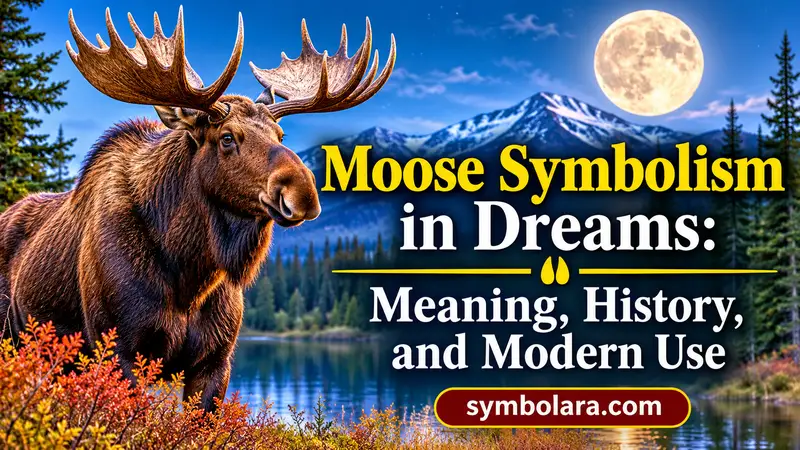
A moose standing quietly in a forest, walking across a road, or approaching someone in a dream can leave a strong impression after waking. Its enormous body, wide antlers, and calm but alert behavior make it an animal that is hard to forget.
People often look up moose symbolism in dreams because they want to understand whether the animal represents strength, independence, a personal challenge, or something happening in their relationships. The meaning can change depending on what the moose does, how the dreamer feels, and what is happening in their waking life.
In the United States, moose are closely associated with northern forests, wilderness, wildlife protection, and the outdoors. They also appear in regional art, souvenirs, outdoor clothing, and state tourism imagery. These real-world associations provide useful background when considering why a moose might appear in a dream.
Quick Answer
Moose symbolism in dreams most commonly relates to personal strength, independence, patience, self-confidence, and the need to respect personal boundaries. These interpretations draw partly from the moose’s real behavior and its long-standing place in North American wildlife and Indigenous cultural traditions, although no single dream meaning applies to everyone.
TL;DR
- Moose commonly represent strength, independence, and personal confidence.
- Large antlers can suggest authority, maturity, or responsibility.
- A peaceful moose may reflect patience and emotional stability.
- An aggressive moose can represent pressure or boundary conflicts.
- North American wildlife traditions influence modern interpretations.
- Dream details and personal experiences matter more than fixed definitions.
What Does a Moose Look Like, and Why Does Its Appearance Matter?
A moose is the largest living member of the deer family. It has long legs, a heavy body, a large head, and a distinctive nose. Adult males, called bulls, usually grow broad, flat antlers that can stretch several feet across.
Moose live mainly in northern parts of North America, Europe, and Asia. In the United States, they are especially associated with Alaska, Maine, Minnesota, Michigan, Wyoming, Montana, and parts of New England and the Rocky Mountain region.
Their physical features help explain many modern symbolic interpretations:
- Large body: Often associated with physical strength, endurance, and the ability to handle difficult situations.
- Wide antlers: Can suggest authority, confidence, maturity, and personal responsibility.
- Long legs: May bring to mind steady movement through difficult terrain.
- Large nose: Reflects the animal’s ability to feed on aquatic plants and vegetation.
- Quiet behavior: Can suggest patience, awareness, and comfort with solitude.
A moose is not simply a gentle forest animal. It can become aggressive when threatened, particularly during mating season or when protecting a calf. This combination of calmness and physical force makes it an interesting animal to encounter in a dream.
What Does a Moose Represent in a Dream?
The most common modern interpretation connects the moose with strength that does not need constant attention or approval.
Unlike animals that depend on group behavior, adult moose often live alone outside mating periods and the relationship between a mother and her calf. Their independent lifestyle can make them a natural image of self-reliance.
Several interpretations commonly appear in modern dream discussions.
Personal strength: A moose may represent the ability to face a difficult situation without giving up. This interpretation is especially relevant when the animal appears calm or confident.
Independence: Seeing a lone moose may reflect a desire to make decisions without outside pressure. It can also relate to feeling comfortable spending time alone.
Patience: A moose moving slowly through a forest may bring attention to the value of taking time before making an important decision.
Confidence: Large antlers and an imposing body can represent a growing sense of self-worth or a willingness to take responsibility.
Personal boundaries: An approaching or charging moose may reflect discomfort with someone who is entering the dreamer’s personal space.
These are possibilities rather than universal rules. A person who grew up around moose may associate them with ordinary wildlife encounters, while someone who has never seen one outside television may connect the animal with wilderness and unfamiliar situations.
Where Did Moose Symbolism Come From?
The moose has been part of northern North American life for thousands of years. Indigenous communities hunted moose for food and used different parts of the animal for practical purposes.
Depending on the community and region, moose provided meat, hides, bones, and materials for tools and clothing. Their presence in northern forests made them an important part of local knowledge and subsistence practices.
For many Indigenous peoples, relationships with animals were shaped by specific lands, stories, customs, and responsibilities. Some traditions include teachings about particular animals, but there is no single Native American interpretation of the moose. Beliefs differ among nations, and it would be inaccurate to claim that all Indigenous communities connect the animal with the same spiritual meaning.
European settlers also encountered moose as they moved through northern North America. The animal became associated with wilderness, hunting, exploration, and the natural resources of the continent.
By the 19th century, natural history illustrations, hunting accounts, and wildlife collections had helped make the moose recognizable to a wider American audience.
These historical connections help explain why modern dream interpretations often associate the animal with survival, independence, and life outside crowded settlements. However, there is no reliable historical evidence establishing one ancient, universal interpretation of seeing a moose in a dream.
Why Is the Moose Important in American Culture?
In American culture, the moose is strongly connected with northern wilderness and outdoor life.
Maine provides one of the clearest examples. Moose are an important part of the state’s wildlife identity, and visitors often hope to see one while exploring its forests and lakes.
Alaska also has a close connection with the animal. Moose are part of the state’s natural landscape and appear in wildlife photography, tourism materials, and outdoor imagery.
The moose also appears in American popular culture through:
- Wildlife calendars and nature photography.
- Roadside warning signs in areas where moose cross highways.
- Souvenirs from Alaska, Maine, and other northern destinations.
- Cabin decorations and rustic furniture designs.
- Outdoor clothing and camping merchandise.
- Children’s books, cartoons, and educational materials.
These associations influence how Americans interpret the animal in dreams. Someone who connects moose with a family camping trip may experience a very different emotional response from someone who associates them with a frightening encounter on a dark road.
The animal’s meaning is therefore connected not only to its physical characteristics but also to the dreamer’s personal relationship with American wilderness.
What Does a Calm Moose Mean in a Dream?
A calm moose can represent a period when a person feels capable of handling responsibilities without rushing.
Imagine dreaming about a moose standing near a lake. It does not chase anyone or appear frightened. It simply watches its surroundings before returning to the trees.
This kind of scene may reflect:
- Feeling comfortable with your current decisions.
- Having enough confidence to avoid unnecessary arguments.
- Learning to wait instead of forcing an outcome.
- Wanting more time and space for personal interests.
- Feeling secure without needing other people’s approval.
The animal’s behavior matters more than its size in this situation. A large animal that remains peaceful can bring attention to controlled strength rather than aggression.
It may also reflect a recent experience in nature, especially for someone who enjoys hiking, fishing, camping, or wildlife photography.
What Does an Aggressive or Charging Moose Mean?
An aggressive moose can create a dream filled with fear, urgency, or confusion. In modern psychological interpretations, such a scene may reflect a situation that feels difficult to control.
Possible connections include:
- Conflict with someone who ignores personal boundaries.
- Pressure from work, school, or family responsibilities.
- Fear of confronting an intimidating person.
- Frustration that has not been openly expressed.
- A need to protect something personally important.
The real animal provides an important distinction. Moose are large and potentially dangerous, but they do not normally seek out people to attack. They may charge when they feel threatened, surprised, or protective.
A dream involving a charging moose may therefore bring up questions about perceived threats and defensive reactions.
It does not predict an actual attack or guarantee that a conflict is coming. Instead, consider whether something in your waking life has recently made you feel pressured, cornered, or unable to establish clear limits.
What Does a Moose With Large Antlers Represent?
Antlers are among the most recognizable features of a male moose. They grow during the warmer months, reach their full size during the fall breeding season, and are normally shed during winter.
Because of their size and appearance, antlers are often connected with status, maturity, and physical presence.
In a dream, large antlers may suggest:
Responsibility: You may be taking on a leadership role or handling duties that require greater maturity.
Recognition: You may want your work, experience, or abilities to receive more attention.
Personal identity: The antlers may reflect how you see yourself or how you want other people to see you.
Protection: Their shape may bring to mind defending personal space or standing up for something important.
However, antlers are not simply weapons or signs of dominance. They are seasonal biological structures used by male moose in competition during the breeding season.
This detail adds another possible interpretation: a dream about antlers may connect with competition, changing roles, or a period when someone is trying to establish their position.
What Does a Baby Moose or Mother Moose Mean?
A baby moose, also called a calf, often brings a different emotional feeling to a dream.
Instead of focusing on physical strength, the scene may bring attention to care, vulnerability, family responsibilities, or something that is still developing.
A mother moose with her calf can suggest:
- Concern for a child or family member.
- A desire to protect someone vulnerable.
- Growing responsibility within a household.
- The need to balance independence with caregiving.
- A personal project that requires time and attention.
A calf walking alone may reflect concern about an unfinished responsibility or a situation that needs support.
The dreamer’s emotional response is important. Feeling happy while watching a calf suggests a different personal connection from feeling worried because the animal appears lost.
Moose calves are born in spring, and mothers are particularly protective during their early development. This real behavior helps explain why family protection is a common modern interpretation.
How Does the Setting Change the Meaning?
The location of the animal can provide useful clues about the dream’s personal meaning. A moose in a forest creates a different scene from one standing outside a house or crossing a busy road.
| Context | Meaning in USA | Common Associations | Notes |
| Moose in a forest | Independence and natural instincts | Wilderness, privacy, self-reliance | May connect with a desire to escape daily pressure. |
| Moose near a house | Personal boundaries and family matters | Safety, domestic life, responsibility | Consider who or what the house represents. |
| Moose crossing a road | A decision or unexpected interruption | Direction, caution, changing plans | May reflect a situation requiring attention. |
| Moose in water | Emotional reflection and adjustment | Calmness, uncertainty, transition | Water may reflect personal associations rather than a fixed meaning. |
| Moose in a city | Unfamiliar circumstances | Discomfort, change, unusual experiences | The animal’s unexpected location may be the main feature. |
| Moose in snow | Endurance and difficult conditions | Winter, survival, patience | May connect with a challenging period in life. |
The setting should be considered alongside the animal’s behavior. For example, a moose peacefully standing near a house may feel reassuring, while an aggressive one outside the same house may bring attention to concerns about privacy or safety.
What Is the Psychological Meaning of Dreaming About a Moose?
Dreams do not come with a universal dictionary that can explain every image. Modern psychology generally treats dream experiences as personal events that may draw on memories, emotions, concerns, and recent experiences.
The continuity hypothesis of dreaming suggests that some dream content reflects aspects of waking life. This does not mean every dream has a hidden message. It means daily experiences and emotional concerns can influence what people dream about.
A moose may become part of a dream because the dreamer recently:
- Watched a wildlife documentary about Alaska.
- Saw a moose crossing sign during a road trip.
- Visited a zoo or wildlife park.
- Read a book featuring northern forests.
- Experienced a situation involving independence or personal boundaries.
The brain may combine these memories with current feelings to create an unusual scene.
For example, someone preparing to move away from home might dream about a lone moose walking through a forest. The dream could connect with thoughts about independence, although it cannot establish what the person should do.
The most useful questions are often simple: What happened in the dream? What emotion stayed with you? Does that feeling resemble anything in your current life?
Why Do People Connect Moose With Independence and Strength?
The connection comes partly from the animal’s natural lifestyle.
Adult moose often spend much of their time alone, searching for food across forests, wetlands, and lakes. They can travel through difficult terrain and survive in cold northern environments.
Their size also makes them difficult to overlook. An adult bull can weigh well over 1,000 pounds, although weight varies by sex, age, and location.
These features have helped establish the moose as a familiar image of self-reliance in North American popular culture.
For some people, independence means making decisions without seeking constant approval. For others, it means becoming financially responsible, leaving an unhealthy situation, or learning to spend time alone.
A moose dream may connect with any of these personal experiences. The animal does not necessarily mean someone should avoid relationships or handle every problem alone. Independence can also include knowing when to accept help.
How Have Moose Interpretations Changed Over Time?
The way people understand moose has developed alongside changes in American life.
Before European settlement: Indigenous communities had long-standing practical and cultural relationships with moose. Meanings varied by nation, geography, and tradition.
During the 18th and 19th centuries: European settlers increasingly encountered the animal through hunting, exploration, and accounts of North American wildlife. The moose became closely associated with northern wilderness.
During the 20th century: Wildlife photography, national and state tourism campaigns, nature programs, and children’s entertainment made the animal familiar to people who had never seen one in person.
During the late 20th and early 21st centuries: Environmental awareness and wildlife conservation helped strengthen the moose’s connection with habitat protection and natural landscapes.
During the 2020s: Online dream discussions, social media, and general interest in personal well-being have made individual animal interpretations more visible. People increasingly connect a moose dream with confidence, boundaries, independence, or emotional experiences.
There is no evidence that the animal has acquired one new, universally accepted dream meaning in recent years. Instead, modern interpretations combine older associations with personal experiences and contemporary ideas about self-development.
How Is the Moose Used in Modern Art, Tattoos, and Fashion?
The moose has become a recognizable design in American outdoor culture. Its wide antlers and distinctive outline make it easy to identify, even when shown as a simple silhouette.
Different forms of personal expression can give the animal slightly different meanings.
Moose tattoos: People may choose a moose tattoo to represent independence, outdoor experiences, family memories, or a connection with northern landscapes. A detailed bull moose with large antlers may communicate confidence, while a small forest silhouette may represent a favorite place or personal memory.
Jewelry: Moose pendants, necklaces, and engraved accessories often appeal to people who enjoy wildlife or have a personal connection with places such as Alaska and Maine.
Home decorations: Wooden moose carvings, metal wall art, antler-inspired designs, and cabin decorations are common in rustic American interior styles. These designs often suggest a love of outdoor recreation and rural living.
Clothing: Moose graphics appear on sweatshirts, hats, outdoor merchandise, and regional souvenirs. Their use is often more about local identity than a specific spiritual belief.
Social media: Wildlife photographs and illustrations can use moose imagery to communicate solitude, nature appreciation, humor, or outdoor adventure.
A person who dreams about a moose and later chooses it as a tattoo may be giving the animal a personal meaning that goes beyond traditional interpretations. The memory of the dream can become part of the design’s importance.
What Are Common Misunderstandings About Moose Dreams?
Several popular interpretations go further than the available evidence supports.
Understanding these differences helps keep dream discussions realistic.
Misunderstanding 1: A moose always represents strength.
Strength is a common interpretation, but the animal may also bring up fear, loneliness, family responsibility, or memories of a wildlife encounter. Its behavior and the dreamer’s feelings matter.
Misunderstanding 2: An attacking moose predicts danger.
A charging animal does not prove that an accident or confrontation will happen. The scene may reflect stress, recent memories, or concerns about personal safety.
Misunderstanding 3: All Indigenous traditions give the moose the same meaning.
Indigenous nations have distinct histories and cultural practices. Some have documented relationships with moose, but there is no single interpretation shared by every community.
Misunderstanding 4: Large antlers always mean authority.
Antlers may suggest status or competition in a modern interpretation, but they are also natural features connected with seasonal growth and reproduction.
Misunderstanding 5: Every dream has a hidden prediction.
Dreams can contain ordinary memories, random combinations of images, and emotional experiences. There is no established scientific method for using a particular animal dream to predict future events.
The most reasonable approach is to treat an interpretation as a way to reflect on personal experiences, not as proof that something specific will happen.
What Should You Ask Yourself After Dreaming About a Moose?
Instead of searching for one fixed definition, look at the details that made the experience memorable.
A few questions can help you understand your personal associations.
- Was the moose calm or aggressive? Its behavior may help identify whether the dream felt reassuring or threatening.
- Was it alone or with other moose? This may bring attention to independence, family, or social relationships.
- Did you feel afraid or comfortable? Your emotional response can be more informative than the animal’s appearance.
- Where did the encounter happen? A forest, road, home, or unfamiliar location may connect with different memories.
- Did anything happen before the dream? A recent trip, documentary, conversation, or stressful event might explain why the animal appeared.
- What stayed in your mind after waking? Sometimes one detail, such as the antlers or the animal’s movement, is more memorable than the entire scene.
Consider a person who dreams about following a moose through a snowy forest. If the experience feels peaceful, it might bring up memories of winter trips or a desire for quiet time. If the person feels lost and frightened, the same setting may connect with uncertainty about a current decision.
Neither interpretation is automatically correct. The dreamer’s own experiences provide the most useful context.
FAQs
Is dreaming about a moose a good sign?
It can feel positive when the animal appears calm, healthy, or comfortable in its surroundings. However, whether the dream feels positive depends more on the dreamer’s emotions than on the animal itself.
What does it mean to dream about two moose?
Two moose may bring attention to companionship, competition, or a relationship between two independent people. If they are fighting, the scene may reflect disagreement; if they stand peacefully together, it may connect with cooperation.
What does a dead moose represent in a dream?
A dead moose may bring up feelings about loss, change, disappointment, or the end of an important period. It can also reflect a recent experience involving road accidents or wildlife, so it should not automatically be treated as a warning.
Does dreaming about a moose have a biblical meaning?
The moose does not have an established symbolic role in the Bible. Some people may connect its size and strength with broader biblical themes of creation and nature, but that is a personal interpretation rather than a specific biblical teaching.
Why do I keep dreaming about the same moose?
Recurring animal dreams can happen when a particular image remains memorable or connects with an ongoing concern. Keeping a short dream journal may help you notice whether the animal’s behavior, location, or your emotional response changes over time.
What does it mean when a moose looks directly at you in a dream?
Direct eye contact may feel like attention, confrontation, or an invitation to notice something in your surroundings. Consider whether you felt observed, threatened, curious, or comfortable, because each reaction can suggest a different personal association.
Does dreaming about a moose mean I need more independence?
Not necessarily, but independence is one possible interpretation. If you have recently felt controlled by other people’s expectations, the image may connect with a desire for more freedom in your decisions.
Conclusion
Moose symbolism in dreams is commonly associated with strength, independence, patience, confidence, and personal boundaries. These interpretations reflect the animal’s size, solitary habits, seasonal antlers, and established place in North American wildlife culture. However, the meaning of an individual dream depends on its setting, behavior, and emotional details.
The moose also carries different associations across American life, from Maine’s northern forests to Alaska’s wildlife traditions and the rustic designs found in outdoor homes. Historical relationships with Indigenous communities add another layer, although those traditions should be understood individually rather than reduced to one universal belief.
A useful interpretation does not require treating a dream as a prediction. Sometimes, the most meaningful detail is simply how you felt when the moose appeared and why that feeling reminds you of something happening in your waking life.