A butterfly with orange wings crossed by black veins is one of the easiest insects to notice in a garden. In North America, that appearance often brings the monarch butterfly to mind, although several other butterflies also carry orange and black markings.
That visual connection explains much of black and orange butterfly symbolism in the United States. People commonly associate the image with change, endurance, seasonal transition, remembrance, and moving from one stage of life to another. The meanings come partly from a butterfly’s life cycle, partly from monarch migration, and partly from the way orange and black appear in American autumn culture.
There is no single historical code saying every orange-and-black butterfly has one fixed meaning. Context matters. A monarch tattoo chosen after a difficult year can communicate something quite different from a butterfly printed on Halloween decorations or included in a memorial design.
Quick Answer
Black and orange butterfly symbolism most often represents transformation, endurance, transition, remembrance, and the ability to move forward after change. In the United States, these meanings have been shaped especially by the monarch butterfly’s metamorphosis and long migration, while autumn traditions give the orange-and-black color combination an additional seasonal association.
TL;DR
- Orange-and-black butterflies often symbolize change and transition.
- Monarch migration adds associations with endurance and journeys.
- Autumn gives the colors a strong seasonal connection.
- Some Mexican traditions connect monarchs with deceased loved ones.
- Tattoos often turn the butterfly into a personal life marker.
- The colors have a biological warning function before any human interpretation.
What Black and Orange Butterflies Actually Look Like
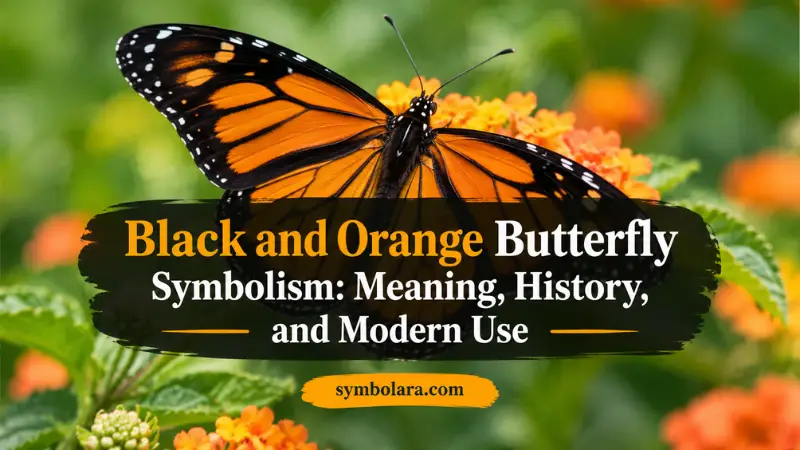
For many Americans, the best-known example is the monarch, Danaus plexippus. Its wings are bright orange with black veins, dark borders, and rows of small white spots near the edges. An adult usually has a wingspan of about three to four inches.
The pattern is not decoration in the human sense. Monarch caterpillars feed on milkweed, and chemicals from the plant can make the adult butterfly unpleasant or harmful for some predators to eat. The bright wing pattern acts as a visual warning.
That biological fact gives the colors an interesting contrast. Humans may read orange as lively or warm and black as serious or somber, but the butterfly itself is not carrying a coded message about human emotions.
Not every black-and-orange butterfly is a monarch, either. Viceroys have a similar appearance and can be mistaken for monarchs. Looking closely at wing patterns matters when someone is trying to identify an actual butterfly rather than interpret artwork.
Why the Orange-and-Black Combination Stands Out
Orange and black create strong visual contrast. Orange catches the eye quickly, while black outlines shapes and makes the brighter areas appear sharper.
That contrast helps explain why the combination can feel more dramatic than the softer colors found on some other butterflies. In human-made designs, it can communicate two ideas at once: movement and seriousness, warmth and loss, or change and uncertainty.
The pairing is especially familiar during fall in the United States. Orange appears in pumpkins, leaves, harvest decorations, and seasonal displays, while black is widely used in Halloween imagery. Library of Congress material identifies black and orange as traditional Halloween colors.
Because of that seasonal setting, a black-and-orange butterfly can feel different in October than the same image would on a spring wedding invitation.
What the Symbol Most Often Means in the United States
The most common interpretation is change with forward movement.
Butterflies already lend themselves to this meaning because their visible life stages are so different. A caterpillar forms a chrysalis and later emerges with wings. That process gives people an easy visual way to represent a changed identity or a new period of life.
Orange-and-black butterflies can therefore appear in designs connected with:
- recovering after a difficult period
- leaving an old situation
- starting a new career or relationship
- becoming more independent
- remembering a major life event
- accepting that life changes in stages
The black elements often make the image feel more serious than a pastel butterfly. Orange keeps it from becoming entirely somber. For some people, that balance is exactly the point: the symbol acknowledges hardship without making hardship the final message.
These interpretations are modern cultural uses, not universal rules. Two people can choose the same butterfly design for completely different reasons.
Why Monarch Butterflies Shape the Meaning
In the United States, the monarch has an unusually large influence on how orange-and-black butterflies are understood.
Monarchs migrate over great distances. Eastern North American monarchs travel from breeding areas in the United States and Canada toward wintering grounds in central Mexico. Western populations generally migrate toward overwintering areas along the California coast and into northern Baja California.
No explanation of that journey requires turning it into a human message. Yet people naturally use migration as a metaphor.
A monarch image can suggest:
Persistence. The butterfly is small, but migration may cover hundreds or thousands of miles.
Direction. Migration follows a seasonal cycle rather than remaining in one place.
Return. The broader population repeats the journey across generations.
Transition. Monarch movement becomes especially visible during seasonal change.
Those real behaviors make journeys and endurance more fitting interpretations than meanings chosen only because of color.
By 2026, the monarch also carries a conservation association. The U.S. Fish and Wildlife Service reports substantial population concerns and, as of September 21, 2026, says the species has been proposed for federal threatened status but has not yet received a final listing decision.
For some Americans, monarch imagery therefore represents care for pollinators, native plants, and changing habitats as much as personal transformation.
How Metamorphosis Became a Symbol of Personal Change
The butterfly’s connection with transformation is easy to understand because the change can actually be observed.
A caterpillar does not simply grow wings onto its existing body. It enters the pupal stage and emerges in a form that looks and behaves very differently.
That physical process has made butterflies useful images for graduation gifts, recovery milestones, memorial artwork, personal journals, and tattoos.
A black-and-orange butterfly may feel especially suited to changes that include both loss and beginning again. Someone moving away from home, for example, may be excited about the future while still grieving what is being left behind.
The symbol works because transformation is not presented as effortless. The image has separate stages, and each stage has an ending.
Still, the biological life cycle should not be treated as proof that seeing a butterfly predicts a coming event. Symbolism describes how people interpret an image; it does not turn an animal encounter into a reliable forecast.
Why Autumn and Halloween Change the Mood
Orange and black carry an extra layer of meaning in American fall culture.
During September and October, monarch migration overlaps with changing leaves, cooling weather, school-year routines, harvest imagery, and Halloween displays in many parts of the country. Monarchs can be seen moving south through parts of the United States during this period.
That timing can make the butterfly feel connected with endings and seasonal transition.
Halloween adds another association. Orange and black are already established colors in American decorations, costumes, packaging, party designs, and store displays.
As a result, an illustrated black-and-orange butterfly placed beside pumpkins, moons, spiderwebs, or candles may suggest Halloween even when the butterfly itself has no special Halloween tradition.
Context changes everything. The same butterfly surrounded by milkweed suggests wildlife and conservation. Beside a name and dates, it may read as a memorial. On October party decorations, it may simply be seasonal artwork.
The Mexican Día de los Muertos Connection
One of the clearest documented cultural connections involving orange-and-black monarchs comes from central Mexico.
Eastern monarch migration reaches forests in central Mexico around the same general season as Día de los Muertos, the annual observance honoring deceased family members and loved ones.
In traditions recorded among communities including the Purépecha of Michoacán and the Mazahua of Estado de México, monarchs have been associated with returning ancestors or souls arriving with the migrating butterflies. Modern Día de los Muertos displays may also include monarch imagery alongside marigolds, candles, and other remembrance symbols.
This should not be turned into a claim that every Mexican person interprets every monarch as a deceased relative. Día de los Muertos practices differ by community and family, and the relationship between monarchs and remembrance is especially tied to regions where the migration is part of local experience.
In the United States, where Día de los Muertos is also observed in many Mexican American communities, monarch designs may appear in public art, school projects, altars, murals, or remembrance events.
That is a specific cultural tradition, not evidence for a universal belief that any butterfly sighting is a message from someone who died.
Tattoos, Jewelry, and Memorial Designs
Personal objects are where butterfly meanings become especially flexible.
A black-and-orange butterfly tattoo can mark a major transition. Someone may choose it after leaving an unhealthy situation, completing school, moving across the country, becoming a parent, or starting over after a loss.
Others focus specifically on the monarch’s migration. For a person whose family has moved between countries or regions, the traveling butterfly can become an image of home, distance, and return.
Memorial uses are different. A butterfly may be paired with initials, dates, flowers, handwriting, or a short phrase connected with someone who died. In that setting, remembrance comes from the complete design and the owner’s intention rather than from a rule saying butterflies always represent the dead.
Jewelry can carry similar meanings in a quieter way. A pendant or pin can serve as a private reminder of someone, somewhere, or a period of personal change without explaining the story to everyone who sees it.
Garden Sightings, Photography, and Social Media
Seeing an orange-and-black butterfly outdoors often creates a more immediate response than seeing one in a design.
A monarch stopping on milkweed or a flowering plant can become memorable simply because the insect is colorful and easy to recognize. People photograph sightings, share migration observations, grow pollinator gardens, and plant native milkweed or nectar plants.
That has helped shift part of the modern meaning from purely personal symbolism toward environmental care.
A monarch photograph posted online may communicate concern about habitat or excitement about migration rather than transformation, grief, or spirituality.
This matters because online captions often detach images from their original context. A picture labeled as a “sign of change” may later circulate as though that interpretation were a fixed cultural tradition.
It usually is not.
Common Misunderstandings About the Symbol
One common mistake is assuming all black-and-orange butterflies are monarchs. Several species use similar colors, so identification should come before attaching monarch-specific migration or cultural associations to a real insect.
Another is treating every online symbolic meaning as historical fact.
Claims such as “an orange butterfly always means money is coming” or “a black-and-orange butterfly guarantees a major life event” do not have a broadly established historical basis.
A third misunderstanding is assuming black automatically makes the butterfly negative. Black can suggest mourning or seriousness in some American settings, but it can also function simply as part of the insect’s natural wing pattern or as a design choice that creates contrast.
Orange is equally flexible. It can suggest fall, warmth, visibility, harvest imagery, or simply the natural coloring of a species.
Symbolic meaning comes from the full setting, not a color chart applied mechanically.
How the Meaning Changed Over Time
There is little reason to treat the exact orange-and-black butterfly combination as one continuous symbol with a single origin.
Several separate ideas eventually came together.
Butterfly metamorphosis supported the familiar association with change. Monarch migration added travel, endurance, seasonal movement, and return. Central Mexican traditions connected the migrating monarch with remembrance around Día de los Muertos. American autumn culture placed orange and black together in another familiar seasonal setting.
Modern media then combined these layers.
Tattoos made the butterfly highly personal. Environmental campaigns connected monarch imagery with habitat protection. Social platforms encouraged short interpretations such as “new chapter,” “keep going,” or “remembering you.”
The result is a symbol whose current meaning is more flexible than its history sometimes appears online.
Meaning Changes With the Context
| Context | Meaning in USA | Common Associations | Notes |
| Monarch garden | Nature and conservation | Milkweed, migration, pollinators | Often tied to real wildlife rather than personal symbolism |
| Memorial design | Remembrance and continuing affection | Names, dates, flowers | Meaning usually comes from the person’s own story |
| Tattoo | Personal transition | Recovery, independence, major milestones | Exact meaning varies widely between wearers |
| Fall decoration | Seasonal change | Leaves, pumpkins, October | Orange and black strengthen the autumn connection |
| Migration artwork | Journey and persistence | Distance, movement, homecoming | Often draws directly from monarch behavior |
FAQs
It can carry either mood, but it is often interpreted positively when used to represent moving forward after change. Black may add seriousness, while orange can keep the design visually lively, so the combination is often suited to mixed emotions rather than a simple good-or-bad meaning.
There is no universal rule that a butterfly sighting means a deceased person is present. Specific traditions in central Mexico connect migrating monarchs with ancestors around Día de los Muertos, but that cultural belief should not automatically be applied to every butterfly or every community.
No. The viceroy is one well-known look-alike, and other butterfly species also contain orange and dark markings. Monarchs can be identified by features such as their black veins, borders, white spots, size, and wing pattern.
The bright pattern helps warn predators that monarchs may be unpleasant or toxic to eat because of chemicals obtained from milkweed during the caterpillar stage. Their colors therefore have a biological function before humans attach symbolic meanings to them.
There is no widely established rule that an orange-and-black butterfly predicts good luck. Someone can still choose to treat a sighting as a personal reminder of hope or a new beginning, but that is an individual interpretation rather than a dependable prediction.
Biologically, a butterfly may land because it needs a resting place or is attracted by moisture, salts, or nearby environmental conditions. If the moment feels personally meaningful, you can remember it that way, but the animal’s behavior does not provide a proven message about future events.
Conclusion
Black and orange butterfly symbolism most often centers on transformation, endurance, seasonal change, remembrance, and moving between stages of life. The monarch butterfly has shaped many of those interpretations in the United States because its orange-and-black wings, visible metamorphosis, and long migration give people concrete images for change and travel.
The symbol also changes with its surroundings. Within a pollinator garden, it may represent conservation. A tattoo might mark a personal turning point, while its use in Día de los Muertos imagery can connect with specific traditions of remembrance. By contrast, an October decoration may simply reflect familiar fall colors.
That flexibility is part of why the image remains useful. A real butterfly has its own biology and behavior; people create the symbolic meaning by deciding which part of that visible story reflects something in their own lives.