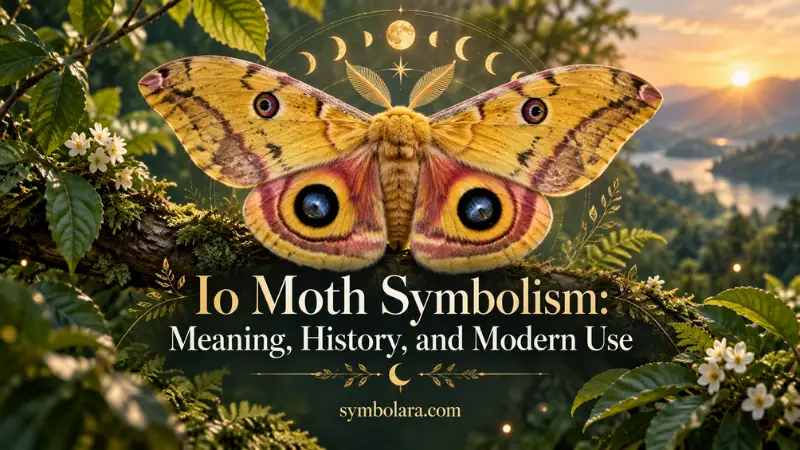
The Io moth has one of the most striking wing patterns among North American moths. When resting, it may look like an ordinary yellow or brown insect. However, when threatened, it reveals two large eyespots on its hindwings that can startle predators.
These unusual markings help explain why people associate io moth symbolism with protection, transformation, awareness, and personal boundaries. Its appearance also offers a reminder that something seemingly delicate can possess effective ways to survive.
In the United States, this native moth attracts attention from nature photographers, wildlife enthusiasts, and people interested in meaningful tattoos. Its life cycle and defensive behavior offer several possible interpretations, although these meanings come mainly from modern personal reflection rather than a single established cultural tradition.
Quick Answer
Io moth symbolism commonly represents protection, transformation, resilience, and the ability to reveal hidden strengths when necessary. These modern interpretations come from the moth’s life cycle and distinctive eyespots, which help defend it against predators. Historically, the species was documented by naturalists rather than widely recognized as a traditional spiritual symbol.
TL;DR
- Protection: Its large eyespots help discourage potential predators.
- Transformation: Its life cycle inspires personal growth and change.
- Resilience: Defensive adaptations suggest survival despite vulnerability.
- History: Its scientific name connects to Greek mythology.
- American culture: Its appearance inspires wildlife photography and nature-themed artwork.
- Personal meaning: Some interpret sightings as reminders to establish healthy boundaries.
What Does the Io Moth Look Like?
The Io moth, scientifically called Automeris io, belongs to the Saturniidae family, which includes several large and colorful silk moths.
Its appearance makes it easy to recognize once its hindwings become visible.
Adult moths generally have a wingspan of approximately two to three inches. Males often display yellow forewings, while females usually have brown, reddish, or purplish coloring. Females also tend to be larger.
Both sexes possess large circular eyespots on their hindwings. These markings usually feature dark centers surrounded by contrasting colors, sometimes including blue, yellow, and reddish shades.
The eyespots are especially noticeable because they remain partly concealed beneath the forewings when the moth rests.
This species occurs across much of eastern North America, including many parts of the eastern and central United States. Its habitats include deciduous forests, wooded neighborhoods, and areas containing suitable host plants.
People may encounter adults near outdoor lighting during warmer months. Caterpillars can appear on trees and shrubs, including willows, maples, and other host plants.
Although the species looks delicate, its unusual defensive features make it a memorable example of how insects survive in nature.
Why the Io Moth’s Eyespots Symbolize Protection
Protection is one of the clearest interpretations associated with this moth because it reflects an observable survival behavior.
When an adult senses danger, it can move its forewings to expose the large eyespots underneath.
This sudden display may startle a bird or another predator long enough for the moth to escape.
The markings resemble animal eyes, particularly because their contrasting colors and small pale highlights create an eye-like appearance.
For someone choosing the moth as a personal symbol, this behavior may suggest three useful ideas.
First, protection does not always require physical strength. An effective response can involve timing, awareness, and knowing when to act.
Second, appearances can be misleading. An insect that seems defenseless may possess unexpected ways to protect itself.
Finally, the eyespots can represent personal boundaries. Someone might connect the moth’s behavior with learning to recognize uncomfortable situations and respond with confidence.
These interpretations reflect human experiences rather than intentions the insect consciously holds.
The moth displays its markings because the behavior can improve its chances of survival, not because it understands human ideas about protection.
How the Io Moth Represents Transformation and Change
Like butterflies and other moths, this species undergoes complete metamorphosis.
Its development includes four stages: egg, caterpillar, pupa, and adult.
Each stage involves a noticeably different appearance and set of behaviors.
The young caterpillars begin life with coloring unlike that of mature larvae. As they grow, they eventually become green, with noticeable stripes and protective spines.
After reaching maturity, a caterpillar forms a thin cocoon in a protected location. Inside, it develops into an adult moth.
This biological process provides a natural basis for interpreting the animal as a symbol of change.
Someone beginning college, moving to a new city, or changing careers might find the transformation meaningful.
It offers a visual reminder that personal development can involve periods when progress is difficult to observe.
Yet the connection has limits.
The moth does not change because it seeks emotional growth or a better identity. Metamorphosis is a normal biological process necessary for its development.
The symbolism comes from how people relate that process to their own experiences.
Unlike a fixed religious emblem, the meaning can vary considerably from one individual to another.
Why Its Hidden Wing Patterns Suggest Inner Strength
One remarkable feature of this species is the contrast between its resting appearance and its defensive display.
With its forewings closed over the hindwings, the moth can blend into surrounding leaves and vegetation.
Its coloring helps reduce unwanted attention.
When danger approaches, the insect reveals markings that seem dramatically different from its ordinary appearance.
This contrast can inspire interpretations related to confidence, privacy, and abilities that are not immediately obvious.
For example, someone who rarely speaks during group discussions may still possess valuable knowledge and leadership skills.
Likewise, a quiet person might respond decisively when faced with an important challenge.
The moth’s two appearances provide a visual comparison for these situations.
Its resting form suggests that a person does not need to display every ability constantly.
Meanwhile, its exposed eyespots can represent recognizing the right moment to stand up for oneself.
This interpretation is especially useful in personal artwork because the moth can be illustrated with either concealed or fully exposed hindwings.
Each design communicates a different mood without requiring additional symbols.
Where the Io Moth’s Name Comes From
The name Io has an identifiable connection to Greek mythology.
In Greek stories, Io was a woman associated with Zeus, the king of the gods. Different versions describe how she was transformed into a cow and later pursued or tormented by a biting insect.
The connection between Io’s suffering and the irritating sting of the moth’s caterpillar helps explain the species’ name.
However, this does not mean that ancient Greeks worshipped the moth or regarded this particular North American insect as sacred.
The mythological connection comes through scientific naming.
Danish naturalist Johan Christian Fabricius described the species in 1775 under the name Bombyx io.
Its current scientific name is Automeris io.
The distinction matters because a mythological name does not automatically establish an ancient symbolic tradition.
The moth’s modern associations with resilience and self-protection come mainly from its observable characteristics.
Some people may personally connect the Greek story with survival after hardship. Others may prefer meanings based entirely on the insect’s appearance.
Both approaches can serve as personal interpretations, provided they are not presented as documented beliefs held by ancient communities.
There is also no well-established, universal Indigenous American interpretation specific to this species. Beliefs about moths should not be assigned to particular cultures without evidence.
How American Naturalists Recorded the Io Moth
American interest in the species originally developed through observation, collecting, illustration, and the study of insects.
Following Fabricius’s eighteenth-century description, naturalists continued documenting its appearance and life cycle.
In 1797, natural-history work associated with John Abbot and James Edward Smith included an account of the moth’s development in Georgia.
Such descriptions helped readers recognize the species as an insect with distinctive stages of growth and unusual markings.
By the nineteenth century, illustrated natural-history publications had become important ways for people to learn about North American wildlife.
The moth’s colorful wings made it a suitable subject for scientific illustrations.
During the early twentieth century, American naturalist and author Gene Stratton-Porter also wrote about the species.
Her 1921 discussion used the name “Hera of the Corn,” connecting the insect with Greek mythology and its occasional presence on corn plants.
These historical examples show how the moth entered written descriptions of American nature.
They do not establish a widely shared historical meaning of luck, death, or spiritual protection.
Over time, field guides, wildlife photography, and educational materials made identifying the moth easier for people outside scientific circles.
Modern symbolic interpretations developed alongside this growing public familiarity with its appearance.
What Seeing an Io Moth Can Mean in American Life
Finding one of these moths in a backyard can feel unusual, especially when it suddenly reveals its colorful hindwings.
Many people encounter wildlife during ordinary activities such as gardening, walking, or relaxing on a porch.
An unexpected sighting may encourage someone to pay closer attention to their surroundings.
For one observer, the experience might suggest patience.
Another person may connect the moth’s defensive markings with a recent decision to establish firmer personal boundaries.
Someone recovering from a difficult period might interpret its changing life stages as a reminder that circumstances can improve.
These responses can be emotionally meaningful even without a supernatural explanation.
There is no scientific evidence that encountering an Io moth predicts good fortune, danger, or a future life event.
Its presence generally reflects natural factors such as habitat, season, reproduction, and suitable environmental conditions.
The practical context matters.
A moth resting near a porch light is behaving as a nocturnal insect, not necessarily delivering a personal message.
Nevertheless, the encounter can still become memorable because the observer associates it with something happening in their life.
The Io Moth in American Wildlife Art and Photography
Nature artists often appreciate insects with recognizable patterns.
The Io moth offers an appealing combination of rounded wings, contrasting colors, and symmetrical markings.
A detailed illustration may emphasize the two eyespots. A photograph, meanwhile, can capture the difference between the insect’s resting posture and its defensive display.
These visual features make the species suitable for nature journals, educational posters, botanical-style illustrations, and wildlife photography.
Artists can also use the contrast between visible and concealed markings to express different ideas.
An illustration with folded forewings may suggest quietness or privacy.
A composition showing the hindwings can communicate alertness or readiness.
The surrounding elements also influence interpretation.
For instance, placing the moth among autumn leaves may emphasize camouflage and seasonal change. Adding native plants can shift attention toward its relationship with the natural environment.
American nature education provides another setting for this imagery.
Field guides and educational displays use recognizable insects to introduce topics such as predator avoidance, insect development, and biodiversity.
In these contexts, accurate representation matters more than personal symbolism.
The same illustration can therefore function as a scientific image, a decorative design, or a meaningful personal emblem.
What Io Moth Tattoos and Jewelry Can Represent
Moth imagery appears in several styles of contemporary body art, including realistic wildlife illustrations and decorative designs.
The Io moth is particularly recognizable when artists reproduce its circular hindwing markings.
Its meaning often depends on the person choosing the design.
For some, a tattoo may commemorate a period of personal change.
Others may choose it to represent self-protection after learning to establish healthier relationships.
A wildlife enthusiast might select the species simply because it is native to North America and visually distinctive.
There is no single meaning that every tattoo wearer accepts.
Jewelry featuring the moth can work in a similar way. A pendant or brooch may celebrate interest in insects, appreciation for nature, or an individual experience.
The following table shows how its meaning can shift across different American settings.
| Context | Meaning in USA | Common Associations | Notes |
| Memorial tattoo | Remembering change after loss | Continuity, remembrance | Meaning depends on the wearer’s experience |
| Two-eyespot jewelry | Personal awareness | Attention, confidence | Often a decorative choice |
| Botanical illustration | Connection to native wildlife | Natural beauty, observation | Plant details add ecological context |
| Bedroom wall art | Appreciating unusual beauty | Individuality, creativity | Often chosen for visual appeal |
| Nature education | Understanding insect survival | Camouflage, defense | Based on actual behavior rather than belief |
For accurate artwork, both hindwing eyespots should be visible in an open-wing design.
Artists can also show the difference between yellowish males and darker females.
These details help distinguish the species from other moths with eye-like markings.
Emotional Meaning: Resilience, Confidence, and Boundaries
The moth’s appearance can encourage people to reflect on how they respond to difficult situations.
Its defensive behavior offers an example of an animal using a specialized adaptation rather than relying on size or physical force.
That observation can become a useful comparison for human resilience.
A person who has experienced repeated criticism, for instance, may find meaning in the idea of protecting personal boundaries.
Someone adjusting to a new environment may identify with the insect’s ability to remain inconspicuous until action becomes necessary.
Another observer might appreciate its contrast between ordinary appearance and vivid markings.
Psychologically, these meanings arise through personal association.
People often connect external objects with experiences, feelings, and memories.
A visual reminder can help someone recall a goal or value, even when the object itself has no established cultural message.
However, simply wearing an insect design does not automatically increase confidence or improve emotional well-being.
Any emotional benefit depends on the individual’s response and the meaning they assign to it.
The symbolism is most useful when it helps express an idea the person already understands or wants to remember.
Why the Caterpillar Adds a Different Meaning
The adult moth receives most of the attention because of its colorful wings.
However, its caterpillar offers another important perspective.
Mature Io moth caterpillars are generally green with contrasting stripes along their sides.
Their bodies are covered with branching spines that can deliver painful stings when touched.
These spines serve as a defense against potential predators.
This characteristic can inspire an interpretation about respecting boundaries.
The caterpillar does not need to chase or attack another creature to protect itself. Its defensive structures can discourage contact.
From a human perspective, this may suggest that boundaries can exist without aggression.
Still, the biological distinction is important.
The caterpillar’s spines are physical defenses, while healthy personal boundaries involve communication, choices, and behavior.
A second misunderstanding concerns the danger posed by the adult.
Unlike the caterpillar, the adult moth does not possess those stinging larval spines.
People should nevertheless avoid unnecessary handling, as moth wings are delicate.
Children and gardeners should also learn to recognize the caterpillar and leave it undisturbed.
Its attractive green coloring does not make it safe to touch.
How Modern Nature Sharing Has Changed Its Image
Digital photography and wildlife-identification communities have made it easier for Americans to encounter images of insects they may never see in person.
A close-up photograph can reveal details that are difficult to notice during a brief outdoor encounter.
For the Io moth, this includes the pale highlights inside its eyespots and the striking contrast between its forewings and hindwings.
These features work especially well in educational posts and short wildlife videos.
A photograph showing only the moth’s resting position may look relatively ordinary. A second image with exposed hindwings can surprise viewers.
This visual contrast encourages curiosity about the species.
It also allows artists and nature enthusiasts to share their personal interpretations.
During the 2020s, online nature communities have offered opportunities to discuss topics ranging from insect identification to artwork inspired by wildlife.
However, increased visibility should not be confused with evidence of a new, universally accepted meaning.
Some viewers see a symbol of transformation. Others appreciate the insect’s defensive adaptations or unusual appearance.
There is also an important environmental consideration.
Greater public interest in native insects can encourage observation and habitat awareness.
In parts of its range, the species has experienced population declines. Its status can differ considerably by region.
For that reason, appreciating the moth can involve more than collecting images. It can also mean protecting native vegetation and observing wildlife without disturbing it.
FAQs
There is no widely established American tradition that identifies this particular species as a definite sign of good luck. Someone may personally associate a sighting with a fortunate experience, but the connection is subjective rather than a reliable prediction.
The species has no broadly recognized religious meaning comparable to established symbols used in religious ceremonies. Its Greek mythological name reflects a naming connection, not proof that the moth was an object of ancient worship.
Its abundance varies by location. Although the species has a broad geographic range, naturalists have documented declines in some regions, including parts of New England, so local sightings may be uncommon.
No. The colorful eyespots are patterns formed by wing scales, not functioning eyes. The moth uses its actual compound eyes to detect visual information.
No. Both belong to the Saturniidae family, but they are different species. Luna moths have pale-green wings and long hindwing tails, while Io moths are recognized by their large circular hindwing markings.
Outdoor lighting can attract nocturnal moths, particularly when suitable habitat is nearby. Trees and shrubs that support their caterpillars may also help explain their presence around residential properties.
Avoid grabbing it by the wings, which can be damaged easily. If necessary, gently guide the adult into a container and release it outdoors in a sheltered location; do not handle a spiny caterpillar with bare hands.
Conclusion
Io moth symbolism centers on protection, transformation, resilience, and the contrast between outward appearance and hidden abilities. These interpretations come largely from its remarkable natural features, particularly its defensive eyespots and changing life stages.
Its historical background is rooted in scientific observation, with a notable naming connection to Greek mythology. Modern Americans may use its image in tattoos, jewelry, wildlife photography, and personal artwork, but the species has no single meaning accepted by everyone.
Perhaps its most memorable feature is the way an ordinary-looking moth can reveal such an unexpected pattern when threatened. That real behavior gives people a specific, recognizable image through which to express ideas about change, awareness, and protecting what matters.