A lion is easy to recognize by its muscular body, large paws, and, in males, a thick mane surrounding the head. Often called the king of beasts, the lion appears on national emblems, sports logos, family crests, jewelry, tattoos, and works of art. Its image usually suggests courage, leadership, and authority.
People look up lion symbolism for different reasons. Someone may have seen a lion in a dream, considered getting a lion tattoo, or noticed one on a coat of arms. Others want to understand why the animal appears in American sports, military traditions, and popular culture.
In the United States, lions often represent confidence, protection, personal strength, and the ability to face challenges. However, the meaning can change depending on where the image appears and what details surround it.
Quick Answer
Lion symbolism most commonly represents courage, leadership, strength, protection, and authority in modern American culture. These associations developed through ancient art, royal traditions, religious stories, and heraldry, where lions often represented rulers, guardians, and bravery.
TL;DR
- Lions commonly represent courage, confidence, and leadership.
- Ancient rulers used lion imagery to communicate authority.
- American sports teams use lions to suggest strength and competition.
- Lion tattoos often express resilience, pride, or family protection.
- Religious artwork connects lions with both courage and danger.
- A resting lion can suggest confidence without aggression.
What Does a Lion Look Like, and Why Does Its Appearance Matter?
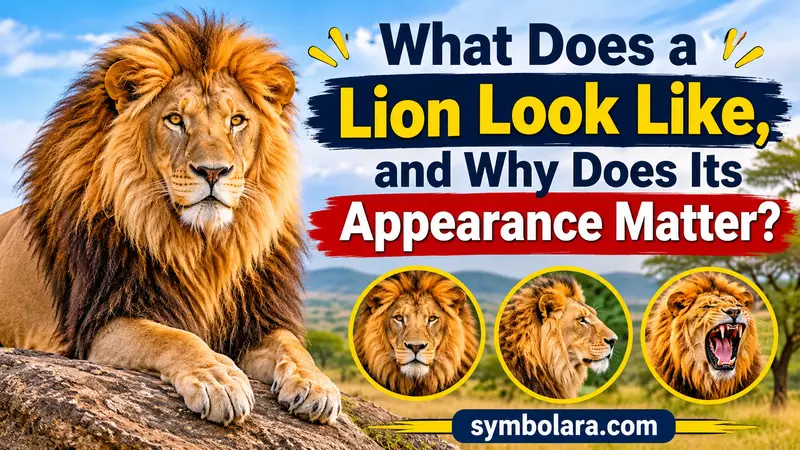
A lion is a large wild cat with a muscular body, rounded ears, strong jaws, and a long tail ending in a dark tuft. Male lions usually have a mane, while females generally do not.
The mane is one of the animal’s most recognizable features. Its size and color vary, and it can make a male lion appear larger than it is. This appearance has helped shape the lion’s association with authority and physical strength.
Different visual details also affect how people interpret lion imagery.
- The mane: Often represents pride, confidence, maturity, and authority.
- The teeth and claws: Suggest defense, aggression, and the ability to overcome threats.
- The raised head: Can communicate alertness, dignity, and leadership.
- The resting position: Often suggests calm confidence and control.
- The roaring expression: Represents warning, dominance, or a refusal to back down.
Lions are social animals that live in groups called prides. Their lives involve cooperation, territory, hunting, and family relationships. These behaviors also provide reasons people associate lions with loyalty and protection.
What Does a Lion Symbolize in Modern American Culture?
In the United States, the lion is mainly associated with qualities people admire in leaders, athletes, parents, and individuals facing difficult situations.
Its most common meanings include:
Courage: A lion often represents the willingness to face danger or uncertainty. People use the image to express bravery during difficult periods in life.
Leadership: The lion’s traditional association with royalty has made it a familiar image of authority. A lion on a business logo, team uniform, or personal emblem can suggest confidence and responsibility.
Protection: Lions are often used in designs representing family, loyalty, and guardianship. A parent might choose a lion tattoo to represent protecting their children.
Pride: The word pride has a direct connection to lions because it describes their social groups. As a symbol, it can also represent self-respect, achievement, and belonging.
Determination: A lion facing forward or standing firmly on all four legs can communicate persistence. It suggests someone who does not give up easily.
These meanings are not universal rules. A lion used in a sports logo may communicate competitive spirit, while the same animal in a family tattoo may represent protection and responsibility.
Where Did Lion Symbolism Begin?
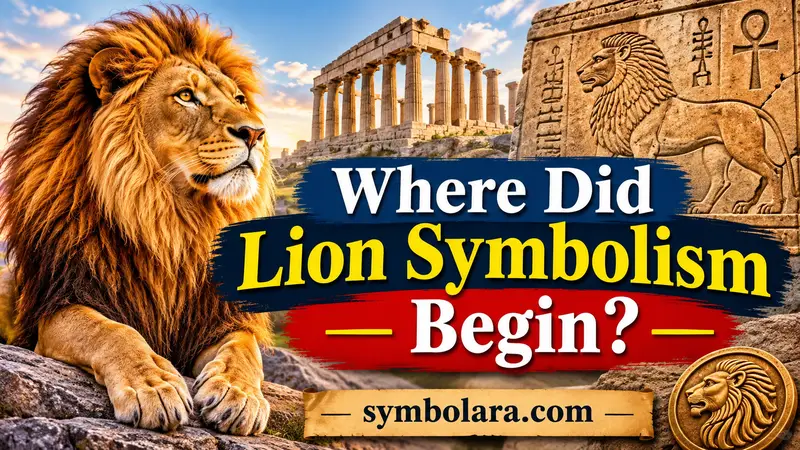
Lions have appeared in human art and visual traditions for thousands of years. Their large size, hunting abilities, and position as major predators made them important subjects in societies that lived alongside them.
One early example comes from ancient Mesopotamia. Lion imagery appeared in royal art and objects connected with rulers. Kings used lions to communicate strength, authority, and their ability to defend their territories.
Ancient Egypt also used lion imagery in religious and royal settings. The goddess Sekhmet, often shown with a lioness’s head, was associated with warfare, protection, healing, and destructive force.
In ancient Greece, lions appeared in mythology and sculpture. The Nemean Lion, defeated by Heracles as one of his famous labors, became a symbol of a dangerous challenge overcome through courage and strength.
These examples show that lion imagery did not begin with one single meaning. Different societies connected the animal with power, protection, danger, and divine authority.
Why Did Kings and Rulers Use Lions as Symbols?
Lions became familiar images of kingship because their physical appearance suited the way rulers wanted to present themselves.
A ruler was expected to protect a community, defeat enemies, and maintain order. The lion provided a recognizable image for those qualities.
In medieval Europe, lions became especially common in coats of arms. A coat of arms was a visual design used to identify families, noble houses, and military groups.
The lion could appear standing upright, walking, sitting, or facing forward.
Some common heraldic designs include:
- Lion rampant: A lion standing upright on its hind legs, usually associated with courage and readiness.
- Lion passant: A walking lion shown in profile.
- Lion sejant: A seated lion, often representing dignity and authority.
- Lion guardant: A lion walking with its head facing the viewer.
These designs helped people identify noble families and their connections. The English royal arms, for example, feature three lions passant guardant.
Over time, the lion became closely linked with royal identity in several European traditions.
What Does a Lion Represent in American History and National Identity?
Although the bald eagle is the national bird and a central symbol of the United States, lions still appear in American public life.
One reason is the country’s historical connection with European heraldry. Early American families, institutions, universities, and organizations adopted visual traditions that included lions.
The animal can be found in decorative architecture, official seals, school emblems, and family crests.
In American culture, a lion often communicates qualities such as:
- Leadership and responsibility.
- Courage during difficult situations.
- Strength in defending a community.
- Family heritage and personal identity.
- Confidence and achievement.
Lions also appear in American military and institutional designs. Their use often reflects established heraldic traditions rather than a uniquely American origin.
The distinction matters: the lion is familiar in American identity, but it is not the country’s official national animal.
What Does a Lion Symbolize in Christianity and Other Religious Traditions?
Lions have important roles in several religious traditions, although their meanings can differ.
In Christianity, the lion is sometimes connected with Jesus through the title Lion of Judah. The phrase comes from the biblical tradition associated with the tribe of Judah and later Christian interpretation.
The lion is also associated with courage and protection in the story of Daniel in the lions’ den. In this account, Daniel survives after being placed among lions, making the story a familiar example of faith and divine protection.
Christian artwork sometimes uses a lion to represent courage, authority, and spiritual victory.
In Hindu traditions, the goddess Durga is often depicted riding a lion or tiger, depending on the artistic tradition. The animal represents her ability to confront destructive forces and restore order.
In Buddhist art, lions can appear as guardians of sacred spaces and symbols of dignity. The lion’s roar is also used as an image for the confident teaching of Buddhist principles.
These interpretations belong to different religious traditions. They should not be treated as interchangeable meanings.
What Does a Lion Mean in African and Asian Cultures?
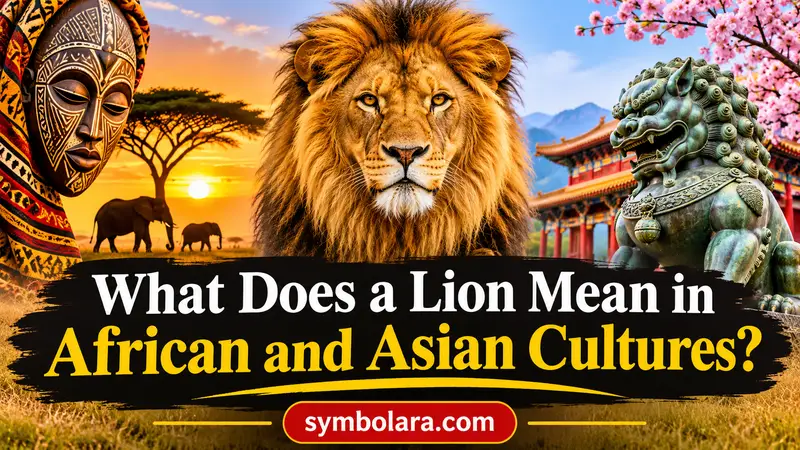
Lions have a real connection with parts of Africa and Asia because the animal has lived in both regions.
In many African communities, lions have appeared in oral traditions, stories, artwork, and cultural expressions. Their presence in local environments has influenced how people describe courage, hunting, danger, and leadership.
However, Africa contains many different societies and languages. There is no single African interpretation of the lion.
In Ethiopia, the lion became an important royal image. The Lion of Judah was closely connected with the Ethiopian monarchy and its historical identity. Its use also has connections with the country’s Christian traditions.
In India, lions appear in religious art, royal imagery, and historic architecture. One notable example is the Lion Capital of Ashoka, a sculpture from the third century BCE. Its lions are now represented in India’s national emblem.
In China, stone lions are commonly placed outside temples, palaces, and traditional buildings. These guardian figures are often called guardian lions or shishi. They are intended to protect entrances and mark important spaces.
The Chinese guardian lion is an artistic and cultural symbol. It is not simply a realistic representation of a living lion.
What Is the Psychological Meaning Behind a Lion?
People often connect with lion imagery because it provides a clear visual expression of qualities they want to develop or communicate.
A person who chooses a lion design may want to express courage without needing to explain a personal experience.
For someone recovering from a difficult period, the animal might represent resilience. For another person, it may communicate independence or a desire to become a stronger leader.
There are several reasons this image can feel meaningful:
A sense of control: Lions are often shown standing firmly or looking directly ahead. These designs can represent confidence and self-control.
Personal courage: The animal can serve as a reminder to face uncomfortable situations rather than avoid them.
Family attachment: A lion with cubs may communicate responsibility, care, and a protective relationship.
Self-respect: A lion can represent pride in personal achievements without necessarily suggesting arrogance.
Psychological interpretations are personal, not fixed scientific meanings. The image does not reveal someone’s personality on its own. Its meaning depends on the person’s experiences and reasons for choosing it.
Why Do People Choose Lion Tattoos?
Lion tattoos are popular because the animal can communicate several ideas through one recognizable design.
Some people choose a lion tattoo to represent a personal achievement. Others use it as a reminder of a difficult experience they survived.
The design often changes the message.
Lion head tattoo: Often represents courage, confidence, and personal identity.
Lion family tattoo: Can represent family loyalty, parenting, and protection.
Geometric lion tattoo: Combines the animal’s traditional associations with modern artistic expression.
Roaring lion tattoo: Often communicates determination, defiance, and readiness to face challenges.
Resting lion tattoo: Can represent patience, calmness, and confidence without aggression.
Before choosing a design, people often consider whether they want to represent personal strength, family relationships, faith, or cultural heritage.
A tattoo’s meaning does not have to match traditional interpretations. Someone can give the image a personal meaning that matters more to them than its historical associations.
What Does a Lion Symbolize in Jewelry, Clothing, and Home Decor?
Lion imagery appears in many everyday objects. Its meaning often depends on how the design is used.
In jewelry, lions commonly appear on rings, pendants, bracelets, and necklaces. A lion ring may represent confidence, family heritage, or personal achievement.
In clothing, lion graphics are often used to create a bold visual statement. A lion printed on a jacket or T-shirt can communicate confidence, competitive spirit, or an interest in wildlife.
Home decor uses lion figures in sculptures, wall art, statues, and decorative objects. A pair of lion statues placed near an entrance may suggest protection and welcome.
In modern interiors, abstract lion artwork can also create a sense of character and confidence without relying on traditional royal designs.
How Do American Sports Teams Use Lion Imagery?
American sports have helped keep lion imagery visible in everyday culture.
The Detroit Lions are one of the best-known examples. Their logo uses a stylized blue lion, connecting the animal with competition, athletic identity, and team pride.
Other schools, colleges, and athletic organizations also use lions as mascots.
A lion makes a recognizable sports symbol because it can communicate several qualities at once:
- Strength against competitors.
- Confidence during difficult matches.
- Team identity and loyalty.
- Determination to keep fighting.
- Pride in a shared community.
The animal’s appearance also works well on uniforms, helmets, merchandise, and stadium decorations.
In this setting, the lion is less about royalty and more about competitive spirit. Fans may wear lion merchandise to show support for a team rather than to communicate a personal belief about the animal.
How Has the Meaning of Lions Changed Over Time?
Lion symbolism has changed as societies, artistic traditions, and popular culture have developed.
In ancient societies, the lion was often connected with rulers, warfare, religious figures, and protection. Its physical presence made it a suitable image for authority.
During the medieval period, European heraldry helped establish the lion as a recognizable sign of noble identity and family status.
In later centuries, the animal continued to appear in public monuments, decorative art, literature, and national imagery.
American popular culture added further meanings during the twentieth century. Sports teams, advertisements, films, and children’s entertainment introduced lion imagery to wider audiences.
Modern interpretations are more personal. Someone might choose a lion tattoo to remember a parent, represent a personal achievement, or express confidence after a difficult experience.
The animal can still represent authority, but it no longer belongs only to kings, rulers, or formal institutions.
Are There Negative Meanings Associated With Lions?
Lions are generally viewed positively, but their symbolism is not limited to admirable qualities.
Their hunting behavior and territorial nature can also connect them with aggression, danger, dominance, and fear.
A roaring lion with exposed teeth may suggest a threat rather than protection. In some stories, a lion represents an obstacle that must be overcome.
The animal can also be used to criticize excessive pride or arrogance. The phrase lion’s pride may sound positive, but too much pride can become a problem when confidence turns into superiority.
There is another important distinction between symbolic meaning and real wildlife.
Lions are wild predators, not harmless guardians. They play an important role in their natural ecosystems, but they can be dangerous to people.
Using a lion as a symbol of courage does not mean the animal behaves according to human ideas of bravery or leadership.
What Do Different Lion Designs Mean in Everyday Life?
A lion’s position, facial expression, and surrounding details can change how people interpret the image.
The following table shows how lion imagery is commonly understood in different American settings.
| Context | Meaning in USA | Common Associations | Notes |
| Family tattoo | Protection and responsibility | Parents, children, loyalty | Often includes a lioness or cubs |
| Business logo | Authority and trust | Leadership, confidence, reputation | Common in organizations seeking a bold identity |
| Sports emblem | Competitive strength | Team pride, determination | Often features a running or roaring lion |
| Jewelry | Personal identity and achievement | Heritage, confidence, status | Signet rings often use heraldic designs |
| Religious artwork | Faith and protection | Courage, spiritual authority | Meaning depends on the religious tradition |
These examples show why the same animal can communicate different ideas. A lion on a family necklace may feel personal, while one on a football helmet represents a larger group.
FAQs
Is a lion a positive or negative symbol?
A lion is generally a positive symbol associated with courage, leadership, and protection. However, some designs can represent aggression, arrogance, or uncontrolled authority.
Does a lion symbolize loyalty?
Yes, lions can represent loyalty, particularly in designs showing a pride or a family group. This meaning is often used in family tattoos and artwork, although real lion social behavior is more complex than human ideas of loyalty.
What does a lion symbolize for a woman?
A lion can represent confidence, independence, courage, and self-respect for a woman. Some women choose lioness designs because they prefer the image of a female lion rather than the traditional male lion with a mane.
What is the difference between a lion and a lioness as symbols?
A male lion is commonly associated with authority, visibility, and traditional leadership imagery. A lioness is often used to represent independence, caregiving, hunting ability, and family protection, although these associations are cultural interpretations rather than fixed meanings.
Why is the lion called the king of beasts?
The phrase comes from the lion’s traditional reputation as a large and formidable predator. Its physical appearance, behavior, and historical use in royal imagery helped establish this title, even though lions do not rule over other animal species.
What does a lion and crown symbolize?
A lion wearing a crown usually represents royalty, authority, leadership, and status. In personal designs, it may also communicate self-respect, achievement, or a desire to take responsibility.
Is the lion an official American national symbol?
No. The bald eagle is the national bird and a major national emblem of the United States. Lions still appear in American organizations, sports logos, family crests, and decorative designs, but they do not hold the same official national status.
Conclusion
Lion symbolism is mainly connected with courage, leadership, protection, confidence, and pride. Its meaning developed through ancient royal imagery, religious traditions, medieval heraldry, and modern popular culture.
In the United States, lions appear in sports, tattoos, jewelry, fashion, family designs, and business branding. The same image can represent competitive spirit in one setting and family responsibility in another.
What makes the lion such a recognizable symbol is the range of ideas people can attach to its appearance. A roaring lion, a resting lion, and a lion standing beside its cubs can tell very different stories, even though they all represent the same animal.