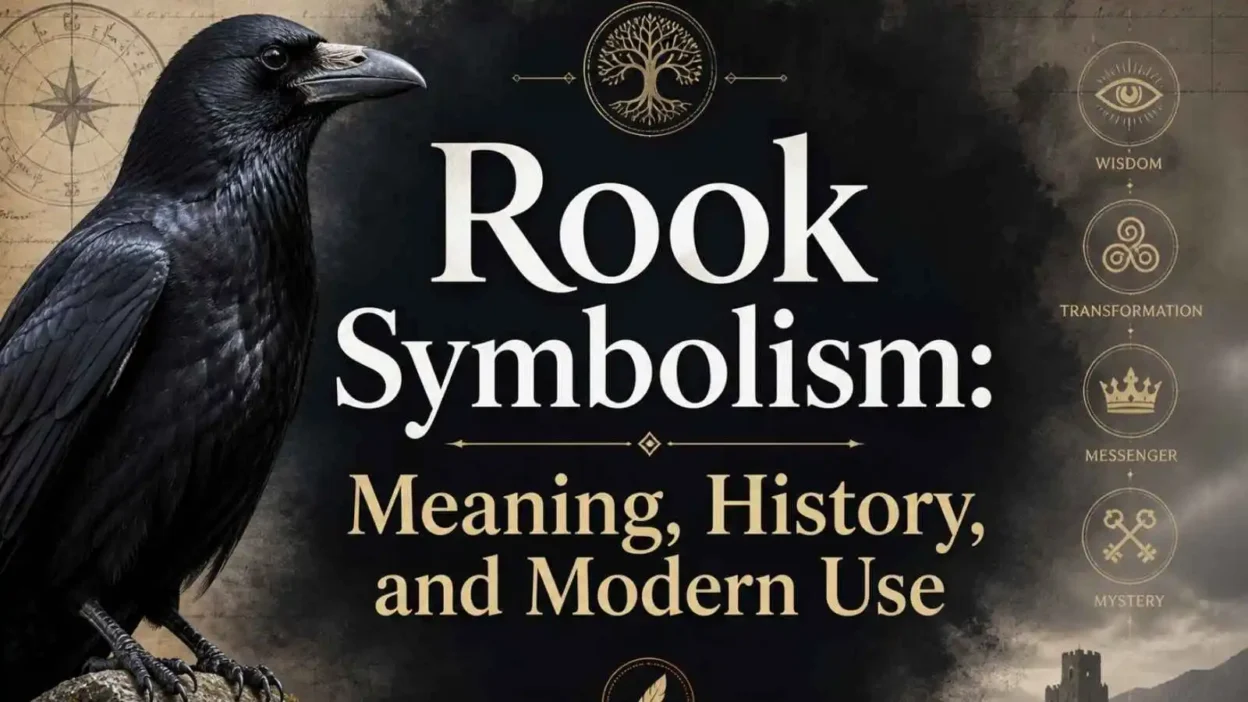
The rook is a black-feathered bird from the crow family that has long appeared in folklore, literature, and cultural traditions. Rook Symbolism often represents intelligence, community, observation, and adaptation, while its darker appearance has also connected it with mystery, endings, and transformation.
Unlike symbols with one fixed meaning, the rook carries different interpretations depending on culture and context. In modern American culture, people often view the bird through the broader symbolism of corvids, associating it with cleverness, survival skills, and the ability to navigate changing environments.
Quick Answer
Rook Symbolism commonly represents intelligence, social connection, and adaptability in modern American culture, especially through its association with clever corvid birds and natural survival. Historically, rooks have also been linked with community life, folklore, farmland traditions, and ideas about mystery or change.
TL;DR
- Rooks symbolize intelligence, cooperation, and adaptability.
- European folklore connected rooks with farming and omens.
- Americans often view rooks through corvid symbolism.
- The bird appears in art, literature, and tattoos.
- Rooks can represent both wisdom and uncertainty.
What Is a Rook and Where Is It Found?
A rook is a medium-sized black bird belonging to the crow family, scientifically known as Corvus frugilegus. It has dark feathers, a pale patch of bare skin around its beak, and a highly social nature. Rooks usually live in large groups called colonies, often building nests close together in tall trees.
The bird is common in parts of Europe and Asia, especially around farmland and open countryside. Unlike some other corvids, rooks have a strong connection with agricultural landscapes because they often feed in fields and appear near human settlements.
Although rooks are less familiar to many Americans than crows or ravens, their symbolism overlaps with these better-known birds. Their behavior, intelligence, and group structure have helped shape their symbolic meanings.
What It Commonly Means in the United States
In the United States, rooks are usually interpreted through the larger cultural understanding of corvid birds. Americans often associate them with intelligence, curiosity, and problem-solving because crows, ravens, and related birds are known for complex behavior.
The rook’s social nature also influences its meaning. A group of rooks working together can represent cooperation, communication, and the importance of community.
Modern interpretations often focus less on superstition and more on personality traits. Someone who chooses a rook image may be expressing independence, awareness, creativity, or an appreciation for overlooked forms of intelligence.
| Context | Meaning in the USA | Common Associations | Notes |
| Nature | Intelligence and adaptation | Survival, observation | Linked with corvid behavior |
| Tattoos | Individuality and wisdom | Mystery, creativity | Often chosen for personal meaning |
| Art and Decor | Awareness and reflection | Gothic style, nature themes | Used for visual impact |
| Folklore | Change and uncertainty | Omens, tradition | Depends on cultural background |
Ancient Roots and Early Symbolism
The symbolic history of rooks developed mainly in European cultures where people lived closely with agricultural environments. Farmers regularly saw rooks gathering in fields, searching for food, and nesting in large colonies.
Because rooks appeared around farmland, some communities viewed them as signs connected with seasonal changes and agricultural cycles. Their arrival and behavior could be interpreted as indicators of weather patterns or environmental conditions.
Over time, the bird gained a mixed reputation. Some traditions respected rooks for their intelligence and connection to the natural world, while others associated dark-feathered birds with uncertainty because of their appearance and presence near fields, forests, and sometimes places of death.
Rooks in Folklore and Traditional Beliefs
Folklore often gives birds symbolic roles because they move between different environments: the ground, the sky, and human spaces. Rooks became part of stories about observation, community, and the unknown.
In some European traditions, large groups of rooks near homes or buildings were considered meaningful signs. Their arrival could be interpreted positively as a connection to nature or negatively as a warning of change.
These beliefs were not universal. Different communities created different explanations based on their relationship with the bird. A farmer who depended on the land might see a rook differently from someone who associated dark birds with mystery.
The Meaning of Intelligence and Awareness
One of the strongest modern interpretations of the rook is intelligence. Corvid birds are known for problem-solving abilities, memory, and complex social behavior.
The rook symbolizes a mind that observes before acting. It represents careful thinking, learning from experience, and using available resources wisely.
For many people, this makes the rook a symbol of strategic thinking rather than physical strength. It suggests that awareness and adaptability can be valuable tools when facing challenges.
Community, Cooperation, and Social Bonds
Rooks are highly social birds that live in large colonies. This behavior gives them a strong connection with themes of cooperation and belonging.
A rook can symbolize the idea that individuals succeed through communication and relationships. Its group behavior contrasts with the common image of a solitary mysterious bird.
In modern interpretations, the rook may represent family bonds, teamwork, friendship, or finding one’s place within a community.
Rook Symbolism in Literature and Culture
Writers have used rooks as symbols because their appearance and behavior create strong visual associations. Their dark feathers and social gatherings make them useful symbols for exploring themes such as intelligence, observation, and uncertainty.
In literature, birds from the crow family often appear when authors want to represent knowledge, mystery, or a connection between ordinary life and deeper questions.
The rook does not always represent something negative. Many writers use it to show resilience, awareness, and the ability to survive difficult circumstances.
Emotional and Psychological Meaning
From a psychological perspective, the rook can represent qualities people admire during periods of change. Its symbolism often connects with:
- curiosity
- mental flexibility
- independence
- awareness
- patience
- social connection
People who feel connected to rook imagery may appreciate traits such as careful observation and creative problem-solving.
The bird can also represent accepting uncertainty. Since rooks have appeared in many different cultural interpretations, they remind people that symbols often depend on personal experience.
Rook Symbolism in Tattoos and Personal Style
Rook tattoos are less common than crow or raven tattoos, which can make them appealing to people looking for a more distinctive symbol. A person may choose a rook tattoo to represent intelligence, resilience, or connection with nature.
Common designs include:
- a single rook in flight
- a detailed black-feathered bird
- a rook among branches
- a minimalist bird outline
- a rook combined with books, clocks, forests, or geometric patterns
The meaning depends on the wearer. Some choose the bird because of its appearance, while others connect it with personal growth or overcoming challenges.
Rooks in Home Decor, Art, and Design
Rook imagery appears in artwork, illustrations, clothing designs, and decorative objects. Its dark silhouette works well with traditional, gothic, rustic, and nature-inspired styles.
In home design, a rook image may create a feeling of intelligence, reflection, or connection with wildlife. It is often used by people who enjoy symbolic artwork rather than because of a specific belief system.
The bird’s visual contrast also makes it attractive in black-and-white designs, where simplicity and symbolism work together.
Cross-Cultural Interpretations of the Rook
While rooks are strongly connected with European traditions, similar meanings appear in other cultures through related corvid birds.
In many cultures, black birds have been connected with wisdom, messages, transformation, or the boundary between the familiar and unknown. However, meanings vary widely.
Some traditions respect corvid birds as intelligent creatures with special awareness. Others developed cautionary stories because these birds appeared in places associated with hardship or death.
The rook’s meaning is best understood within its specific cultural setting rather than as a universal symbol.
Positive and Negative Associations
The rook carries both favorable and challenging interpretations.
Positive meanings include:
- wisdom
- cooperation
- creativity
- adaptability
- awareness
Negative associations may include:
- uncertainty
- bad omens
- loneliness
- mystery
These darker interpretations usually come from historical folklore rather than modern scientific understanding. Today, many people view the rook as a symbol of intelligence and resilience rather than fear.
Common Misunderstandings About the Symbol
One common misunderstanding is that all black birds represent the same ideas. Rooks, crows, and ravens share some symbolism because they belong to the same bird family, but each has its own characteristics.
Another misconception is that a rook always represents something negative. While some folklore connected dark birds with warnings, many traditions respected them for their intelligence and connection to nature.
Modern interpretations are usually more personal. A rook image can represent many ideas depending on the individual using it.
How Rook Meaning Has Changed Over Time
The meaning of the rook has shifted as human relationships with nature have changed. Earlier agricultural societies often viewed the bird through practical experiences with farming, seasons, and survival.
Modern audiences are more likely to focus on symbolic qualities such as intelligence, creativity, and adaptation. Scientific discoveries about bird behavior have also influenced how people understand corvids.
Today, the rook exists between old folklore and modern appreciation for wildlife. It represents both cultural memory and contemporary ideas about intelligence.
FAQs
A rook can symbolize awareness, transformation, and connection with nature in spiritual interpretations. These meanings come from folklore and personal beliefs rather than a single universal tradition.
A rook can represent both positive and negative ideas depending on the culture. Today, many people associate it with intelligence, teamwork, and adaptability rather than negative meanings.
A rook tattoo often represents intelligence, independence, resilience, or appreciation for nature. The meaning usually depends on the person’s personal connection with the design.
Traditional beliefs differ. Some cultures viewed rooks as signs connected with change or warnings, while others respected them as intelligent birds connected with the natural world.
Rooks and ravens share some corvid symbolism, but rooks are often linked more with community and farmland, while ravens are more commonly associated with mystery and mythology.
Rooks are associated with intelligence because corvid birds show advanced problem-solving skills, memory, and complex social behavior.
Rooks are less common in American symbolism than crows and ravens. However, many Americans interpret them through similar themes of intelligence, adaptation, and observation.
Conclusion
The rook is a symbol shaped by nature, folklore, and changing human perspectives. Rook Symbolism today is most often connected with intelligence, cooperation, adaptability, and awareness, while older traditions also linked the bird with uncertainty and change.
Rather than having one fixed meaning, the rook reflects how people understand the relationship between humans, animals, and the natural world. Its lasting appeal comes from a combination of unusual appearance, social behavior, and the many stories built around it.