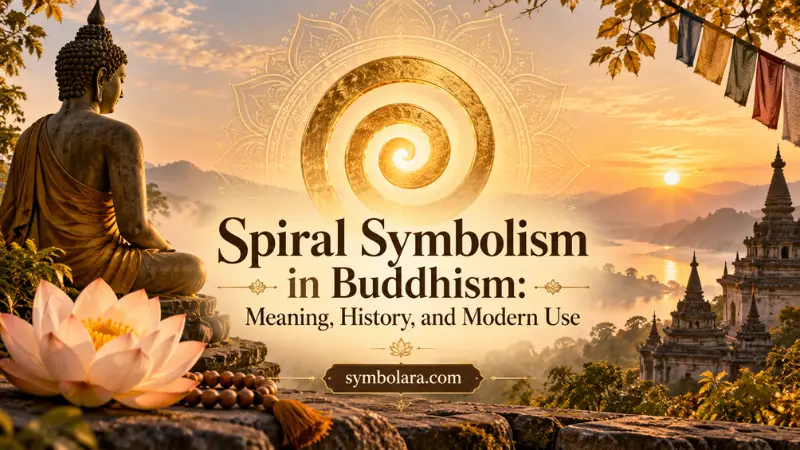
A spiral begins with a curved line that winds around a central point. You can see this shape in the small curls of a Buddha statue, the shell of a ceremonial conch, and certain designs found in Tibetan Buddhist art.
Spiral symbolism in Buddhism is connected with several ideas, including Buddhist teachings, awakening, continuity, and the relationship between different parts of spiritual practice. However, these meanings depend on the specific object or tradition. Buddhism does not have one universal spiral symbol with a single meaning.
Today, Americans encounter these designs in museums, meditation spaces, tattoos, jewelry, and decorative artwork. Some people see a spiral as a reminder of patience and personal growth. Others recognize it as part of a particular Buddhist religious tradition.
Understanding the difference helps explain why a simple curved shape can carry several meanings.
Quick Answer
Spiral symbolism in Buddhism can represent spiritual learning, continuity, and the process of moving toward greater understanding. Historically, spiral forms appear in Buddhist art through the Buddha’s curled hair, the right-turning conch shell, and certain Tibetan religious designs, each with its own specific meaning.
TL;DR
- Buddhist spirals can suggest learning, continuity, and spiritual development.
- The Buddha’s curled hair is a traditional feature of Buddhist sculpture.
- The right-turning conch represents the spread of Buddhist teachings.
- Tibetan Buddhist art includes the three-part swirling gankyil.
- The unalome is associated with spiritual progress in some Southeast Asian traditions.
- Modern interpretations often focus on mindfulness, patience, and personal growth.
What Does a Spiral Look Like in Buddhist Art?
A spiral is a curved line that winds around a central point. It may move outward, inward, or form several connected turns.
In Buddhist artwork, spiral-like forms appear in different ways.
Some Buddha statues have rows of small, tightly curled shapes covering the head. Each curl resembles a tiny circular coil.
A conch shell has a natural spiral structure, with a pointed end and a larger opening. In Tibetan Buddhist art, artists often emphasize this curved form.
Other designs use several curved sections arranged around a shared center. The Tibetan gankyil is one example.
These forms may look similar, but their meanings are not interchangeable.
A spiral on a Buddha statue belongs to a tradition of depicting the Buddha’s physical characteristics. A conch shell represents the communication of Buddhist teachings. A gankyil can express the relationship between different aspects of Buddhist practice.
The surrounding image matters as much as the spiral itself.
For example, a small curl inside a flower pattern may simply be decorative. A carefully drawn conch within a set of religious symbols has a more specific cultural meaning.
This distinction is useful when examining Buddhist paintings, statues, and religious objects.
Is the Spiral One of Buddhism’s Main Symbols?
Buddhism has several widely recognized symbols, but a plain spiral is not usually listed among its primary traditional emblems.
The Dharma wheel, lotus flower, and other established images have clearer roles in Buddhist teaching and art.
The Dharma wheel represents the Buddha’s teachings and the path of practice. Its spokes, circular rim, and central hub carry meanings that differ across traditions.
The lotus commonly represents purity and awakening. Its ability to grow from muddy water makes it a fitting image for spiritual development.
In Tibetan Buddhism, the Eight Auspicious Symbols form another important group. These include the right-turning conch shell, endless knot, treasure vase, and Dharma wheel.
The conch has a spiral structure, but its traditional identity is a shell rather than an abstract spiral.
This difference explains why descriptions of Buddhist spiral meanings sometimes seem inconsistent.
One writer may be discussing a modern interpretation of personal growth. Another may be describing a particular religious image.
Neither meaning should automatically replace the other.
A useful approach is to identify the actual design before deciding what it represents. That prevents a modern decorative interpretation from being mistaken for an established Buddhist teaching.
Why Do Buddha Statues Have Spiral Hair Curls?
Many Buddha statues show small curls arranged neatly across the head. These curls are among the most recognizable features of Buddhist sculpture.
Their appearance developed through artistic traditions rather than through one universally documented historical event.
During the early centuries of the Common Era, artists in regions such as Gandhara and Mathura created influential images of the Buddha.
Gandharan sculptors often depicted flowing or wavy hair. Other sculptural traditions favored shorter, tighter curls.
Over time, the tightly curled hairstyle became common in many parts of Asia.
Traditional accounts sometimes explain the Buddha’s curled hair through stories about his decision to leave his former life and become a spiritual seeker.
One legend says his hair remained short and curled after he cut it.
These stories help explain how some Buddhist communities understood the hairstyle. They should not be treated as verified physical descriptions of the historical Buddha.
The curls are also distinct from the ushnisha, the raised feature on top of the Buddha’s head that is associated with his exceptional qualities and awakening.
In American museums, visitors can see these artistic features on Buddhist sculptures from India, Indonesia, Myanmar, and other Asian regions.
The curls help identify the figure while showing how artists developed a shared visual tradition across different cultures.
What Does the Right-Turning Conch Spiral Symbolize?
The white conch shell is one of the Eight Auspicious Symbols used in Tibetan Buddhism.
Its meaning is especially connected with the sound of Buddhist teachings.
A conch shell can produce a loud, carrying sound when used as a trumpet. This physical quality helped establish its religious meaning.
In traditional Buddhist interpretation, the shell represents the Buddha’s teachings reaching people and helping them overcome ignorance.
The shell’s right-turning form is considered auspicious in the relevant artistic tradition.
However, determining whether a particular shell turns right or left can require careful attention to how it is positioned. A flat drawing does not always make the direction obvious.
The conch also has a history outside Buddhism.
It appears in Hindu religious traditions and has served as a ceremonial instrument in South Asia. Buddhist communities adopted and interpreted the shell within their own religious settings.
In Tibetan ceremonial practice, conch trumpets may accompany religious activities. The symbolic image of a conch and an actual ceremonial instrument are closely related but not identical.
Today, Americans may encounter this design on Tibetan paintings, textiles, ceremonial objects, or educational displays.
For someone familiar with its Buddhist meaning, the shell can serve as a reminder to listen carefully, learn, and share useful teachings with others.
The Gankyil: Three Spirals Connected as One
The gankyil is a distinctive swirling design associated with Tibetan Buddhist traditions, especially Dzogchen teachings.
It commonly contains three curved, interlocking sections arranged around a central point.
The sections appear to turn together, creating the impression of continuous movement.
The name is often translated as “wheel of joy.”
In some Dzogchen explanations, the three connected parts represent the base, path, and result of spiritual practice.
These terms describe different aspects of the tradition’s approach to understanding reality and awakening.
The sections are visually distinct, yet they form one continuous design.
This arrangement expresses their inseparable relationship.
Other interpretations exist, and the symbol’s meaning depends on the particular religious context.
The gankyil also has connections with Bön, a Tibetan religious tradition distinct from Buddhism. Its appearance therefore should not automatically be treated as proof that an object belongs to a Buddhist setting.
In modern American artwork, the gankyil may be appreciated for its balanced curves and three-part structure.
Still, its traditional purpose involves more than visual balance. It belongs to particular teachings that give the design its religious meaning.
The Unalome: Why a Spiral Leads Into a Straight Line
The unalome is another spiral-like design often associated with Buddhist spirituality, particularly in Thai cultural and tattoo traditions.
Its appearance usually begins with a small spiral or curl.
The line may then pass through several bends before continuing upward in a straighter direction. Some modern versions end with a dot or decorative element.
A common contemporary interpretation presents this design as a journey from confusion toward clarity.
The curved beginning represents difficulty or uncertainty, while the straighter section suggests a more settled understanding.
This reading makes the unalome especially attractive to people who want a visual reminder of learning from mistakes.
However, its cultural background is more specific than many modern descriptions suggest.
Unalome forms appear within Thai religious imagery, including designs associated with sacred sak yant tattoo traditions. In those settings, the motif can have meanings connected with religious figures and traditional symbolic forms.
The familiar explanation of a winding personal journey should not be presented as the only original meaning.
Nor is the unalome a universal symbol used in exactly the same way by every Buddhist school.
In the United States, simplified unalome designs appear in tattoos, pendants, and minimalist artwork.
People often choose them to mark a personal turning point, although that modern interpretation may differ from the design’s traditional religious context.
Why Do Buddhists Walk Clockwise Around Stupas?
Movement around a sacred place is an important practice in several Buddhist traditions.
A stupa is a Buddhist religious structure that may contain relics or commemorate significant events and teachings.
Practitioners sometimes walk around a stupa or temple in a clockwise direction, keeping the sacred structure on their right.
This practice is called circumambulation. In Tibetan Buddhism, it is commonly known as kora.
The movement expresses respect and devotion.
A person may walk quietly, recite prayers, or reflect on Buddhist teachings while completing the circuit.
At Boudhanath Stupa in Kathmandu, Nepal, for example, visitors can observe people walking clockwise around the structure.
From above, their route forms a circle rather than a true spiral.
That distinction matters.
The practice is not based on a general rule that every spiral produces spiritual progress.
Instead, it belongs to an established religious custom in which the direction, place, and intention have particular importance.
Americans visiting Buddhist temples may encounter similar practices, depending on the community.
For an observer, repeated movement may suggest patience and focused attention. For a practitioner, the action has a religious purpose that goes beyond the visual pattern.
How Are Spirals Different From the Buddhist Wheel of Life?
The idea of repeated movement can remind people of the Buddhist understanding of rebirth.
Buddhist teachings describe samsara as the ongoing cycle of birth, death, and rebirth under the conditions of ignorance and craving.
This idea appears visually in the Wheel of Life, also called the bhavachakra.
Traditional versions use a circular image divided into several parts. Figures and scenes illustrate causes of suffering and different forms of existence.
The wheel is not normally drawn as an ascending spiral.
That difference is important because modern descriptions sometimes suggest that every turn of a spiral represents improvement.
Traditional Buddhist teachings do not describe repeated rebirth as an automatic process of becoming wiser.
Instead, the goal involves liberation from the conditions that keep suffering going.
A modern spiral may still remind someone of repeated attempts to change a habit.
For instance, a person might notice the same emotional reaction returning during stressful situations. Through reflection and practice, they may begin responding differently.
This is a reasonable personal use of spiral imagery.
It should simply be distinguished from the traditional Wheel of Life and its specific religious teachings.
How Spiral Designs Changed Across Buddhist Regions
Buddhist artwork developed across many regions, including India, Central Asia, China, Tibet, Korea, Japan, and Southeast Asia.
As Buddhist teachings moved between communities, artists adapted their visual forms.
During the second and third centuries CE, sculpture from Gandhara often portrayed the Buddha with wavy hair and carefully arranged clothing.
Other sculptural traditions used tighter hair curls, contributing to the familiar Buddha images seen today.
By the eighth and ninth centuries, Buddhist sculpture in Java, Indonesia, included heads with closely arranged spiral curls.
In Tibetan art, the right-turning conch became an important element within groups of auspicious symbols.
The gankyil also developed particular significance within Tibetan religious teachings.
These examples show different uses of curved forms rather than one spiral symbol spreading unchanged from place to place.
Cultural exchange played an important role in Buddhist art, but artists did not always attach the same meaning to similar shapes.
This remains true in American museums.
Two Buddhist objects may contain spirals while representing different periods, regions, and religious practices.
Looking at the date, place of origin, and identity of the object provides a more accurate interpretation than examining the shape alone.
What Spiral Shapes Can Mean Emotionally
A spiral can create a strong visual impression because the eye naturally follows its turning line.
Unlike a straight path, the spiral changes direction repeatedly.
This quality can make it useful as a personal image of patience, reflection, and gradual change.
Someone who practices mindfulness may associate the shape with learning to notice thoughts without immediately reacting to them.
Another person may view the spiral as a reminder that progress does not always happen in a straight line.
These interpretations can feel encouraging during periods of uncertainty.
For example, someone beginning a meditation routine may repeatedly become distracted. Returning attention to the present moment becomes part of the practice.
A spiral can serve as a personal reminder of that return.
However, Buddhism does not teach that looking at a spiral automatically improves concentration or produces awakening.
The shape itself has no scientifically established ability to change someone’s mental state merely through its religious association.
Its emotional value depends on how the individual understands and uses it.
For many Americans, the attraction comes from combining a simple visual pattern with a personal commitment to patience or self-awareness.
That meaning can be worthwhile without claiming that every Buddhist tradition teaches the same interpretation.
How Americans Use Buddhist Spiral Imagery Today
In the United States, Buddhist-inspired spiral designs appear in several settings.
Museums and cultural exhibitions provide opportunities to examine traditional objects. A visitor may notice the Buddha’s curls on a statue or the conch shell on Tibetan religious artwork.
Buddhist temples and meditation centers offer a different setting, where religious images belong to ongoing community practices.
Outside these spaces, spiral designs also appear in clothing, jewelry, tattoo artwork, and home decoration.
The meanings can change depending on how the object is presented.
A person wearing a spiral pendant may associate it with emotional balance. Someone displaying an accurately identified gankyil may understand its relationship to specific Tibetan teachings.
In 2025–2026, digital artwork and social media also provide ways for people to encounter Buddhist-inspired designs without visiting a religious or cultural institution.
This wider visibility creates opportunities for learning, but it can also separate a design from its original context.
The following table shows how interpretation changes across common American settings.
| Context | Meaning in USA | Common Associations | Notes |
| Museum displays | Cultural and artistic identity | Sculpture, regional history | Object labels help identify the original tradition. |
| Meditation spaces | Reminder of religious practice | Attention, reflection | Meanings depend on the Buddhist community. |
| Tattoo designs | Personal transformation | Life changes, resilience | Sacred motifs may carry placement restrictions. |
| Jewelry | Personal values and identity | Patience, commitment | Decorative spirals are not always Buddhist. |
| Home decoration | Visual calm or cultural appreciation | Balance, simplicity | Accurate identification helps avoid mislabeling. |
| Online illustrations | Simplified spiritual identity | Mindfulness, self-discovery | Modern explanations may differ from traditional ones. |
The table highlights an important point: an object’s meaning depends partly on its setting.
A spiral purchased as decoration and a spiral included in a religious painting may look alike without serving the same purpose.
Buddhist Spiral Tattoos, Misunderstandings, and Respectful Use
Spiral-based tattoos have become one way for Americans to express personal beliefs and experiences.
An individual might choose a small curved design to remember a difficult period or celebrate a new beginning.
Others select recognizable Buddhist motifs, including the unalome or gankyil.
These choices deserve careful consideration because some designs belong to living religious traditions.
In Thailand, for example, sak yant tattoos may involve religious instruction, ceremonial practices, and commitments connected with the wearer.
A decorative copy does not necessarily carry the same meaning as a tattoo created within that tradition.
Buddhist communities also differ in their views about tattooing religious figures and symbols.
Some people consider certain placements disrespectful, especially when sacred imagery appears on lower parts of the body.
There is no single opinion shared by all Buddhists.
Another misunderstanding concerns the direction of a spiral.
Although the right-turning conch has specific religious importance, this does not mean every clockwise spiral is holy or every counterclockwise spiral is harmful.
Similarly, the Buddha’s hair curls should not be described as proof that real snails covered his head. Stories involving snails belong to later popular explanations, not verified historical evidence.
Modern artwork sometimes combines spiral shapes with lotuses, mandalas, or other Buddhist-inspired designs.
Such combinations may be visually appealing, but they do not automatically form a traditional religious emblem.
The most respectful approach is to learn what a particular symbol represents before using it.
That allows someone to appreciate Buddhist art without assigning invented meanings to a living religious tradition.
FAQs
Certain spiral-shaped forms have sacred meaning in particular Buddhist traditions. The right-turning conch, for example, is a recognized auspicious symbol, but an ordinary spiral drawn on paper is not automatically a sacred Buddhist emblem.
Some modern designs, especially popular interpretations of the unalome, connect spiral forms with a journey toward enlightenment. Traditional Buddhist teachings describe awakening through understanding and practice, not through the presence of a spiral shape alone.
Clockwise direction matters in certain Buddhist symbols and practices, including the right-turning conch and circumambulation. Its meaning depends on the specific tradition, so it should not be treated as a universal rule for every curved design.
Buddhist and Hindu art sometimes use related forms because their histories developed within overlapping South Asian cultural settings. However, the religious meaning of a particular conch, wheel, or other curved design depends on how each tradition uses it.
Unalome motifs have connections with Thai religious imagery and sacred tattoo traditions. Many modern minimalist versions have been adapted for decorative use, so their appearance and explanations do not always match traditional practice.
A simple spiral necklace is not inherently Buddhist, so wearing one usually does not raise a specific religious concern. If the necklace includes a recognized sacred motif, learning its identity and significance is a considerate choice.
No. Buddhist mandalas often use circles, squares, and carefully arranged figures to represent religious teachings or sacred settings. Some designs contain curved or swirling elements, but a spiral is not a required feature of every mandala.
Conclusion
Spiral symbolism in Buddhism is best understood through the specific objects and traditions in which it appears. The Buddha’s curled hair, the right-turning conch shell, the Tibetan gankyil, and the unalome each have different cultural backgrounds and meanings.
In modern American life, spiral designs may also represent patience, personal development, and the process of learning from experience. These interpretations can be meaningful, provided they are not confused with established religious teachings.
The next time you notice a spiral on a Buddha statue, Tibetan painting, or piece of jewelry, look at the complete design and where it came from. Those details often explain far more than the curved line alone.