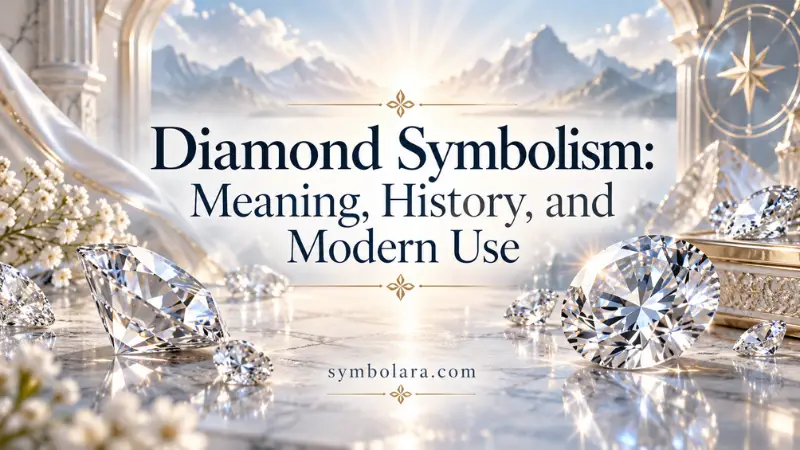
A diamond can look almost colorless until light strikes its polished surfaces, creating bright white flashes and rainbow colors. Its remarkable hardness and brilliant appearance help explain why people associate it with lasting love, personal strength, and lasting promises.
Diamond symbolism goes far beyond expensive jewelry. A diamond engagement ring can represent commitment, while a small diamond necklace might honor a family member or celebrate personal achievement. The meaning often depends on the person wearing it and the occasion behind the gift.
In American culture, diamonds appear in wedding traditions, birthday celebrations, fashion, movies, and family collections. Yet these familiar meanings developed over centuries through trade, craftsmanship, changing social customs, and advertising.
Understanding those influences helps explain why one gemstone can represent romance, success, endurance, and treasured memories.
Quick Answer
Diamond symbolism represents lasting love, commitment, strength, purity, and resilience. These meanings grew from the gemstone’s unusual hardness, rarity, and historical association with wealth and marriage. In modern American culture, diamonds commonly express romantic promises, personal milestones, and lasting family connections.
TL;DR
- Love: Diamonds commonly represent devotion, commitment, and romantic partnership.
- Strength: Their exceptional hardness suggests endurance and resilience.
- History: Early diamond trading and symbolism developed in India.
- Marriage: Advertising helped establish modern American engagement traditions.
- Personal meaning: Diamond jewelry can celebrate achievements and treasured relationships.
- Modern values: Ethical sourcing and personal choice increasingly influence diamond purchases.
What Makes a Diamond Special?
Diamonds are gemstones made of carbon arranged in a tightly bonded crystal structure. Most natural diamonds formed far below Earth’s surface under extreme heat and pressure, often billions of years ago.
Their appearance depends on their color, cut, clarity, and size.
A well-cut diamond reflects light through carefully arranged surfaces called facets. These surfaces produce its familiar sparkle.
Although colorless diamonds receive considerable attention, natural diamonds also occur in yellow, brown, pink, blue, and other colors.
The gemstone’s physical characteristics contribute to its symbolic appeal.
Diamonds rank 10 on the Mohs scale of mineral hardness. This makes them especially resistant to scratches, which helps explain their connection with endurance.
However, hardness does not mean a diamond cannot break. A strong impact in the wrong direction can chip or fracture one.
This contrast creates an interesting comparison with human relationships. Something can be remarkably strong while still needing care.
Its geological age also adds emotional meaning. A gemstone formed long before human civilization can become a reminder of continuity across generations.
Why Do Diamonds Symbolize Love, Commitment, and Strength?
The most recognized meaning of a diamond in the United States is lasting romantic commitment.
When someone gives a diamond engagement ring, the gemstone usually communicates a promise to build a shared future.
That interpretation connects the diamond’s durability with the hope that a relationship will endure difficult periods.
Still, love is only one part of its meaning.
Diamonds commonly represent five related ideas:
Love and devotion
Diamond rings often mark a serious romantic commitment. Their lasting appearance makes them a fitting reminder of a promise.
Strength and resilience
Because diamonds resist scratching, people associate them with perseverance. A diamond pendant might celebrate someone who has overcome a difficult experience.
Purity and honesty
The clear appearance of many diamonds encourages associations with sincerity and openness. This interpretation is cultural rather than a scientific property.
Success and achievement
Diamonds can commemorate professional accomplishments, important birthdays, or financial independence.
Permanence and memory
An inherited diamond may represent a family relationship that continues to matter after the original owner has died.
These meanings overlap, but they are not interchangeable. An engagement ring and a graduation necklace can contain identical stones while telling completely different stories.
Where Did Diamond Symbolism Begin?
India played a central role in the earliest documented diamond trade.
Diamonds were collected from rivers and other deposits, and historical accounts indicate that Indian diamonds entered trade networks by approximately the fourth century BCE.
Their unusual hardness, limited availability, and attractive appearance made them desirable among wealthy individuals and ruling families.
Early diamond jewelry often looked quite different from modern examples.
Instead of the carefully shaped stones seen in American jewelry stores, many diamonds were worn with much of their natural crystal form preserved.
The stone’s rarity and durability encouraged beliefs about status, protection, and personal fortune.
Some historical Indian traditions also connected gemstones with religious and astrological ideas. However, these interpretations varied by region, period, and belief system.
How Diamond Trade Expanded
Over time, Indian diamonds reached markets beyond South Asia.
Trade routes carried gemstones into the Middle East and Europe, where wealthy collectors and rulers increasingly valued them.
During the early 1700s, Brazil became an important diamond producer as Indian supplies declined.
Major discoveries in southern Africa during the nineteenth century later transformed the global diamond industry.
As more diamonds entered international markets, their meaning gradually shifted.
They remained expensive luxury goods, but improved cutting techniques and commercial jewelry production helped make them recognizable symbols of romance.
How Diamonds Became Associated With European Marriage Traditions
Diamond engagement rings did not begin as a universal marriage custom.
Earlier European betrothal rings frequently featured plain metal bands or other gemstones. Diamonds became associated with elite marriage arrangements during the late medieval period.
A frequently cited example dates to 1477.
Archduke Maximilian of Austria arranged his engagement to Mary of Burgundy, and a surviving written account describes advice to use a diamond in the engagement ring.
This example is significant, although it should not be treated as proof that the couple invented diamond engagement rings.
Among European aristocrats, precious gemstones could communicate family status, wealth, and political relationships.
Their use was not always centered on personal romance.
Later developments in jewelry design changed how diamonds appeared.
In 1886, Tiffany & Co. introduced a six-prong setting that raised the diamond above the ring’s band. This arrangement allowed more light to reach the gemstone and emphasized its appearance.
The design helped establish the recognizable solitaire engagement ring.
As jewelry styles changed, the diamond increasingly became the center of attention rather than one decorative element among many.
How American Advertising Changed the Meaning of Diamonds
One of the most important changes in American diamond culture occurred during the twentieth century.
Diamond engagement rings existed before this period, but they were not always considered an expected part of marriage proposals.
In 1947, advertising copywriter Frances Gerety created the phrase A Diamond Is Forever for De Beers.
The slogan appeared in advertising beginning in 1948.
Its message connected a diamond’s physical durability with the idea of a lasting marriage.
That comparison was memorable and easy to understand.
The advertising campaigns also helped establish diamond jewelry as a familiar symbol of romantic success.
Hollywood contributed to this image.
In the 1953 film Gentlemen Prefer Blondes, Marilyn Monroe performed Diamonds Are a Girl’s Best Friend, reinforcing the connection between gemstones, glamour, and luxury.
These cultural influences helped make diamond jewelry a recognizable feature of American proposals and special occasions.
Importantly, advertising did not create every romantic meaning associated with diamonds.
Instead, it expanded an existing custom and helped establish stronger expectations around purchasing a diamond engagement ring.
What Do Diamonds Represent in American Relationships Today?
Diamonds remain familiar symbols of romantic commitment, but their use has become more flexible.
A traditional engagement ring often features a single prominent diamond. However, many couples choose different arrangements that reflect their personalities.
Some prefer small stones, colored gemstones, vintage settings, or rings without diamonds.
Others choose matching bands or select their jewelry together.
The commitment matters more than following one particular design.
Diamond Engagement Rings
For many couples, the diamond represents a shared decision to marry.
The ring serves as a visible reminder of that promise.
Its emotional importance may come from the circumstances surrounding the proposal rather than the gemstone’s market value.
Diamond Wedding Jewelry
Diamonds can also appear in wedding bands.
Some couples add stones to their rings after important life events, such as anniversaries or the birth of a child.
Each addition can represent another chapter in their relationship.
Diamond Anniversary Gifts
The sixtieth wedding anniversary is commonly called the diamond anniversary.
This association makes diamonds especially suitable for celebrating a marriage that has lasted six decades.
Some anniversary traditions also connect diamonds with the seventy-fifth year.
These customs emphasize years of shared experience rather than the size or price of a gemstone.
What Do Diamonds Mean in Different Cultures and Religious Traditions?
Diamond interpretations developed differently across societies.
Although durability is a recurring theme, not every culture connects diamonds primarily with romantic love.
Indian Traditions
Diamonds have a long history in Indian trade, ornament, and royal collections.
In some Hindu astrological traditions, diamonds are associated with Venus, which is connected with beauty, pleasure, and relationships.
Such beliefs belong to particular religious and cultural systems. They should not be presented as beliefs shared by everyone in India.
Buddhist Traditions
The Sanskrit word vajra can mean both diamond and thunderbolt.
In Vajrayana Buddhism, the vajra represents qualities such as firmness and the ability to overcome ignorance.
A ritual vajra is generally a specially shaped symbolic object rather than a gemstone.
The connection comes from the comparison between a diamond’s hardness and qualities valued within the religious tradition.
European Historical Beliefs
During parts of medieval and Renaissance European history, gemstones appeared in writings about protection, health, and good fortune.
Diamonds were sometimes credited with protective properties.
These were historical beliefs, not demonstrated medical effects.
The comparison between diamond hardness and personal courage also helped strengthen associations with bravery and endurance.
Together, these traditions show how different societies interpreted the same physical material through their own customs.
Why Do People Connect Diamonds With Personal Strength?
Not every diamond gift celebrates romance.
For some Americans, buying a diamond is a way to recognize an achievement or mark a new beginning.
Someone might purchase a diamond ring after finishing college, establishing a business, or recovering from a difficult period.
In that situation, the gemstone becomes a personal reminder of progress.
Its hardness provides an easy comparison with persistence.
The emotional meaning often develops through experience.
A diamond received from a grandparent may feel comforting because it preserves a connection to family history.
A ring purchased independently may represent financial confidence or freedom of choice.
Another person might associate a diamond with an uncomfortable relationship or an unwanted expectation.
There is no single emotional response that applies to everyone.
The gemstone itself does not create resilience or change a person’s circumstances. Instead, people use it to represent qualities and experiences they already value.
What Do Different Diamond Colors and Shapes Symbolize?
Diamonds do not all communicate exactly the same visual message.
Their colors and shapes can influence how people interpret jewelry, especially when the design is chosen for a personal reason.
White or Colorless Diamonds
Colorless diamonds are often associated with clarity, elegance, and traditional commitment.
Their familiar appearance makes them popular for engagement rings.
Pink Diamonds
Pink diamonds may suggest affection, tenderness, and individuality.
Their less common appearance can appeal to people seeking jewelry that feels different from traditional designs.
Blue Diamonds
Blue diamonds are sometimes associated with calmness, loyalty, and distinction.
The famous Hope Diamond, displayed at the Smithsonian Institution, is a 45.52-carat blue diamond with a complicated history involving European royalty and private collectors.
Yellow Diamonds
Yellow diamonds can suggest warmth, confidence, and cheerful personal style.
These associations come largely from the emotional meanings people attach to the color yellow.
Diamond Shapes
A heart-shaped diamond clearly emphasizes romance.
Round diamonds are associated with classic jewelry design, while emerald-cut diamonds may communicate a preference for clean lines and understated elegance.
Pear-shaped and oval diamonds often appeal to people who prefer a distinctive silhouette.
None of these meanings are fixed rules.
Diamond shape and color are personal design choices, not reliable indicators of someone’s character.
Why Do Diamonds Appear in Tattoos, Fashion, and Popular Culture?
Diamonds are recognizable even when no actual gemstone is present.
A simple drawing with pointed edges and geometric facets can immediately suggest luxury, endurance, or personal worth.
Diamond Tattoos
Diamond tattoos often represent resilience, confidence, or something a person considers valuable.
A small diamond tattoo might commemorate surviving a difficult experience.
Others choose the design because they enjoy its balanced geometric appearance.
The specific meaning depends on the person wearing it.
Fashion and Accessories
Diamond designs appear on clothing, handbags, watches, and accessories.
In these settings, the image frequently suggests elegance, luxury, or a polished personal style.
An actual diamond is unnecessary for the message to work.
Digital Communication
The diamond emoji is sometimes used online to express admiration, rarity, or an expensive appearance.
It can also suggest that someone or something is especially valuable.
However, its meaning changes with the conversation.
A diamond emoji in a romantic message may communicate affection, while the same image in a fashion post may simply emphasize sparkle.
How Diamond Symbolism Changes Across American Celebrations
Diamonds carry different associations depending on the occasion and how the jewelry is presented.
| Context | Meaning in USA | Common Associations | Notes |
| April birthday jewelry | Personal identity and celebration | Birthstones, birthdays, individuality | Diamond is April’s traditional birthstone. |
| Championship jewelry | Victory and recognition | Teamwork, sporting achievement, prestige | Some championship rings feature diamonds. |
| Family inheritance | Continuity between generations | Memory, heritage, family connections | Emotional value may exceed resale value. |
| Personal milestone gift | Independence and achievement | Graduation, career growth, self-recognition | A diamond can be purchased as a gift to oneself. |
| Luxury branding | Exclusivity and refinement | High-end design, quality, status | Diamond imagery may appear without real gemstones. |
These examples show why context matters.
The same gemstone can honor an athlete’s victory, celebrate a birthday, or preserve memories of a family member.
Why Inherited Diamonds Carry Special Meaning
An inherited diamond often becomes more than a piece of jewelry.
It may preserve a story about someone who wore it during an important period of life.
For example, a grandmother’s engagement ring can connect later generations with a marriage they remember through photographs and family stories.
The stone might eventually be placed in a new setting.
Although the design changes, the family association can remain.
Some people preserve inherited jewelry exactly as they received it. Others redesign it into a necklace or another ring so they can wear it comfortably.
Neither choice makes the memory less meaningful.
Family diamonds can also carry complicated emotions, especially when inheritance involves disagreements or painful relationships.
Their significance depends on the family’s experiences, not simply their age.
This explains why an ordinary-looking inherited stone may be more personally valuable than a much larger diamond purchased from a jewelry store.
Do Natural and Lab-Grown Diamonds Have Different Meanings?
Laboratory-grown diamonds have changed modern jewelry choices.
Both natural and lab-grown diamonds consist of crystallized carbon and share essentially the same chemical, physical, and optical properties.
The main difference is how they form.
Natural diamonds develop through geological processes, while laboratory-grown diamonds are produced using specialized equipment.
For some buyers, a natural diamond’s geological age contributes to its appeal.
They may associate it with rarity and the natural world.
Other buyers appreciate laboratory-grown diamonds because they offer different pricing and purchasing options.
A lab-grown diamond can still represent love, marriage, or personal accomplishment.
The origin of the stone does not determine whether someone’s promise is sincere.
It is also important to distinguish lab-grown diamonds from diamond simulants.
Cubic zirconia and moissanite can resemble diamonds, but they are different materials.
In contemporary American relationships, the symbolic value of a ring increasingly reflects personal preference rather than one required gemstone category.
How Have Conflict Diamonds Changed Public Perceptions?
Diamond symbolism also has a difficult historical side.
Mining and gemstone trading have sometimes been connected with exploitation, environmental damage, and armed conflict.
The term conflict diamonds commonly refers to diamonds used by rebel movements to finance armed conflicts against governments.
Public concern about this problem contributed to the creation of the Kimberley Process Certification Scheme, which began operating in 2003.
The scheme aims to limit the international trade in conflict diamonds.
However, its definition and certification rules do not address every possible labor, human rights, or environmental concern.
For this reason, certification alone should not be treated as a guarantee that every stage of a diamond’s production was free from harm.
Some buyers now ask retailers about sourcing, traceability, working conditions, and environmental practices.
Others consider secondhand diamonds or laboratory-grown stones.
These alternatives also involve practical tradeoffs.
For example, producing laboratory-grown diamonds requires electricity, so broad claims that every such diamond is environmentally friendly can be misleading.
For many modern consumers, the diamond’s meaning now includes questions about the people and practices involved in bringing it to market.
Common Misunderstandings About Diamond Meaning
Several familiar ideas about diamonds become less accurate when examined closely.
Diamonds Cannot Be Broken
A diamond is extremely resistant to scratching, but it can chip or fracture.
Its hardness and durability are not the same as complete resistance to damage.
Diamonds Guarantee Lasting Love
No gemstone can guarantee the success of a relationship.
A ring expresses commitment, but trust, communication, and shared effort sustain that commitment.
A Larger Diamond Means Greater Love
Diamond size is not a reliable measure of affection.
A modest ring chosen thoughtfully can carry more personal meaning than a large stone purchased mainly to impress others.
Diamonds Have One Universal Spiritual Meaning
Diamond interpretations vary across cultures and religious traditions.
Some historical beliefs connected diamonds with protection, while modern consumers may associate them mainly with romance or luxury.
Neither meaning applies universally.
Diamond Value Always Increases
Jewelry does not automatically become more valuable over time.
Resale prices depend on quality, demand, market conditions, and other factors.
A diamond’s personal significance can remain important even when its financial value changes.
How Diamond Symbolism Is Changing in 2025–2026
Americans continue to recognize diamonds as symbols of romance and achievement, but expectations surrounding them are becoming more flexible.
People increasingly encounter choices involving natural stones, laboratory-grown diamonds, inherited jewelry, and alternative gemstones.
These options allow couples and individuals to decide what matters most to them.
Some emphasize tradition. Others prioritize affordability, appearance, personal history, or questions about sourcing.
Diamond jewelry is also no longer limited to engagement announcements.
People may purchase it to celebrate career achievements, meaningful birthdays, or personal independence.
This broadens the gemstone’s message beyond romantic relationships.
At the same time, cultural expectations have not disappeared.
Advertisements, celebrity jewelry, and familiar wedding customs still influence what Americans associate with diamonds.
The result is a symbol that can represent established traditions while allowing room for individual interpretation.
FAQs
In some religious traditions, diamonds represent firmness, clarity, or qualities associated with spiritual discipline. In Vajrayana Buddhism, the diamond-related idea of the vajra has a specific religious meaning that differs from modern jewelry symbolism.
Some historical traditions regarded diamonds as protective or fortunate stones. Other stories, including legends surrounding the Hope Diamond, associated particular gemstones with misfortune, but there is no evidence that diamonds control luck.
A diamond given between friends can represent appreciation, loyalty, or a meaningful shared experience. Unlike an engagement ring, its meaning comes from the relationship and the reason for the gift rather than an established marriage custom.
Diamonds are included in the standardized American birthstone tradition, which was formalized by the jewelry trade in 1912. Today, April birthstone jewelry is commonly given as a personalized birthday gift, regardless of whether the recipient believes gemstones carry special meanings.
It can symbolize either or both, depending on the setting. A diamond displayed in luxury advertising may emphasize status, while a modest engagement ring usually places greater emphasis on affection and commitment.
A diamond in a dream may reflect personal thoughts about commitment, achievement, value, or something difficult to lose. Dream imagery does not have a scientifically established universal meaning, so the dreamer’s experiences and emotions are more useful than fixed predictions.
Not necessarily. While diamonds commonly suggest affection and achievement, they can also remind someone of social pressure, excessive spending, loss, or concerns about mining practices. Their meaning depends on context and personal experience.
Conclusion
Diamond symbolism centers on love, commitment, strength, resilience, and personal value. These associations developed through early gemstone traditions, European jewelry customs, and the changing expectations of American society.
Today, diamonds represent more than marriage or luxury. They can celebrate individual achievements, preserve family memories, and mark moments people want to remember.
A diamond’s meaning ultimately comes from the story attached to it. Whether it is a small inherited ring or a carefully chosen gift, the lasting value people recognize often comes from the relationship, memory, or achievement it represents.