
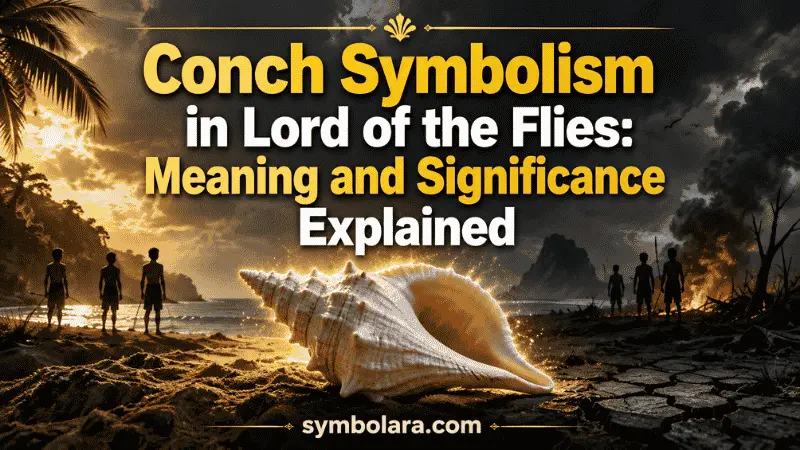
Conch symbolism in Lord of the Flies centers on civilization, democratic participation, social order, and the right to be heard. William Golding takes an ordinary shell and gradually turns it into one of the novel’s clearest measures of whether the stranded boys still accept rules stronger than individual force.
At first, the conch helps bring scattered children together and gives their meetings a recognizable structure. Later, its authority weakens as Jack rejects Ralph’s leadership and the group becomes increasingly governed by fear, loyalty, and violence. The shell therefore does more than represent civilization in a general sense: its changing status shows civilization breaking down in real time.
Published in 1954, Lord of the Flies appeared in the aftermath of World War II, a period that strongly shaped Golding’s thinking about social order and human behavior. That historical setting makes the conch especially important because the novel repeatedly asks whether institutions and rules can survive when people stop agreeing to respect them.
Quick Answer
Conch symbolism in Lord of the Flies primarily represents civilization, democratic order, shared authority, and the right to speak. As the boys stop respecting the shell, it also comes to symbolize the fragility of social rules: when the conch is finally destroyed, the organized society Ralph tried to maintain effectively disappears with it.
TL;DR
- The conch represents civilization, rules, and democratic participation.
- Holding it gives boys a recognized right to speak.
- Ralph links the conch with orderly leadership and cooperation.
- Jack rejects it as he turns toward personal power.
- Its fading authority mirrors the collapse of the boys’ society.
- Its destruction marks the final defeat of organized civil order.
What the Conch Represents at a Glance
The conch carries several connected meanings rather than one fixed definition. Its central associations all grow from the way the boys use it.
| Context | Symbolic Meaning | What It Shows |
|---|---|---|
| Calling the first assembly | Unity and organization | Separate survivors become a group |
| Speaking during meetings | Voice and participation | Rules can protect individual speakers |
| Ralph’s leadership | Legitimate authority | Leadership depends on accepted procedures |
| Jack’s rejection of it | Rebellion against civil order | Power begins replacing agreement |
| Its declining influence | Fragile institutions | Rules fail when people stop honoring them |
| Its destruction | Collapse of civilization | Violence replaces discussion completely |
The important point is that the shell does not possess political authority naturally. The boys give it authority by agreeing that it matters. That makes the conch a symbol not only of government but of the social agreement that makes government possible.
How Ralph and Piggy Turn a Shell Into Authority
Ralph and Piggy discover the shell soon after arriving on the island. Piggy understands that it can produce a loud call, and Ralph uses it to summon the other survivors. Its first function is therefore practical: the conch brings scattered individuals into one place.
That first gathering changes its meaning. The shell becomes connected with assembly, leadership, and collective decision-making. Ralph holds it while the boys organize themselves, and his association with the conch helps establish him as a public leader rather than simply another child.
Piggy is especially important to this development. He recognizes that orderly meetings require procedures. Ralph has the presence and popularity to lead, while Piggy repeatedly understands why systems, rules, and rational discussion matter.
The conch grows out of both qualities. It needs Ralph’s visible authority, but it also expresses Piggy’s belief that society requires structure.
The Conch as a Symbol of Democracy
The most widely accepted interpretation of the conch is that it represents democracy and civilized government. The boys hold assemblies, vote on leadership, establish rules, and create procedures for speaking. Educational interpretations of the novel consistently identify democracy and civilization as central meanings of the shell.
Golding does not present their island government as a sophisticated political system. The boys are children reproducing institutions they remember from adult society. Yet that simplicity strengthens the symbolism.
Voting represents consent. Meetings represent public deliberation. Speaking rules represent procedural fairness. The conch ties those elements together.
This also explains why Jack increasingly dislikes it. His problem is not merely with the physical shell. The conch limits his ability to dominate a discussion simply because he is louder, more intimidating, or more aggressive.
The Conch as the Right to Speak
The conch has another closely related meaning: voice.
During assemblies, the boy holding the shell is supposed to receive an opportunity to speak without interruption. In principle, this creates space for individuals who do not possess physical strength or high social status.
That feature matters especially for Piggy. He lacks the qualities that give Jack and Ralph immediate influence. He is frequently mocked and interrupted, yet the rule of the conch gives him a procedural claim to attention.
The distinction is important. The shell cannot make other boys respect Piggy personally. What it can do is represent a rule saying that personal popularity should not determine whether someone deserves to speak.
In that sense, the conch represents more than free expression. It represents protected participation: the idea that a community needs procedures allowing people to contribute even when others would prefer to ignore them.
Why the Conch Represents Civilization
Civilization in the novel is not represented mainly by buildings, technology, or comfort. It appears through behavior.
Can the boys wait their turn?
Can they listen to arguments they dislike?
Can they follow rules when nobody is physically forcing them?
Can they work toward long-term goals rather than immediate excitement?
The conch becomes civilization in miniature because using it requires restraint. A boy who wants to interrupt must remain quiet. A leader must recognize another speaker’s temporary right to the floor. The group must accept an abstract rule even when breaking that rule would be easier.
That is why the shell’s decline matters. The boys do not suddenly forget what rules are. They increasingly decide that rules no longer deserve obedience.
Golding therefore portrays civilization as a practice rather than a permanent condition.
What Does the Conch Symbolize Beyond Civilization?
The conch represents civilization, but its symbolism reaches beyond simple ideas of order and rules. It also represents the invisible agreements that allow communities to function.
A society does not operate only because laws exist. It works because people accept shared expectations about fairness, responsibility, and cooperation. The boys give the conch meaning by agreeing that it deserves respect.
This makes the shell a symbol of social trust. When the boys listen to it, they accept that discussion is stronger than immediate force. When they ignore it, they reveal that their belief in cooperation has weakened.
Golding uses the conch to show that civilization is not only a physical structure or a set of written rules. It is a choice people make through their actions. The shell becomes powerful because the group chooses to honor what it represents.
Once that shared belief disappears, the conch becomes only an object. Its failure shows that institutions depend on human commitment, not just on symbols or traditions.
Why the Conch’s Power Depends on Shared Belief
One of the most important ideas behind the conch is that its authority is socially created.
Physically, it is only a shell. It cannot arrest anyone, punish anyone, or force anyone to remain silent. Its influence exists because the boys collectively treat it as legitimate.
This makes the conch a useful symbol for institutions in the adult world. Money, elections, courts, offices, constitutions, ceremonial objects, and official titles all depend partly on communities recognizing the systems behind them.
Golding pushes that principle into a dangerous situation. What happens when enough people stop recognizing the rule?
The answer is visible in Jack’s behavior. Once he develops another source of authority—hunting success, emotional excitement, group loyalty, intimidation, and eventually violence—the conch becomes less useful to him.
Its weakness is therefore also its point. Civil authority based on consent is vulnerable when people decide that force offers greater rewards.
Ralph, Piggy, and Jack Represent Three Attitudes Toward the Conch
The main characters do not respond to the conch in the same way.
Ralph treats it as part of legitimate leadership. He values meetings, rules, shelters, rescue, and organized cooperation. As conditions worsen, his attachment to the conch reflects his attempt to preserve the social structure the boys created.
Piggy believes even more strongly in procedural order. He often trusts rules because they offer rational protection against impulsive group behavior. For him, the conch represents the principle that reason and agreed procedures should matter.
Jack gradually treats the shell as an obstacle. He prefers authority rooted in personality, status, fear, hunting, rewards, and coercion. The more powerful his alternative system becomes, the less willing he is to recognize the conch.
Their attitudes turn the shell into a political dividing line. Respecting it means accepting a certain kind of community. Rejecting it means rejecting the assumptions behind that community.
How the Conch Changes as the Boys Change
The conch itself remains largely passive, but its symbolic value changes dramatically.
Early in the story, its sound gathers the boys. Meetings feel important. Rules appear possible. The shell carries prestige because the children still remember and imitate the organized world they came from.
Later, assemblies become less effective. Arguments grow louder. Responsibilities are neglected. Fear of the beast competes with rational discussion, while Jack’s hunting increasingly offers excitement and group identity.
The shell’s authority fades before the shell physically disappears.
That sequence matters. Golding does not suggest that civilization collapses because the conch is destroyed. Instead, the conch can be destroyed because civilization has already lost much of its hold on the boys.
The physical destruction completes a process that has been happening socially for much longer.
The Conch as a Symbol of Innocence and Childhood Order
The conch also represents the boys’ remaining connection to childhood innocence and the organized world they knew before the island.
At the beginning of the novel, the boys still believe adults’ systems can be recreated. They hold meetings, choose leaders, create rules, and attempt to solve problems through discussion. The conch becomes the object that supports this hopeful version of society.
As the story progresses, that innocence fades. The boys become more willing to accept fear, violence, and personal power over cooperation. The weakening of the conch reflects this emotional and moral change.
The shell does not simply represent government. It represents the belief that people can solve conflicts through fairness and communication. When that belief disappears, the boys lose more than political order. They lose part of the innocence that connected them to the civilized world.
Golding uses the conch’s decline to show how quickly social values can change when external rules and adult supervision disappear.
Jack’s Rejection of the Conch Means More Than Breaking Rules
Jack begins by operating within the group’s procedures. He participates in leadership decisions and initially recognizes Ralph’s position, even though he resents losing the vote for chief.
Over time, however, Jack becomes less interested in winning authority through the existing system. He begins questioning whether the conch should have authority everywhere and whether everyone deserves equal speaking rights. The novel increasingly places his model of leadership against Ralph’s rule-based one.
This is a crucial development.
Breaking an occasional rule is different from denying that the rule has legitimacy at all. Jack moves toward the second position.
Once that happens, disagreements cannot easily be settled through the original system because the two sides no longer share the same political assumptions. Ralph appeals to rules. Jack builds power outside them.
The conflict has shifted from who should lead the system to which system should exist.
The Destruction of the Conch and What It Means
The conch reaches its final symbolic moment during the confrontation at Castle Rock.
Piggy still tries to appeal to reason, rules, and moral choice. At almost the same moment that Roger’s released boulder kills Piggy, the conch is shattered. The official William Golding resource describes the paired destruction of Piggy and the shell as representing the final loss of order on the island.
The timing gives the scene several layers of meaning.
Piggy represents rational argument and faith in rules. The conch represents the procedure that allows such argument to be heard. Both disappear together.
Afterward, Ralph cannot rely on assemblies, elections, speaking rights, or shared standards to protect him. The conflict becomes increasingly physical.
The destruction therefore marks more than a tragic plot event. It shows that organized civil disagreement has been replaced by coercive power.
The Conch and Piggy’s Glasses Symbolize Different Parts of Civilization
The conch and Piggy’s glasses are sometimes grouped together because both connect with civilization, but they represent different parts of it.
The conch represents social and political organization: assemblies, shared rules, public speech, and legitimate authority.
Piggy’s glasses are more closely connected with reason, knowledge, technology, and practical power, especially because they can be used to make fire.
This difference becomes particularly revealing when Jack’s group steals the glasses while showing little interest in possessing the conch.
The glasses remain useful even when democratic rules disappear. Fire can still be made regardless of anyone’s beliefs.
The conch works differently. Its practical value as a political object disappears once people refuse to recognize its authority.
Golding thereby distinguishes material power from institutional power.
Conch Symbolism Compared With Other Major Symbols in Lord of the Flies
The conch becomes clearer when compared with other major symbols in Lord of the Flies.
- The conch: Represents democracy, communication, rules, and shared authority.
- Piggy’s glasses: Represent intelligence, reason, technology, and practical knowledge.
- The signal fire: Represents hope, rescue, responsibility, and connection to civilization.
- The beast: Represents fear and the unknown threats people create through their imagination.
- The Lord of the Flies: Represents violence, corruption, and humanity’s darker impulses.
These symbols interact throughout the novel. The conch depends on cooperation, while the glasses depend on knowledge and the fire depends on discipline.
Golding shows that civilization requires several elements working together. Rules alone are not enough. A society also needs reason, responsibility, and the ability to control destructive impulses.
The conch’s destruction becomes more meaningful because it represents the loss of one essential part of a larger civilized system.
The Conch and the Signal Fire Serve Different Goals
The signal fire also belongs to the civilized side of the novel, but it represents another concern.
The conch organizes the boys within their island society. The fire connects them to the possibility of returning outside it.
Ralph places enormous importance on maintaining the signal because rescue remains his long-term goal. Keeping the fire going requires discipline, planning, cooperation, and delayed gratification—the same habits that support the conch’s system.
Jack’s hunting pulls attention in the opposite direction. Hunting produces food, excitement, status, and immediate emotional rewards.
The conch and fire therefore reinforce one another without meaning exactly the same thing. One protects social organization; the other preserves a connection with rescue and the wider civilized world.
The Conch Versus the Beast and the Lord of the Flies
Golding strengthens the conch’s meaning by surrounding it with symbols that work in different directions.
The conch depends on communication, agreement, and restraint.
The beast grows through fear.
The pig’s head known as the Lord of the Flies becomes associated with violence, corruption, and the frightening possibility that the greatest danger comes from human beings themselves.
These forces operate differently. The conch asks the boys to control impulse through agreed rules. Fear makes control harder because frightened groups become easier to manipulate and less willing to reason carefully.
As fear grows stronger, the conch becomes weaker.
The contrast helps explain why the shell is not simply a symbol of “goodness.” It represents a method of containing destructive behavior. Golding’s darker question is whether that method can endure when fear and aggression become more emotionally persuasive.
What the Conch Says About Leadership
The conch complicates the novel’s treatment of leadership because Ralph cannot simply command obedience.
His authority initially depends on several things: the vote, the conch, the assemblies, the boys’ cooperation, and the shared goal of rescue.
Jack develops a different political model. He offers meat, hunting, ritual, belonging, protection from imagined dangers, and the threat of punishment.
That contrast separates legitimacy from control.
Ralph can possess legitimate authority while losing practical control. Jack can gain practical control while rejecting the rules that originally established leadership.
The conch belongs to the first model. It symbolizes leadership restrained by procedure rather than power exercised solely through the leader’s personality.
That remains one of the novel’s most relevant political ideas.
The Conch Shows How Institutions Can Fail Gradually
The shell’s symbolism is effective because its decline happens in stages.
First, the boys broadly respect it.
Then interruptions become more common.
Rules are questioned.
Meetings lose effectiveness.
Jack challenges the conch’s jurisdiction.
A separate group forms.
The shell continues to exist physically even though its influence is becoming increasingly narrow.
Finally, it is destroyed.
This pattern makes the conch a symbol of institutional erosion as much as institutional collapse. A society does not need to lose every rule at once. A rule can remain officially recognized while becoming weaker in practice.
Golding shows that procedures depend on habits. Once people repeatedly ignore those habits without consequences, the institution may survive in name while losing real authority.
How American Readers Can Understand the Conch Today
Although Golding wrote about British schoolboys, the political symbolism is easy to translate into familiar American civic ideas.
The boys vote for a leader. They organize public assemblies. They create speaking procedures. They debate shared responsibilities. Most importantly, their system depends on participants accepting rules even when those rules produce outcomes they dislike.
That resembles a basic principle of constitutional democracy: institutions matter most when they restrict people who would rather act without restraint.
For an American reader, the conch can therefore suggest the importance of peaceful participation, procedural fairness, representative leadership, and respect for rules that apply beyond one individual’s immediate advantage.
The novel is not a direct allegory of the U.S. political system, however. Treating every character as a specific American political figure would go beyond what the symbol supports.
Its political lesson is broader: democratic institutions cannot function through symbols and procedures alone if the people involved cease to recognize their legitimacy.
Why Golding Uses a Conch Shell
A conch works unusually well for the role Golding gives it because it begins as a natural object rather than an official badge of government.
The boys do not arrive with a constitution, judge’s gavel, parliamentary mace, or government seal. They find an object on the island and assign it a civic function.
Its shape also allows it to become a signaling instrument. Before it controls discussion, it literally creates a call that gathers people together.
That movement—from sound, to gathering, to assembly, to speaking rights, to political legitimacy—allows the symbolism to develop through action rather than explanation.
Its physical fragility also becomes meaningful. A shell can look impressive while remaining breakable. The same is true of the social order surrounding it.
Readers should be cautious, however, about importing every traditional religious or cultural meaning associated with conch shells into Golding’s novel. The strongest interpretation comes from what the boys actually do with this particular shell.
Why the Conch Is More Powerful as a Symbol Than as an Object
The conch is effective because its physical weakness contrasts with the amount of authority the boys give it. A shell cannot enforce rules, punish disobedience, or protect anyone by itself.
Its importance comes entirely from shared recognition.
This contrast strengthens Golding’s message about social systems. Many forms of authority depend on collective acceptance rather than physical strength. A symbol, law, or institution works only when people continue to respect it.
The conch also develops naturally through the story. It begins as a tool for gathering people, becomes connected with meetings and leadership, and finally becomes a reminder of what the boys have lost.
Because it is fragile, the shell highlights the fragile nature of civilization itself. Golding suggests that social order may appear strong while depending on surprisingly delicate foundations.
Common Misunderstandings About the Conch
One common mistake is saying the conch simply symbolizes “power.”
That is partly true, but too broad. Jack has power too, and his authority increasingly operates without the shell. The conch more specifically represents legitimate, procedural, shared authority.
Another mistake is assuming that whoever holds the shell automatically becomes leader. The holder receives a speaking privilege during assemblies; possession does not permanently transfer leadership.
It is also misleading to say that smashing the conch suddenly causes civilization to collapse. The opposite sequence is more accurate. Respect for civil order has already deteriorated so badly that destroying the conch has become possible.
Finally, the shell should not be treated as magical. Its effectiveness comes from collective belief and agreed behavior. Golding’s symbolism becomes more interesting precisely because an ordinary object can acquire enormous social authority—and lose it.
FAQs
The conch primarily symbolizes civilization, democracy, orderly government, and regulated speech. Its weakening authority tracks the boys’ movement away from cooperation and toward rule by fear and force.
The conch supports the kind of leadership Ralph tries to maintain. It connects his authority with meetings, voting, discussion, rules, and collective decisions rather than personal intimidation.
For Piggy, the conch represents something close to legal protection: an agreed rule that gives a speaker the right to be heard. His faith in it reflects his broader trust in logic, procedure, and civilized standards.
Jack increasingly sees the conch as a restriction on his authority. Once he can attract followers through hunting, fear, rewards, tribal loyalty, and violence, he no longer needs the rule-based system represented by the shell.
Its destruction represents the final collapse of the boys’ organized civil society. Because Piggy dies in the same violent event, the scene also joins the loss of rational argument with the destruction of the procedures that once protected it.
Yes, but “freedom of speech” alone is slightly incomplete. The conch represents an organized right to participate in public discussion—a rule requiring other members of the group to recognize a speaker’s turn.
The conch is mainly associated with constructive ideas such as order, participation, cooperation, and legitimate authority. At the same time, its failure exposes how vulnerable those ideas become when a community no longer agrees to uphold them.
Conclusion
Conch symbolism in Lord of the Flies is ultimately about the relationship between civilization and consent. The shell represents democratic participation, organized speech, legitimate authority, and rules that allow a group to manage conflict without immediately turning to force.
Its most important lesson comes from the way its authority disappears. The conch never had the physical ability to control anyone; its power existed because the boys agreed to respect what it represented. When that agreement disappears, the shell becomes almost powerless before it is physically destroyed.
Golding turns that fragile object into a clear reminder that institutions survive not merely because rules exist, but because people continue choosing to recognize them.


[…] glasses are one of the most memorable symbols in Lord of the Flies because they turn an everyday object into a clear image of reason under pressure. They help Piggy […]