The northern flicker is one of North America’s most distinctive woodpeckers, and its meaning reaches beyond birdwatching. Northern Flicker Symbolism often centers on renewal, grounded awareness, rhythm, persistence, and the sudden insight that comes from noticing what others overlook.
This bird stands out because it does not behave exactly like the woodpecker many people imagine. Instead of spending all its time clinging to tree trunks, it often feeds on the ground, searching for ants, beetles, and other small insects. That habit gives the flicker a practical, earth-connected meaning.
For many Americans, seeing a northern flicker feels like a small interruption from nature. Its spotted belly, black chest crescent, white rump flash, and red or yellow wing feathers make it memorable. The bird’s loud call and flashing flight often feel like reminders to slow down and pay attention.
Quick Answer
Northern Flicker Symbolism commonly represents grounded awareness, renewal, rhythm, and the ability to notice hidden opportunities in modern American culture. Historically, flickers and other woodpeckers have also been connected with luck, friendship, fire, communication, and seasonal change in several Indigenous and folk traditions.
TL;DR
- Northern flickers often symbolize renewal and alert awareness.
- Ground-feeding links them with practical wisdom.
- Drumming suggests rhythm, communication, and persistence.
- Bright feathers represent warmth, vitality, and hidden color.
- Americans connect flickers with birding, tattoos, art, and regional pride.
- Misuse often comes from vague “spirit animal” claims.
What the Northern Flicker Looks Like
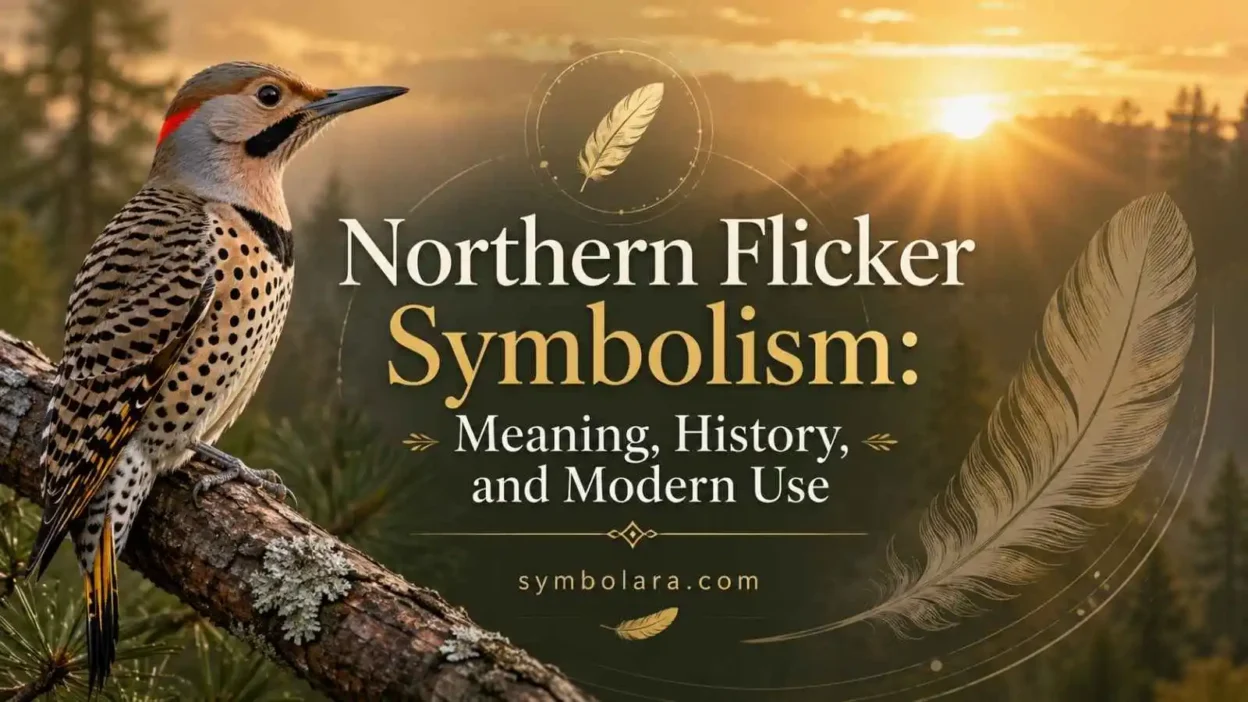
The northern flicker is a large, brownish woodpecker with black bars across its back, dark spots on its belly, and a bold black crescent across the upper chest. When it flies, a bright white patch on the rump often flashes into view, making the bird easier to identify from a distance.
Its most striking color is partly hidden. Eastern yellow-shafted flickers show yellow under the wings and tail, while western red-shafted flickers show salmon-red or orange-red tones. This sudden flash of color gives the bird much of its symbolic appeal: something that looks quiet at first may carry brightness underneath.
Male flickers have a facial “mustache” mark, which is usually black in eastern birds and red in many western birds. Females lack that mark, but both sexes share the spotted body, strong bill, and upright woodpecker posture.
People may see northern flickers in yards, parks, open woods, forest edges, suburbs, cemeteries, golf courses, and rural fields with scattered trees. Because the bird lives across much of North America, its symbolism feels familiar and close to home rather than rare or distant.
Northern Flicker Symbolism Compared With Other Woodpeckers
Northern flicker symbolism overlaps with general woodpecker symbolism, but the bird has several qualities that make its meaning unique. Woodpeckers are commonly associated with persistence, focus, communication, and steady effort because of their repeated drumming. The northern flicker carries these ideas but adds themes connected with the ground, color, and seasonal movement.
Unlike many woodpeckers that spend most of their time climbing tree trunks, northern flickers often search the soil for insects. This behavior gives them a more grounded symbolism. They represent looking closer, finding value in overlooked places, and staying connected to everyday reality.
The flicker’s bright wing and tail colors also separate it from many other woodpeckers. A bird that appears simple while resting can suddenly reveal yellow, orange, or red flashes during flight. Symbolically, this can represent hidden qualities becoming visible at the right moment.
While all woodpeckers can represent persistence, the northern flicker adds a message of awareness, adaptability, and discovering unexpected opportunities.
What It Commonly Means in the United States
In the United States, the northern flicker is most often understood as a symbol of awareness, renewal, persistence, and connection to everyday nature. It is not as nationally famous as the bald eagle, cardinal, dove, or raven, but it carries a quieter meaning among bird lovers, tattoo wearers, nature writers, and backyard observers.
Much of its symbolism comes from behavior. The flicker searches the ground, drums to communicate, flashes color in flight, and becomes especially noticeable during seasonal change. Those traits make it a natural emblem of paying attention, finding what is hidden, and announcing change without dominating the landscape.
For Americans who notice birds in ordinary places, the flicker can feel like a sign to pause. It belongs to edges: trees and lawns, silence and sound, camouflage and color, earth and air. That in-between quality makes it meaningful for people moving through change.
Why Ground-Feeding Changes Its Symbolism
Most people picture woodpeckers tapping on tree trunks. The northern flicker does that too, but it is especially known for feeding on the ground. It probes lawns, soil, and open patches for ants and other insects.
Because of this habit, the bird has a grounded meaning. Symbolically, the flicker does not only rise above a problem. It investigates what is underfoot and suggests that answers may come from ordinary places: the yard, the soil, the overlooked detail, or the thing sitting right in front of you.
This is why northern flicker symbolism often feels practical rather than dreamy. The bird represents curiosity with purpose. It listens, probes, digs, and finds nourishment where others may see only dirt.
For someone drawn to the flicker as a personal symbol, the message is simple: look beneath the surface, trust patient observation, and do not dismiss humble places as meaningless.
Drumming, Rhythm, and Communication
Like other woodpeckers, northern flickers drum to communicate. They may drum on trees, posts, houses, or even metal surfaces because the purpose is not always feeding. Sound itself becomes the message.
This behavior gives the flicker a strong association with rhythm and voice. It can symbolize the need to be heard, but not always through direct speech. A habit, creative practice, repeated effort, or steady routine can also become a kind of message.
The flicker’s call adds another layer. Its loud, rolling sound is often heard in spring and early summer. To many listeners, that call feels like a seasonal announcement: winter is fading, and the landscape is active again.
In personal symbolism, the flicker may represent finding your own rhythm. It asks what you repeat every day and what that repetition says about your life.
Color Symbolism: Red, Yellow, Black, and White
Color plays a major role in the meaning of the northern flicker. Its brown and barred body helps it blend into bark, dry grass, and woodland edges, while its wing and tail colors appear suddenly in motion. That contrast suggests hidden vitality.
Red-shafted flickers are often associated with warmth, action, courage, and life force. Yellow-shafted flickers can suggest sunlight, alertness, renewal, and mental clarity. These meanings come partly from common color associations and partly from the bird’s real visual effect: it seems plain until it opens its wings.
The black chest crescent may be read as a mark of boundary, seriousness, or protection. Meanwhile, the white rump flash creates a moment of visibility and direction, especially when the bird is flying away.
Together, these colors make the flicker a symbol of concealed brightness. Its beauty is not fully revealed while it stands still. Motion brings the meaning forward.
Historical Roots and Older Associations
Northern flicker symbolism developed from natural observation, Indigenous traditions, regional names, and broader woodpecker folklore. Since flickers are native to North America, their meaning is not mainly borrowed from ancient European symbolism. Much of it comes from people living near the bird and noticing its sound, color, and habits.
In some Native American contexts, flickers and woodpeckers have been associated with luck, friendship, healing, happiness, fire, and medicine-related meaning. These interpretations vary by region and community, so they should not be treated as one universal belief.
Regional names also shaped the bird’s symbolism. Northern flickers have been called yellowhammers, wake-ups, wick-ups, and other names inspired by sound, color, or behavior. Such names show how strongly people connected the bird with calling, movement, and sudden notice.
Over time, the flicker’s meaning grew from repeated encounter. People heard it, watched it flash through trees, saw it feeding on the ground, and built meaning from those details.
Northern Flicker Symbolism in Indigenous Contexts
Indigenous symbolism must be handled carefully because there is no single Native American meaning for the northern flicker. Different Nations, languages, regions, and ceremonial traditions may interpret birds in different ways.
In some Indigenous stories and cultural materials, flickers and woodpeckers appear as lucky birds, friendly birds, or birds connected with healing and fire. Certain West Coast traditions have linked flicker markings with fire-related stories and ceremonial meaning.
A respectful modern approach avoids treating the flicker as a generic “spirit animal.” When a specific tribal tradition is being discussed, the meaning should come from that community’s own cultural knowledge rather than from vague online summaries.
Even with that caution, it is fair to say the flicker held meaning long before modern birding, tattoos, wall art, or social media symbolism. Its cultural presence is older than many contemporary interpretations.
Northern Flicker Symbolism in Native American Art and Storytelling
Northern flickers have appeared in some Indigenous art forms and storytelling traditions because of their distinctive appearance, behavior, and connection to the natural world. However, meanings differ greatly between Nations, so there is no single traditional interpretation shared by all Indigenous communities.
In some regions, woodpeckers and related birds appear in stories connected with fire, transformation, luck, or communication. The flicker’s bright markings may have contributed to associations with warmth and energy, while its drumming behavior connects it with sound and messages.
A respectful understanding of Indigenous symbolism requires attention to specific communities rather than broad labels. Traditional meanings come from living cultures, languages, landscapes, and histories.
Today, many people appreciate the northern flicker as a reminder of the long relationship between humans and birds. Its symbolism continues to develop through observation, storytelling, art, and personal connection with nature.
The Flicker as a Sign of Spring and Seasonal Change
Many Americans notice northern flickers most strongly in spring. Their calls become louder, their drumming becomes more frequent, and their movement through yards and woods becomes easier to observe.
Because some flickers migrate while others remain in parts of their range, the bird is often linked with seasonal transition. It does not symbolize rebirth in a vague way. Instead, it points to the practical return of sound, nesting, food-seeking, courtship, and movement after quieter months.
The flicker can also symbolize change that has already begun. A person may hear the call before the season fully turns. Then comes the flash of wings, the activity in the yard, and the sense that the landscape is waking up.
For that reason, the flicker works well as a symbol of early renewal. Growth often announces itself through small, repeated signals before life looks completely different.
Meaning in Dreams and Personal Encounters
When people ask what it means to see a northern flicker, they are usually thinking about a personal moment. A bird may land near a window, call from a nearby tree, appear during a difficult week, or return again and again to the same yard.
A grounded interpretation starts with the real bird. A flicker sighting may simply mean the area has ants, open ground, trees, or nesting places nearby. Still, the moment can feel meaningful because people often make sense of life through what catches their attention.
In dreams, a northern flicker may suggest restlessness, communication, hidden insight, or a need to return to practical basics. A tapping flicker may point to a message that keeps repeating in waking life. A bird flying away with bright color visible may suggest that something has more life in it than it first appeared to have.
The best interpretation is personal without becoming exaggerated. A flicker does not need to predict the future to matter. Sometimes it simply sharpens awareness.
What Does a Northern Flicker Visiting Your Yard Mean?
A northern flicker visiting your yard can have both a practical meaning and a personal symbolic meaning. In nature, the bird may simply be searching for insects, nesting areas, water, or suitable habitat. A yard with trees, open soil, native plants, or older wood can naturally attract flickers.
For people who enjoy symbolism, a flicker visit may feel like a reminder to slow down and notice what is around them. Because the bird searches beneath the surface for food, some interpret its appearance as encouragement to look deeper before making decisions.
Repeated sightings can feel especially meaningful because humans naturally connect memorable experiences with personal moments. Someone going through a change may view the flicker as a symbol of renewal, patience, or finding hidden opportunities.
The meaning of a flicker encounter depends on personal beliefs. The most grounded interpretation begins with appreciating the actual bird while allowing room for personal reflection.
Tattoos, Jewelry, and Personal Style
Northern flicker tattoos are often chosen by people who feel connected to birds, woodlands, resilience, regional identity, or quiet transformation. Many designs highlight the spotted chest, black crescent, red or yellow wing shafts, or white rump flash.
As a tattoo, the flicker can represent persistence without aggression. It may symbolize someone who keeps working, keeps listening, and keeps finding nourishment in unexpected places. For people who want a bird symbol less common than an eagle, owl, raven, swallow, or cardinal, the flicker offers a more personal choice.
In jewelry and small art pieces, the flicker usually carries a gentler meaning. It can suggest attentiveness, warmth, creativity, and love of local wildlife. Because the bird combines camouflage with sudden color, it suits people who identify with hidden brightness or understated strength.
Strong flicker designs do not need to turn the bird into a fantasy creature. Its real markings already carry enough visual meaning.
Home Decor, Garden Meaning, and Backyard Symbolism
In home and garden settings, the northern flicker often symbolizes a lively relationship with the land around a house. A flicker in the yard reminds people that a lawn is not just decoration; it is part of an ecosystem.
Gardeners and birdwatchers often welcome flickers because they eat many ants and insects. Their presence can make a yard feel more alive, especially when native plants, older trees, snags, and quiet foraging areas are nearby.
Flicker imagery also works well in rustic, woodland, Southwestern, Pacific Northwest, and nature-inspired decor. The bird’s warm colors and graphic markings make it visually interesting without feeling overly sentimental.
As a home symbol, the flicker suggests rootedness, seasonal rhythm, and attention to small signs of life. It is a fitting bird for people who see home as habitat, not just shelter.
Alabama, the Yellowhammer, and Regional Identity
In Alabama, the northern flicker has a special public meaning because the yellowhammer, a name for the yellow-shafted northern flicker, is the state bird. This gives the species a regional symbolism that goes beyond private interpretation.
The yellowhammer is tied to Alabama identity, including the state nickname “The Yellowhammer State.” Its meaning there is layered: part bird, part emblem, part historical memory, and part local pride.
This does not mean every northern flicker carries the same symbolism everywhere. A red-shafted flicker in Oregon, Colorado, or New Mexico may feel more connected to western landscapes, open woods, and regional birdlife than to Alabama’s state identity.
Still, the Alabama connection shows how a bird can move from natural presence into civic culture. In that context, the flicker becomes both a living species and a public symbol.
Cross-Cultural and Religious Interpretations
The northern flicker is a North American bird, so it does not have the same global religious symbolism as doves, eagles, owls, or ravens. Even so, it belongs to the woodpecker family, and woodpeckers have broader symbolic associations in many cultures.
Woodpeckers are often connected with persistence because of their tapping. They may also suggest communication, warning, craft, and the ability to find what is hidden beneath the surface. These meanings fit the northern flicker, though the flicker’s ground-feeding and bright wing shafts give it a more earth-centered and color-centered tone.
In Christian symbolism, the northern flicker does not have a major traditional role. Some modern Christians may personally interpret the bird as a reminder of creation, renewal, or attentiveness to the natural world, but that is a personal devotional reading rather than an established doctrine.
Contemporary spiritual writing sometimes describes the flicker as a messenger or guide. Those interpretations are modern and personal, not universal.
Emotional and Psychological Meaning
Emotionally, the northern flicker often communicates alert calm. It is neither a fierce predator nor a fragile songbird. Instead, it appears active, watchful, rhythmic, and practical.
Psychologically, the bird can symbolize the ability to notice patterns. Its tapping, probing, calling, and flashing movement all point toward attention: listen again, look closer, and check beneath the surface.
This is one reason people connect the flicker with intuition. Not intuition as magic, but intuition as careful perception. The bird notices what is useful and works patiently to uncover it.
For someone in a transitional period, the flicker can feel like a fitting emblem. It suggests staying alert, keeping a rhythm, and looking for life in unexpected places.
Common Misunderstandings and Misuse
The biggest misunderstanding about northern flicker symbolism is the idea that it has one fixed meaning. It does not. Its symbolism depends on context, including natural behavior, region, cultural background, personal experience, and artistic use.
Another issue is the overuse of broad Indigenous claims. Online descriptions sometimes use phrases like “Native American spirit animal” without naming a specific people, place, or tradition. That approach is too vague and can become disrespectful.
A better approach is to say that flickers and woodpeckers hold meaning in some Indigenous traditions while avoiding claims that all Native cultures interpret them the same way. Specific meanings should be tied to specific communities whenever possible.
Some people also treat the flicker only as a mystical sign. The living bird has real habits, habitats, and ecological needs. Its symbolism becomes stronger when it stays connected to the actual creature.
How Its Meaning Has Evolved
The meaning of the northern flicker has changed as people’s relationship with the bird has changed. First, it was a familiar presence in Indigenous landscapes, where it could enter story, ceremony, and practical observation.
Later, regional names connected the bird with sound, color, and behavior. As American natural history grew, the flicker became part of bird guides, state identity, and backyard observation.
In modern culture, the bird appears in tattoos, prints, nature photography, social media posts, and personal spiritual interpretations. Its meaning now blends older observation with contemporary ideas about ecology, identity, and emotional resilience.
There is also a conservation layer. Northern flickers remain widespread, but they can be affected by habitat loss, pesticide use, competition for nesting cavities, and the removal of dead or dying trees. That reality gives the bird a modern meaning: common wildlife still needs attention before it becomes uncommon.
Northern Flicker Symbolism in Literature, Photography, and Modern Culture
Modern northern flicker symbolism appears in wildlife photography, nature writing, artwork, tattoos, and online discussions about animal meanings. Unlike symbols that come mainly from mythology, the flicker’s modern meaning often develops from direct observation.
Photographers often highlight the bird’s sudden movement and hidden colors. A quiet brown bird becoming bright during flight creates a natural visual metaphor for transformation, discovery, and unexpected beauty.
Writers and artists may use the flicker to represent attention to small details, connection with local landscapes, or the importance of listening. Its presence near homes and parks also makes it a symbol of everyday encounters with nature.
In modern culture, the northern flicker represents a quieter form of strength. It is not usually portrayed as a dominant or powerful animal. Instead, it reflects patience, adaptability, curiosity, and the beauty found in ordinary places.
Northern Flicker Meanings by Context
| Context | Meaning in the USA | Common Associations | Notes |
| Backyard sighting | Awareness and seasonal change | Spring calls, open lawns, trees | Often linked with noticing nearby nature |
| Tattoo or art | Resilience and hidden brightness | Red or yellow feathers, spotted chest | Works well as a personal transformation symbol |
| Alabama identity | Regional pride and state symbolism | Yellowhammer, state bird | A civic meaning, not only private symbolism |
| Dream or repeated encounter | Message, rhythm, or reflection | Drumming, calling, flashing flight | Best interpreted through personal context |
| Indigenous context | Varies by Nation and region | Luck, friendship, fire, healing | Avoid universal claims |
| Ecological meaning | Connection to living habitat | Ants, snags, migration, nesting | Reminds people that common birds need protection |
FAQs
A northern flicker most often symbolizes grounded awareness, renewal, rhythm, and the ability to find hidden opportunities. Its meaning comes from its ground-feeding habits, bright wing flashes, loud call, and woodpecker drumming.
Many people interpret a northern flicker sighting as positive because the bird is associated with alertness, luck, seasonal movement, and vitality. From a practical angle, its presence may also show that the area has open ground, insects, trees, or nesting habitat.
A northern flicker tattoo can represent persistence, personal renewal, hidden strength, communication, or a connection to North American landscapes. The red or yellow feather shafts often add meanings of warmth, energy, clarity, or inner brightness.
Flickers and woodpeckers have meaning in some Indigenous traditions, including associations with luck, friendship, fire, or healing in certain regions. There is no single Native American meaning, so specific cultural claims should be tied to specific communities.
Spiritually, a northern flicker is often interpreted as a reminder to pay attention, return to your rhythm, and look beneath the surface. This is a modern personal interpretation rather than a fixed religious meaning.
Yes, the northern flicker is often associated with spring because its calls, drumming, courtship behavior, and movement become more noticeable during that season. Symbolically, this connects the bird with renewal, return, and early signs of change.
Woodpecker symbolism usually emphasizes persistence, rhythm, and communication. Northern flicker symbolism includes those ideas but adds grounding, hidden color, seasonal movement, and the search for nourishment in overlooked places.
Conclusion
The northern flicker is meaningful because its symbolism grows directly from its life. It drums to be heard, searches the ground for hidden food, flashes red or yellow in flight, and often appears at the edges of human spaces and wild habitats.
Northern Flicker Symbolism is best understood as a blend of awareness, renewal, rhythm, grounded wisdom, and concealed brightness. The bird does not need exaggerated meaning; its behavior, color, sound, and seasonal presence already say enough.
To notice a flicker is to remember that the ordinary world is rarely empty. Sometimes the message is not high in the sky. It is tapping, calling, and searching at ground level.