

A dragonfly can hover in one place, change direction in an instant, and move across the water with surprising speed. Its long body, transparent wings, and bright colors make it easy to recognize near ponds, lakes, gardens, and wetlands.
People often look up Dragonfly Symbolism when they see one unexpectedly, consider getting a dragonfly tattoo, or find the insect appearing in jewelry, artwork, or a personal memory. In American culture, it commonly represents change, freedom, adaptability, and the ability to move forward after a difficult period.
However, its meaning is not the same in every culture or situation. Some interpretations come from the insect’s natural life cycle, while others developed through folklore, literature, and personal experiences.
Quick Answer
Dragonflies commonly symbolize transformation, freedom, adaptability, and personal growth in modern American culture. Their association with change comes partly from their life cycle, which takes them from aquatic nymphs to winged adult insects.
TL;DR
- Dragonflies commonly represent change, personal growth, and freedom.
- Their life cycle provides a natural connection to transformation.
- Japanese traditions associate dragonflies with courage and victory.
- Native American interpretations vary among different communities.
- Tattoos often express independence, resilience, or a new beginning.
- Their presence near water connects them with wetlands and nature.
What Does a Dragonfly Look Like in Nature?
Dragonflies belong to the insect order Odonata. They have long, narrow bodies, large compound eyes, and two pairs of strong, transparent wings. Unlike many insects, they can move each pair of wings independently, allowing them to hover, turn quickly, and fly in different directions.
Their colors vary by species. Some have metallic blue or green bodies, while others display red, yellow, brown, or black markings. Their wings may appear almost invisible in sunlight, although some species have noticeable dark patches.
Dragonflies are commonly found around:
- Freshwater ponds and lakes
- Rivers, streams, and marshes
- Wetlands and garden ponds
- Meadows and wooded areas near water
One important detail about their biology helps explain their symbolic associations. Most of their lives are spent underwater as nymphs. When they mature, they climb out of the water, shed their outer skin, and emerge as flying adults.
This change in appearance gives people a natural reason to connect them with personal development and new beginnings.
Why Do Dragonflies Symbolize Change and Transformation?

Transformation is one of the most common meanings associated with dragonflies.
Their development happens in stages. A young dragonfly begins life in water, where it may spend months or even several years before becoming an adult. Eventually, it leaves its aquatic environment and develops wings.
People often compare this process to major changes in human life.
For example, someone who finishes college, changes careers, moves to another state, or begins rebuilding life after a difficult relationship might connect with the image of a dragonfly.
The insect does not simply grow larger. Its entire way of living changes.
This makes it a useful representation of:
- Personal development: Becoming more confident through experience.
- New beginnings: Starting a different chapter after a major event.
- Adaptability: Learning to handle unfamiliar situations.
- Emotional growth: Recognizing how past experiences have changed you.
The comparison is symbolic rather than scientific. A dragonfly’s biological development does not predict a person’s future. Instead, its life cycle gives people a recognizable example of change.
What Does a Dragonfly Represent in American Culture?
In the United States, dragonflies are generally viewed positively, especially in art, personal accessories, nature photography, and decorative designs.
Their modern meanings often center on independence, flexibility, and appreciating the present.
Several associations are particularly common.
Freedom and independence
A dragonfly’s ability to fly in almost any direction makes it a natural image of freedom. Someone who has left a restrictive situation may choose it to represent independence and personal choice.
Living in the present
Dragonflies move quickly and are difficult to follow with the eye. Their brief adult stage also encourages some people to connect them with enjoying ordinary moments instead of constantly worrying about the future.
Renewal after hardship
Because they emerge from an underwater stage as winged insects, they can represent a fresh start. This interpretation is especially common in personal artwork and memorial designs.
Confidence and individuality
Their unusual shape and bright colors make them stand out from more familiar nature symbols. Some people use dragonfly designs to express a personality that feels independent or unconventional.
There is no single official American meaning. A dragonfly on a garden sign, a memorial necklace, and a personal tattoo may communicate three different ideas.
How Did Dragonfly Symbolism Develop Historically?
Dragonflies have appeared in human art and folklore for a long time, but their meanings were not identical across regions.
Some of the clearest historical records come from Japan.
The Japanese chronicle Nihon Shoki, compiled in 720 CE, contains stories involving dragonflies and early emperors. One account describes a dragonfly catching a biting horsefly that had landed on Emperor Yuryaku. The story helped support the insect’s association with victory and good fortune.
An older name associated with Japan, Akitsushima, is also connected with the dragonfly. The exact historical and linguistic details behind the name have been discussed in different interpretations, so it is best not to treat every popular explanation as settled fact.
During later Japanese periods, dragonflies appeared on samurai equipment and decorative objects. Their hunting ability, speed, and tendency to move forward made them suitable emblems for warriors.
In Europe, the insect developed a more mixed reputation. Some traditional names and folk stories presented it as frightening or associated it with the devil. These beliefs existed alongside admiration for its appearance.
By the nineteenth century, however, European artists and jewelry makers increasingly treated the insect as an attractive nature motif.
This history shows that the insect did not carry one universal message. Its meaning depended on the stories, artistic traditions, and everyday experiences of the people who encountered it.
What Does a Dragonfly Mean in Japanese Culture?
Japan has one of the best-documented cultural connections with dragonflies.
The insect is traditionally called tombo. It is also associated with the expression kachimushi, meaning a victorious or lucky insect.
This association developed partly because dragonflies are skilled hunters. Their ability to catch other insects in flight made them an appealing image of speed, courage, and success.
Historical examples include:
- Dragonfly designs on samurai helmets.
- Decorative patterns on traditional clothing and equipment.
- Dragonfly imagery in Japanese paintings and seasonal artwork.
- References to the insect in classical Japanese literature.
The association with summer is also important. Dragonflies are familiar sights in Japanese rice fields, rivers, and gardens during the warmer months.
A red dragonfly, in particular, is commonly associated with autumn.
These connections are not simply modern interpretations of personal growth. They come from specific Japanese stories, seasonal traditions, and historical objects.
What Do Dragonflies Symbolize in Native American Traditions?
Dragonflies appear in the cultural traditions and artwork of several Native American communities, but their meanings should not be treated as identical across all Indigenous nations.
Research on insect symbolism documents associations with water, fertility, abundance, protection, and good fortune among particular communities.
For example, dragonfly imagery appears on Mimbres pottery from the American Southwest. Some Southwest traditions also connect the insect with water and the conditions that support life.
On the northern Plains, historical accounts describe dragonflies as favorable signs among Cheyenne and Dakota communities. Their images appeared on clothing, dwellings, and war shields.
A well-known Zuni story about the creation of dragonflies also appears in the children’s book The Boy Who Made Dragonfly by Tony Hillerman.
It is important to distinguish documented community traditions from general internet claims. There is no single Native American interpretation that applies to every nation, family, or individual.
Dragonfly imagery can also have contemporary cultural meaning that differs from its historical use. When using Indigenous designs, it is respectful to understand their specific origins rather than treating them as interchangeable decoration.
Why Do People Emotionally Connect With Dragonflies?
People often connect with natural objects because those objects remind them of experiences they have personally lived through.
Dragonflies offer several visual qualities that make this connection easy.
Their movement suggests flexibility. Their wings suggest lightness. Their development from an aquatic nymph into an adult insect provides a visible example of change.
These qualities can become meaningful during important life events.
Consider someone who has spent years caring for a family member and is finally returning to personal goals. A dragonfly might represent the freedom to build an independent routine again.
Another person might associate it with a loved one who enjoyed spending time near lakes or gardens. In that case, the insect becomes a reminder of shared experiences rather than a general symbol of transformation.
Three emotional associations are especially understandable:
- Hope: The image of emerging from water can suggest a different beginning.
- Acceptance: Its changing stages can remind people that growth involves different phases.
- Self-expression: Its unusual appearance gives people a way to communicate individuality.
The personal story behind a symbol often matters more than a dictionary-style definition.
Why Are Dragonflies Popular Tattoo Designs?
Dragonfly tattoos are popular because the insect has a recognizable shape that works in both small and large designs.
A simple outline can fit on a wrist or ankle, while a detailed illustration can cover a shoulder, back, or upper arm.
The design can also communicate different personal messages.
A small dragonfly outline
This style often represents independence, simplicity, or a personal reminder to keep moving forward.
A colorful dragonfly
Blue, green, purple, and red details can emphasize individuality, creativity, and a connection with nature.
A dragonfly with flowers
Adding flowers creates a softer nature-inspired design. Depending on the flowers selected, the tattoo may also communicate affection, remembrance, or appreciation for life.
A dragonfly with a date or name
This version is often chosen to remember a family member, friend, or important life event.
A dragonfly near water
Waves, reeds, and small water details can emphasize the insect’s natural habitat and its association with personal change.
A tattoo does not have a fixed meaning simply because it includes a particular insect. Two people can choose the same design for entirely different reasons.
What Does a Dragonfly Necklace or Piece of Jewelry Mean?
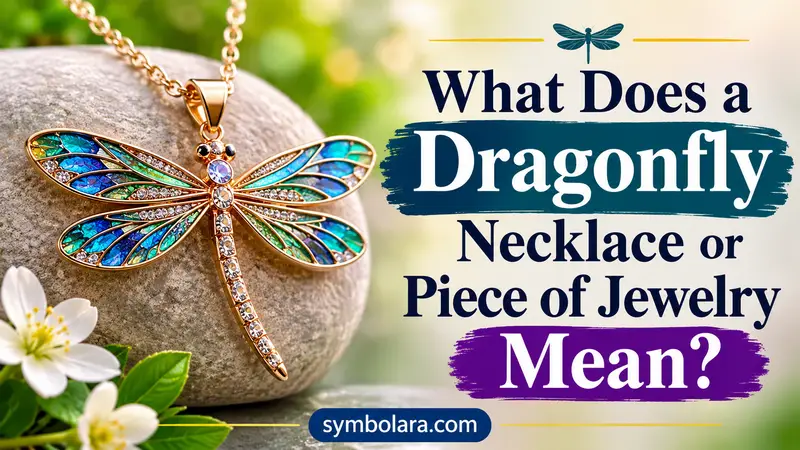
Dragonfly jewelry has a particularly interesting history.
During the Victorian period (1837–1901), European jewelers used insects as decorative subjects. Dragonflies were especially suitable because their narrow bodies and delicate wings could be recreated with gold, silver, enamel, and gemstones.
The popularity of these designs continued into the Art Nouveau movement around the turn of the twentieth century.
Artists such as René Lalique helped make insect-inspired jewelry recognizable through flowing natural shapes and colorful enamel techniques.
In the United States, the work of Louis Comfort Tiffany and Tiffany Studios also helped establish dragonflies as recognizable decorative motifs. Dragonfly lampshades became an important part of the studio’s design history.
Today, dragonfly necklaces, earrings, brooches, and bracelets can communicate several things:
- A personal connection with nature.
- A reminder of a new beginning.
- A gift celebrating a major life change.
- A memory of someone important.
- An appreciation for artistic and nature-inspired designs.
A dragonfly pendant is not automatically a memorial object or a spiritual accessory. Its meaning depends on the person wearing it and the reason it was chosen.
International Antique Jewelers Association+2
Do Dragonflies Have Negative or Unusual Meanings?
Although dragonflies are generally viewed positively in modern American culture, older folklore sometimes gave them unpleasant associations.
In parts of Europe, people used names such as “Devil’s Darning Needle.” These names reflected old fears and stories rather than the insect’s actual behavior.
A dragonfly does not sew people’s mouths shut, sting horses, or deliberately harm humans. Most species are harmless to people and are useful predators of mosquitoes and other small flying insects.
American folklore also includes the expression “snake doctor.” In some Southern traditions, people believed dragonflies could help snakes or repair injuries to them. This was folklore, not a description of real animal behavior.
Other misunderstandings include:
- Dragonflies predict death: There is no scientific evidence that seeing one predicts someone’s death.
- Every dragonfly sighting is a spiritual message: This is a personal belief, not an established fact.
- Dragonflies always represent good luck: Their interpretations differ across cultures and historical periods.
- Their appearance means a major life change is coming: This is a symbolic interpretation, not a reliable prediction.
Understanding these differences makes it easier to appreciate the insect without confusing folklore with biology.
How Has Dragonfly Meaning Changed Over Time?
The way people interpret dragonflies has changed as art, culture, and everyday life have changed.
In older Japanese traditions, the insect was associated with victory, courage, and good fortune. These associations were supported by historical stories and its use in samurai decoration.
During the Victorian period, European jewelers increasingly used dragonflies as decorative subjects. Their unusual wings and slender bodies worked well with the gemstones and enamel popular in fashionable accessories.
The Art Nouveau movement, particularly between the 1890s and early 1900s, brought another change. Artists explored flowing natural shapes, and dragonflies became recognizable subjects in jewelry, lamps, and decorative art.
In more recent American culture, the emphasis has shifted toward personal meaning.
People now commonly choose dragonfly designs to represent:
- Starting over after a difficult experience.
- Celebrating independence.
- Remembering someone who has died.
- Accepting personal growth.
- Expressing an interest in nature.
Social media and modern tattoo culture have helped spread these interpretations. However, there is no single date when the modern meaning became established.
The important change is that dragonflies are now often interpreted through individual experiences rather than only through traditional folklore.
Where Do Dragonflies Appear in Modern Art and Everyday Life?
Dragonflies are easy to recognize, making them useful subjects for different types of creative work.
In American homes, they appear on garden decorations, wall art, stained-glass panels, ceramic pieces, fabrics, and outdoor ornaments.
Their association with water also makes them suitable for garden designs featuring ponds, fountains, and flowering plants.
In fashion, dragonfly patterns appear on scarves, clothing, handbags, and accessories. Some designs use realistic insect details, while others reduce the shape to a simple outline.
Artists also use dragonflies in nature illustrations and environmental artwork. Their connection with freshwater habitats makes them relevant to projects about wetlands, biodiversity, and water conservation.
Their appearance can communicate different ideas depending on the setting.
For example:
- A dragonfly on a garden sign may simply celebrate local wildlife.
- A dragonfly in a memorial illustration may represent remembrance.
- A dragonfly on a summer-themed greeting card may suggest warmth and outdoor life.
- A dragonfly in environmental artwork may draw attention to freshwater ecosystems.
Not every decorative dragonfly carries a hidden message. Sometimes, the design is simply appreciated for its shape and color.
What Does a Dragonfly Mean in Different American Contexts?
The same insect can communicate different ideas depending on how someone uses it. The following comparisons show how its interpretation changes in everyday American settings.
| Context | Meaning in USA | Common Associations | Notes |
| Personal tattoos | Independence and transformation | New beginnings, resilience | Often connected to a personal milestone |
| Memorial jewelry | Remembrance and affection | Loved ones, memories, continuing bonds | Meaning usually comes from the giver or wearer |
| Garden decorations | Appreciation of nature | Summer, ponds, wildlife | Often purely decorative |
| Fine jewelry | Individuality and beauty | Elegance, creativity, nature | Popular in enamel and gemstone designs |
| Nature artwork | Environmental awareness | Wetlands, biodiversity, freshwater habitats | Can have an educational purpose |
| Gifts | Encouragement and positive change | Graduation, recovery, fresh starts | The occasion helps determine the meaning |
FAQs
Is seeing a dragonfly considered good luck?
Many people consider dragonflies a positive sign because of their associations with happiness, change, and good fortune. In Japanese tradition, the insect has a documented connection with victory and success. However, seeing one does not guarantee a particular outcome.
What does it mean when a dragonfly lands on you?
A dragonfly landing on someone usually has a natural explanation, such as resting, warming itself, or using a convenient surface. Some people personally interpret the encounter as a reminder to slow down, welcome change, or appreciate the present moment. There is no established universal meaning.
Do dragonflies have a connection with death or deceased loved ones?
Some people use dragonfly imagery when remembering someone who has died. It can represent affection, remembrance, and the continuation of meaningful memories. This is a personal and cultural interpretation, not evidence that a deceased person is communicating through an insect.
What does a blue dragonfly symbolize?
A blue dragonfly is often associated with calmness, peace, clarity, and communication in modern decorative interpretations. Its blue color contributes to these associations, although there is no universal historical rule assigning every blue dragonfly the same meaning.
What does a red dragonfly represent?
Red dragonflies can suggest confidence, vitality, courage, and passion in modern color-based interpretations. In Japanese seasonal traditions, the red dragonfly is also associated with autumn, giving it a connection with the changing seasons.
Are dragonflies mentioned in the Bible?
Dragonflies are not specifically named in the Bible. Some modern readers connect their life cycle with themes such as renewal and personal growth, but these are later symbolic comparisons rather than established biblical meanings.
Why do dragonflies appear in memorial gifts?
Dragonflies provide a gentle way to express remembrance without using direct images of death or mourning. Their association with change and the natural world can help someone communicate love, appreciation, and the importance of memories. The meaning is usually personal to the family or individual choosing the gift.
Conclusion
Dragonflies commonly represent transformation, freedom, adaptability, and personal growth in modern American culture. Their natural development from aquatic nymphs into flying adults provides a clear reason for their association with change, while Japanese traditions, Indigenous cultural connections, and European decorative arts have added other interpretations.
Today, Dragonfly Symbolism appears in tattoos, jewelry, memorial gifts, garden decorations, and artwork. Its meaning depends on the setting and the person using the image. One person may see independence, while another sees a reminder of someone they miss.
Perhaps that is what makes the dragonfly such an appealing subject: its meaning does not have to be complicated. A small insect resting beside a garden pond can remind someone of a new beginning, a favorite memory, or simply the beauty of an ordinary afternoon.


