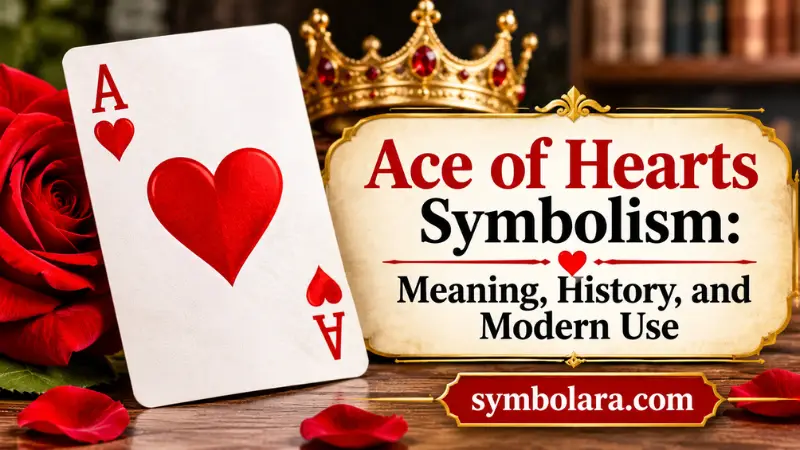
The Ace of Hearts is a red playing card marked with a single heart symbol. In a standard 52-card deck, it is the highest-ranking card in many games, although its value depends on the rules being played. Outside card games, its red heart and leading position have helped it become associated with love, emotional connection, new beginnings, and good fortune.
People often look up the ace of hearts meaning when they encounter the card in a dream, receive it as a gift, consider using it in a tattoo, or see it in artwork. Its interpretation can change depending on the situation. A card used in a romantic design may suggest affection, while one appearing in a game may simply represent a valuable playing card.
In American culture, the Ace of Hearts appears in card games, Valentine’s Day decorations, jewelry, tattoos, and popular entertainment. Its familiar shape makes it easy to recognize, even among people who rarely play cards.
Quick Answer
The Ace of Hearts commonly symbolizes love, affection, emotional honesty, new relationships, and good fortune. Its associations developed from the heart suit in European playing cards, while its modern romantic meaning draws on the heart’s long-standing use as a visual sign of love and affection.
TL;DR
- Love: Represents affection, romance, and emotional connection.
- New beginnings: Can suggest a fresh relationship or emotional chapter.
- Good fortune: Its high rank gives it associations with success and favorable outcomes.
- History: The heart suit developed in European playing cards during the late medieval period.
- American culture: Appears in Valentine’s Day designs, tattoos, games, and personal gifts.
- Personal meaning: Its message depends on the setting and the person using it.
What Does the Ace of Hearts Look Like?
The Ace of Hearts has a simple design. It usually features one large red heart in the center, with a small letter A and a heart symbol printed in the upper-left and lower-right corners. The corner markings allow players to identify the card without turning it in a different direction.
Most standard American decks use a white background with a bright red heart. Some premium decks feature decorative borders, detailed illustrations, gold accents, or unusual artwork.
Unlike the King, Queen, and Jack of Hearts, the Ace does not usually show a person. Its design focuses on one suit symbol, making the heart itself the main visual feature.
The card’s appearance combines two familiar ideas:
- The heart: A widely recognized sign of love, care, and emotional attachment.
- The ace: A card that often holds the highest position in a game’s ranking system.
Together, these features make the card suitable for designs involving affection, confidence, personal achievement, and romantic commitment.
What Does the Card Represent in Modern Culture?
The most common modern associations involve love and emotional connection. However, the card can communicate several related ideas.
Romantic love: A red heart is widely recognized as a sign of affection. When placed on an ace, it can suggest that love holds an important place in someone’s life.
Emotional openness: The heart can represent a willingness to express feelings, communicate honestly, and build meaningful relationships.
A fresh start: The ace is often associated with beginnings because it represents the number one in a deck. Combined with the heart suit, it can suggest the start of a romantic relationship or a new emotional chapter.
Good luck: In games where the ace has the highest value, the card can represent a favorable position or an advantage.
Self-worth: Some people use the card to express confidence in their ability to love, make personal choices, and value their own feelings.
These interpretations are not fixed rules. Someone who chooses the design for a wedding gift may have a different intention from someone who uses it as a symbol of personal independence.
Where Did the Heart Suit Come From?
The history of the heart suit goes back to European playing cards. Playing cards were established in Europe by the late fourteenth century, although their earlier origins are connected to card traditions from outside Europe.
Early European decks did not all look alike. Italian and Spanish cards commonly used suits associated with cups, coins, swords, and batons. German cardmakers later developed a different system that included hearts, bells, leaves, and acorns.
By the fifteenth century, the heart had become an established playing-card symbol in German decks. French cardmakers later adopted and simplified the heart design as part of their familiar four-suit system: hearts, diamonds, clubs, and spades.
The French system became especially influential because its simplified shapes and two-color printing made cards easier and cheaper to produce. Red hearts and diamonds could be distinguished from black clubs and spades without elaborate illustrations.
The exact original reason for choosing a heart shape is not fully settled. Some historical interpretations connect the four suits with different social groups, including the clergy, nobility, merchants, and workers. However, these explanations should not be treated as proven facts about the original designs.
The heart eventually became one of the most recognizable symbols in card decks across Europe and North America.
How Did the Ace Become a Symbol of Importance?
The word ace comes from the Latin word as, which referred to a single unit or a small denomination. The term later became associated with the number one in gaming and other activities.
In early card games, the ace did not always hold the highest position. Depending on the game and historical period, it could rank below other cards. Its position gradually changed in different European games, and modern games still follow different ranking systems.
In poker, for example, an ace can serve as the highest card or the lowest card in a straight. In blackjack, it can count as either one or eleven, depending on which value benefits the hand.
This flexibility helped give the ace a broader association with importance and advantage. People began using the word outside card games to describe someone who excels at a skill, such as an ace pilot or an ace student.
When this idea is combined with the heart suit, the card can suggest that love, affection, or emotional commitment deserves a leading place in life.
Why Is the Ace of Hearts Associated With Love?
The connection between hearts and love existed long before modern playing cards became common.
Although the actual shape of the heart symbol does not closely match the human heart, it became a widely recognized visual representation of affection in European art and culture. Medieval and Renaissance artwork helped spread the familiar heart shape through romantic and religious imagery.
By the nineteenth century, heart designs had become especially common in printed Valentine’s Day cards. Commercial cardmakers used red hearts, flowers, Cupids, and affectionate messages to express romantic feelings.
The Ace of Hearts brings these established associations together with the idea of being first or holding a leading position.
For someone giving the card to a romantic partner, it may communicate:
- You hold a special place in my life.
- Love is one of my greatest priorities.
- I want to begin something meaningful with you.
- I value the connection we share.
These messages come from personal and cultural interpretation rather than a universal rule attached to the card.
What Does It Mean in American Culture?
In the United States, the card has several cultural connections. Its meaning often depends on whether it appears in entertainment, celebrations, personal gifts, or everyday activities.
Valentine’s Day: Red hearts are a familiar part of February 14 celebrations. An Ace of Hearts can fit naturally into handmade cards, romantic decorations, and gifts because it combines the playing-card design with a recognizable sign of affection.
Card games: Americans encounter aces regularly in poker, blackjack, bridge, and other games. In these settings, the card is primarily understood through the rules of the game. Its romantic associations may be secondary.
Personal gifts: Some people give an Ace of Hearts as a small romantic gesture. It can also be included in handmade scrapbooks, anniversary gifts, or framed artwork.
Fashion and accessories: Heart-shaped playing-card designs appear on shirts, necklaces, earrings, handbags, and other accessories. The card can communicate a playful interest in romance or card-game culture.
Entertainment: Playing cards frequently appear in American movies, television, magic performances, and casino imagery. An ace can suggest an important move, a winning hand, or an unexpected advantage.
These uses show why the card does not have just one cultural meaning. It can represent affection in one setting and skill or chance in another.
Does It Have a Spiritual or Fortune-Telling Meaning?
Some traditions of cartomancy, which means interpreting ordinary playing cards for fortune-telling, assign personal meanings to individual cards.
In some historical cartomancy systems, the Ace of Hearts represents the home, domestic life, or the household of the person receiving the reading. Other interpretations connect it with love, happiness, emotional fulfillment, or a positive personal development.
These meanings differ across readers and traditions. There is no single accepted system that gives every playing card the same interpretation.
It is also worth separating ordinary playing-card traditions from tarot. Tarot has its own deck structure, including a suit of Cups, which modern tarot readers often associate with emotions and relationships. The Ace of Cups is not the same card as the Ace of Hearts, even though their interpretations can overlap.
For people who enjoy spiritual or reflective practices, the card may serve as a personal reminder to consider relationships, family connections, or emotional priorities. Such readings are matters of belief and interpretation, not scientifically established predictions.
What Is the Emotional and Psychological Appeal?
People often connect with familiar images because they can express feelings that are difficult to put into words.
A heart is an especially accessible example. Someone may use it to communicate affection without writing a long message. The addition of the ace gives the image a connection to achievement, importance, or being someone’s first choice.
The card can also appeal to people who enjoy games and competition. Its association with a favorable position may remind them of confidence, taking chances, and making decisions.
Personal experiences also influence interpretation.
For example, someone who received an Ace of Hearts from a grandparent may associate it with family memories rather than romantic relationships. Another person may connect it with a favorite card game played with friends.
These individual experiences matter because a symbol does not always carry the same emotional meaning for everyone.
Why Do People Choose It for Tattoos?
An Ace of Hearts tattoo can combine personal expression with familiar visual details. Its compact design works well on different parts of the body, and it can be adapted to match different styles.
Common tattoo interpretations include:
- Romantic commitment: A reminder of a partner, spouse, or important relationship.
- Family affection: A tribute to parents, children, or relatives.
- Personal confidence: A statement about self-respect and emotional independence.
- Good fortune: A reference to winning, taking chances, or overcoming difficulties.
- Memories: A way to remember a person, event, or meaningful period in life.
Design choices can change the message. A simple red heart on a white playing card creates a traditional appearance. A cracked heart may suggest heartbreak or recovery, while a card with a name or date can commemorate a particular relationship.
Some people combine the design with other playing cards, roses, initials, or numbers. These additions can make the tattoo more personal, especially when they refer to a specific memory.
How Is It Used in Jewelry, Fashion, and Home Decor?
The Ace of Hearts is not limited to playing cards. Its recognizable design makes it suitable for objects people use or display.
Jewelry: Necklaces and pendants may feature a miniature playing card with a red heart. Some designs are used as matching accessories between romantic partners or close friends.
Clothing: Shirts, jackets, socks, and hats sometimes feature the card as part of a larger deck-inspired design. In fashion, it can suggest a playful personality or an interest in gambling and card games.
Home decor: Framed playing cards, wall prints, decorative cushions, and handmade artwork can incorporate the design. A romantic bedroom or game room may use it as part of a broader decorative theme.
Digital designs: Social media graphics, profile pictures, and personal illustrations sometimes use the card to express affection, confidence, or a playful personality.
The card’s simple layout also makes it useful for customized gifts. A person can add a name, date, or short message without changing the original design beyond recognition.
How Does Its Meaning Change Across Different Settings?
The same card can communicate different ideas depending on where and how it appears.
| Context | Meaning in USA | Common Associations | Notes |
| Romantic gift | Affection and commitment | Love, devotion, appreciation | Often paired with Valentine’s Day messages or personal notes. |
| Tattoo | Personal identity and relationships | Family, romance, confidence | Additional names and dates create individual meaning. |
| Poker or card games | A playing card with game-specific value | Advantage, strategy, winning | Its actual rank depends on the rules. |
| Jewelry | A decorative expression of affection | Connection, friendship, romance | Often used in pendants and matching accessories. |
| Fortune-telling | A card interpreted through cartomancy | Home, happiness, relationships | Meanings vary between reading traditions. |
| Artwork | A recognizable visual motif | Luck, romance, individuality | Often combined with roses, other cards, or hearts. |
What Are Common Misunderstandings About the Card?
Several assumptions about the Ace of Hearts can create confusion.
1. It always represents romantic love.
Not necessarily. Although romance is a common association, the heart can also represent family affection, friendship, emotional honesty, or personal values.
2. It always means good luck.
The card’s high rank in some games contributes to its favorable reputation. However, it does not guarantee a winning hand or a fortunate outcome in everyday life.
3. It has one official fortune-telling interpretation.
Cartomancy systems vary. Some associate the card with the home, while others focus on affection or happiness. No universal interpretation applies to every tradition.
4. The heart suit was originally designed to represent romance.
The historical development of playing-card suits is more complicated. The heart symbol existed in European decks long before the modern commercial association between heart imagery and Valentine’s Day became widespread.
5. It is the same as the Ace of Cups in tarot.
Both can be associated with emotions in modern interpretations, but they belong to different card systems. The Ace of Cups is part of the tarot deck, while the Ace of Hearts belongs to a standard playing-card deck.
Understanding these differences helps separate historical information, game rules, and personal interpretations.
How Has Its Meaning Changed Over Time?
The card’s history reflects changes in playing-card design, entertainment, and popular visual culture.
During the late medieval period, hearts became established as one of the suit symbols used in European decks. At that stage, their primary purpose was to identify cards within a game rather than communicate a romantic message.
By the late fifteenth and sixteenth centuries, French card designs had helped establish the four familiar suits used in many modern decks. Their simpler printing methods also made playing cards more widely available.
During the nineteenth century, the popularity of printed Valentine’s Day cards increased in Britain and the United States. Red hearts became common decorative features in messages of affection, strengthening the connection between heart imagery and romance.
In the twentieth century, playing cards became familiar features of American entertainment, from poker tables to magic performances. The ace also developed broader cultural associations with skill and excellence.
Today, the card appears in digital illustrations, fashion, tattoos, personalized gifts, and social media designs. Younger generations may encounter it through gaming and online artwork, while others associate it with traditional card games or romantic gifts.
Its appearance has remained recognizable, but the reasons people use it have expanded.
FAQs
Is the Ace of Hearts a positive or negative symbol?
It is generally viewed as positive because of its associations with affection, happiness, and favorable outcomes. However, an individual may use a modified design, such as a broken or damaged card, to express heartbreak or a difficult experience.
Does the Ace of Hearts represent marriage?
It can be used to express romantic commitment, but it is not an established universal sign of marriage. A couple might include it in wedding decorations or anniversary gifts because of its association with love.
What does receiving an Ace of Hearts as a gift mean?
It may be a playful way of showing affection or making someone feel special. The giver’s relationship with the recipient and any accompanying message are more useful clues than the card alone.
What does the Ace of Hearts mean in a dream?
Some people interpret it as a reflection of romantic feelings, family relationships, or a desire for emotional connection. However, dream meanings are personal, and there is no scientific evidence that a particular playing card predicts a future event.
Is the Ace of Hearts connected to Valentine’s Day?
It is not an official Valentine’s Day symbol, but its design fits naturally with the holiday’s familiar red-heart imagery. People may use it in handmade cards, romantic artwork, and February celebrations.
Does the Ace of Hearts represent a new relationship?
Some modern interpretations connect the ace with beginnings and the heart with affection. Together, they can represent the possibility of a new relationship, although this is a personal interpretation rather than a fixed historical meaning.
Conclusion
The Ace of Hearts brings together two familiar ideas: the heart as a sign of affection and the ace as a card associated with importance or advantage. Its modern associations include romantic love, family connections, emotional honesty, personal confidence, and good fortune.
The history of the heart suit reaches back to medieval European playing cards, while its connection to romance grew alongside the wider use of heart imagery in art, printed Valentine’s Day cards, and popular culture. Today, Americans use the design in everything from jewelry and tattoos to games and personalized gifts.
Ultimately, the ace of hearts meaning depends on the person and the situation. A playing card can be part of a winning hand, a thoughtful gift, or a reminder of someone important. Sometimes, its meaning comes not from the card’s history but from the memory attached to it.